

SUBSCRIBE TO OUR FREE NEWSLETTER
Daily news & progressive opinion—funded by the people, not the corporations—delivered straight to your inbox.
5
#000000
#FFFFFF
To donate by check, phone, or other method, see our More Ways to Give page.
Daily news & progressive opinion—funded by the people, not the corporations—delivered straight to your inbox.
Ok. So we don't expect much from these mega-blockbuster disaster films.
But maybe just a hint about reality could spice things up. At least maybe a passing acknowledgement that the actual San Andreas could turn the Diablo Canyon nukes into a seething heap of radioactive rubble and permanently irradiate all of California?
Is that too much to ask, even of Hollywood?
Apparently so.
Ok. So we don't expect much from these mega-blockbuster disaster films.
But maybe just a hint about reality could spice things up. At least maybe a passing acknowledgment that the actual San Andreas could turn the Diablo Canyon nukes into a seething heap of radioactive rubble and permanently irradiate all of California?
Is that too much to ask, even of Hollywood?
Apparently so.
In a Hollywood high-budget Earth-coming-to-an-end flick like this one, there will always be a lame love story, totally improbable close calls where death is narrowly escaped again and again, and lead characters--male and female alike--with zero body fat who emerge onto the screen fresh from four hours of pumping iron.
San Andreas more than delivers on all of the above. The male lead (Dwayne "The Rock" Johnson) might be mistaken in some circles for basketball superstar LeBron James, who is six feet eight, 250 pounds--but who leaps like a gazelle and ball handles like a ballerina.
I knew this guy wasn't LeBron because LeBron and the Cavaliers were losing game one of the NBA finals to the Warriors elsewhere in the Bay Area exactly as we watched this.
The Warriors also emerged from that game with an improbable (overtime) victory.
And I hope you appreciate that I missed that memorable contest and suffered through the excruciating, sleep-inducing, occasional laugh-out-loud plot twists of this mega-melodrama to confirm just one thing:
Yes! In fact they did make a super-high-budget disaster movie about the eruption of the San Andreas fault without once mentioning the nuclear power plant that would define it all for generations to come.
In the film two seismologists discover how to predict earthquakes just in time to warn the world that San Francisco is about to shudder and fall.
The destruction of the city is actually a sight to behold. And an awesome tsunami does make an appearance.
Three words do not: Fukushima; Diablo Canyon.
Should we reasonably expect such a real-world accommodation in such a frivolous entertainment?
Here's what we know:
The San Andreas is 45 miles from the two 1,100-megawatt-plus reactors at Diablo Canyon. That's just half the distance Fukushima was from the quake that wrecked at least Unit 1 and sent in that tsunami to finish off Units 2, 3 and 4.
In all likelihood a 9-plus shaking from the San Andreas could reduce the two reactors at Diablo to radioactive rubble. As at Fukushima, we'd expect hydrogen explosions, maybe some fission, the loss of the cores, the cracking of the spent fuel pools, fires, mayhem, and apocalyptic emissions.
Things would be made far worse, of course, because we now know at least a dozen fault lines surround those reactors, and they were not made to withstand them. One, the Shoreline, passes within 700 yards of the two cores. The NRC's own resident inspector, Dr. Michael Peck, has warned that Diablo simply cannot reliably survive those faults going off ... and should be shut.
We also know that all those fault lines are interconnected. There's a hint of that as our scientific expert (Paul Giamatti) shows us how a previously unknown fault line in Nevada could touch off the Big One in California.
In fact, there's simply no way that a shock and tsunami anywhere near as big as depicted in this 3-D IMAX monster would not result in the state being saturated with massive radiation releases from those melted, exploded, rubble-ized reactors. Diablo's radioactive cloud would quickly blanket North America, destroying our food sources and our economy and ultimately killing millions.
None of this, of course, makes it into the film.
The reason is simple: imagine yourself a Hollywood screenwriter depicting extreme bravery followed by happy endings while everyone both on the screen and in the city where it's being shown are massively dosed by a radioactive cloud that will continue to spew for the next, say, thousand years.
Try to envision the dramatic possibilities of watching the vast majority of the nation's fruit, vegetable and nut supplies being hopelessly contaminated, and the land on which they're being grown rendered useless for millennia to come.
Then let's think about the romantic twists of radiation sickness setting in and millions of chiseled Hollywood actors realizing that their lives and those of their progeny have been forever ruined.
Let's throw in a few humorous moments here and there to lighten things up. Plus some flappings of the American flag and a stage right hymn to the exceptional ability of we Americans to "start all over again."
Then, when we've written such a screenplay, let's go get it funded.
So the rumor that San Andreas makes no mention of Diablo Canyon is confirmed. The spent fuel pools at San Onofre, Rancho Seco and Humboldt do not appear. Nor are we reminded that a tsunami far smaller than what the filmmakers roll through the San Francisco Bay would utterly wreck not only Diablo but all the fracking, oil and other extraction rigs along the coast and inland throughout the Golden State, taking the term "pollution" to a whole new level.
At great personal cost, I've confirmed all that. If you like seeing apocalyptic urban destruction and a giant tsunami wave, take in this film. You might want to bring something to read during the dramatic interludes.
But don't count on even a shred of radioactive reality.
And join me to watch Game 2. Unless the Big One does come.
In which case, I guarantee, despite what you won't see in San Andreas ... it will be "Game Over."
A strong earthquake hit Japan's northern coast Saturday near the Fukushima nuclear power plant crippled in the 2011 tsunami.
Japan's Meteorological Agency said the magnitude-6.8 quake struck 6 miles below the sea surface just off the coast of Fukushima. The 4:22 a.m. local time quake rattled buildings in Tokyo, about 120 miles southwest of the epicenter.
A small tsunami reached the coast of Ishinomaki Ayukawa and Ofunato about 50 minutes after the quake. Smaller waves were observed at several other locations along the coast, but changes to the shoreline were not visible on television footage aired by public broadcaster NHK.
Eight towns devastated by the March 2011 earthquake and tsunami, including Rikuzentakata, Higashi Matsushima and Otsuchi, issued evacuation advisories to thousands of households along the northern coast, along with schools and community centers.
All tsunami and evacuation advisories were lifted about two hours after the quake.
Fukushima Dai-ichi - the nuclear plant decimated in the 2011 disaster - and two other nuclear power plants, along with other nuclear facilities along the coast, claimed their reactors and fuel storage pools were being cooled safely, according to Japan's Nuclear Regulation Authority.
Plant operators Tokyo Electric said there were no immediate reports of abnormality after the quake, according to Kyodo news agency.
The meteorological agency advised people to leave the coast immediately, while Japan's public broadcaster NHK said some local authorities issued evacuation advisories to their residents.
The 2011 disaster killed about 19,000 people and triggered multiple catastrophic meltdowns at the Fukushima nuclear facilitiy. More than 100,000 people have been displaced by radiation contamination in communities near the nuclear plant.
This is a developing story... Check back for updates...
The Pacific Tsunami Warning Center has issued a warning that a tsunami may have been triggered off the coast of Chile Tuesday night after a massive earthquake beneath the seabed measuring 8.2 on the Richter scale.
According to Twitter:
The Chilean government has reportedly ordered evacuations all along its lengthy Pacific coast. Warnings and evacuations were also given for those living along the coasts of Ecuador and Peru, to the north.
The islands of Hawaii were also placed on the tsunami warning list by the PTWC, which stated that if a wave does reach that far its estimated earliest arrival would be just before 3:30 AM local time on Wednesday.
Readings from the U.S. Geological Survey say the quake was centered 62 miles northwest of the city of Iquique at a depth of 6.2 miles beneath the seabed. At 8:13 PM EST, the USGS tweeted:
Later revisions put the earthquake's magnitude even higher, coming in at 8.2.
Follow ongoing updates via Twitter:
| Tweets from https://twitter.com/commondreams/chile-quake-tsunami | Tweets about "Chile Earthquake Tsunami" |
According to the Associated Press:
A powerful magnitude-8.2 earthquake struck off Chile's northern coast Tuesday night, causing landslides and setting off a tsunami that forced an evacuation of coastal areas. There were no immediate reports of injuries or major damage, but buildings shook in nearby Peru and in Bolivia's high altitude capital of La Paz.
The U.S. Geological Survey initially reported the quake at 8.0, but later upgraded the magnitude. It said the quake struck 61 miles (99 kilometers) northwest of the Chilean city of Iquique at 8:46 p.m., hitting a region that has been rocked by numerous quakes over the past two weeks. Aftershocks followed, including a magnitude-6.2 tremor and a 5.5 quake.
Coastal residents of northern Chile evacuated calmly as waves measuring almost 2 meters (6 1/2 feet) struck ahead of a tsunami that was expected to come ashore later. The Pacific Tsunami Warning Center issued an alert for all of Latin America's Pacific coast. Chile's Emergency Office said a large tsunami wave was expected to hit Robinson Crusoe island and others in the Juan Fernandez archipelago just before midnight local time.
Chile's emergency service reported some roads blocked by landslides caused by the quake, but said no injuries had been reported so far.
An official at Peru's civil defense office said evacuations were underway on that country's coast. The official, who did not give her name, said there were no immediate reports of damage. Police officer Alejandro Rosado in a Tacna, a Peruvian town near the coast, said no damage or injuries had been reported there.
Chile is one of the world's most earthquake-prone countries. A magnitude-8.8 quake and ensuing tsunami in central Chile in 2010 killed more than 500 people, destroyed 220,000 homes, and washed away docks, riverfronts and seaside resorts.
____________________________________
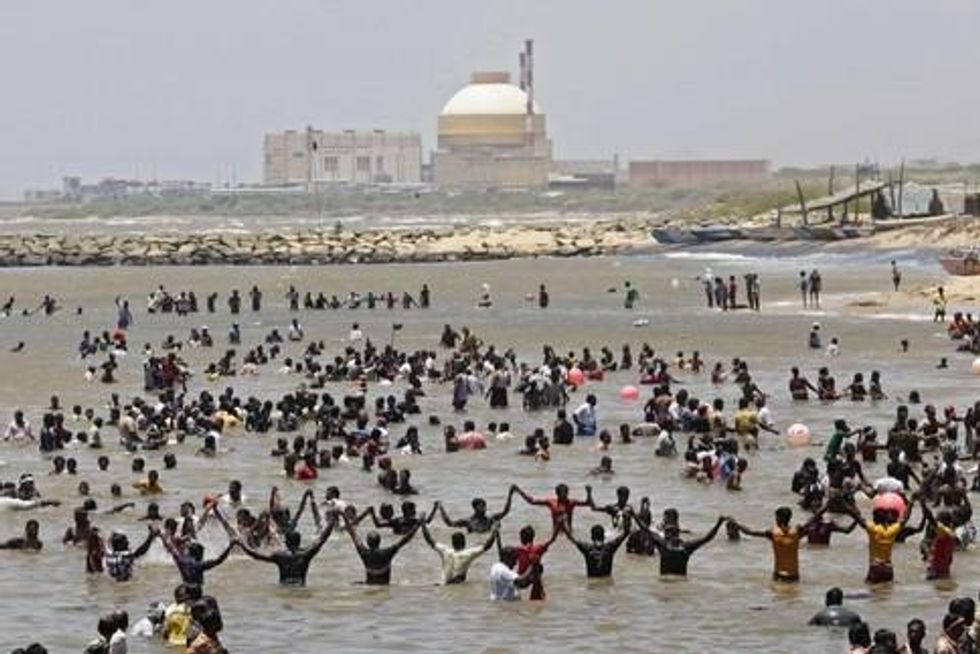
Despite years of opposition and protest from local residents, India opened its largest nuclear power plant on Tuesday in the southeastern state of Tamil Nadu on a stretch of coast slammed by a 2004 tsunami.
The joint Indo-Russian Kudankulam Nuclear Power Plant opened at the tail-end of Indian Prime Minister Manmohan Singh's visit to Russia. Nuclear Power Corporation of India Ltd., which, according to Bloomberg, is the country's only atomic energy producer, started up part of one of its reactors worth $2.84 billion on Tuesday.
The opening moved forward despite a thousands-strong protest over the weekend in which over 200 people were arrested.
The plant, which was planned in 1988 and started undergoing construction in 1997, has faced a series of delays due to protests from local communities concerned that it will ruin the Bay of Bengal ecosystem and devastate the local fishing economy, AsiaNews reports.
Protests increased in intensity and regularity following the tsunami-sparked meltdown and ongoing disaster at the Fukushima nuclear plant in Japan.
To mark the second anniversary of the Fukushima meltdown in March 2013, 600 boats filled with 4,000 workers in the fishing industry waved black flags in the sea behind the Kudankulam plant.
Despite widespread concerns, Singh has vowed to drastically expand nuclear power in India.
It was June when I wrote an article titled "Problems with Nuclear Power Highlighted by Gulf Disaster?", highlighting the consequences of undue optimism, the particularly grave implications regarding nuclear power. With AP currently reporting the Japanese government is forecasting the possibility of 'multiple' reactor meltdowns, the first three paragraphs of that article read:
Nobody's perfect, and so mistakes do happen. But while I doubt if any of us could conceive of the tragedy coming with a reported 35,000 to 60,000 barrels of oil daily entering The Gulf, are we any more capable of conceiving what might come with a nuclear disaster? While optimism is important, it's sometimes a trap - just ask BP.
Before we are 'sold' into a wholehearted embrace of the 'clean, safe, and reliable' energy that gave us the Chernobyl Disaster, perhaps we might want to consider why so many of us are so sure 'the unthinkable' can never occur...at least until it does.
We humans are an interesting species, our achievements demonstrating that we are capable of virtually incalculable greatness. Unfortunately, our catastrophes - such as that ostensibly 'one in a million' chance oil debacle in The Gulf - demonstrate that we have our downsides too. Of course, sometimes even I happen to have that ever so rare occasion when, dare I say it, even I actually make an error; though, I reassure myself that this just means I'm only human. But that's precisely it - 'human error' can be a problem.
Currently, as seawater is being pumped into at least three reactors in what has widely been described as a desperate, last resort attempt to avert the 'unthinkable', The Washington Post quoted a nuclear industry expert citing the differences between Japan's nightmare and BP's Gulf debacle. He emphasized that: "The problem with the BP event is that they didn't have a Plan B...we have, I would say, sufficient defense in depth. We have Plan B, C, D and possibly E."
Given present circumstances, and that - as of this writing - there are reportedly at least three reactors in severe trouble, and at least three more in a reported 'emergency' condition, I wonder where on this expert's back-up plans we presently are. Notably, Daiichi 3 just blew up, a hydrogen explosion similar to that which occurred at Daiichi 1 occurring.
Unfortunately, in a display of 'technological courage' number 3 is fueled with an experimental plutonium and uranium mixture termed 'mox'. As plutonium is substantively more toxic than uranium, what that means is markedly increased health injuries and contamination in case of a release.
Earlier, news reported a relief valve at number 3 was stuck and being opened manually, hampering possibilities to release pressure. I won't speculate if that was pressure within the reactor container or the building surrounding it, and we're told that the reactor containment is intact following the explosion.
As with BP, it does seem the infallible backup systems keep failing. I wonder what letter the plan for running as fast as you can is, not that it would do much good.
A reactor at Onagawa - about a hundred kilometers NW of Fukushima's Daiichi reactors - was said to have registered radiation at 400 times normal, the radiation attributed to the Daiichi problem. Of course, with an exclusion zone of only twenty kilometers around the Daiichi plant, and the city of Sendai between Daiichi and Onagawa, there would seem substantive problems yet to be addressed. The fact that the US aircraft carrier Ronald Reagan encountered radiation a hundred miles offshore emphasizes the point.
Maybe it's time to rethink nuclear power, how 'clean, safe and inexpensive' it really is.
Notably, and since it should now be obvious how 'clean and safe' nuclear power is, The Wall Street Journal ran an interesting article titled "Japan Govt, Not Insurers, Responsible For Nuclear Cleanup Costs: Experts". Given this, it would seem that not only must Japan's citizens endure the ongoing nuclear nightmare (as of this writing, about 200 are reported under threat of radiation poisoning - a number virtually certain to grow), but pay for the privilege. Of course, in the US the Price-Anderson Act ensures virtually the same thing, limiting corporate liability in case of a nuclear accident to $11 billion.
I won't mention that California has four nuclear reactors near fault lines, nor what could happen to them. Fortunately, Harvey Wasserman recently did, writing:
"The two huge reactors each at San Onofre and Diablo Canyon are not designed to withstand such powerful shocks (similar to Japan). All four are extremely close to major faults.
All four reactors are located relatively low to the coast. They are vulnerable to tsunamis..."
The title of Wasserman's article is " An 8.9 Quake Could Have Irradiated the Entire US".
As I pointed out in June, during the height of BP's Gulf destruction, the damaging effects of radiation can last a lot longer than those of oil. Though some of us certainly claim that today's nuclear power is 'clean, safe, and reliable', of course, wasn't the same said of today's deepwater oil exploration?
Recalling Chernobyl, the area surrounding it is estimated at being habitable in a few centuries, though the land immediately surrounding the meltdown is forecast as taking 2,000 years before being so. As for what will occur in Japan, only time will tell.
We're all human, and as such we make mistakes. One of those was not realizing tsunamis could knock out back-up power at nuclear plants, and another is actually believing we can think of every contingency which could make nuclear nightmares real. But, if the nuclear industry isn't aware of this, then why do the Japanese taxpayers have to pay for the current catastrophe, and why does America have the Price-Anderson Act?
We all make mistakes, and the idea of 'clean, safe, and inexpensive' nuclear power is proving one of the worst. Of course, when things go horribly wrong, at least then it becomes apparent there is a dire need to correct them.
The explosion at the Fukushima nuclear power plant is being described as caused by a "hydrogen build-up" The situation harks back to the "hydrogen bubble" that was feared would explode when the Three Mile Island plant in 1979 underwent a partial meltdown.

Eruption of hydrogen gas as a first reaction in a loss-of-coolant accident has been discussed with great worry in U.S. government and nuclear industry literature for decades.
That is because a highly volatile substance called zirconium was chosen back in the 1940's and 50's, when plans were first developed to build nuclear power plants, as the material to be used to make the rods into which radioactive fuel would be loaded.
There are 30,000 to 40,000 rods--composed of twenty tons of zirconium--in an average nuclear power plant. Many other substances were tried, particularly stainless steel, but only zirconium worked well. That's because zirconium, it was found, allows neutrons from the fuel pellets in the rods to pass freely between the rods and thus a nuclear chain reaction to be sustained.
But there's a huge problem with zirconium--it is highly volatile and when hot will explode spontaneously upon contact with air, water or steam.
The only other major commercial use of zirconium through the years has been in flashbulbs used in photography. A speck of it, on a flashbulb, ignites to provide a flash of light.
But in a nuclear plant, we're not talking about specks--but tons and tons of zirconium, put together as a compound called "zircaloy" that clads tens of thousands of fuel rods.
Heat, a great deal of heat, builds up in a very short time with any interruption of coolant flow in a nuclear power plant--the problem at Fukushima after the earthquake that struck Japan.
Zirconium, with the explosive power, pound for pound, of nitroglycerine, will catch fire and explode at a temperature of 2,000 degrees Fahrenheit, well below the 5,000 degree temperature of a meltdown.
Before then, however, zirconium reacts to the heat by drawing oxygen from water and steam and letting off hydrogen, which itself can explode--and is said to have done so at Fukushima.
As a result of such a hydrogen explosion, there is additional heat--bringing the zirconium itself closer and closer to its explosive level.
Whether in addition to being a hydrogen explosion, zirconium also exploded at Fukushima remains to be known.
But what has happened regarding hydrogen at Fukushima, like the "hydrogen bubble" when the Three Mile Island plant in Pennsylvania underwent its near partial meltdown, is no mystery--but precisely what is expected in a loss-of-coolant accident.
It is described in U.S. government and nuclear industry accident studies as a "metal-water" reaction. It's a reaction, the research has long stated, that can easily trigger a meltdown.
Using tons of a material otherwise used as the speck that explodes in a flashbulb in nuclear power plants --yes, absolutely crazy.
Moreover, in the spent fuel pools usually situated next to nuclear power plants, there are large numbers of additional fuel rods, used ones, disposed of as waste. There must be constant water circulation in the spent fuel pools. In what is labeled a "loss-of-water' accident in a spent fuel pool, the zirconium cladding of the fuel rods is projected as exploding--sending into the environment the lethal nuclear poisons in a spent fuel pool.
In the aftermath of the largest earthquake to occur in Japan in recorded history, 5,800 residents living within five miles of six reactors at the Fukushima nuclear station have been advised to evacuate and people living within 15 miles of the plant are advised to remain indoors.
Plant operators haven't been able to cool down the core of one reactor containing enormous amounts of radioactivity because of failed back-up diesel generators required for the emergency cooling. In a race against time, the power company and the Japanese military are flying in nine emergency generators. Secretary of State Hillary Clinton announced today that the U.S. Air Force has provided cooling water for the troubled reactor. Complicating matters, Japan's Meteorological Agency has declared the area to be at high risk of being hit by a tsunami.
The plant was operating at full power when the quake hit and even though control rods were automatically inserted to halt the nuclear reaction, the reactor core remains very hot. Even with a fully functioning emergency core cooling system, it would take several hours for the reactor core to cool and stabilize. If emergency cooling isn't restored, the risks of a core melt, and release of radioactivity into the environment is significantly increased. Also, it's not clear if piping and electrically distribution systems inside the plant have been damaged. If so, that would interfere with reactor cooling.
A senior U.S. nuclear power technician tells me the window of time before serious problems arise is between 12 and 24 hours.
Early on, Japanese nuclear officials provided reassurances that no radiation had been released. However, because the reactor remains at a very high temperature, radiation levels are rising on the turbine building - forcing to plant operators to vent radioactive steam into the environment.
The devastating Japanese quake and its outcome could generate a political tsunami here in the United States. For instance, it may become impossible for the owners of the San Onofre and Diablo Canyon reactors to extend their operating.
These two California reactors are sitting in high seismic risk zones near earthquake faults. Each is designed to withstand a quake as great as 7.5 on the Richter scale. According to many seismologists, the probability of a major earthquake in the California coastal zone in the foreseeable future is a near certainty. The U.S. Geological Survey reports the largest registering 8.3 on the Richter scale devastated San Francisco in 1906.
"There have been tremblers felt at U.S. plants over the past several years, but nothing approaching the need for emergency action," Scott Burnell, a spokesman at the Nuclear Regulatory Commission told Reuters.
As the 25th anniversary of the Chernobyl nuclear catastrophe approaches next month, Japan's earthquake serve as a reminder that the risks of nuclear power, when things go seriously wrong. The Chernobyl accident required nearly a million emergency responders and cleanup workers. More than 100,000 residents from 187 settlements were permanently evacuated because of radioactive contamination. And area an equal to half of the State of New Jersey was rendered uninhabitable.
Fortunately, U.S. and Japanese reactors have extra measures of protection that were lacking at Chernobyl, such as a secondary concrete containment structure over the reactor vessel to prevent escape of radioactivity. In 1979, the containment structure at the Three Mile Island reactor did prevent the escape of a catastrophic amount of radioactivity after the core melted. But people living nearby were exposed to higher levels of radiation from the accident and deliberate venting to stabilize the reactor. With one hour, the multi-billion dollar investment in that plant went down the drain.
Meanwhile, let's hope that the core of the Japanese reactor can be cooled in time. We shouldn't need yet another major nuclear power accident to wake up the public and decision-makers to the fact that there are better and much safer ways to make electricity.
The world's largest seismic dislocation since the 1940s which occurred in the Indian Ocean on the 26th of December was catastrophic. When two tectonic plates shifted under the Andaman Sea, they created a tsunami of terrible intensity, wreaking immense destruction in Sumatra, Thailand, Sri Lanka, India, even the east coast of Africa. At first 20,000 deaths were reported; as of the moment of my writing, the death toll has climbed to more than 150,000. Five million are reported homeless. There is every reason to believe that both figures will increase as rescue workers reach areas as yet unsurveyed.
World response has been swift and generous. Offers of aid -- food, money, transport -- have led to huge rescue operations and the relatively swift provision of food and clean water. Even in the USA, where the generosity of the people far outstrips the miserly commitment to human welfare of the current business-oriented political establishment, President Bush was forced by public opinion to increase US contributions to the relief effort from $35 million to $350 million. Private donations augment public funds, and help for the two most severely hit nations, Indonesia and Sri Lanka, is well under way.
Nature, many have realized, is not to be controlled: it continually reminds us that human life is contingent. At the same time, billions have understood, watching images on television or listening to eyewitness reports on radio, that we are all united on this globe we inhabit. Tragedies which occur in one part of our planet affect us all by reminding us that those made wretched could, but for the grace of accident or fate, be ourselves.
The earthquake has also revealed to many a difference between more developed nations, which have put in place tsunami warning stations in the Pacific, and less developed nations, which do not have such easy access to funding and therefore have made such warning stations a low priority. Despite the fact that we live on one globe, disasters have more severe repercussions in impoverished nations than wealthy ones.
Still, another tsunami -- metaphorical but no less real -- has crested beyond the shores of the nations of the world, and is heading toward those shores, threatening devastation to both underdeveloped and developed nations. It will spare India and China, but should wreak havoc on Bangladesh, Cambodia, Indonesia, possibly Pakistan, and a host of other nations, not excepting the USA. The worst consequences, as we might expect, will come in the poorest places.
About this tsunami, not natural in origin but humanly created, and therefore capable of being prevented by human intervention, there is little public recognition and almost no outcry of concern. Indeed, dominant financial interests have made certain that no steps will be taken to prevent the destruction that it will occasion.
In 1973, a Multi-Fiber Agreement set international textile quotas, providing a large number of developing nations with access to new manufacturing sectors and, more importantly, enabled them to generate large numbers of new jobs. Those quotas expired on 1 January.
The ensuing new economy of textiles will transform the world. New wealth will be amassed, new jobs created. And millions of current workers, some in the most impoverished areas of the world, will be permanently thrown out of work. (Business Week reported that the end of MFA quotas could mean losses of 30 million jobs.) The nations inhabited by these newly and soon-to-be unemployed will likely plunge into a downward economic spiral unlike anything those nations have experienced in recent decades.
What is so appalling is that this tsunami, created by greed and an ideological commitment to "free trade," can be prevented. But there are few warning systems in place: the mass media and even the intellectual centers in universities serve the interests of the rich and powerful. Of course, when the tidal wave of massive unemployment occurs it may not be dramatic enough to appear on television screens.
Yet, the suffering brought about by this tidal wave of unemployment and the national economic catastrophes which ensue will quite literally dwarf the immense suffering which has been the consequence of the historic tsunami in the Indian Ocean.
Textile manufacture, and what it can do to working people, is far less photogenic than natural disaster. For almost two and a half centuries, the textile industry has been a mixed blessing, providing employment on a large scale -- but almost always at low wages and in extremely difficult working conditions.
The production of textiles and apparel can be called, with good reason, the great motor of economic development. The industrial revolution began in Britain, occasioned by the invention of the spinning jenny and the mechanical shuttle, which in the 18th century made it possible for machines to do much of the work historically performed by human hands. It is fruitless to argue whether Britain's navy or its textile manufacture or its banks made that nation into a great imperial power: the navy protected and expanded the shipping routes which were essential to textile trade, and the textile trade created the profits which enriched the London banks and underwrote the costs of the world's most potent navy.
Likewise, Germany's emergence as a world power in the 19th century was also based on the textile industry -- although not in textile manufacture directly. Germany's development of the chemical dyes which supplanted plant-based dyes in textile manufacture created not just great profits, but a strong chemical industry which served as the industrial armature for one of the world's great producers of munitions. Two World Wars were indirect results of this.
But textile industry jobs -- both the production of cloth, and the sewing of fabric into clothing -- have been, since the onset of the industrial revolution, low-paying jobs. As industrialists turned their attention to high-priced items, first cars and then electronics, they shipped low-paying textile jobs to underdeveloped areas internally and then externally. For example, immigrant communities in the north of the USA, and later low-wage agrarian areas of the American south, had an influx of such jobs; when labor costs rose, those jobs were sent to low wage nations overseas.
Under the 1973 MFA, with its set-asides to enable nations to achieve a small slice of market share of the world need for clothing, underdeveloped nation after underdeveloped nation used clothing manufacture as a means to provide jobs to its poorest citizens. Four years ago, wanting to write a report on what international clothing manufacture looks like in the daily life in a developed nation, I visited a local Wal-Mart (the world's largest chain of stores) and began reading labels in clothing. Poland, the Mauritius, Sri Lanka, Egypt, Guatemala, Nepal, Turkey, Kenya, the Philippines. The list ran on and on, to over 50 countries.
As Mark Weisbrot, an economist with Washington's Center for Economic and Policy Research said recently, "These quotas were there for a reason, so that some of the poorest developing countries would have a chance to have an apparel and textile industry and use that as a steppingstone for development."
Textile manufacture provides jobs, but the jobs are a mixed blessing. To be sure, weavers and more importantly today sewers earn wages, which enables those workers to enter into and even survive in a cash economy. But textile workers have, since the origin of textile factories in Britain in the 18th century, always and everywhere been lowly paid and badly exploited.
This is not the place to argue whether the location of exploitative shops in Bangladesh and El Salvador and Kenya are good or bad for those national economies. Certainly, the textile industry provides not just large numbers of jobs, it also provides important new sources of the foreign exchange so necessary for a nation's economic well-being and development. Yet, for every increased dollar of needed foreign currency which flows into those nations, new problems emerge: the uncontrolled growth of cities, grueling labor, the expansion of urban poverty, dramatic new inequities of wealth.
The largest benefits from textiles and apparel accrue to those who own textile and clothing factories, and in the post-modern world, to those huge multinational conglomerates which merchandise and sell clothing. In developed nations, and increasingly in developing ones, the "value added" which comes through advertising brand names is far, far higher, in many products, than the value of the raw materials, weaving, and sewing which go into those products.
The profits on the manufacture of this clothing make a small group of entrepreneurs rich. Let us look, for instance, at Nike, the world's wealthiest maker of sports shoes and sports clothing. Here is a fiscal analysis by the US-based National Labor Committee: "Nike sneakers made in China by young women paid 20 cents an hour arrive in the USA with a total customs value of $14.61. That $14.61 includes every conceivable expense -- the materials, labor, shipping, and the profit to Nike's contractor in China." That profit to the contractor is not inconsiderable: it has been the driving force behind the growth of the new wealth in China. "Nike then turns around and sells the sneakers in the USA for $135, which represents a 924 per cent mark-up." What labor earns is pitifully small, especially as compared to the profits made by the multinational conglomerates, as another example reveals: a worker in the Dominican Republic who sews a sweatshirt for Nike earns eight cents ($0.08 dollar) for a garment which retails in the USA for $22.99.
Now, with the expiration of the Multi-Fiber Agreement quotas, the world enters a new era, one of global free trade in textiles and clothing.
The world textile and apparel market is enormous, in excess of $353 billion annually. Nations with low labor costs, chemical and fiber-producing industries, strong transportation infrastructure, and access to large ports are expected to be the big winners. (India is the world's third largest cotton producer, the second largest yarn spinner. It has infrastructure in place: not just experience with textiles -- until Independence, India had the world's largest textile industry -- but an existent base, with textiles currently employing 35 million, the second largest sector in India's economy after agriculture. Already, textiles are 17 per cent of India's manufacture, 27 per cent of its export earnings, and generative of 8 per cent of GDP.)
There will be winners in the "free trade" era following the elimination of the MFA quotas. According to the World Trade Organization, China, which currently has a 16 per cent share of the US clothing market, will jump to 50 per cent of that $77 billion annual market. India will be another winner, going from 4 to 15 per cent. South America will be a big loser, dropping from 16 to 5 per cent.
Figures can be so dull, yet we ignore them at our peril. So, despite a kind of brute facticity, I hope the reader will bear with me for several paragraphs. For these figures are like a seismological reading of a major earthquake which will produce tsunamis all over the globe. We can ignore the instruments and what their statistics speak to us, but we do so at our peril.
Indonesia has 1.7 million workers in clothing: many of its factories are expected to close, and the remaining factories expect to cut 20 to 30 per cent of their workers. Business Week estimates one million jobs will be lost in Indonesia. The direct casualties of economic disaster -- jobs are there to turn to when the factories close? -- will be higher by a factor of five than the fatalities of the recent tsunami. And that is without counting any of the family members who depend on those textile paychecks for their collective livelihood.
To take a small yet surprising example: More than a third of Morocco's 200,000 textile workers face the loss of their jobs. Singapore's The Age revealed, "As many as 50,000 workers in the tiny mountain kingdom of Lesotho in southern Africa could lose their jobs after WTO textile quotas are lifted." Or to take a larger one: a sizeable proportion of Vietnam's almost 3 million textile jobs are imperiled.
Nor is the developed world immune. In the USA's largest textile-producing state, North Carolina, 160,900 jobs were lost in the last decade: 100,000 remain, and between a quarter and half of them will be gone in next four years. Overall, one-third of the 675,000 textile/apparel jobs which remain in the USA are at risk.
Among the worst casualties will be many of the nations of South Asia.
In Bangladesh, between 1.8 and 2 million people are employed in the textile trades, 80 per cent of them women. The UN Development Fund expects up to one million Bangladeshis will lose their jobs in the wake of the MFA quota expiration.
Cheap and efficient Chinese and Indian manufacture will likely lead to these huge job losses, which will come in jobs held by vulnerable people. As a trade specialist at Bangladesh's mission to the WTO said recently, "These are mostly very low qualified female workers who will find it very difficult to find employment in other sectors."
The economic catastrophe will be much larger, of course, since the direct employment of textile workers indirectly provides further employment of another 5 to 10 million workers (the latter figure is the estimate of the Bangladesh government); one responsible economist suggests the figure will be closer to 15 million. Even more difficulties loom in terms of the nation's finances. Bangladesh accounted for four per cent of clothing imports into the USA in 2002, and three per cent of the European Union's import market, for a total of $5.5 billion in export income. Three-quarters of Bangladesh's foreign exchange comes from these textile exports. Thus, the ultimate effect of the elimination of MFA quotas will be deeper fiscal penury not just for individuals, but for the nation of Bangladesh. And it is not just Bangladesh.
Nepal has 50,000 textile trade workers, 60 per cent of them women. According to broader figures supplied by the Garment Association of Nepal, another 50,000 workers are provided jobs because of linkages to the textile industry. Ten per cent of the workforce is employed in textile and apparel manufacture. When their families are included, up to 350,000 people rely on the textile industry. Three quarters of Nepal's foreign exchange comes from textile exports. Analysts predict that Nepali job losses will be massive.
This article is a continuation of Gutman's Man-Made Tsunami . . .
Pakistan is vulnerable as well, with textile products comprising two-thirds of its $12 billion in exports. Textiles account for 1.4 million jobs and over 11 per cent of its GDP. There is disagreement about whether Pakistan, which produces cotton and has ports, will be able to hold its own -- or whether it will like Bangladesh see its textile industry destroyed by more efficient production facilities in India and especially China. This past year, Pakistan imported 1.9 million bales of cotton, making Pakistan the third largest cotton importer in the world. That cotton is used in textile production -- but it could very easily go elsewhere, like China. Indeed, the South China Morning Post recently reported that "Bangladesh, Cambodia and Pakistan are the most vulnerable to the end of textile quotas, as garments account for more than 70 per cent of their exports, according to the IMF and the WTO."
In Sri Lanka, textiles are responsible for 450,000 jobs in a nation of 19 million people, over 15 per cent of all economic activity, and 65 per cent of all industrial exports. According to a recent report in the Washington Post, 93 per cent of those textile exports went to the USA and EU countries where the MFA guaranteed access. "Fifty to 60 thousand people might lose their jobs. Fifty to 100 factories will be closed," according to Sri Lanka's minister of trade, Jeyaraj Fernandopulle.
Mongolia is greatly vulnerable to textile job loss. One hundred foreign-owned textile companies operate in Mongolia, 48 of them from China. Textiles provide 12 per cent of its exports, and 30 per cent of its labor force. In Cambodia and Laos, textiles provide 90 per cent of foreign exports.
And it is not just Asia. Egypt and El Salvador, Tunisia and Mexico, Botswana and Guam are all at risk. Individual workers will be laid off, families will sink beneath subsistence, social programs will be ended because foreign exchange is no longer available.
On the other hand, China will reap the advantages of cheap labor, excellent infrastructure, efficient transportation, vast pools of capital investment -- and economies of scale which stagger the imagination. Consider the city of Datang, the apparent sock capital of the world. Last year, its 2,500 factories produced five billion pairs of socks -- about a third of socks produced in the whole world! Although a majority of the socks were sold in the domestic market, even before the expiration of the MFA, Chinese exports to the USA had increased from 11 million to 260 million in the last three years.
China is expected to increase its production dramatically, and to garner a larger share of the world market for clothing: 50 percent of the US market, for instance. There will be more jobs for Chinese workers, but the wealth will be unevenly distributed, flowing far more into the pockets of those who own the factories than those who work there.
To offset the concerns of many nations about its unfair advantages -- with great access to capital both internally and from abroad, with government subsidies which go unreported, with an artificially low yuan pegged to a sinking dollar -- China has said it will place an export tax on textile products. But though this will raise the cost of Chinese goods marginally, it will also bring new revenue into the Chinese Treasury, enabling the government to spend additional money upgrading infrastructure, providing loans, and extending subsidies.
Waves pound behind the waves that are forthcoming. One can foresee devastation in Bangladesh, for instance: a million workers losing their jobs in one of the world's most fragile economies. Fifteen million more jobs at risk. And no more foreign exchange to help develop alternate infrastructure, or pay for rice when the next typhoon destroys part of the current crop.
The loss of foreign exchange as cotton exports plummet in nations like Bangladesh, will set in motion draconian social forces. The more negative a country's current accounts balance, the less money it has available for use in the trade between nations, the less it has for internal investment, the more it is helpless before IMF mandates to cut its national budget. Without supplies of foreign exchange, all development will atrophy. Without supplies of foreign exchange, the IMF will demand ever greater reductions in social programs as the requirement for extending existing loans or guaranteeing new ones. Without such exchange, the desperately poor nations of the world will become outcasts, orphans.
But one can also foresee devastation in the nations that gain jobs. For the world's labor market, and especially in textiles, has been a race to the bottom. As soon as workers ask for more money, or a burgeoning economy develops, buyers look for cheaper sources of labor It is the MNCs which win, not laboring men and women. Ann Chen, a partner in the business consulting firm Bain & Co., said recently, "The big winners in the WTO's plans to eliminate textile quotas will be global retailers, such as Wal-Mart, who will be given even more power to squeeze textile suppliers for lower price points on goods. Global retailers will be free to offer almost any volume of commitment to a Chinese factory, which could further stifle global competition in textile manufacturing. Among the losers will be consumers as the variety of textile goods will decrease." Even bigger losers will be textile workers with jobs whose wages will likewise be squeezed by lower price points: it is estimated that US apparel prices will drop as much as 20 per cent in the wake of the end of MFA quotas. And then there are the possible 30 million workers who will lose their jobs.
In a world guided by rationality, it ought to be realized that the intent of the MFA, to give every nation a chance to develop a textile industry and provide textile jobs to its citizens, was both visionary and just. And this should have guaranteed protection of the quotas that rein in the MNCs so that human values, and not just profits, determine how and where textile products are manufactured.
But we live in a world where greed is rampant -- not among all of us, but among the powerful. And the powerful will do what they want, even if a devastating but silent tsunami is the result. The wealthy and powerful, after all, can take vacations in lovely places and live in gated compounds: they can block out every vestige of human misery. For the workers of the world, and the underdeveloped nations, the expiration of the MFA quotas will quite likely be another story.
Concluded.