

SUBSCRIBE TO OUR FREE NEWSLETTER
Daily news & progressive opinion—funded by the people, not the corporations—delivered straight to your inbox.
5
#000000
#FFFFFF
To donate by check, phone, or other method, see our More Ways to Give page.
Daily news & progressive opinion—funded by the people, not the corporations—delivered straight to your inbox.
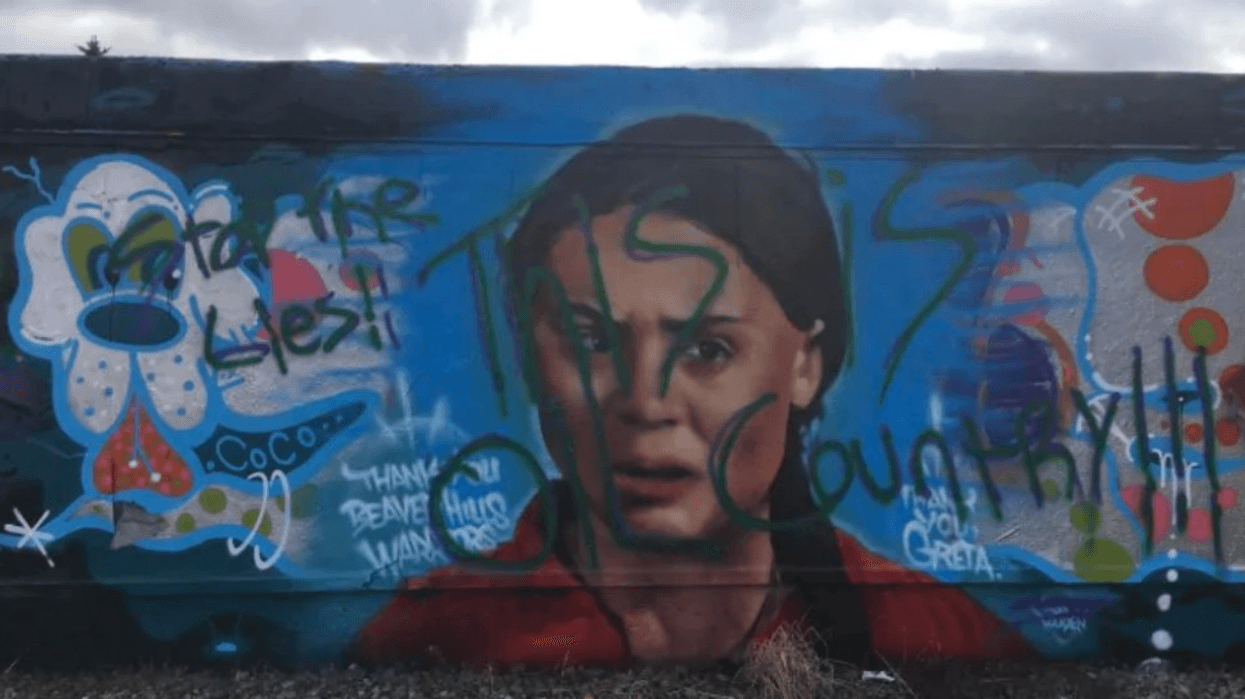
It is incredible that Greta Thunberg's fight for our climate began with a solitary school strike outside the Swedish Parliament in August 2018. And now, that singular act of protest by a fifteen-year-old has spread - involving millions of students world-wide. Currently in California she declined an environmental prize from the Nordic Council, saying, "the climate movement does not need any more prizes...what we need is for our rulers and politicians to listen to the research."
Before arriving in California, Greta led a climate strike outside the Alberta Legislature in the province's capital city of Edmonton. Not far from the Legislature on a section of a downtown "free graffiti wall" Greta's portrait was admiringly painted by a local artist. Predictably, the mural was quickly defaced with a pro-oil message. The vandal, captured on camera, says, "This is Alberta. This is oil country. My father has worked in the oil industry. We don't need foreigners coming in and telling us how to run our business, support our families, put food on our tables. [Thunberg] is a child who is, "doing what she's told."Child or no child, with handlers or without handlers - Greta is globally recognized as an instigator of change. Unfortunately, young activists like her are fighting a two-prong battle. The first battle is with a "populist conservatism" that mindlessly cherishes tradition and is usually about calculating profits. Leading this battle in Alberta is Premier Jason Kinney who has committed $30-million to a "war room". This war room will be tasked to flush-out and counter what his United Conservative government is calling "foreign interests" that support activists who spread lies about the province's oil and gas industry.
Politicians can now publicly agree with Greta--showing their constituents they are in sync with this popular movement. Privately, these same politicians ignore climate change experts who, for years, have been showing them dire empirical data.
The second battle Greta is facing is far more insidious. This battle is with a "liberalism" that pays lip-service to progressive values but, in reality, does nothing but pander to anyone eligible to vote. Enter Justin Trudeau. On one hand the Prime minister vigorously marched with Greta in Montreal but, on the other hand, his Liberal Party Cabinet endorsed the use government resources to buy the Trans Mountain oil pipeline for $4.5 billion. Elizabeth May, the leader for the Green Party, responded to this by saying, "If you're serious about fighting climate change, you invest public funds in renewable energy. You don't invest them in a bitumen pipeline."
Children-activists tap into our collective desires to enact transformational change. However, activism is meaningless unless there is the political will to leverage civic engagement into policy change. Greta has been adamant we need to listen to the science and adhere to regulatory practices. Sadly, the only thing Greta has provided is a platform for politicians to conceptualize the seriousness of it all. Politicians can now publicly agree with Greta - showing their constituents they are in sync with this popular movement. Privately, these same politicians ignore climate change experts who, for years, have been showing them dire empirical data. For instance, many studies have found people to be unaware of how their flying habits contributes to climate change. Aviation is a fossil fuel industry, one which guzzles an unbelievable 5-million barrels of oil daily. That fuel currently contributes around 2.5% to our total carbon emissions. And yet, our political leaders hide their complicity - unwilling to tell voters that flying is kept artificially cheap and was given "special status" and excluded from the Kyoto and Paris climate change agreements.
Unlikely compatriots, but the stories of Greta and Malala Yousafzai share something in common. Malala, at the age of 14, was shot by the Taliban for promoting literacy in Pakistan. Following recovery, her remarkable story was told and she won a Nobel Prize. Pakistani politicians promised to make education a national priority. Seven years later, Pakistan still has one of the lowest literacy rates in the world. Advocates for change who challenge Pakistan's conservative society often face vicious opposition. Like in Canada, conservatives represent voters and are pandered to during election time. So, unless there is a convergence in our collective thinking--such as agreeing to educate women in Pakistan or reducing our carbon footprint we will be always be faced with opposing views and politicians who cater to these ideologies.
The Edmonton mural painter told the media he was inspired by Greta and was not bothered by the sprayed over pro-oil statement. "Nothing lasts forever--one of my favourite things about that wall is that anyone is allowed to express themselves there, so I'm not upset at all... if anyone is upset about what was painted over the portrait, they can just paint back over it, it's not a big deal at all." Magnanimous words, democratically spoken--but hopefully there comes a time when there is no "painting over" Greta because we know politicians come-and-go but there should be no debate on certainties like educating young girls or climate change.
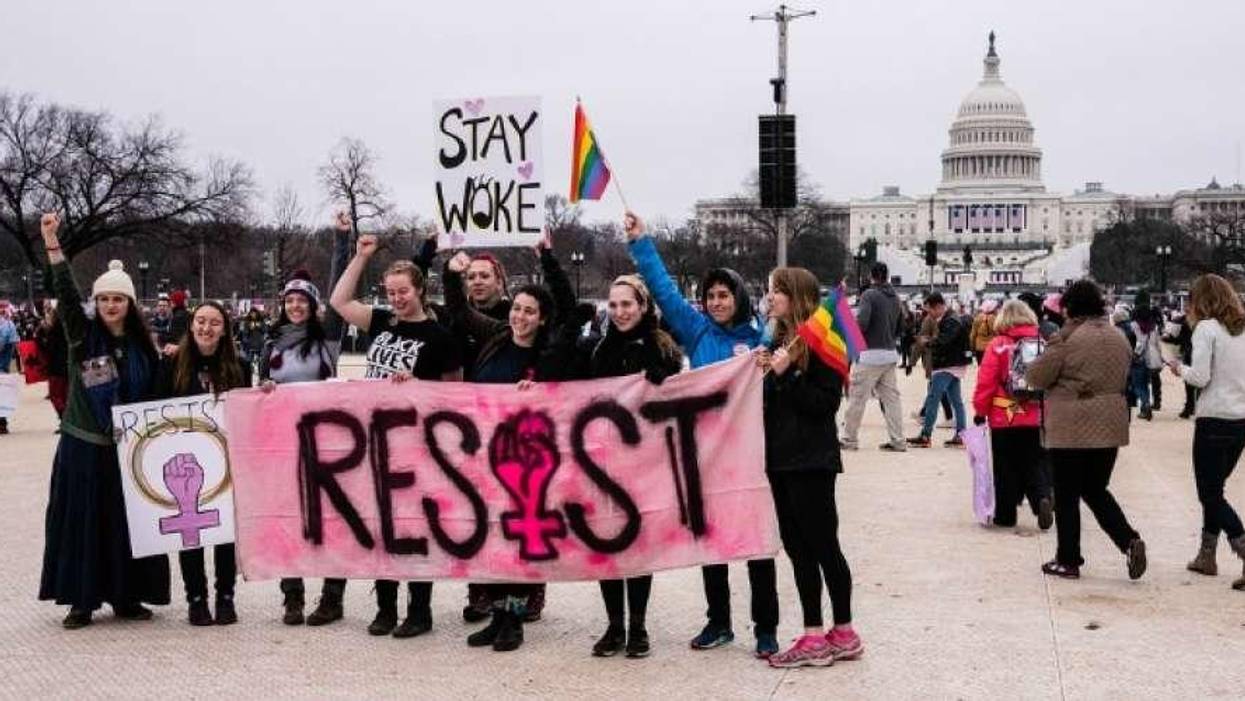
'Wathint' Abafazi, Wathint' Imbokodo'- You Strike A woman, You Strike Rock! Famous words by South Africa women resisting and standing up to racial oppression in 1956 when 20, 000 women of all races refused to be subjugated by the apartheid government. Although the women's March was against restrictive pass laws, this movement proved to be a turning point in the struggle against an unjust political system. The women's march to the Union Buildings in Pretoria led to significant changes in the law and the emancipation women in South Africa.
History provides examples of women who refused the status quo and forever changed the course of events. From American civil society activist Rosa Parks to Kenyan environmental and women's rights campaigner Wangari Maathai who are recognised for their contribution and their place in the revolution.
Today, nothing has changed. Women remain at the forefront of the civil society movement, ensuring their rightful place in bringing about peace and building equality in communities at national and international levels.
While there has been significant progress and commitments made in the gender narrative, we still have a long way to go to ensure women are no longer on the fringes of society. This is where education plays a crucial role as an equaliser and is an indispensable tool to truly transforming women's place in society. According to UNWomen, gender inequality still remains a vital cause of hunger and poverty. "It is estimated that 60 percent of chronically hungry people are women and girls" as stated by 2015 - WFP Gender Policy 2015-2020. When it comes to employment, men's average wages remain higher than that of women and women, the backbones of society, work longer hours than men. Women still lag behind men in decision making and leadership positions.
In education, gender inequality still exists. Women make up more than two-thirds of the world's 796 million illiterate people. In Sub-Saharan Africa, a region with the highest rate of out-of-school children, girls are most excluded, with 24% of girls not in school compared to 18% of boys. In Northern Africa and Western Asia, 12% of girls are out of school compared to 10% of boys. These numbers indicate that the stakes are high when it comes to bridging the gender gap and ensuring that girls and women are not left behind.
The role of education in emancipating women
It goes without saying that an educated woman is more likely to have greater decision-making power within her household. Educated girls have great potential to bring about positive change to their immediate families and to society at large. A good example is the formidable Malala Yousafzai, Nobel Prize Laureate and staunch activist for female education and the young 16 year old Greta Thunberg, who is shaking things up in the climate movement.
TheGlobal Campaign for Education,is a worldwide civil society movement. The campaign is committed to defend education as a basic human right and mobilises public pressure on governments and the international community to provide free, compulsory public basic education for all people, in particular for children, women and those from excluded communities. GCE recognises that gender equality is a human right and a requisite for achieving broader social, political and economic development goals, as stated in the Agenda for Sustainable Development.
This year the UN celebrates International Women's Day under the theme "Think equal, build smart, innovate for change" and spotlights innovative ways in which we can all enforce gender equality and the empowerment of women. In the 21st century, women no longer occupy undervalued roles in society. Now more than ever it is imperative that women are celebrated and elevated at the highest level for their immense contribution to shaping a world that is non-sexists, non-gender biased and unequivocally builds gender equitable systems for all.
GCE celebrates this day and enforces the call for education systems that take into account a full analysis of the gendered barriers girls and boys face to complete a free, inclusive, public quality education. In order to tell a different gender story next year, a wider systematic approach must challenge and transform patriarchal societies into ones that value equality and inclusion.
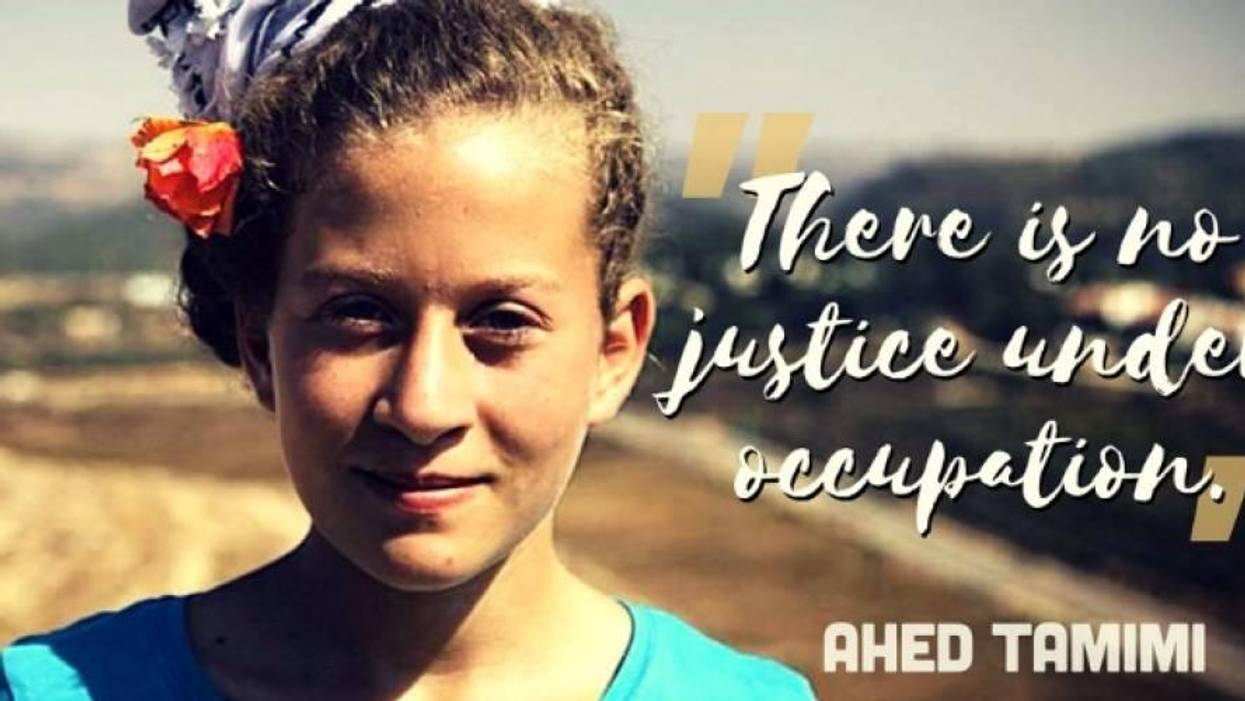
After Israeli forces shot her 15-year-old cousin in the head with a rubber bullet last December, Ahed Tamimi, a Palestinian girl from Nabi Saleh in the West Bank, stood up to the occupying Israeli forces and was arrested and charged for slapping a soldier. The story of the activist went viral.
But what Ahed was fighting for was largely buried beneath sensationalized media representations of her.
Her story is unlikely to circulate in the same elevated spaces granted to Malala Yousafzai, the Pakistani girl who survived a brutal attack on her school by the Taliban, even though both Ahed and Malala are fighting for similar rights and freedoms. Both are young women facing down brutal military repression at the hands of fully-armed men, yet their stories could not have been received more differently.
The reasons for our complicated responses to Malala and Ahed's stories are as multi-layered as the political realities that shape their lives. They encapsulate a range of ideas about gender and the girl-child, nationalism and education, and about forms of activism that are palatable and therefore deemed legitimate and those which are not.
Disrupting gender
Both Malala and Ahed refuse to be victims. Malala has dedicated her life to advocating for girls' education. Her story helps to send powerful and inspiring messages to girls around the world -- girls like Ahed, who dream of being a lawyer. Ahed turned the Israeli female prison unit where she was held into a school, where she and other incarcerated Palestinian women read and studied legal texts.
But Malala's platform also has the contours of a story that can buttress imperialist worldviews and justify militarized interventions in Asia. The use of rhetoric about saving women and children in the Middle East by politicians is one of the ways that liberalism appeals to Western emotions to garner support for the U.S. led "War on Terror," as the scholar Maya Mikdashi writes.
Ahed is too empowered, too unmanageable and altogether too adulterated by her community's struggle to appeal widely to liberal sympathies in the West. She is also too blonde, according to U.K. Prof. Yosefa Loshitzky. Loshitzky characterizes Ahed as someone who completely disrupts the gendered and racial logics of the Israeli occupation.
The point isn't that Malala doesn't deserve the platform she's been given, but that while we celebrate Malala's advocacy for girls' education, we must ask why that platform is not extended to children like Ahed. Anything less is a disservice to them both.
The liberal politics of hope
Malala's status as a worthy cause has a critical relationship to Ahed's status as an exception to that cause. The differences between the reception of Malala and Ahed in the global cultural marketplace illustrate this point in fairly stark terms: Malala's activism wins her the Nobel Prize, and takes her to Oxford, while Ahed's activism landed her in an Israeli prison.
Prof. Shanila Khoja-Mooji powerfully writes that Ahed's struggle, and the way it has been sidelined in the West by feminist and human rights groups, "exposes the West's selective humanitarianism."
Malala's story emerged amid the politics of hope that characterized President Barack Obama's campaign. She won the Nobel Prize in 2014. In 2016, the year Trump was elected, Ahed was denied a visa to the United States to be part of the speaking tour, "No Child Behind Bars/Living Resistance."
Whether the Obama administration would have had the political courage to grant Ahed a visa is impossible to know. Obama's gestures of support for Palestinians were largely superficial, while his financial support for the Israeli military was unwavering.
By comparing Ahed and Malala, we come closer to understanding the limits and even the failure of liberal visions of social progress in the 21st century. Ahed is a classic case of how American liberalism's blind spots breed discontent around the world.
Life stories in a global marketplace
Malala's advocacy circulates in a neoliberal economy in which much of the value of her story has become something that communicates the power of the individual to overcome extreme hardship and to effect social change against an enemy long reviled by the West. In this transaction, the politics that underwrite her suffering are managed by focusing on her personal story of survival.
In her story is redemption for the West, whose role in the violence that harmed her (and thousands of girls like her) is mitigated by their efforts to uplift her.
In Malala's story of fighting for the right to education, as a girl, the Western media and political machinary finds a story that chimes powerfully with arguments used to bolster the U.S. led military invasion of Afghanistan.
In this sense, Malala's message has been co-opted by the neoliberal idea that everyone can gain access to the same opportunities, so long as they follow the proper procedures. In her case, by fighting an enemy recognizable to us, Malala gains access to recognition, including entry to the oldest university in the country that colonized what is now Pakistan.
By contrast, Ahed cannot perform her suffering in ways that appeal to the paternalistic liberal imagination. Ahed's story cannot be yoked to the Janus-faced work of neoliberalism, global development and military intervention.
Ahed's enemy -- the Israeli army that maintains and deepens the illegal military occupation of her country -- can rarely be recognized in dominant Western discussions without accusations of anti-Jewish sentiments.
Stories like Ahed's that insist on collective forms of liberation over individual liberation, draw our attention to diffuse and entrenched systems of oppression that cannot be remedied through individual acts of uplift.
"There is no justice under occupation and this court is illegal," Ahed told her prosecutors, as she smiled and the international media captured the scene for the world to see.
Ahed's smile in these photos unsettles liberal conceptions of suffering that separate the rights of the individual from their social, political and economic making. Wringing our hands and watching from the West, we are implicated in the sham of liberal justice.

Rebuking the Trump administration's horrific treatment of migrants approaching the Southern border, Nobel laureate Malala Yousafzai on Thursday offered advice to U.S. lawmakers: "Don't greet refugees with tear gas."
Twenty-one-year-old Yousafzai made the remarks in Cambridge, Massachusetts where the Harvard Kennedy School's Center for Public Leadership awarded her the Gleitsman Award for her education activism. According to the Boston Globe, "Sixty members of Congress, both Republicans and Democrats, were in attendance."
The ceremony included a conversation with Samantha Power, who served as U.S. ambassador to the United Nations under the Obama administration. The Globe reports:
When asked by Power what she'd like to say to the members of Congress about refugees, Yousafzai paused briefly, before saying: "Firstly, don't greet refugees with tear gas."
"You should not assume it is these people's fault," Yousafzai said, before encouraging everyone to "just be human."
"We need to look at it from the human eye and be more welcoming and consider themselves as our brothers and sisters," Yousafzai said, according to the Harvard Crimson. "And let's understand that we are living on this one planet Earth, which is already in danger, which is already at a great risk because of climate change."
Among the lawmakers in attendance was Democratic Rep.-elect Deb Haaland of New Mexico, who called attention to the Malala Fund founder's comments on social media:
Yousafzai won the Nobel Peace Prize in 2014 for her activism promoting girls' education--and her work toward that equity made her a target of the Taliban; members of the extremist group shot her in the head in 2012.
"Malala speaks powerfully to the strength and perseverance of women and girls who are oppressed," said David Gergen, professor of public service at Harvard Kennedy School and director of the Center for Public Leadership in an earlier press release announcing the award. "Her remarkable story has inspired girls--and boys as well--to follow in her footsteps and has activated a generation of practitioners and legislators who are fighting for equality in their own communities."
Previous recipients of the Gleitsman Award have included African National Congress President Nelson Mandela in 1993; Maria Adela Antokoletz, Argentinean founder of the Madres de Plaza de Mayo, in 1997; and International Bridges to Justice founder Karen Tse in 2009.
Yousafzai's "inspiring and passionate work on behalf of girls' education in Pakistan" brought her to the Obama White House in 2013, though not all of her comments to the president were deemed headline-worthy. She urged then-President Barack Obama to end drone strikes, saying such "attacks are fueling terrorism."
The Trump administration, for its part, has drawn international outrage for, among other things, its recent firing of tear gas by U.S. Border Patrol agents against migrants including families with young children.

At least the timing is exquisite. Former President George W. Bush and his wife, Laura, are coming to Philadelphia on Sunday night to receive the National Constitution Center's much-ballyhooed Liberty Medal, which is supposed to be earmarked for leaders "who have strived to secure the blessings of liberty to people around the globe."
This Veterans Day also marks the 100th anniversary of the end of World War I -- the massive and utterly pointless global conflagration that killed tens of millions and alienated an entire generation for reasons that historians are still struggling to explain a century later. The immoral similarities between "The War to End All Wars" and George W. Bush's 2003 lie-and-propaganda-laden push to bring the "blessings of liberty" to Iraq at the tip of a Tomahawk missile are almost beyond parody.
In announcing in July that the Bushes would be receiving the same Liberty Medal that's been draped around actual freedom fighters like Nelson Mandela, Malala Yousafzai, and Rep. John Lewis, the Constitution Center cited the couple's work with returning soldiers through George W. Bush's Military Service Initiative, which helps them cope with "the invisible wounds" of a disastrous war of choice that was launched by the 43rd president; his No. 2, Dick Cheney; and their posse.
Helping our veterans is a very good thing, and, yeah, it's a better way for the ex-president to spend his retirement years than devoting every waking moment to lucrative speeches on the hedge-fund-billionaire rubber-chicken circuit. But let's be honest: W.'s post-presidential good deeds are a kind of a mandatory community-service sentence after an administration that was essentially a criminal enterprise that caused America's standing in the world to plummet (not for the last time, unfortunately).
It's a pretty safe bet that no one on the Constitution Center's panel that selected the Bushes for the now-tarnished Liberty Medal consulted with the Iraq-born novelist Sinan Antoon, who wrote in the New York Times in March that "Fifteen Years Ago, America Destroyed My Country" and noted that estimates of as many as one million dead mean the war "is often spoken of in the United States as a 'blunder,' or even a 'colossal mistake,' " but, he writes, "It was a crime."
Nor did the panel likely investigate the "blessings" that America under Bush's leadership bestowed upon Lakhdar Boumediene, a Bosnian national scooped up in 2001 by U.S. intelligence on baseless allegations and flown to the U.S. prison camp at Guantanamo Bay, where during nine years of imprisonment he said he was kept awake for days at a time, forced into uncomfortably painful positions, and brutally force-fed during a hunger strike. "These are things I do not want to write about," he wrote. "I want only to forget."
Apparently America only wants to forget the Bush years as well. (The Iraqi Antoon complained of our "mostly amnesiac citizenry" after watching Bush do a happy dance with liberal TV host Ellen DeGeneres.) The very different kind of awfulness of Donald Trump's presidency and the arrival of a new generation of voters make it important now to do something that wouldn't have been necessary just a decade ago -- to remind everybody how the George W. Bush presidency wasn't just flawed but a moral low point in American history.
Leading a nation whose citizens felt a mix of unbridled patriotism and raw fear after 9/11, Bush, Cheney, and their crowd abused those sentiments to gin up fervor for a war against a country that had zero connection to the 2001 attacks. Not unlike World War I, Americans have never been given an understandable rationale for a war that had something to do with Machiavellian machinations in a region rich with oil -- an abstract exercise of American power that killed more than 4,000 very real Americans on top of those hundreds of thousands of Iraqis, many of them innocent women and children.
We do know this: To make their splendid little war happen, Bush and his minions lied again and again -- about "ticking time bombs" that had been unplugged years earlier, about weapons of mass destruction that did not exist, and about ties between Iraq's Saddam Hussein and Al-Qaeda that never were. The Iraq war has destabilized the Middle East to this day and paved the way for the rise of a new anti-American group called ISIS that remains a murderous scourge. And it made the world safe for oil, right at the moment when the planet's survival depends on moving away from fossil fuels.
The Iraq war alone should be disqualifying, but there's so much more to this sordid story. Team Bush also manipulated the post-9/11 mood to bring back waterboarding and other forms of torture that are clearly illegal, thanks to a 1988 treaty enacted and praised by conservative icon Ronald Reagan. Detainees who were mostly innocent -- rounded up by bounty hunters seeking easy cash -- were both abused and held for years without charges at the Guantanamo prison camp, in a stunning betrayal of American values, while others were whisked to CIA black sites around the world or tortured at notorious prisons like Afghanistan's Bagram or Iraq's Abu Ghraib.
The Bush administration also shredded the Fourth Amendment with its large-scale illegal wiretapping and surveillance of everyday Americans -- which makes Sunday's celebration of all things Bush by a center that honors the U.S. Constitution all the more bizarre. Of course, some of Bush's unpopularity when he left the White House in January 2009 was the result of things -- the inadequate response to Hurricane Katrina, the 2008 economic collapse -- that merely made W. a very bad president. But what happened in Iraq, Guantanamo, and Abu Ghraib made him a very bad person.
The sad truth is that George W., Laura, their kids, and the next 20 generations of Bushes can (and should) help veterans find jobs or cope with post-traumatic stress disorder, but it won't bring back the dead from Mosul or the hollers of West Virginia, nor can it expunge the crimes that were committed during those years. Writing Bush's name alongside the Dalai Lama, Lech Walesa, and Thurgood Marshall on the roll of Liberty Medal winners is an embarrassment to Philadelphia. And the National Constitution Center -- which told me that its head, Jeffrey Rosen, was too busy traveling for an interview and steered me to its materials touting the Bushes' award -- should be ashamed.
But the Constitution Center's action is merely the exclamation point on this much broader amnesia, a dangerous blind spot in the American soul. What are we to make at the explosion of nostalgia for the once deeply unpopular 43rd president at a time when a majority of Americans are so disgusted by the antics of the 45th president? Donald Trump's narcissistic embrace of racism, crudeness, and blatant lying is too easy to brand as un-American and "not who we are." But George W. Bush's militarism, empire-building, and hypocrisy in pursuit of those goals was maybe a little too American -- an inevitable tragedy in a country that is not very exceptional, with dark places we'd rather not confront in the mirror.
The reason you see Democrats like former vice president and 2020 White House aspirant Joe Biden -- who'll be handing the Bushes their medals on Sunday -- aiding in the restoration of W.'s reputation is because too many of us so desperately cling to notions that American Exceptionalism makes it impossible to have a criminally bad president -- and that a few acts of elite humanitarianism can bring redemption for a "colossal mistake" that was actually a war crime.
Until Donald Trump took a sledgehammer to our state of denial.
What we need to understand is that America's failure in not confronting the massive sins of the Bush years -- powerful proof that there is zero accountability for elites in this country -- is exactly what created the climate for Trump's warped presidency. A medal for George W. Bush means that nothing matters anymore -- and that's a recipe for American autocracy. That a place calling itself the National Constitution Center rewards and enables all of this is infuriating.

The United Nations estimated Tuesday that in the past month, more than 123,000 Rohingya people have fled Myanmar for Bangladesh, attempting to escape what has been called the "deadliest outbreak of violence in the area for decades."
The Rohingya, who have been described as the world's most persecuted people, are an impoverished, stateless, mostly Muslim ethnic minority. They live primarily in the western Rakhine state of Myanmar (formerly Burma), and have been fleeing the nation for decades, but a recent military crackdown has triggered allegations of atrocious human rights abuses and an influx of refugees arriving in Bangladesh.
"Many of those who have fled describe troops and Rakhine Buddhist mobs razing their villages and killing civilians in a campaign to drive them out," BBC reports.
An estimated 20,000 people "are stranded in the 'no man's land' between the two countries, having been denied entry by Bangladesh border guards," and another 400,000 stateless Rohingya people are trapped in conflict zones in western Myanmar, according to the Guardian.
The trip to reach the border has proven deadly. Last week, at least 46 Rohingya people--including 19 children--were killed when a boat bound for Bangladesh capsized. However, despite the risks, Mohammed Abdiker, director of operations and emergencies at the U.N.'s Migration Agency, said on Tuesday that there are "clear signs that more will cross into Bangladesh from Myanmar before [the] situation stabilizes" and without more international support, "suffering will continue."
Border camps in Bangladesh are "running out of space," and the U.N. Refugee Agency said on Tuesday that "those who have made it to Bangladesh are in poor condition. Most have walked for days from their villages--hiding in jungles, crossing mountains and rivers with what they could salvage from their homes. They are hungry, weak, and sick."
Although the U.N. has been able to provide some relief supplies to the refugees in border camps, in an exclusive report on Monday, the Guardian revealed that "Myanmar has blocked all United Nations aid agencies from delivering vital supplies of food, water, and medicine to thousands of desperate civilians at the center of a bloody military campaign against the country's Muslim Rohingya minority."
The move was immediately condemned by rights groups, and Tirana Hassan, Amnesty International's director for crisis response, said: "Rakhine state is on the precipice of a humanitarian disaster. Nothing can justify denying life-saving aid to desperate people. By blocking access for humanitarian organizations, Myanmar's authorities have put tens of thousands of people at risk and shown a callous disregard for human life."
Offering broad criticism on Monday, Pakistani education activist and Nobel Peace Prize recipient Malala Yousafzai joined other human rights activists in calling on Myanmar's leader, Aung San Suu Kyi, also Peace Prize recipient, to put an end to the inhumane treatment of the Rohingya in Myanmar.
So reality has inexorably, inescapably penetrated my life. It didn't take long. Yes, Donald Trump is actually the president of the United States. In that guise, in just his first weeks in office, he's already declared war on language, on loving, on people who are different from him -- on the kind of world, in short, that I want to live in. He's promised to erect high walls, keep some people in and others out and lock up those he despises, while threatening to torture and abuse with impunity.
So reality has inexorably, inescapably penetrated my life. It didn't take long. Yes, Donald Trump is actually the president of the United States. In that guise, in just his first weeks in office, he's already declared war on language, on loving, on people who are different from him -- on the kind of world, in short, that I want to live in. He's promised to erect high walls, keep some people in and others out and lock up those he despises, while threatening to torture and abuse with impunity.
Still, a small personal miracle emerges from this nightmare. It turns out that, despite growing up an anarchist protest kid who automatically read Howard Zinn's A People's History of the United States alongside the official textbooks, I love this country more each day. So I find myself eternally upset about our new political reality-show, about a man so thin-skinned he lashes out at everything and so insulated in his own alt-reality that no response to him seems to matter.
"I've been thinking about September 2001 again because, only weeks into his presidency, Donald Trump already seems like a one-man 9/11."
Above all, I am so mad. Yeah, I'm mad at all those people who voted for Trump and even madder at the ones who didn't vote at all. I'm mad at everyone who thinks the sum total of their contribution to the political well-being of this country is voting every two or four years. I'm mad at our corporate-political system and how easily distracted people are. I'm steaming mad, but mostly at myself.
Yep, I'm mad at myself and at the Obamas. They made empire look so good! Their grace and intelligence, their obvious love for one another and the way they telegraphed a certain approachability and reasonableness. So attractive! They were fun -- or at least they looked like that on social media. Michelle in the karaoke car with Missy Elliot singing Beyonce and talking about global girls' education! Barack and a tiny Superman at a White House Halloween party. Michelle, unapologetically fierce after Trump's demeaning Access Hollywood comments came to light. I loved those Obamas, despite my politics and my analysis. I was supposed to resist all his efforts at world domination through drones and sweeping trade deals and instead I fell a little bit in love, even as I marched and fasted and tried to resist.
Falling in Love With My Country
Now, we have a new president. And my love is gone, along with my admiration, my pride, and my secret wish to attend a state dinner and chat with the Obamas over local wine and grass-fed beef sliders.
What's not gone, though, what's strangely stronger than ever, is my love for this country.
I didn't love the United States under Jimmy Carter or Ronald Reagan or Bush the First. I was a kid and they were names on protest banners and headlines in the news. My parents were the Catholic peace activists Liz McAlister and Phil Berrigan, and I grew up in an anarchist collective of Christian resisters. My parents and their friends went to jail repeatedly and resolutely. We demonstrated, rallied, and railed at every institution of power in Washington. Those presidents made the adults around me angry and agitated, so they scared me.
I didn't love the United States under Bill Clinton either -- I was young and in college and opposed to everything -- nor under George W. Bush. I was young and in New York City and still opposed to almost everything.
I started calling myself a "New Yorker" three years after moving there when, on a sunny Tuesday morning, airplanes became weapons, tall towers fell, and 3,000 people died. I emerged from my routine subway ride at 14th Street, unaware and unscathed, to stand still with the rest of the city and watch the sky turn black. I spent the rest of that day in Manhattan with friends trying to reach my parents and following the news, as we all tried (and failed) to come to grips with the new reality. Once the bridges reopened, we walked home to Brooklyn that evening, terrified and shell-shocked.
9/11 provided the rationale for sweeping changes in Washington. War by fiat, paid for in emergency supplementals that circumvented Congressional processes; a new Department of Homeland Security (where did that word "homeland" even come from?); a proliferation of increasingly muscular intelligence agencies; and a new brand of "legal" scholarship that justified both torture and indefinite detention, while tucking secret black sites away in foreign countries. All this as the United States went to war against "terrorism" -- against, that is, an idea, a fringe sentiment that, no matter how heavily weaponized, had been marginalized until the United States put it on the map by declaring "war" on it.
The U.S. then invaded and occupied big time, including a country that had nothing to do with the terrorists who had attacked us, and we've been at war ever since at a heavy cost -- now inching toward $5 trillion. Conservative estimates of how many people have been killed in the many war zones of what used to be called the Global War on Terror is 1.3 to 2 million. The number of U.S. military personnel who have lost their lives is easier to put a number to: more than 7,000, but that doesn't count private contractors (aka mercenaries), or those (far more difficult to quantify) who later committed suicide. Now, President Trump has begun adding to this bloody death toll, having ordered his first (disastrous) strike, a Special Operations raid on Yemen, which killed as many as 30 civilians, including children, and resulted in the death of an American Navy SEAL as well.
September 11th was a long time ago. But I finally fell in love with my country in the days following that awful attack. I saw for the first time a certain strain of patriotism that swept me away, a strain that says we are stronger together than alone, stronger than any blow that strikes us, stronger in our differences, stronger in our unities. I'm talking about the kind of patriotism that said: don't you dare tell us to go to Disney World, Mr. President! (That was, of course, after George W. Bush had assured us that, while he made war, our response as citizens to 9/11 should be to "get down to Disney World in Florida. Take your families and enjoy life, the way we want it to be enjoyed.")
Instead of heeding that lame advice, some of us went out and began to try to solve problems and build community. I had read about it in books -- the labor movement of the 1920s and 1930s and the civil rights movement of the 1950s and 1960s -- but I hadn't seen it myself, hadn't been a part of it before, and I fell in love.
Of course, the drumbeat for war started instantly in Washington and was echoed throughout the nation, but many of us -- the intended victims of that attack -- said "our grief is not a cry for war." We circled around the victims' families; we reminded America that it wasn't only lawyers and hedge-fund managers who died that day, but cooks and couriers and homeless people and undocumented immigrants, too.
We pulled people from the rubble. We made the "pile" a place of sacred memory long before a huge monument and gift shop were erected there. We honored the first responders who died, we stood up for Muslims and Arabs and all those whom ignorance scapegoated. We marched against war in Afghanistan and then in far vaster numbers against war in Iraq. We called for an international police response to those acts of terrorism -- that weapon of the weak, not the powerful -- instead of the unilateral, militarized approach adopted by the Bush administration. We celebrated, and saw as a strength, New York's incredible diversity. We made art and music and poetry. We prayed in all languages to all the names of God.
The Donald, a One-Man 9/11
I guess I've been thinking about September 2001 again because, only weeks into his presidency, Donald Trump already seems like a one-man 9/11. He's ridden roughshod over business as usual without even a geopolitical crisis or calamity as an excuse -- and that's not so surprising since Trump himself is that calamity.
With a razor-thin mandate, considerable bluster, and a voracious appetite for alt-facts (lies), he's not so much tipping over the apple cart as declaring war on apples, carts, and anything else beginning with the letter A or C.
It seems almost that random and chaotic. In these weeks, he's shown a particular appetite for upending convention, saying screw you to just about everyone and everything, while scrapping the rules of decorum and diplomacy. With a sweep of his pen and a toss of his hair, he takes away visas, nullifies months of work by advocates for refugees, and sends U.S. Special Forces off to kill and be killed. With a few twitches of his thumbs he baits Mexico, disses China, and throws shade at federal judges. With a few ill-chosen words about Black History month (comments that would have been better written by my 10 year old), he resurrects Frederick Douglass, disparages inner cities, and slams the "dishonest" media again (and again and again). His almost-month as president can be described as busy and brash, but it barely hides the banality of greed.
Flying Our Flag
Sure, Donald Trump's a new breed, but perhaps in the end our resistance will make him the aberration he should be, rather than the new normal. So many of his acts are aimed at demeaning, degrading, demonizing, and denigrating, but he's already failing -- by driving so many of us to a new radical patriotism. I'm not the only one falling in love with this country again and this love looks like resistance -- a resistance that, from the first moments of the Trump era, has seemed to be almost everywhere you looked.
"Sure, Donald Trump's a new breed, but perhaps in the end our resistance will make him the aberration he should be, rather than the new normal."
Even at his inauguration, a group of young people stood on chairs wearing matching sweatshirts spelling out R-E-S-I-S-T in big letters. They had positioned themselves in the inner ring of the Capitol and were loud and visible as Chief Justice John Roberts swore the new president into office. The environmental group Greenpeace greeted Trump's White House with a daring banner drop from a crane across the street -- a huge, bright banner also emblazoned with RESIST. Pink woolen "pussy hats" were popularized by the Women's March, a global event and possibly the largest demonstration in American history,one that rekindled our hope and strengthened our resolve on inauguration weekend. Now, those hats help us recognize and salute one another.
We're working hard. We're tying up the phone lines all over Capitol Hill, turning town halls into rowdy rallies for health care and human rights, shelling out money to support Planned Parenthood, the ACLU, the immigration lawyers fighting for people barred from the U.S. and the closest Black Lives Matter chapter. We're getting organized, getting trained, getting prepared, and getting connected. And we're doing it all with a sense of humor: the Bowling Green Massacre Victims Fund? Priceless!
We are, in short, resisting in old ways and new.
Given my background, it's no surprise that I'm not a flag waver. While growing up, I learned a lot more about what was wrong with my country than about what was right with it. But I'm seeing so much that's right about it in this new Trump era of engagement or, if you prefer, call it radical patriotism. I'm mad... I'm scared... I'm hopeful... I'm still in love -- more so than ever -- with this country Trump is trying to hijack.
I don't live in a big city any more. I'm not a scrappy kid in my early thirties either. I'm a mother of three kids and a homeowner. I've sunk my roots in a small, struggling, stalwart community along Connecticut's eastern shoreline and I'm planning to live here for the rest of my life.
New London is a community of 27,000 or so, poor and diverse. It's almost a majority-minority community, in fact. We're home to three refugee families settled from Syria and Sudan. We have a good school system, getting better all the time. Every Wednesday, the chefs at the middle school up the street from my house cook a meal, open the cafeteria, and invite the whole community to eat dinner for five dollars per person. I went with my girls a couple of weeks ago for Cajun shrimp stew and white rice. The room was full and the mood was high. Young professionals and hipsters with kids ate alongside folks who had just stood in line for an hour and a half for a free box of food from the United Way across the street and gotten a free meal coupon as well for their troubles.
New London's mayor held a press conference soon after in the lobby of City Hall where the heads of all the city departments asserted their support for immigrants and refugees in our community. The last city council meeting was standing room only as people pushed an ordinance to keep fracking waste out of our area.
The weekend after the inauguration, my husband and I raised a flagpole on the second story porch of our house and hung a rainbow peace flag from it. I look up at it every morning waving in the breeze and I'm glad I live here, in this country, in this moment of radical upsurge and a new spirit of patriotism.
I'm talking to my neighbors. I'm going to city council meetings. I'm writing letters to the editor of our local paper. I'm taking my Sudanese neighbors grocery shopping and to the post office. I'm loaded for bear (nonviolently, of course) if anyone tries to mess with them.
My kids are the anti-Trumps. "We went to the women's march in Hartford, Mommy," two-year-old Madeline shouts every time she hears the word woman. She knows enough to be proud of that. "Look, Mommy! They have a flag like ours!" says four-year-old Seamus with delight whenever he sees another rainbow, even if it's just a sticker. He's learning to recognize our tribe of patriots.
We're engaged, we're awake, we're in love, and no one is taking our country from us.
Andrea Burton, a 30 year old Ohio criminal defense lawyer, was rocketed onto the national social justice scene this summer after she was handcuffed and jailed for refusing to take off a Black Lives Matter pin while in court.
Burton's stance received international attention. "I think that you can't remain silent or you remain a party to oppression," she told The Washington Post. "I am usually a pretty agreeable person. I'm always smiling. I'm polite. I have manners. But at some point it eats away at you how any time people see you talk about Black Lives Matter, then you're being sensitive, you're the person who's racist." In interviews with local media Burton insisted "I'm not anti-police, I work with law enforcement and I hold them in the highest regard, and just to say for the record, I do believe all lives matter. But at this point they don't all matter equally."
The Black Lives Matter pin was about one inch across, the size of a nickel. Burton refused an order to remove the Black Lives matter pin from Youngstown Ohio Judge Robert Milich. Burton told the Judge she was asserting her First Amendment rights. "I said I'm respecting my first amendment right, that I'm not neutral to injustice, and to remain neutral becomes an accomplice to oppression." The judge held her in contempt of court, jailed her and sentenced her to five days. After being jailed for five hours and the NAACP was called in to help, the judge released Burton pending an appeal of his decision.
Judge Milich, who was already famous for announcing his refusal to perform any marriages on the day the U.S. Supreme Court legalized same sex marriage, told the media that his own personal opinions had nothing to do with the decision. The local NAACP chapter questioned that assertion and wondered whether the Judge would have jailed Burton if she was wearing a "Support the Troops" pin. When asked by The Daily Beast, whether he would jail a lawyer for wearing a pin that said Support Our Troops, he refused to say. "I can't speculate on what a political pin might be until I look at it. I just used the definition in the Black's Law Library Dictionary, and the standard dictionary of what's political." The Judge further muddied the waters when he said "There's a difference between a flag, a pin from your church or the Eagles and having a pin that's on a political issue."
Burton paid a high price for her convictions. After she was jailed, Burton, who had been previously regularly appointed to represent numerous Youngstown Municipal criminal defendants, said she was "frozen out" of the appointment process for representing criminal defendants and received no appointments at all.
Burton then filed a federal civil rights damages action against Judge Milich, the other Youngstown Municipal Judge, and the City of Youngstown for violations of her constitutional rights to Freedom of Speech, Due Process and Equal Protection. In the civil rights case, filed in the Northern District of Ohio, Burton pointed out police officers were in the same courtroom with black tape over their badges and the judge did nothing to them. After court monitored settlement discussions, Burton agreed to drop her federal civil rights case. In return the Judge agreed to drop her contempt charge. Burton said she will continue to wear her BLM pin in the courthouse but not inside the courtroom. Further, the settlement provided that local judges agreed not to retaliate against her and will fully consider her requests for future appointments to court-appointed cases.
Who is this brave lawyer?
Beginnings
Burton grew up in Youngstown, Ohio in a family active in the civil rights movement. "My grandfather marched on Washington with Martin Luther King," said Burton. "He was a good friend of A. Phillip Randolph. He protested in the South during the Civil Rights Movements and attended the 1963 March on Washington. He was one of the first black Councilpersons for Youngstown. My mother was pretty active in the black awakening during the 60s. She was fairly militant about civil rights as a teen and was what we know now as a feminist."
Some of her courage is no doubt due to her upbringing. Burton's older brother was born with a rare genetic disorder that left him mentally disabled and very sickly as a child. Dad operated a successful business despite addiction issues until his death when Burton was 15. Mom, a legal secretary and later a court bailiff, did heroic work caring for the family.
"My mother's compassion and dedication greatly influenced how empathetic I have become. She pushed me greatly to do more than what was expected, to excel when it would be simpler to be typical. She never told me that there was anything I could not do if I set my sights on achieving it. She worked hard to make the resources available to me if I actually wanted them. Both my parents were college educated. Both were heavily invested in learning.
"My parents never really treated me as a child so I was often exposed to difficult realties and frank conversations. I was conscious of the ways people were different (i.e., gender, orientation, race, or class) but how it did not matter at all in determining their worth."
Studies
Burton always did well in school. "I was expected to be a good student. My father was relentless about math grades and performances especially. I won a sport in the Junior Statesman Program at Georgetown University to study government when I was 16 years old. It was a highly competitive program that included people from all over the world.
Burton earned a scholarship and graduated from Youngstown State University in 2008 in pre-law and journalism. She was awarded another scholarship to study for her Masters in Library and Information Science at University of Illinois at Urbana-Champaign.
"I decided to become a lawyer as I finished my bachelor's degree." So after she received her graduate degree she returned to Ohio and commuted from home to attend the University of Akron School of Law. "The best part of law school was working in the legal clinic." There she wrote appellate briefs for prisoners, provided legal research to inmates, handled applications for clemency to the governor and other pro bono services to low income individuals. She took social justice classes when she could and wrote a major paper on Kelley Williams-Bolar who was convicted of a felony for enrolling her children in another better school district. "I wanted to study why anyone would commit a felony to educate their kids, why was it necessary? What differences where there?"
After becoming a lawyer, Burton began a small private practice and spent a lot of her time working as a public defender. "It was a shock," Burton admits. "People with power and influence held some bigoted ideas. People were not treated fairly and it was quite disheartening.
"As a criminal defense lawyer, I am motivated by humanity, compassion and the oath I took to uphold the Constitution of the United States. I am often asked how I could represent those accused of crimes, some heinous crimes. I see criminal defense work as an opportunity to make sure that the promise that the criminal justice system makes "innocent until proven guilty" is followed. Getting convictions and imparting justice are two very different things. My job is to make sure that statutes and rules are followed to guarantee a fair and impartial trial. Politics should not factor into that. I am merely an instrument of justice but I take my role extremely seriously.
"It is sometimes challenging to work with other attorneys and people in the justice system who are oblivious to the discrepancies people of color and impoverished people experience within the system that is set up to eradicate those inequities. I am also disappointed in people who accept the status quo just because it is easy and convenient. We need to be willing to continually re-evaluate our role in furthering injustice.
Justice
"Justice sometimes comes slowly, through time, by the changing of minds through understanding and experience. Other times it is the result of tumultuous uncertain revolutions. The problem with maintaining justice is that often we only recognize what justice is by seeing injustice. Sometimes the world needs a major event, a major catalyst to stir change. That process is often frightening. To me, living in a world where we value some more than others is unjust. Especially when some are undervalued to the point that people are systematically dying. When people are too afraid to have an informed dialogue about how factors intersect to create injustice that perpetuates injustice. Willful blindness in the face of a wealth of information is the greatest threat to civilization today.
"One of the ways I sustain myself is that I read continuously. I read philosophy as well as political and spiritual texts. I have a close friend that I speak with virtually every week. He has been a savior for me since I was 17 years old. We understand each other because we are both avid readers, with similar interests in philosophy and in that we both have always felt a sense of isolation and disconnection from our peers. This is important because I think that more and more people feel a sense of disconnect from the world despite the many connections created through social media.
"When someone asks me for a book recommendation, I suggest Strength to Love by Martin Luther King Jr. It is a religious book, but I do not read it simply for the Christian aspects of it. I read it because it's empowering, powerful and because King was an extremely smart compassionate person and it shows. I also read Nietzsche religiously.
"I am involved in the YWCA which is dedicated to eliminating racism, empowering women and promoting peace, justice, freedom and dignity for all.
"My dream is that differences in color would actually be as relevant as shoe size and that religious fanaticism would disappear."
Advice to Law Students
"Learn to see value in every human being and truly read the papers that are the foundation of this Country. Study and understand the Constitution and The Federalist Papers. They demonstrate how this democracy was formulated. Know your history because it shapes today in ways you will never appreciate fully otherwise. Be prepared to examine yourself for your own conflicts in logic and your own biases. Learn how lawyers can become accomplices to injustice, even if unintentionally.
Role Models
"Harriet Tubman, Sojourner Truth, Alexander Hamilton, W.E.B Du Bois, Langston Hughes, James Baldwin, Gandhi, Malala Yousafzai, Martin Luther King, A. Phillip Randolph, Rosa Parks, Thurgood Marshall, Ralph Abernathy, and Joseph Lowery inspire me. Malcolm X of course. And our President Barack Obama and the First Lady Michelle Obama. I am also inspired by the countless individuals who face oppression and injustice in their lives daily but continue to work toward a better world. I am inspired by those who fight for those who are limited in power or face nearly insurmountable odds. I think the work of those individuals is the key to making the world a place where love conquers hate and fear.
Conclusion
"The day I wore that button and was found in contempt changed my life, the effect of it are still rippling, some in destructive ways and others in very inspiring ways. I wore it because my soul was so tired from all the inequities I had seen over my 4 years of practice. I was exhausted from losing a series of small battles for understanding for my vulnerable clients. I was tired of the indifference of the prosecutorial offices. And all I could think to do was wear this button for a little joy. For a small win. To hope to change someone's mind."
As the United States this week expands its bombing campaign against the Islamic State (ISIS) to Libya, Khizr Khan, the Gold Star father who gave a powerful anti-Donald Trump speech at the Democratic National Convention (DNC), has criticized U.S. wars in Muslim nations as leaving us in a "quagmire," "more vulnerable," and creating "chaos for ourselves." But Khan's take on the war on terror is unlikely to be amplified by corporate media, as one political writer points out.
Khan, a Muslim, Pakistani-American, and father of a U.S. Army captain who was killed in Iraq in 2004, made waves last week for his speech at the DNC. Standing beside his wife, Ghazala, he directed his criticism at the Republican presidential nominee, and said, "You have sacrificed nothing and no one," and asked, "Have you even read the United States Constitution?"
As the New Yorker's Amy Davidson wrote, "Khan, though his speech centered on the loss of his son, had made the case against Trump more powerfully than almost any other speaker."
Since the convention, Khan "has become something of a media celebrity," writes Ben Norton, politics staff writer at Salon. The portrayal often used in these accounts, Norton continues, focuses on patriotism. One such example can be seen here, as posted on CNN Money on Tuesday:
Here was an in-the-flesh example of Muslim assimilation--a man who had lost his son, yet who espoused patriotism to the point of literally brandishing a pocket-sized copy of the Constitution. Not only was the couple's grief universal and relatable, but the Khans put a face on Muslims who are pursuing the American Dream just as countless other ethnicities have done.
On Monday, the same day the U.S. started its new campaign in Libya--a move one antiwar group said will only further "entrench divisions and intensify violence" in the region--the Khans gave an interview on MSNBC's "Hardball."
Asked by host Chris Matthews, "What do you think when you, or feel, when you see us attack Iraq or go into Afghanistan after Osama bin Laden, or we go attack with bombs Libya? We're bombing Syria now--all Islamic countries. What do you feel as an Islamic man?"
Khizr Khan replied, "As a Muslim-American, not just as Islamic man--as a Muslim American, I feel that these policies are not in the interest of United States of America, and we see the result of it. We are more vulnerable now. We have created a chaos and--for ourselves."
"Well, you know you're speaking to the choir," Matthews responded. (In fact, "Matthews' record isn't entirely consistent" on being against either the war in Iraq or on avoiding a military approach to confronting ISIS, Norton notes.)
"I wish this country would have listened to Chris Matthews when he was talking, when he was preaching," Khan said, "we could have saved ourselves from this quagmire."
This section of the interview, Norton points out, "is not included in the isolated clips for the episode on MSNBC's website. One has to watch the full episode to see it."
The situation may remind some of how the corporate media chose to portray Malala Yousafzai, the Nobel laureate and children's education advocate who was attacked by the Taliban. She met with President Barack Obama at the White House and told him that "drone attacks are fueling terrorism." Yet, as Peter Hart wrote at FAIR in 2013, that "didn't register in a corporate media that followed Malala's visit, and her story, very closely." Hart continued:
This is in keeping with other media patterns we've seen. Earlier this year, Farea al-Muslimi, a Yemeni writer and activist, came to Washington to deliver moving testimony to the Senate Judiciary Committee about the effect of drone strikes on his country: "What the violent militants had previously failed to achieve, one drone strike accomplished in an instant. There is now an intense anger against America." His words received scant coverage in the US media (FAIR Blog, 4/24/13).
If Americans wish to understand how US wars are experienced by those on the other side of the military attacks, it is important to hear these voices. But will US media allow these voices to be heard?
Meanwhile, the U.S.-led coalition's strikes on ISIS continue with deadly consequences. According to the transparency group Airwars, July 2016 had the highest number of reported civilian deaths in Syria from coalition strikes since the bombing campaign began nearly two years ago.
Also this week, the U.S. has said it will begin, based on credible evidence, a second probe into whether its strikes near Manjib, Syria killed civilians.
The second formal investigation centers around a July 28 strike, which, according to the U.K.-based Syrian Observatory for Human Rights, left at least 28 civilians dead.
The first formal investigation, which the Pentagon announced last week, will look into a July 20 strike which, according to the monitoring group, may have killed scores.
Democratic presidential candidate Bernie Sanders retained a previously established lead and became the hands-down winner of the readers' choice for TIME's "Person of the Year," the magazine announced on Monday, beating out all his political rivals in the U.S. as well as notable individiuals from around the world by receiving nearly twice the support of the runner-up.
The results of the online poll arrived on the same day that Sanders released a sweeping action plan to deal with planetary climate change.
According to TIME:
The Vermont Senator won with a little more than 10% of the vote when the poll closed Sunday at midnight. That's well ahead of Pakistani girls' education activist Malala Yousafzai, who was in second place at 5.2%, and Pope Francis, TIME's 2013 Person of the Year, who finished third with 3.7%.
Sanders also placed far ahead President Obama (3.5%) and ahead other 2016 candidates, including Republican Donald Trump (1.8%) and Democratic rival Hillary Clinton (1.4%).
Though the editors of the popular mainstream magazine will announce their own choice for who they believe is the most influential person of 2015 on Wednesday of this week, they acknowledged that Sanders popularity among those participating in the readers poll has been constant since the survey was opened. "Sanders," the magazine noted, "has helped define the presidential race, calling for big-ticket progressive items from single-payer healthcare to tuition-free public universities. He has mobilized the Democratic Party's liberal base and inspired massive campaign rallies across the country."
The 'Person of the Year' will be announced on NBC's Today show on Wednesday morning.
Reaction to Sanders' victory was making the rounds on Twitter: