

SUBSCRIBE TO OUR FREE NEWSLETTER
Daily news & progressive opinion—funded by the people, not the corporations—delivered straight to your inbox.
5
#000000
#FFFFFF
To donate by check, phone, or other method, see our More Ways to Give page.
Daily news & progressive opinion—funded by the people, not the corporations—delivered straight to your inbox.
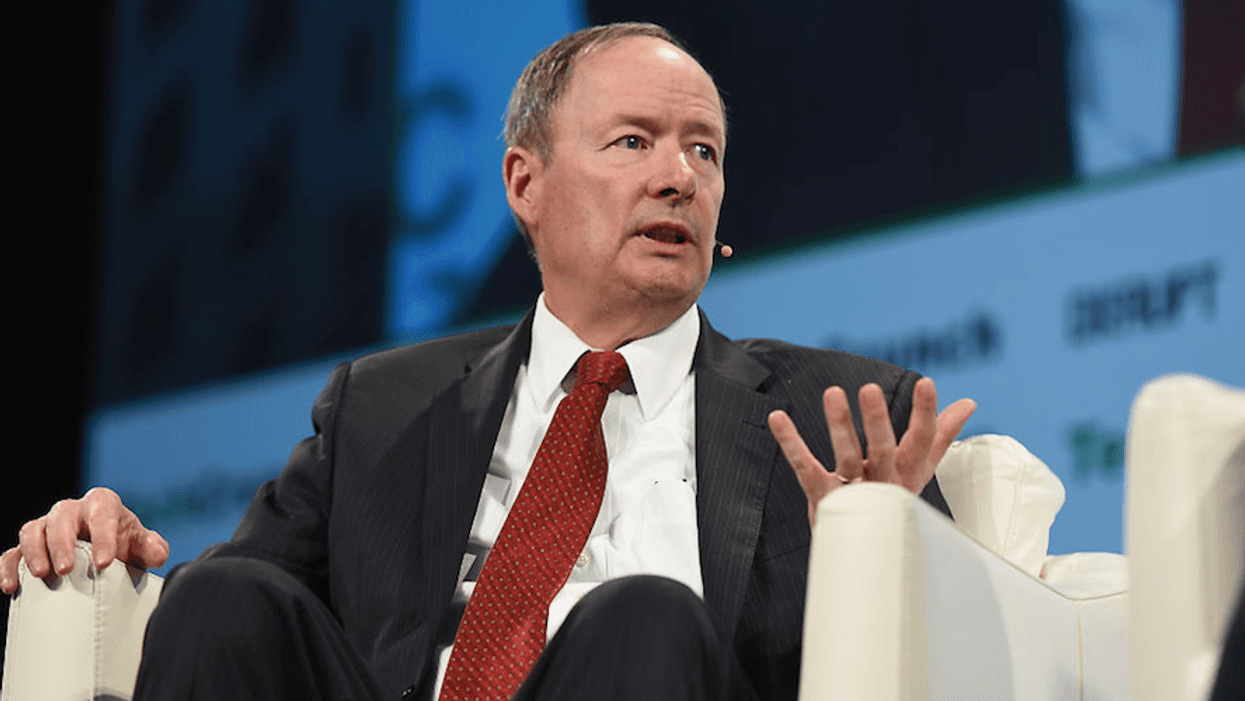
Keith Alexander--a retired four-star U.S. Army general and former National Security Agency director who infamously lied about the federal government's mass surveillance program--has joined the board of Amazon, the online retail giant announced Thursday.
News that Alexander, co-chief executive officer of IronNet Cybersecurity Inc., is joining Amazon's audit committee first came in the form of a Securities and Exchange Commission (SEC) filing on Wednesday.
"It turns out 'Hey Alexa' is short for 'Hey Keith Alexander.' Yes, the Keith Alexander personally responsible for the unlawful mass surveillance programs that caused a global scandal."
-- Edward Snowden
Over the course of his 40-year military career, Alexander led the Army Intelligence and Security Command in the post-9/11 period, running a network of more than 10,000 spies and eavesdroppers around the world. In 2003 he was named deputy chief of staff for intelligence for the Army during a time when members of the 205th Military Intelligence Brigade were torturing detainees at the notorious Abu Ghraib prison in Iraq.
After that horrific abuse was revealed to the world, Alexander joined other top Bush administration officials in issuing a memorandum seeking to justify the unlawful treatment of detainees in the so-called "War on Terror," including their detention at the notorious Guantanamo Bay military prison.
In 2005, Defense Secretary Donald Rumsfeld appointed Alexander director of the NSA, a position he would hold until he retired in 2014, a year after revelations by former CIA contractor and NSA whistleblower Edward Snowden regarding the agency's global mass phone surveillance program, which including spying on millions of Americans.
Alexander--who also headed U.S. Cyber Command from 2010 until his retirement--lied in 2012, claiming the NSA does not collect data on American citizens. He repeated this lie while testifying under oath before Congress.
Last week, a federal appeals court unanimously ruled that the NSA's warrantless surveillance of Americans' phone records was illegal.
Amazon itself has faced accusations it spies on and profiles its users through its Alexa-driven devices. Amazon keeps copies of everything its Alexa smart speakers record, and last year the company admitted that its employees listen to customer voice recordings on its Echo and Alexa devices--reportedly including people having sex and possible sexual assaults.
Reacting to the news of Alexander joining Amazon, Snowden tweeted from exile in Russia that "it turns out that 'Hey, Alexa' is short for 'Hey, Keith Alexander.'"
Amazon's privacy violations aren't just limited to its devices. Earlier this month, VICE reported the company sought to hire intelligence analysts to track "labor organizing threats" inside the company. The online retailer--whose founder and CEO Jeff Bezos, the world's richest person, recently became the first-ever multi-centibillionaire--also operated a secret surveillance program to spy on its workers' private Facebook groups.
A report (pdf) last month from Open Markets Institute also highlighted how Amazon has built a web of surveillance infrastructure to spy on its workers.
Former NSA Director Keith Alexander says his services warrant a fee of up to a million dollars, due to a cyber-surveillance technique he and his partners at his new security firm IronNet Cybersecurity have developed, Foreign Policy reported on Tuesday. The claim follows reporting earlier this month that Alexander is slated to head a 'cyber-war council' backed by Wall Street.
Alexander claims that the new technology is different from anything the NSA has done as it uses "behavioral models" to predict hackers' actions ahead of time.
In his article, "The NSA's Cyber-King Goes Corporate," Foreign Policy journalist Shane Harris says that Alexander stated that IronNet has already signed contracts with three separate companies, although Alexander declined to name them. He plans on filing at least nine patents for the technology and finishing the testing phase of it by the end of September.
While it's not uncommon for former government employees to be granted patents for their inventions, Alexander is thought to be the first ex-NSA director to apply for patents "directly related to the job he had in government," said Harris.
"Alexander is on firm legal ground so long as he can demonstrate that his invention is original and sufficiently distinct from any other patented technologies," according to Harris. Therefore when he files the patents, if he can prove that he "invented the technology on his own time and separate from his core duties, he might have a stronger argument to retain the exclusive rights to the patent."
According to critics, Alexander's very experience as the NSA director has informed his move to the corporate sector--whether or not he developed the technology independently--and that in itself is cause for alarm and a possible investigation.
"Alexander stands to profit directly off of his taxpayer-funded experience, and may do so with a competitive advantage over other competing private firms," Carl Franzen pointed out at The Verge.
"Is it ethical for an NSA chief to pursue patents on technologies directly related to their work running the agency?" wrote Xeni Jardin of boingboing. "Will the Justice Department investigate? Don't hold your breath."
Journalist Dan Froomkin of The Intercept weighed in on Twitter:
As independent journalist Marcy Wheeler pointed out on her blog, there are a multitude of questions still remaining concerning the legality of Alexander's services, that are unrelated to the issue of patent legality. Among those she poses this:
with Alexander out of his NSA, where will he and his profitable partners get the data they need to model threats? How much of this model will depend on the Cyber Information sharing plan that Alexander has demanded for years? How much will Alexander's privatized solutions to the problem he couldn't solve at NSA depend on access to all the information the government has, along with immunity?
To what degree is CISA about making Keith Alexander rich?
The NSA's own actions under Alexander seem to have laid the groundwork for the exact cyber-defense market the retired general is now looking to exploit.
When Alexander first addressed Securities Industry and Financial Markets Association shortly after his retirement in March, company executives were apparently most interested in learning about destructive programs such as Wiper, which the U.S. government has claimed was used in cyber-attacks originating in North Korea and Iran.
Harris says the singling out of programs like Wiper is "a supreme irony" in the eyes of many computer security experts, who say that it is nothing more than "a cousin of the notorious Stuxnet virus, which was built by the NSA -- while Alexander was in charge -- in cooperation with Israeli intelligence."
New documents obtained by the Associated Press under a Feedom of Infomation Act request appear to reveal that high-level officials knew in advance that British agents were attempting to destroy documents leaked by Edward Snowden that were contained on computers owned by the Guardian newspaper.
Though the "White House had publicly distanced itself on whether it would do the same to an American news organization," reports the AP, the internal NSA emails show "senior intelligence officials were notified of Britain's intent to retrieve the Snowden documents and that one senior U.S. official appeared to praise the effort."
According to AP:
"Good news, at least on this front," the current NSA deputy director, Richard Ledgett, said at the end of a short, censored email to then-NSA director Gen. Keith Alexander and others. The subject of that July 19, 2013, email was: "Guardian data being destroyed." A paragraph before Ledgett's comment was blacked out by censors, and the NSA declined to answer questions about the documents.
The White House said Thursday the comment from Ledgett -- then the head of the NSA's Media Leaks Task Force -- was confined to intelligence operations because it was "good news" that classified information was recovered and "didn't reflect a broader administration view" on press freedoms.
The Guardian's hard drives were destroyed the day after Ledgett's email. Top editor Alan Rusbridger made the decision after a week of increasingly blunt threats from British officials. A senior aide to British Prime Minister David Cameron even warned that Rusbridger's nearly 200-year-old newspaper faced closure unless the documents were destroyed.
Responding to the developments, a spokesperson for the Guardian said:
We're disappointed to learn that cross-Atlantic conversations were taking place at the very highest levels of government ahead of the bizarre destruction of journalistic material that took place in the Guardian's basement last July.
What's perhaps most concerning is that the disclosure of these emails appears to contradict the White House's comments about these events last year, when they questioned the appropriateness of the UK government's intervention.
_______________________________
Wall Street's largest trade group is proposing a government-industry coalition 'cyber war council'--and they've already snagged former NSA chief Keith Alexander to 'facilitate' that effort, according to a report in Bloomberg.
After Alexander's services were retained by the Securities Industry and Financial Markets Association (Sifma), he managed to bring on Michael Chertoff, former head of the Department of Homeland Security, along with his firm Chertoff Group.
Alexander has reportedly pitched his services to multiple banking and trade organizations through his new consulting firm, IronNet Cybersecurity Inc., for up to $1 million per month.
The Bloomberg report draws on information obtained from an internal document dated June 27 and reportedly reveals that Sifma is looking to put together a committee that would consist of representatives from eight different U.S. government agencies, including the NSA and the Department of Homeland Security, and be headed by a senior White House official.
According to Bloomberg:
The government-industry group would develop plans for "much quicker, near real-time" dissemination of information from agencies to the private sector and ways to "actively defend the industry" if preparations for a cyber attack are discovered in advance. Sifma is also seeking "pre-discussed and mutually understood protocols" for the industry to request government help during and after an attack.
Congressman Alan Grayson (D-Fla.) stated in an email to Bloomberg that he was worried that such a coalition sharing information in a 'near real-time' manner could lead to preemptive and possibly illegal attempts to thwart cyber attacks.
"Because of the murky nature of cybersecurity, I am concerned that a council like this might propose either physical attacks or cyberattacks by the U.S. military on the perceived source of the threats," Grayson said. "This could in effect make the banks part of what would begin to look like a war council."
In a letter (pdf) to Sifma, Consumer Bankers Association, and the Financial Services Roundtable in late June, Grayson touted the opinion of security expert Bruce Schneier that Alexander's proposed fee to the three groups of between $600,000 and $1 million per month is "on its face unreasonable," unless "he's giving them classified information."
Liz Pierce, a spokewoman for Sifma, declined to comment on the contents of the document, but stated that the group "is doing everything possible to help the industry prepare for and defend against cyberattacks."
The Senate Intelligence Committee voted on Tuesday to advance a bill aimed at boosting cooperation between government and private-sector cyber-defence efforts, including insulating banks from liability that might arise from the sharing of information for cybersecurity.
_____________________
The just-retired long-time NSA chief, Gen. Keith Alexander, recently traveled to Australia to give a remarkably long and wide-ranging interview with an extremely sycophantic "interviewer" with The Australian Financial Review. The resulting 17,000-word transcript and accompanying article form a model of uncritical stenography journalism, but Alexander clearly chose to do this because he is angry, resentful, and feeling unfairly treated, and the result is a pile of quotes that are worth examining, only a few of which are noted below:
AFR: What were the key differences for you as director of NSA serving under presidents Bush and Obama? Did you have a preferred commander in chief?
Gen. Alexander: Obviously they come from different parties, they view things differently, but when it comes to the security of the nation and making those decisions about how to protect our nation, what we need to do to defend it, they are, ironically, very close to the same point. You would get almost the same decision from both of them on key questions about how to defend our nation from terrorists and other threats.
The almost-complete continuity between George W. Bush and Barack Obama on such matters has been explained by far too many senior officials in both parties, and has been amply documented in far too many venues, to make it newsworthy when it happens again. Still, the fact that one of the nation's most powerful generals in history, who has no incentive to say it unless it were true, just comes right out and states that Bush and The Candidate of Change are "very close to the same point" and "you would get almost the same decision from both of them on key questions" is a fine commentary on a number of things, including how adept the 2008 Obama team was at the art of branding.
The fact that Obama, in 2008, specifically vowed to his followers angered over his campaign-season NSA reversal that he possessed "the firm intention -- once I'm sworn in as president -- to have my Attorney General conduct a comprehensive review of all our surveillance programs, and to make further recommendations on any steps needed to preserve civil liberties and to prevent executive branch abuse in the future" only makes that point a bit more vivid.
AFR: Can you now quantify the number of documents [Snowden] stole?
Gen. Alexander: Well, I don't think anybody really knows what he actually took with him, because the way he did it, we don't have an accurate way of counting. What we do have an accurate way of counting is what he touched, what he may have downloaded, and that was more than a million documents.
It's hard to recall a better and clearer example of how mindless and uncritical the American media is when it comes to the unproven pronouncements of the U.S. Government. Back in December, 60 Minutes broadcast a now-notorious segment of pure access journalism in which they gullibly disseminated one false NSA claim after the next in exchange for being given exclusive(!) access to a few Secret and Exciting Rooms inside the agency's headquarters. The program claimed that Snowden "is believed to still have access to 1.5 million classified documents he has not leaked". On its Twitter account, 60 Minutes made this claim to promote its show:
Mike McConnell, the vice chairman of Booz Allen and former Director of National Intelligence in the Bush administration, then claimed that "Snowden absconded with 1.7 million to 1.8 million documents."
Ever since then, that Snowden "stole" 1.7 or 1.8 million documents from the NSA has been repeated over and over again by US media outlets as verified fact. The Washington Post's Walter Pincus, citing an anonymous official source, purported to tell readers that "among the roughly 1.7 million documents he walked away with -- the vast majority of which have not been made public -- are highly sensitive, specific intelligence reports". Reuters frequently includes in its reports the unchallenged assertion that "Snowden was believed to have taken 1.7 million computerized documents." Just this week, the global news agency told its readers that "Snowden was believed to have taken 1.7 million computerized documents."
In fact, that number is and always has been a pure fabrication, as even Keith Alexander admits. The claimed number has changed more times than one can count: always magically morphing into randomly chosen higher and scarier numbers. The reality, in the words of the General, is that the US Government "really [doesn't] know[] what he actually took with him" and they "don't have an accurate way of counting". All they know is how many documents he accessed in his entire career at NSA, which is a radically different question from how many documents he took. But that hasn't stopped American media outlets from repeatedly affirming the inflammatory evidence-free claim that Snowden took 1.7 million documents. As usual, even the most blatantly unreliable claims from National Security State officials are treated as infallible papal pronouncements by our Adversarial Watchdog Press.
There's an equally vital point made by Alexander's admission. The primary defense of the NSA and its defenders is that one need not worry about the staggering sums of data they collect because they have implemented very rigorous oversight mechanisms and controls that prevent abuse. Yet Edward Snowden spent months downloading a large amount of highly sensitive documents right under their noses. And not only did they have no idea that he was doing it, but now - even after spending large sums of money to find out - they are still completely incapable of learning which documents he took or even how many he took. Does that at all sound like a well-managed, tightly controlled system that you can trust to safeguard your most personal data and to detect and prevent abuse of this system by the tens of thousands of people who have access to it?
AFR: What is your personal opinion on the decision to award a Pulitzer Prize to the Guardian and Washington Post newspapers for their "revelation of widespread secret surveillance by the National Security Agency, helping through aggressive reporting to spark a debate about the relationship between the government and the public over issues of security and privacy"?
Gen. Alexander: I'm greatly disappointed that we have rewarded those who have put so many lives at risk. I think that's the best way to say that. . . . At the end of the day, I believe peoples' lives will be lost because of the Snowden leaks because we will not be able to protect them with capabilities that were once effective but are now being rendered ineffective because of these revelations.
There are few things in life more ironic than being accused by U.S. Generals, including those who participated in the war in Iraq, of being responsible for the loss of lives. For that sort of irony, nothing will beat that episode where the US Pentagon chief and Chairman of the Joint Chiefs of Staff announced that WikiLeaks - not themselves, but WikiLeaks - has "blood on its hands" by virtue of publishing documents about the U.S. war in Afghanistan. In the world of the U.S. National Security State and its loyal media, those who go around the world killing innocent people over and over are noble and heroic, while those who report on what they do are the ones with "blood on their hands".
But what makes this claim so remarkable is how often it is made and how false it always turns out to be. The accusation about WikiLeaks was ultimately demonstrated to be false. The same was true of the identical claim made about NSA whistleblower Thomas Drake, and the leaker who exposed the Bush-era warrantless eavesdropping program, and Pentagon Papers leaker Daniel Ellsberg, and virtually every other person who has brought unwanted transparency to what the U.S. Government is doing in the dark. But accusing whistleblowers and journalists of causing the deaths of innocent people is a tactic people like Gen. Alexander continue to embrace because it's virtually never pointed out by our stalwart media how many times that claim has been proven to be an utter fabrication.
* * * * *
The release date for my book on the NSA, privacy, and our reporting of the surveillance story, No Place to Hide, is next Tuesday, May 13, at which time all of the previously unpublished NSA documents that are reported on in the book will be placed online, with free access, at the book's website.

Asked whether the National Security Agency should collect all communications of U.S. residents at a Senate Intelligence Committee hearing on Thursday, NSA Director General Keith Alexander replied, "I believe it is in the nation's best interest to put all the phone records into a lockbox - yes."
Alexander, who was joined by Director of National Intelligence James Clapper and Deputy Attorney General James Cole, went on to maintain the the NSA's collect-it-all approach to communications surveillance in the U.S. and around the world is necessary--urging Senators not to be moved by the rising tide of public discontent that has surged since NSA whistleblower Edward Snowden revealed a trove of incriminating evidence through several newspapers, exposing the agency's unconstitutional surveillance practices.
Alexander blamed "sensational headlines," not the actual dragnet surveillance practices revealed in the media, for public anger--a notion that seemed to be shared by most of the Senators at the hearing, who are supposed to be in charge of NSA congressional oversight.
Barring questions posed by NSA critics Sen. Ron Wyden (D-Ore.), Sen. Mark Udall (D-Colo.), most of the hearing consisted of 'soft balls' lobbed at the intelligence chiefs sitting in the not-so-hot seat. As Matt Sledge at The Huffington Post puts it:
[Sen. Dianne] Feinstein and Sen. Saxby Chambliss (R-Ga.), the committee's ranking Republican who called Snowden "a hero to our enemies," peppered their remarks with references to the Sept. 11 attacks and the recent assault on the Westgate shopping mall in Nairobi, Kenya. Other senators, including Dan Coats (R-Ind.), said that they had no questions for the nation's top spies despite months of revelations about the NSA's highly controversial actions.
And as Glenn Greenwald, the reporter who helped break the Snowden leaks, writes Friday:
The Senate Intelligence Committee yesterday held a hearing, ostensibly to investigate various issues raised about the NSA's activities. What the hearing primarily achieved instead was to underscore what a farce the notion of Congressional oversight over the NSA is.
And as Kevin Gosztola at FireDogLake reports, "Multiple senators used their time to express the opinion that the media was to blame for sensationalizing what Snowden had exposed when there was nothing corrupt going on at the NSA and oversight was occurring properly." He adds, "It was a sham of a hearing."
Feinstein and Chambliss also proposed an NSA reform bill at the hearing but the bill "broadly echoes the small tweaks the intelligence establishment says it will consider, but does not go further," The Guardian reports.
However, Wyden and Udall, who on Wednesday proposed a separate NSA reform bill that was hailed by civil liberties experts as a positive step towards curbing the agency's abusive practices, managed to squeeze in a few legitimate questions within the strict time limit imposed by Feinstein, who entirely cut off a second round of questioning.
Asked in a series of questions posed by Udall whether the NSA sought to collect the records of all Americans, Alexander replied: "yes" and there is "no upper limit," but continued to refuse to release any extensive details of the program.
When asked by Wyden, "Has the NSA ever collected or ever made any plans to collect Americans' cell site information?" Alexander refused to answer, citing classified information.
"The leadership of your agencies built an intelligence collection system that repeatedly deceived the American people," Wyden said in a more heated moment with Alexander, in reference to recent misleading statements made by Alexander and Clapper to Congress about the NSA.
"You talk about the damage that has been done by disclosures, but any government official who thought this would never be disclosed was ignoring history," Wyden said. "The truth always manages to come out."
"Now that these secret interpretations of the law and violations of the constitutional rights of Americans have become public, your agencies face terrible consequences that were not planned for," Wyden added.
Watch Wyden's exchange with the intelligence heads in the video below:
Wyden Statement at Finance Committee Hearing on IRS Budget and Filing SeasonApril 19, 2023 - Senator Ron Wyden (D-Ore.)