SUBSCRIBE TO OUR FREE NEWSLETTER
Daily news & progressive opinion—funded by the people, not the corporations—delivered straight to your inbox.
5
#000000
#FFFFFF
To donate by check, phone, or other method, see our More Ways to Give page.
Daily news & progressive opinion—funded by the people, not the corporations—delivered straight to your inbox.
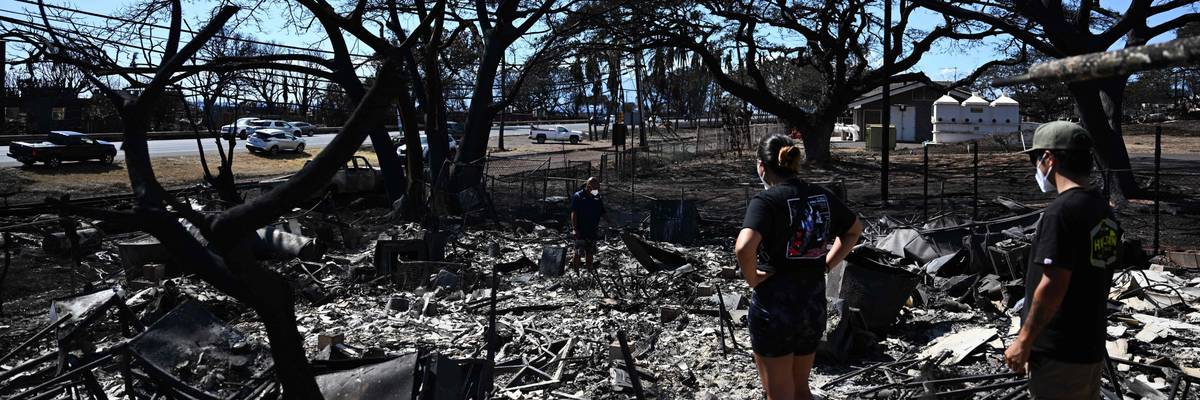
Hano Ganer and Taylor Ganer look through the ashes of their family's home in the aftermath of a wildfire in Lahaina, western Maui, Hawaii on August 11, 2023.
Let’s follow the science and do what is advised to address climate change.
I live near Washington, D.C., and work outside Boston, which provides two perspectives on summer. July was brutally hot in the nation’s capital. And new reports from Boston show a dwindling winter effect from climate change with a loss of annual snow.
Now we are in the dog days of summer. (This reference to hot, sultry, sizzling July and August days is a nod to the Dog Star, the brightest star in the sky—Sirius. It’s in the constellation of Canis Major.)
With school supply sales just around the corner, we are forced to confront the question: Will summers ever be the same?
Thanks to climate change, summers may become longer than we remember. Scientists predict that by 2100 summer could last nearly half the year, with winter being less than two months long. That changes the notion of four seasons and could have enormous consequences for everything from school planning to agriculture and food.
Summers may also be drier than we remember, causing fears of future droughts that affect food supply chains. Climate models project that overall summer precipitation in large parts of the United States will fall.
But even without steady rain, these same models predict sporadic flooding because of how climate change affects dry, compacted soil that can no longer absorb rainfall. That leads to a greater number of heavy storm events. Certain crops will become vulnerable to disease.
Summers may be more humid than we remember. Changes to humidity and average temperature patterns are redistributing the energy that drives summer weather, meaning we can expect more hurricanes, thunderstorms, and hail. We are told to also expect more heat waves and air pollution (although fewer cyclones).
Rising temperatures put a strain on healthcare systems that must deal with heat-related illnesses and emergencies. In Arizona this summer, people showed up to emergency rooms with burns from hot sidewalks.
Hot weather means more air conditioning and strain on America’s aging electric grids.
Even travel, trade, and tourism can be affected by the longer summers and shorter winters.
Going to the beach could become dangerous due to red tide, in which algae blooms produce toxins. From Cape Cod to Florida, swimmers are being told to stay out of the water.
Las Vegas has seen a decline in tourism this summer, and summer camps reported lost revenue and added expense from air-conditioning. In Portland, Ore., a camp set up shop in a former department store. In Nevada, campfires were taken off the activity list, and campers found themselves inside more often.
Trips to Europe for a respite from the heat did not work out well. Wildfires made for a hot, unhealthy summer in Greece. Major tourist spots closed, and others were barely able to handle travelers during the heat wave.
Canada is experiencing its worst fire season on record. According to the Canadian Interagency Forest Fire Centre, 4,774 fires have swept across the country so far this year, with a cumulative burned area of more than 121,000 square kilometers.
That figure has surpassed the land area of South Korea and is 7.5 times larger than the cumulative area affected by forest fires in China from 2000 to 2021. It is a vicious cycle because the forest fires emit carbon dioxide, methane, and nitrous oxide, which then worsen climate change, with the smoke wafting its way to America.
“Ah, summer, what power you have to make us suffer and like it,” said noted author Russell Baker.
Summer should not be synonymous with suffering. We have it within our control to confront climate change. Let’s follow the science and do what is advised to address climate change so that summers will return to the ones we so fondly remember.
Dear Common Dreams reader, It’s been nearly 30 years since I co-founded Common Dreams with my late wife, Lina Newhouser. We had the radical notion that journalism should serve the public good, not corporate profits. It was clear to us from the outset what it would take to build such a project. No paid advertisements. No corporate sponsors. No millionaire publisher telling us what to think or do. Many people said we wouldn't last a year, but we proved those doubters wrong. Together with a tremendous team of journalists and dedicated staff, we built an independent media outlet free from the constraints of profits and corporate control. Our mission has always been simple: To inform. To inspire. To ignite change for the common good. Building Common Dreams was not easy. Our survival was never guaranteed. When you take on the most powerful forces—Wall Street greed, fossil fuel industry destruction, Big Tech lobbyists, and uber-rich oligarchs who have spent billions upon billions rigging the economy and democracy in their favor—the only bulwark you have is supporters who believe in your work. But here’s the urgent message from me today. It's never been this bad out there. And it's never been this hard to keep us going. At the very moment Common Dreams is most needed, the threats we face are intensifying. We need your support now more than ever. We don't accept corporate advertising and never will. We don't have a paywall because we don't think people should be blocked from critical news based on their ability to pay. Everything we do is funded by the donations of readers like you. When everyone does the little they can afford, we are strong. But if that support retreats or dries up, so do we. Will you donate now to make sure Common Dreams not only survives but thrives? —Craig Brown, Co-founder |
I live near Washington, D.C., and work outside Boston, which provides two perspectives on summer. July was brutally hot in the nation’s capital. And new reports from Boston show a dwindling winter effect from climate change with a loss of annual snow.
Now we are in the dog days of summer. (This reference to hot, sultry, sizzling July and August days is a nod to the Dog Star, the brightest star in the sky—Sirius. It’s in the constellation of Canis Major.)
With school supply sales just around the corner, we are forced to confront the question: Will summers ever be the same?
Thanks to climate change, summers may become longer than we remember. Scientists predict that by 2100 summer could last nearly half the year, with winter being less than two months long. That changes the notion of four seasons and could have enormous consequences for everything from school planning to agriculture and food.
Summers may also be drier than we remember, causing fears of future droughts that affect food supply chains. Climate models project that overall summer precipitation in large parts of the United States will fall.
But even without steady rain, these same models predict sporadic flooding because of how climate change affects dry, compacted soil that can no longer absorb rainfall. That leads to a greater number of heavy storm events. Certain crops will become vulnerable to disease.
Summers may be more humid than we remember. Changes to humidity and average temperature patterns are redistributing the energy that drives summer weather, meaning we can expect more hurricanes, thunderstorms, and hail. We are told to also expect more heat waves and air pollution (although fewer cyclones).
Rising temperatures put a strain on healthcare systems that must deal with heat-related illnesses and emergencies. In Arizona this summer, people showed up to emergency rooms with burns from hot sidewalks.
Hot weather means more air conditioning and strain on America’s aging electric grids.
Even travel, trade, and tourism can be affected by the longer summers and shorter winters.
Going to the beach could become dangerous due to red tide, in which algae blooms produce toxins. From Cape Cod to Florida, swimmers are being told to stay out of the water.
Las Vegas has seen a decline in tourism this summer, and summer camps reported lost revenue and added expense from air-conditioning. In Portland, Ore., a camp set up shop in a former department store. In Nevada, campfires were taken off the activity list, and campers found themselves inside more often.
Trips to Europe for a respite from the heat did not work out well. Wildfires made for a hot, unhealthy summer in Greece. Major tourist spots closed, and others were barely able to handle travelers during the heat wave.
Canada is experiencing its worst fire season on record. According to the Canadian Interagency Forest Fire Centre, 4,774 fires have swept across the country so far this year, with a cumulative burned area of more than 121,000 square kilometers.
That figure has surpassed the land area of South Korea and is 7.5 times larger than the cumulative area affected by forest fires in China from 2000 to 2021. It is a vicious cycle because the forest fires emit carbon dioxide, methane, and nitrous oxide, which then worsen climate change, with the smoke wafting its way to America.
“Ah, summer, what power you have to make us suffer and like it,” said noted author Russell Baker.
Summer should not be synonymous with suffering. We have it within our control to confront climate change. Let’s follow the science and do what is advised to address climate change so that summers will return to the ones we so fondly remember.
I live near Washington, D.C., and work outside Boston, which provides two perspectives on summer. July was brutally hot in the nation’s capital. And new reports from Boston show a dwindling winter effect from climate change with a loss of annual snow.
Now we are in the dog days of summer. (This reference to hot, sultry, sizzling July and August days is a nod to the Dog Star, the brightest star in the sky—Sirius. It’s in the constellation of Canis Major.)
With school supply sales just around the corner, we are forced to confront the question: Will summers ever be the same?
Thanks to climate change, summers may become longer than we remember. Scientists predict that by 2100 summer could last nearly half the year, with winter being less than two months long. That changes the notion of four seasons and could have enormous consequences for everything from school planning to agriculture and food.
Summers may also be drier than we remember, causing fears of future droughts that affect food supply chains. Climate models project that overall summer precipitation in large parts of the United States will fall.
But even without steady rain, these same models predict sporadic flooding because of how climate change affects dry, compacted soil that can no longer absorb rainfall. That leads to a greater number of heavy storm events. Certain crops will become vulnerable to disease.
Summers may be more humid than we remember. Changes to humidity and average temperature patterns are redistributing the energy that drives summer weather, meaning we can expect more hurricanes, thunderstorms, and hail. We are told to also expect more heat waves and air pollution (although fewer cyclones).
Rising temperatures put a strain on healthcare systems that must deal with heat-related illnesses and emergencies. In Arizona this summer, people showed up to emergency rooms with burns from hot sidewalks.
Hot weather means more air conditioning and strain on America’s aging electric grids.
Even travel, trade, and tourism can be affected by the longer summers and shorter winters.
Going to the beach could become dangerous due to red tide, in which algae blooms produce toxins. From Cape Cod to Florida, swimmers are being told to stay out of the water.
Las Vegas has seen a decline in tourism this summer, and summer camps reported lost revenue and added expense from air-conditioning. In Portland, Ore., a camp set up shop in a former department store. In Nevada, campfires were taken off the activity list, and campers found themselves inside more often.
Trips to Europe for a respite from the heat did not work out well. Wildfires made for a hot, unhealthy summer in Greece. Major tourist spots closed, and others were barely able to handle travelers during the heat wave.
Canada is experiencing its worst fire season on record. According to the Canadian Interagency Forest Fire Centre, 4,774 fires have swept across the country so far this year, with a cumulative burned area of more than 121,000 square kilometers.
That figure has surpassed the land area of South Korea and is 7.5 times larger than the cumulative area affected by forest fires in China from 2000 to 2021. It is a vicious cycle because the forest fires emit carbon dioxide, methane, and nitrous oxide, which then worsen climate change, with the smoke wafting its way to America.
“Ah, summer, what power you have to make us suffer and like it,” said noted author Russell Baker.
Summer should not be synonymous with suffering. We have it within our control to confront climate change. Let’s follow the science and do what is advised to address climate change so that summers will return to the ones we so fondly remember.