

SUBSCRIBE TO OUR FREE NEWSLETTER
Daily news & progressive opinion—funded by the people, not the corporations—delivered straight to your inbox.
5
#000000
#FFFFFF
To donate by check, phone, or other method, see our More Ways to Give page.
Daily news & progressive opinion—funded by the people, not the corporations—delivered straight to your inbox.
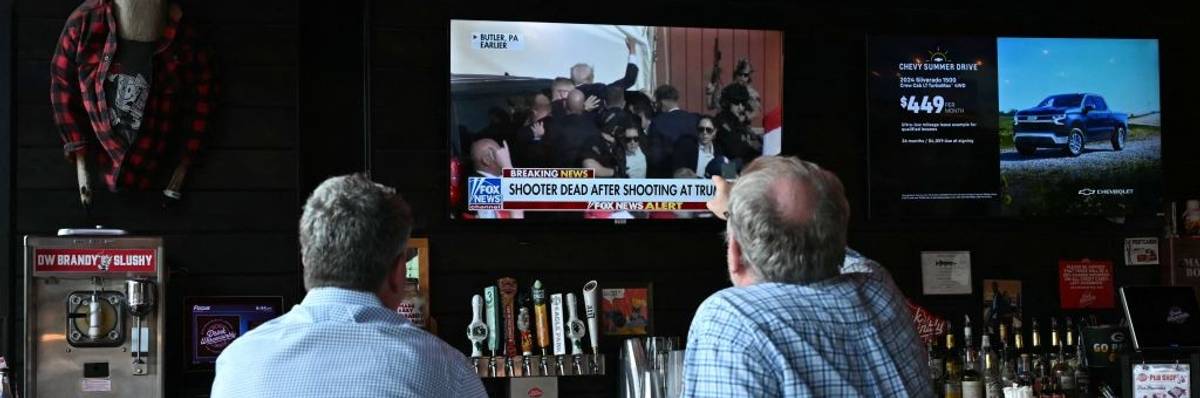
People watch the news on television inside a bar on July 13, 2024 in Milwaukee, Wisconsin, after hearing that Donald Trump was evacuated from the stage of his rally in Pennsylvania after shots were fired.
In an era where misinformation can spread faster than ever before, it is more important than ever for journalists and politicians to uphold the highest standards of accuracy and integrity.
Saturday's assassination attempt on former President Donald Trump has highlighted a deeply troubling trend in American politics: the pervasive spread of misinformation and conspiracy theories. Following the incident at a rally in Pennsylvania, baseless claims quickly spread online, suggesting that the attack was orchestrated by political opponents or even President Biden himself. Figures like Senator JD Vance and Congresswoman Marjorie Taylor Greene have propagated these theories, further fueling division.
These conspiracy theories not only distract from the severity of the event but also contribute to the erosion of public trust in democratic institutions. For instance, U.S. Attorney General Merrick Garland had to publicly refute claims that the FBI had been authorized to use deadly force against Trump during the Mar-a-Lago search, calling these allegations "false and extremely dangerous." This incident starkly illustrates how quickly misinformation can take root and distort public perception.
In this landscape, the role of the media and politicians becomes critically important. Media outlets bear a significant responsibility to ensure their reporting is accurate and fact-based. Sensationalism and the rush to break news can sometimes lead to the dissemination of unverified information, which can then be exploited by those seeking to promote false narratives. Rigorous fact-checking and a steadfast commitment to journalistic integrity are essential in countering this trend.
The assassination attempt on Donald Trump should serve as a wake-up call.
Politicians also have a crucial role to play. When leaders propagate or fail to denounce misinformation, they contribute to a culture of distrust and division. The reaction to the assassination attempt on Trump is a case in point. While some political figures have taken steps to clarify and refute false claims, others have either remained silent or, worse, amplified these conspiracy theories for political gain.
The dangers of false narratives are manifold. They can incite violence, as evidenced by the January 6, 2021, Capitol riot, where misinformation about the 2020 presidential election played a significant role. The recent attempt on Trump's life, followed by immediate and widespread conspiracy theories, echoes this dangerous precedent. When people are led to believe in falsehoods, they may feel justified in taking extreme actions.
Moreover, misinformation corrodes the foundational principles of democracy. Trust in institutions is essential for a functioning democracy; when that trust is undermined, the very fabric of society is at risk. Citizens need to have confidence that their leaders and the media are committed to the truth. Without this trust, democratic processes become vulnerable to manipulation and coercion.
Addressing this issue requires a collective effort. Media organizations must prioritize accuracy over speed, ensuring that their reporting does not inadvertently contribute to the spread of misinformation. Implementing stringent editorial standards and encouraging a culture of accountability can help in this regard.
Politicians and public figures must also commit to truthfulness in their communications. This means actively debunking false narratives and refraining from using misinformation as a political tool. Bipartisan efforts to promote media literacy and critical thinking among the public can also play a vital role in combating the spread of false information.
The assassination attempt on Donald Trump should serve as a wake-up call. It is a stark reminder of the importance of truthfulness in political discourse. By prioritizing fact-based reporting and holding our leaders accountable for their words, we can begin to rebuild trust in our democratic institutions and safeguard the future of our democracy.
Truthfulness is not just a moral imperative; it is a practical necessity for the health of our society. In an era where misinformation can spread faster than ever before, it is more important than ever for journalists and politicians to uphold the highest standards of accuracy and integrity. Doing so will not only help prevent future violence but also ensure that our democracy remains robust and resilient in the face of challenges. By collectively committing to truthfulness, we can move toward a more informed and united society, better equipped to tackle the complex issues of our time.
Dear Common Dreams reader, It’s been nearly 30 years since I co-founded Common Dreams with my late wife, Lina Newhouser. We had the radical notion that journalism should serve the public good, not corporate profits. It was clear to us from the outset what it would take to build such a project. No paid advertisements. No corporate sponsors. No millionaire publisher telling us what to think or do. Many people said we wouldn't last a year, but we proved those doubters wrong. Together with a tremendous team of journalists and dedicated staff, we built an independent media outlet free from the constraints of profits and corporate control. Our mission has always been simple: To inform. To inspire. To ignite change for the common good. Building Common Dreams was not easy. Our survival was never guaranteed. When you take on the most powerful forces—Wall Street greed, fossil fuel industry destruction, Big Tech lobbyists, and uber-rich oligarchs who have spent billions upon billions rigging the economy and democracy in their favor—the only bulwark you have is supporters who believe in your work. But here’s the urgent message from me today. It's never been this bad out there. And it's never been this hard to keep us going. At the very moment Common Dreams is most needed, the threats we face are intensifying. We need your support now more than ever. We don't accept corporate advertising and never will. We don't have a paywall because we don't think people should be blocked from critical news based on their ability to pay. Everything we do is funded by the donations of readers like you. When everyone does the little they can afford, we are strong. But if that support retreats or dries up, so do we. Will you donate now to make sure Common Dreams not only survives but thrives? —Craig Brown, Co-founder |
Gleb Tsipursky, PhD, serves as the Chair of the Board of Directors of the Pro-Truth Pledge project and authored Pro Truth: A Practical Plan for Putting Truth Back Into Politics.
Saturday's assassination attempt on former President Donald Trump has highlighted a deeply troubling trend in American politics: the pervasive spread of misinformation and conspiracy theories. Following the incident at a rally in Pennsylvania, baseless claims quickly spread online, suggesting that the attack was orchestrated by political opponents or even President Biden himself. Figures like Senator JD Vance and Congresswoman Marjorie Taylor Greene have propagated these theories, further fueling division.
These conspiracy theories not only distract from the severity of the event but also contribute to the erosion of public trust in democratic institutions. For instance, U.S. Attorney General Merrick Garland had to publicly refute claims that the FBI had been authorized to use deadly force against Trump during the Mar-a-Lago search, calling these allegations "false and extremely dangerous." This incident starkly illustrates how quickly misinformation can take root and distort public perception.
In this landscape, the role of the media and politicians becomes critically important. Media outlets bear a significant responsibility to ensure their reporting is accurate and fact-based. Sensationalism and the rush to break news can sometimes lead to the dissemination of unverified information, which can then be exploited by those seeking to promote false narratives. Rigorous fact-checking and a steadfast commitment to journalistic integrity are essential in countering this trend.
The assassination attempt on Donald Trump should serve as a wake-up call.
Politicians also have a crucial role to play. When leaders propagate or fail to denounce misinformation, they contribute to a culture of distrust and division. The reaction to the assassination attempt on Trump is a case in point. While some political figures have taken steps to clarify and refute false claims, others have either remained silent or, worse, amplified these conspiracy theories for political gain.
The dangers of false narratives are manifold. They can incite violence, as evidenced by the January 6, 2021, Capitol riot, where misinformation about the 2020 presidential election played a significant role. The recent attempt on Trump's life, followed by immediate and widespread conspiracy theories, echoes this dangerous precedent. When people are led to believe in falsehoods, they may feel justified in taking extreme actions.
Moreover, misinformation corrodes the foundational principles of democracy. Trust in institutions is essential for a functioning democracy; when that trust is undermined, the very fabric of society is at risk. Citizens need to have confidence that their leaders and the media are committed to the truth. Without this trust, democratic processes become vulnerable to manipulation and coercion.
Addressing this issue requires a collective effort. Media organizations must prioritize accuracy over speed, ensuring that their reporting does not inadvertently contribute to the spread of misinformation. Implementing stringent editorial standards and encouraging a culture of accountability can help in this regard.
Politicians and public figures must also commit to truthfulness in their communications. This means actively debunking false narratives and refraining from using misinformation as a political tool. Bipartisan efforts to promote media literacy and critical thinking among the public can also play a vital role in combating the spread of false information.
The assassination attempt on Donald Trump should serve as a wake-up call. It is a stark reminder of the importance of truthfulness in political discourse. By prioritizing fact-based reporting and holding our leaders accountable for their words, we can begin to rebuild trust in our democratic institutions and safeguard the future of our democracy.
Truthfulness is not just a moral imperative; it is a practical necessity for the health of our society. In an era where misinformation can spread faster than ever before, it is more important than ever for journalists and politicians to uphold the highest standards of accuracy and integrity. Doing so will not only help prevent future violence but also ensure that our democracy remains robust and resilient in the face of challenges. By collectively committing to truthfulness, we can move toward a more informed and united society, better equipped to tackle the complex issues of our time.
Gleb Tsipursky, PhD, serves as the Chair of the Board of Directors of the Pro-Truth Pledge project and authored Pro Truth: A Practical Plan for Putting Truth Back Into Politics.
Saturday's assassination attempt on former President Donald Trump has highlighted a deeply troubling trend in American politics: the pervasive spread of misinformation and conspiracy theories. Following the incident at a rally in Pennsylvania, baseless claims quickly spread online, suggesting that the attack was orchestrated by political opponents or even President Biden himself. Figures like Senator JD Vance and Congresswoman Marjorie Taylor Greene have propagated these theories, further fueling division.
These conspiracy theories not only distract from the severity of the event but also contribute to the erosion of public trust in democratic institutions. For instance, U.S. Attorney General Merrick Garland had to publicly refute claims that the FBI had been authorized to use deadly force against Trump during the Mar-a-Lago search, calling these allegations "false and extremely dangerous." This incident starkly illustrates how quickly misinformation can take root and distort public perception.
In this landscape, the role of the media and politicians becomes critically important. Media outlets bear a significant responsibility to ensure their reporting is accurate and fact-based. Sensationalism and the rush to break news can sometimes lead to the dissemination of unverified information, which can then be exploited by those seeking to promote false narratives. Rigorous fact-checking and a steadfast commitment to journalistic integrity are essential in countering this trend.
The assassination attempt on Donald Trump should serve as a wake-up call.
Politicians also have a crucial role to play. When leaders propagate or fail to denounce misinformation, they contribute to a culture of distrust and division. The reaction to the assassination attempt on Trump is a case in point. While some political figures have taken steps to clarify and refute false claims, others have either remained silent or, worse, amplified these conspiracy theories for political gain.
The dangers of false narratives are manifold. They can incite violence, as evidenced by the January 6, 2021, Capitol riot, where misinformation about the 2020 presidential election played a significant role. The recent attempt on Trump's life, followed by immediate and widespread conspiracy theories, echoes this dangerous precedent. When people are led to believe in falsehoods, they may feel justified in taking extreme actions.
Moreover, misinformation corrodes the foundational principles of democracy. Trust in institutions is essential for a functioning democracy; when that trust is undermined, the very fabric of society is at risk. Citizens need to have confidence that their leaders and the media are committed to the truth. Without this trust, democratic processes become vulnerable to manipulation and coercion.
Addressing this issue requires a collective effort. Media organizations must prioritize accuracy over speed, ensuring that their reporting does not inadvertently contribute to the spread of misinformation. Implementing stringent editorial standards and encouraging a culture of accountability can help in this regard.
Politicians and public figures must also commit to truthfulness in their communications. This means actively debunking false narratives and refraining from using misinformation as a political tool. Bipartisan efforts to promote media literacy and critical thinking among the public can also play a vital role in combating the spread of false information.
The assassination attempt on Donald Trump should serve as a wake-up call. It is a stark reminder of the importance of truthfulness in political discourse. By prioritizing fact-based reporting and holding our leaders accountable for their words, we can begin to rebuild trust in our democratic institutions and safeguard the future of our democracy.
Truthfulness is not just a moral imperative; it is a practical necessity for the health of our society. In an era where misinformation can spread faster than ever before, it is more important than ever for journalists and politicians to uphold the highest standards of accuracy and integrity. Doing so will not only help prevent future violence but also ensure that our democracy remains robust and resilient in the face of challenges. By collectively committing to truthfulness, we can move toward a more informed and united society, better equipped to tackle the complex issues of our time.

