SUBSCRIBE TO OUR FREE NEWSLETTER
Daily news & progressive opinion—funded by the people, not the corporations—delivered straight to your inbox.
5
#000000
#FFFFFF
To donate by check, phone, or other method, see our More Ways to Give page.
Daily news & progressive opinion—funded by the people, not the corporations—delivered straight to your inbox.
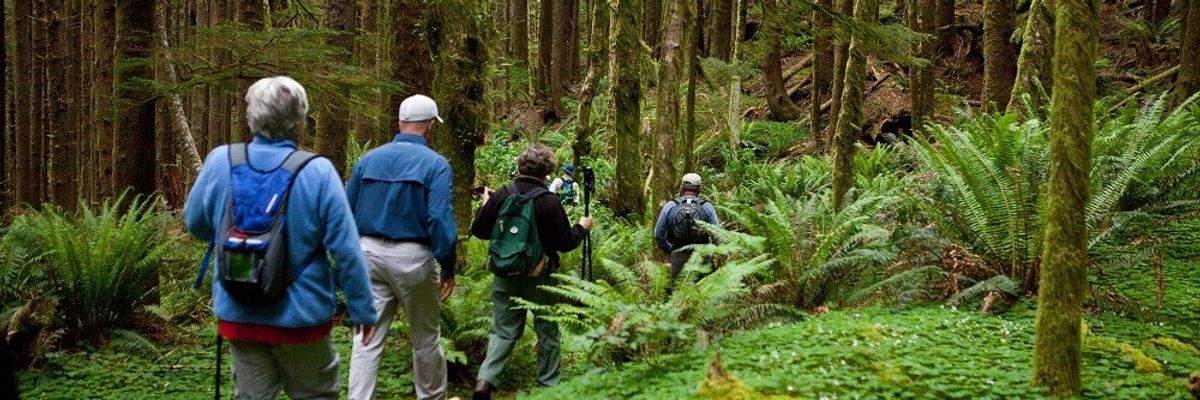
Hikers stroll through Siuslaw National Forest in Oregon.
The Forest Service now seems to think that it can throw away decades of policy preventing “forever” permits that privatize forests for corporate use.
In my 34-year career at the U.S. Forest Service, the agency worked to support American industry while also maintaining public lands and the renewable resources they foster. That’s why I am shocked to learn that the agency plans to make a fundamental change to how it manages our public lands: allowing private parties to permanently dump industrial pollution in national forests.
While I was serving as Siuslaw National Forest Supervisor in Oregon, and deputy chief for all U.S. national forests, the agency updated its Special Use permit rules in 1998. At that time, the agency was adamant that no industry—no matter how useful to society—had the right to permanently use or occupy national forest lands. The agency was clear that it opposed “an exclusive and perpetual use of Federal land.” To do otherwise would undermine longstanding policy meant to protect national forest ecosystems and recreational uses.
Now, in an alarming contradiction, the Forest Service proposes to blow a pipeline-sized hole in its regulations, quoting here “to allow exclusive or perpetual right of use or occupancy... of National Forest System (NFS) lands” for carbon waste injection and storage. This carbon waste, in addition to requiring pipelines and injection wells, can cause people and animals to suffocate or even die. This I know: Once gases are piped underground, there are no do-overs. What’s done is done. And I wouldn’t want to be a Forest Service ranger working anywhere near these dangerous operations.
The agency has a golden opportunity to elevate the value of carbon sequestration by protecting mature and old-growth forests.
Why the abrupt change? Nothing in laws establishing our national forests has changed since the rule was updated in the 1990s, but the Forest Service now seems to think that it can throw away decades of policy preventing “forever” permits that privatize forests for corporate use.
Maybe the answer comes—as it often does—from following the money. The carbon would likely come from smokestacks of facilities like coal-fired power plants. Fossil fuel companies are eager to adopt carbon capture and storage as a way perpetuate business as usual in the face of our need to transition to renewable energy. After capturing their pollution, these industries have to put it somewhere. Sending the waste through pipelines to national forests is surely more appealing than dealing with landowner opposition to carbon pipeline companies’ efforts to take private property by eminent domain. To add icing to the cake: the federal government is offering companies massive tax subsidies to dispose of their carbon waste, even though research has shown this program is wrought with fraud.
Some national forests will be targeted sooner based on their geology, but this rule change puts all of them at risk of future applicants’ desire to make quick profits and spoil public lands permanently. Impacts of this rule change could spread across our landscape: National forests are widely distributed throughout America, and highly valued for recreation, domestic water sources, crucial fish and wildlife habitat, and outstanding scenery.
Ultimately, policy questions turn on values. Forests store tremendous amounts of carbon–naturally! The agency has a golden opportunity to elevate the value of carbon sequestration by protecting mature and old-growth forests. Isn’t this a better values choice than chasing tired polluting industry practices that are squarely opposite where our climate change battle should be heading?
The Forest Service should abandon its proposal to permanently privatize the public’s land and endanger our shared renewable resources and ecosystems, which only benefits a small group of rich companies and investors. National forests have a huge role to play in protecting biodiversity and storing carbon in forested landscapes. Allowing polluters to permanently industrialize these lands will only rob the public of real climate solutions in order to chase after fraught, false ones.
Dear Common Dreams reader, It’s been nearly 30 years since I co-founded Common Dreams with my late wife, Lina Newhouser. We had the radical notion that journalism should serve the public good, not corporate profits. It was clear to us from the outset what it would take to build such a project. No paid advertisements. No corporate sponsors. No millionaire publisher telling us what to think or do. Many people said we wouldn't last a year, but we proved those doubters wrong. Together with a tremendous team of journalists and dedicated staff, we built an independent media outlet free from the constraints of profits and corporate control. Our mission has always been simple: To inform. To inspire. To ignite change for the common good. Building Common Dreams was not easy. Our survival was never guaranteed. When you take on the most powerful forces—Wall Street greed, fossil fuel industry destruction, Big Tech lobbyists, and uber-rich oligarchs who have spent billions upon billions rigging the economy and democracy in their favor—the only bulwark you have is supporters who believe in your work. But here’s the urgent message from me today. It's never been this bad out there. And it's never been this hard to keep us going. At the very moment Common Dreams is most needed, the threats we face are intensifying. We need your support now more than ever. We don't accept corporate advertising and never will. We don't have a paywall because we don't think people should be blocked from critical news based on their ability to pay. Everything we do is funded by the donations of readers like you. When everyone does the little they can afford, we are strong. But if that support retreats or dries up, so do we. Will you donate now to make sure Common Dreams not only survives but thrives? —Craig Brown, Co-founder |
In my 34-year career at the U.S. Forest Service, the agency worked to support American industry while also maintaining public lands and the renewable resources they foster. That’s why I am shocked to learn that the agency plans to make a fundamental change to how it manages our public lands: allowing private parties to permanently dump industrial pollution in national forests.
While I was serving as Siuslaw National Forest Supervisor in Oregon, and deputy chief for all U.S. national forests, the agency updated its Special Use permit rules in 1998. At that time, the agency was adamant that no industry—no matter how useful to society—had the right to permanently use or occupy national forest lands. The agency was clear that it opposed “an exclusive and perpetual use of Federal land.” To do otherwise would undermine longstanding policy meant to protect national forest ecosystems and recreational uses.
Now, in an alarming contradiction, the Forest Service proposes to blow a pipeline-sized hole in its regulations, quoting here “to allow exclusive or perpetual right of use or occupancy... of National Forest System (NFS) lands” for carbon waste injection and storage. This carbon waste, in addition to requiring pipelines and injection wells, can cause people and animals to suffocate or even die. This I know: Once gases are piped underground, there are no do-overs. What’s done is done. And I wouldn’t want to be a Forest Service ranger working anywhere near these dangerous operations.
The agency has a golden opportunity to elevate the value of carbon sequestration by protecting mature and old-growth forests.
Why the abrupt change? Nothing in laws establishing our national forests has changed since the rule was updated in the 1990s, but the Forest Service now seems to think that it can throw away decades of policy preventing “forever” permits that privatize forests for corporate use.
Maybe the answer comes—as it often does—from following the money. The carbon would likely come from smokestacks of facilities like coal-fired power plants. Fossil fuel companies are eager to adopt carbon capture and storage as a way perpetuate business as usual in the face of our need to transition to renewable energy. After capturing their pollution, these industries have to put it somewhere. Sending the waste through pipelines to national forests is surely more appealing than dealing with landowner opposition to carbon pipeline companies’ efforts to take private property by eminent domain. To add icing to the cake: the federal government is offering companies massive tax subsidies to dispose of their carbon waste, even though research has shown this program is wrought with fraud.
Some national forests will be targeted sooner based on their geology, but this rule change puts all of them at risk of future applicants’ desire to make quick profits and spoil public lands permanently. Impacts of this rule change could spread across our landscape: National forests are widely distributed throughout America, and highly valued for recreation, domestic water sources, crucial fish and wildlife habitat, and outstanding scenery.
Ultimately, policy questions turn on values. Forests store tremendous amounts of carbon–naturally! The agency has a golden opportunity to elevate the value of carbon sequestration by protecting mature and old-growth forests. Isn’t this a better values choice than chasing tired polluting industry practices that are squarely opposite where our climate change battle should be heading?
The Forest Service should abandon its proposal to permanently privatize the public’s land and endanger our shared renewable resources and ecosystems, which only benefits a small group of rich companies and investors. National forests have a huge role to play in protecting biodiversity and storing carbon in forested landscapes. Allowing polluters to permanently industrialize these lands will only rob the public of real climate solutions in order to chase after fraught, false ones.
In my 34-year career at the U.S. Forest Service, the agency worked to support American industry while also maintaining public lands and the renewable resources they foster. That’s why I am shocked to learn that the agency plans to make a fundamental change to how it manages our public lands: allowing private parties to permanently dump industrial pollution in national forests.
While I was serving as Siuslaw National Forest Supervisor in Oregon, and deputy chief for all U.S. national forests, the agency updated its Special Use permit rules in 1998. At that time, the agency was adamant that no industry—no matter how useful to society—had the right to permanently use or occupy national forest lands. The agency was clear that it opposed “an exclusive and perpetual use of Federal land.” To do otherwise would undermine longstanding policy meant to protect national forest ecosystems and recreational uses.
Now, in an alarming contradiction, the Forest Service proposes to blow a pipeline-sized hole in its regulations, quoting here “to allow exclusive or perpetual right of use or occupancy... of National Forest System (NFS) lands” for carbon waste injection and storage. This carbon waste, in addition to requiring pipelines and injection wells, can cause people and animals to suffocate or even die. This I know: Once gases are piped underground, there are no do-overs. What’s done is done. And I wouldn’t want to be a Forest Service ranger working anywhere near these dangerous operations.
The agency has a golden opportunity to elevate the value of carbon sequestration by protecting mature and old-growth forests.
Why the abrupt change? Nothing in laws establishing our national forests has changed since the rule was updated in the 1990s, but the Forest Service now seems to think that it can throw away decades of policy preventing “forever” permits that privatize forests for corporate use.
Maybe the answer comes—as it often does—from following the money. The carbon would likely come from smokestacks of facilities like coal-fired power plants. Fossil fuel companies are eager to adopt carbon capture and storage as a way perpetuate business as usual in the face of our need to transition to renewable energy. After capturing their pollution, these industries have to put it somewhere. Sending the waste through pipelines to national forests is surely more appealing than dealing with landowner opposition to carbon pipeline companies’ efforts to take private property by eminent domain. To add icing to the cake: the federal government is offering companies massive tax subsidies to dispose of their carbon waste, even though research has shown this program is wrought with fraud.
Some national forests will be targeted sooner based on their geology, but this rule change puts all of them at risk of future applicants’ desire to make quick profits and spoil public lands permanently. Impacts of this rule change could spread across our landscape: National forests are widely distributed throughout America, and highly valued for recreation, domestic water sources, crucial fish and wildlife habitat, and outstanding scenery.
Ultimately, policy questions turn on values. Forests store tremendous amounts of carbon–naturally! The agency has a golden opportunity to elevate the value of carbon sequestration by protecting mature and old-growth forests. Isn’t this a better values choice than chasing tired polluting industry practices that are squarely opposite where our climate change battle should be heading?
The Forest Service should abandon its proposal to permanently privatize the public’s land and endanger our shared renewable resources and ecosystems, which only benefits a small group of rich companies and investors. National forests have a huge role to play in protecting biodiversity and storing carbon in forested landscapes. Allowing polluters to permanently industrialize these lands will only rob the public of real climate solutions in order to chase after fraught, false ones.