SUBSCRIBE TO OUR FREE NEWSLETTER
Daily news & progressive opinion—funded by the people, not the corporations—delivered straight to your inbox.
5
#000000
#FFFFFF
To donate by check, phone, or other method, see our More Ways to Give page.


Daily news & progressive opinion—funded by the people, not the corporations—delivered straight to your inbox.
The vast majority of prisoners at Guantanamo Bay [1] have been on hunger strike since 6 February [2]. The Pentagon currently puts the number of hunger strikers at over 100 of the remaining 166 prisoners, with over two dozen prisoners reported to be force fed in a method the UN has described as torture [3].
On Friday 17 May, the hunger strike will enter its 100th day. Hunger strikes can be fatal both in the short and longer term with food deprivation leading to organ failure and other medical complications. At least 8 of the 9 prisoners known to have died at Guantanamo Bay in unusual circumstances, reported as "suicide" in at least 7 cases, had previously taken part in sustained hunger strikes. British resident Shaker Aamer [4] is on hunger strike and reported to being force fed.
As part of an international weekend of action [5], the London Guantanamo Campaign [6] will hold a demonstration on Saturday 18 May at 2-4pm outside the US Embassy in London. A murder scene will be staged to highlight the potentially fatal effects of this hunger strike and the culpability of the US administration for the deaths of prisoners who have died there, all of whom faced no charges or trial, and in the case of the last fatality had long been cleared for release [7].
Aisha Maniar, an organiser from the London Guantanamo Campaign, said:
"Weeks of official denial of the legitimate protest by prisoners has been met with violence and a lockdown. There has been no attempt whatsoever to address the issues raised by the hunger strike or to bring this desperate protest to an end, which inches ever closer to a fatality.
President Obama's recent statements on Guantanamo Bay ring hollow in light of actions he sanctioned just prior to and during this hunger strike. The time for rhetoric expired long ago as did the indefensible defences for over a decade of indefinite detention. The current and former US administrations have deliberately chosen not to close Guantanamo Bay; it remains as expedient as ever. With hands already steeped in the blood and physical and psychological torture of prisoners, unless it takes immediate positive action, the US government will continue to see this situation spiral out of control with disastrous consequences all round."
NOTES TO EDITOR
1. 166 prisoners remain at Guantanamo Bay, of whom more than half have been cleared for release and less than a dozen face charges. With few exceptions, all have been held for up to and over 11 years without charge or trial.
https://www.humanrightsfirst.org/wp-content/uploads/pdf/USLS-Fact-Sheet-Gitmo-Numbers.pdf
2. On 4 March, lawyers for the prisoners wrote to the prison commander Rear Admiral John Smith raising these matters and the resulting hunger strike, calling on the US military to "take immediate measures to bring an end this potentially life - threatening situation in the camps by addressing the reasons that give rise to it.
"Camp authorities must cease the arbitrary and regressive practices being reported by our clients, including all intrusive searches of the Qur'an."
https://ccrjustice.org/files/2013_03_04_Ltr_JTF_Smith_Welsh.pdf
3. https://rt.com/news/guantanamo-prison-torture-un-677/
4. Shaker Aamer was cleared for release by the US military in 2007. He claims to have been tortured repeatedly during his time in US custody, on one occasion in the presence of a British intelligence agent. He has a British wife and four children living in Battersea, south London. Former Prime Minister Gordon Brown sought his release in August 2007, along with four other residents held at Guantanamo Bay, the last of whom was released in February 2009. https://www.reprieve.org.uk/cases/shakeraamer/
5. https://londonguantanamocampaign.blogspot.co.uk/2013/04/17-19-may-2013-global-weekend-of-action.html
As well in other countries, actions are also planned in Crewe, Oxford, Glastonbury, Manchester and at the US military base in Menwith Hill.
6. The London Guantanamo Campaign campaigns for justice for all prisoners at Guantanamo Bay, for the closure of this and other secret prisons, and an end to the practice of extraordinary rendition. https://londonguantanamocampaign.blogspot.com
7. https://witnesstorture.org/survivors/adnan-farhan-abdul-latif/
The London Guantanamo Campaign campaigns for justice for all prisoners at Guantanamo Bay, for the closure of this and other secret prisons, and an end to the practice of extraordinary rendition.
A foreign policy expert told Common Dreams that Israel’s unprecedented attack on Lebanon, backed by the US, “appeared to be a direct attempt to blow up the ceasefire, and it worked.”
A Pakistani official said Wednesday that despite Israel’s unprecedented attack on Lebanon, it is still part of the ceasefire agreement that Pakistan's prime minister helped to mediate the previous day, even as Israel and the US insist otherwise.
Pakistani Prime Minister Shehbaz Sharif, who played a key role in brokering the deal announced on Tuesday, said that "Iran and the United States of America, along with their allies, have agreed to an immediate ceasefire everywhere, including Lebanon and elsewhere, EFFECTIVE IMMEDIATELY.”
But within hours of the agreement, Israel launched what it said was its largest military operation against Lebanon yet, which killed at least 254 people and wounded 1,165 others, according to the Lebanese Health Ministry. The Israel Defense Forces acknowledged that the assault included attacks on many civilian areas.
Contrary to the mediators, Israeli Prime Minister Benjamin Netanyahu declared that the ceasefire "does not include Lebanon.” White House Press Secretary Karoline Leavitt followed suit, confirming that the US's position was also that “Lebanon is not part of the ceasefire,” adding that “that has been relayed to all parties involved."
But Pakistan's ambassador to the US, Rizwan Saeed Sheikh, said on Wednesday afternoon that this was not the agreement the parties reached on Tuesday.
He told CNN anchor Becky Anderson that the deal announced by his prime minister, which included Lebanon, "could not have been more authentic" to what the two parties agreed to, and that it was still the prime minister's understanding that Lebanon was included.
He added that this was another instance in which a ceasefire "could be disrupted" by Israel's actions. He also noted that "there have been instances in the past where ceasefires have been disrupted," a possible reference to Israel's routine violations of its previous ceasefire with Lebanon and the current one with Gaza, and its repeated assassinations of Iranian negotiators as they've sat down for talks with the US.
The US-Iran ceasefire is less than 24 hours old, but Israel's attack on Wednesday has already thrown it into peril. Iran responded to the attacks on Wednesday by once again closing the Strait of Hormuz after briefly reopening the critical waterway in accordance with the deal. Iran is also reportedly considering withdrawing from the ceasefire altogether and resuming strikes against Israel.
President Donald Trump has appeared eager to declare victory and move on from the war, which has further tanked his already plummeting support at home and sparked a global economic crisis.
But Janet Abou-Elias, a researcher with the Democratizing Foreign Policy program at the Quincy Institute for Responsible Statecraft, told Common Dreams that Israel's goals are very different.
She explained that Israel was largely sidelined from the talks that culminated in Tuesday's ceasefire and that within Israel's internal politics, the agreement is being portrayed as "catastrophic."
She noted that Yair Lapid, the leader of the opposition to Netanyahu's government, has portrayed it as “the worst political failure in our history,” and accused the prime minister of failing to achieve his goals.
"What we’ve seen since looks like Israel acting to undermine a diplomatic process over which it had lost influence," Abou-Elias said.
She said that Israel's attack on Lebanon on Wednesday, which it has referred to as Operation Eternal Darkness, "appeared to be a direct attempt to blow up the ceasefire, and it worked."
According to the Human Rights Activists News Agency, a US-based human rights monitor for Iran, at least 1,701 civilians have been killed in US-Israeli attacks against Iran since the war was launched on February 28.
After Wednesday's bombardment, Lebanon's Health Ministry reported that the death toll in the country was now up to at least 1,739 since the war began on March 2.
"At this point, any durable end to this conflict, even a temporary one, requires Washington to rein in Israel," Abou-Elias said. "Trump has the leverage to do it. What’s unclear is whether he has the political will to use it."
"No family should have to worry about putting food on the table, but congressional Republicans have made sure that millions will," said one critic of the GOP's budget law.
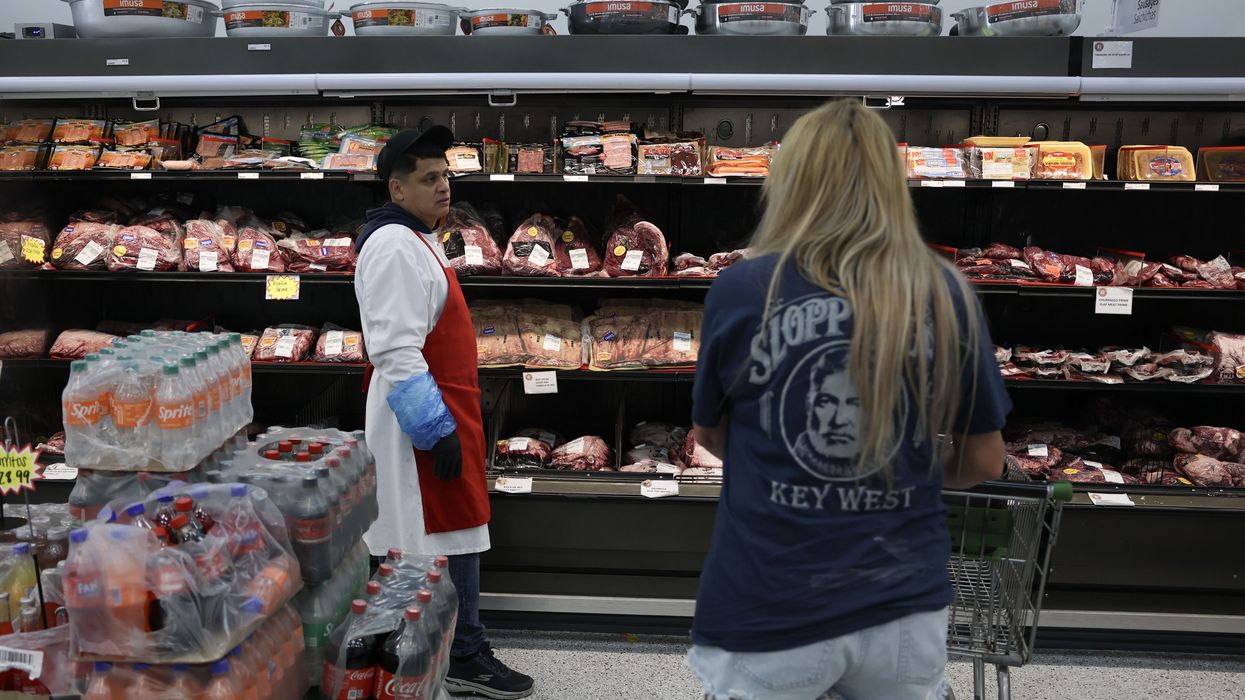
An analysis published Wednesday by the Center for Budget and Policy Priorities found that millions of low-income Americans have stopped participating in the Supplemental Nutrition Assistance Program ever since President Donald Trump signed the One Big Beautiful Bill Act into law last year.
According to CBPP's analysis, SNAP participation declined by 6% between July 2025 and December 2025, with 2.5 million fewer Americans receiving benefits.
CBPP estimated that millions more will be dropped from SNAP benefits in the coming months as states adjust their budgets to remain in compliance with the law.
"Starting in 2027, most states will have to pay between 5% and 15% of SNAP benefit costs, totaling hundreds of millions of dollars a year in many states," explained CBPP. "The magnitude of the cost shift... may incentivize states to take drastic measures to reduce their payment error rates quickly and cut program costs, even if it means delaying or improperly denying benefits to eligible people."
In total, concluded CBPP, "we estimate that 4 million people in a typical month will lose out" on SNAP benefits "once the changes are fully implemented."
CBPP published a separate analysis focusing specifically on Arizona, where SNAP participation has already fallen "far more than anticipated," while warning that other states could soon see similarly steep participation drops as they rush to comply with the law.
The GOP budget law contained roughly $186 billion in cuts to SNAP over the span of a decade, which came from expanding work requirements, shifting some of the cost of the program to the states, and restricting benefit increases. As a result, millions of Americans became vulnerable to losing their benefits.
Leor Tal, campaign director at Unrig Our Economy, pointed to CBPP's analysis as an example of the GOP waging class warfare on behalf of rich donors.
“SNAP is a lifeline for working Americans nationwide," Tal said. "Now, that lifeline is being ripped away from millions because Republicans in Congress decided that giving tax breaks to billionaires and waging war are more important than protecting food for families. No family should have to worry about putting food on the table, but congressional Republicans have made sure that millions will.”
"A foreign country that a majority of Americans now disapprove of gets $3.8 billion a year from them."
The bipartisan support Israel and its powerful lobby have enjoyed for decades in the US—with lawmakers from both parties insisting the federal government must help Israel "defend itself" with nearly $4 billion per year in military aid—is likely to shift considerably in the coming years as public support for the country continues to collapse, particularly among young voters, in the latest Pew Research poll.
The survey was taken last month as the US-Israeli war on Iran, which Israeli Prime Minister Benjamin Netanyahu reportedly pitched to President Donald Trump in an unusual Situation Room meeting in February, was escalating and spreading across the Middle East. It found that overall, 60% of US adults had an unfavorable view of Israel.
That share has grown considerably since 2022, before Israel began its US-backed war on the population of Gaza in retaliation for a Hamas-led attack. That year, just 42% in the US viewed Israel unfavorably.
Public opposition to the country's government has also gone up by seven percentage points since last year, according to Pew. The share of adults who describe themselves as having a "very unfavorable" view of Israel has gone up by 9% since 2025 and has nearly tripled since before Israel began waging war on Gaza.
Journalist Prem Thakker commented that it was "absurd" to continue providing a country that a sizable majority of Americans disapprove of with military funding.
Over the past two-and-a-half years—as US public support for Israel has steadily declined—that funding has helped Israel to kill more than 72,000 Palestinians; injure more than 172,000; displace more than 90% of Gaza's population; carry out nearly 800 attacks on the healthcare system, damaging 94% of hospitals; damage or destroy 97% of school buildings; and impose a mass starvation policy through a blockade on humanitarian aid. Israeli officials have publicly called for the killing of 50 Palestinians for every Israeli killed in the Hamas-led October 7, 2023 attacks, for Gaza to be burned to the ground, and for Israelis to "remember what Amalek has done to you," a reference to the Israelites' enemies in the Old Testament, whom King Saul was ordered to massacre.
All the while, Israeli officials and bipartisan US lawmakers who continue to support the Israeli government—and take donations from the American Israel Public Affairs Committee and other influential pro-Israel lobbying groups—have accused Americans who have spoken out against Israel's genocidal attacks on Gaza of being antisemitic.
In the poll released by Pew, the shift away from support for Israel is most pronounced among voters aged 18-49, with 70% of respondents in that age bracket reporting unfavorable views. Majorities of both Democrats (84%) and Republicans (57%) under 50 had unfavorable views. In 2025, just 50% of Republicans under 50 viewed Israel negatively, while 71% of young Democrats said the same—representing a 13-point jump in just a year among the latter group.
Americans' views on Netanyahu have also grown more negative, with 59% of respondents saying they did not trust the prime minister to do the right thing in terms of world affairs—up from 53% last year.
The poll was released as Israel continued its assault on Lebanon, which it began attacking in March after Hezbollah retaliated against Israeli forces for the US-Israeli killing of Iran's Ayatollah Ali Khamenei. Israeli officials claim the two-week ceasefire reached between the US, Israel, and Iran does not include Lebanon, despite statements from Pakistan, which helped broker the deal declaring otherwise.
Israel has killed more than 1,400 people in Lebanon in the last month, in addition to striking Iran along with the US in attacks that have killed more than 2,000 people.
The Pew survey was released days after a poll by the IMEU Policy Project and Data for Progress found that among Democratic primary voters in Texas, the US relationship with Israel was not seen as an abstract foreign policy issue, but one that significantly impacted how many chose between US Senate candidate James Talarico and his primary opponent, US Rep. Jasmine Crockett (D-Texas).
The poll found that Talarico gained a 4-to-1 advantage over Crockett when he spoke out against providing US weapons to Israel. Nearly 90% of respondents agreed with his stance, and 44% of his supporters said his position deeply influenced their vote.
"Democrats," said political operative Isi Baehr-Breen in response to the poll of Talarico supporters, "are gonna have to choose between Israel and winning elections."