SUBSCRIBE TO OUR FREE NEWSLETTER
Daily news & progressive opinion—funded by the people, not the corporations—delivered straight to your inbox.
5
#000000
#FFFFFF
To donate by check, phone, or other method, see our More Ways to Give page.
Daily news & progressive opinion—funded by the people, not the corporations—delivered straight to your inbox.
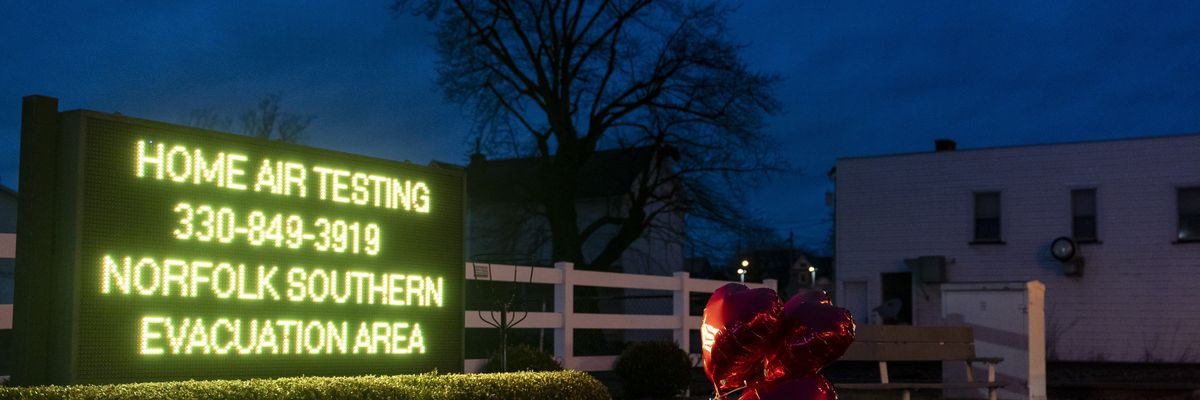
Balloons are placed next to a sign displaying information for residents to receive air-quality tests from Norfolk Southern Railway on February 16, 2023 in East Palestine, Ohio.
"Norfolk Southern must be in the midst of some bad publicity for it to sign an agreement with around 3,000 unionized maintenance-of-way workers for seven paid sick days," remarked one journalist.
Facing intense scrutiny and backlash over the toxic derailment of one of its trains in eastern Ohio, Norfolk Southern on Wednesday reached a deal with a leading rail union to provide up to a week of paid sick leave per year to around 3,000 track maintenance workers.
Under the agreement, Norfolk Southern will immediately give four workdays of paid sick leave annually to maintenance employees who previously had none, an industry-wide outrage that nearly led to a national rail strike late last year.
The deal will also allow employees to "utilize up to a maximum of three paid personal leave days per year as paid sick leave."
Tony Cardwell, president of the Brotherhood of Maintenance of Way Employes Division (BMWED), said in a statement that "after 45 years of fighting for this issue, the carrier and union have accomplished what is needed for those who contribute the most to railroad profits, the workers on the ballast line."
Speaking to Freight Waves, BMWED media representative Clark Ballew stressed that while the paid sick leave agreement is "a good development in an industry that is in dire need of positive momentum," it is "not the end" of workers' fight for basic quality-of-life benefits.
"Our members are tasked with rebuilding the track of the [East] Palestine derailment and it is imperative that they have resources available that keep them safe and healthy at a site that many would be apprehensive to work," Ballew said. "Paid sick time is one of those resources, but there are several others, and we expect NS to start doing right by their employees and the public and afford all resources necessary to not exacerbate an already bad situation."
Norfolk Southern, which has around 19,000 employees total, is the third Class 1 railroad in the past month to agree to provide paid sick leave to some of its workers after aggressively fighting unions' demands for years, including during recent White House-brokered negotiations that produced a contract with zero paid sick days.
Congress voted in December to impose the contract on workers after unions representing a majority of U.S. rail employees rejected it and threatened to strike.
The sick leave deal comes as Norfolk Southern is under mounting pressure after one of its trains crashed and spewed hazardous chemicals earlier this month in the small town of East Palestine, Ohio.
"Norfolk Southern must be in the midst of some bad publicity for it to sign an agreement with around 3,000 unionized maintenance-of-way workers for seven paid sick days," responded The American Prospect's David Dayen.
The East Palestine wreck, its toxic aftermath, and Norfolk Southern's handling of the clean-up process spurred a close examination of the company's efforts in recent years to kill safety rules that could have prevented or mitigated the impacts of the derailment. The company, along with other rail giants, has persistently lobbied both Republicans and Democrats, successfully beating back attempts to upgrade train braking systems and more strictly regulate freight cars carrying hazardous materials.
"Amid the lobbying blitz against stronger transportation safety regulations, Norfolk Southern paid executives millions and spent billions on stock buybacks—all while the company shed thousands of employees despite warnings that understaffing is intensifying safety risks," The Lever reported earlier this month. "Norfolk Southern officials also fought off a shareholder initiative that could have required company executives to 'assess, review, and mitigate risks of hazardous material transportation.'"
Dear Common Dreams reader, It’s been nearly 30 years since I co-founded Common Dreams with my late wife, Lina Newhouser. We had the radical notion that journalism should serve the public good, not corporate profits. It was clear to us from the outset what it would take to build such a project. No paid advertisements. No corporate sponsors. No millionaire publisher telling us what to think or do. Many people said we wouldn't last a year, but we proved those doubters wrong. Together with a tremendous team of journalists and dedicated staff, we built an independent media outlet free from the constraints of profits and corporate control. Our mission has always been simple: To inform. To inspire. To ignite change for the common good. Building Common Dreams was not easy. Our survival was never guaranteed. When you take on the most powerful forces—Wall Street greed, fossil fuel industry destruction, Big Tech lobbyists, and uber-rich oligarchs who have spent billions upon billions rigging the economy and democracy in their favor—the only bulwark you have is supporters who believe in your work. But here’s the urgent message from me today. It's never been this bad out there. And it's never been this hard to keep us going. At the very moment Common Dreams is most needed, the threats we face are intensifying. We need your support now more than ever. We don't accept corporate advertising and never will. We don't have a paywall because we don't think people should be blocked from critical news based on their ability to pay. Everything we do is funded by the donations of readers like you. When everyone does the little they can afford, we are strong. But if that support retreats or dries up, so do we. Will you donate now to make sure Common Dreams not only survives but thrives? —Craig Brown, Co-founder |
Facing intense scrutiny and backlash over the toxic derailment of one of its trains in eastern Ohio, Norfolk Southern on Wednesday reached a deal with a leading rail union to provide up to a week of paid sick leave per year to around 3,000 track maintenance workers.
Under the agreement, Norfolk Southern will immediately give four workdays of paid sick leave annually to maintenance employees who previously had none, an industry-wide outrage that nearly led to a national rail strike late last year.
The deal will also allow employees to "utilize up to a maximum of three paid personal leave days per year as paid sick leave."
Tony Cardwell, president of the Brotherhood of Maintenance of Way Employes Division (BMWED), said in a statement that "after 45 years of fighting for this issue, the carrier and union have accomplished what is needed for those who contribute the most to railroad profits, the workers on the ballast line."
Speaking to Freight Waves, BMWED media representative Clark Ballew stressed that while the paid sick leave agreement is "a good development in an industry that is in dire need of positive momentum," it is "not the end" of workers' fight for basic quality-of-life benefits.
"Our members are tasked with rebuilding the track of the [East] Palestine derailment and it is imperative that they have resources available that keep them safe and healthy at a site that many would be apprehensive to work," Ballew said. "Paid sick time is one of those resources, but there are several others, and we expect NS to start doing right by their employees and the public and afford all resources necessary to not exacerbate an already bad situation."
Norfolk Southern, which has around 19,000 employees total, is the third Class 1 railroad in the past month to agree to provide paid sick leave to some of its workers after aggressively fighting unions' demands for years, including during recent White House-brokered negotiations that produced a contract with zero paid sick days.
Congress voted in December to impose the contract on workers after unions representing a majority of U.S. rail employees rejected it and threatened to strike.
The sick leave deal comes as Norfolk Southern is under mounting pressure after one of its trains crashed and spewed hazardous chemicals earlier this month in the small town of East Palestine, Ohio.
"Norfolk Southern must be in the midst of some bad publicity for it to sign an agreement with around 3,000 unionized maintenance-of-way workers for seven paid sick days," responded The American Prospect's David Dayen.
The East Palestine wreck, its toxic aftermath, and Norfolk Southern's handling of the clean-up process spurred a close examination of the company's efforts in recent years to kill safety rules that could have prevented or mitigated the impacts of the derailment. The company, along with other rail giants, has persistently lobbied both Republicans and Democrats, successfully beating back attempts to upgrade train braking systems and more strictly regulate freight cars carrying hazardous materials.
"Amid the lobbying blitz against stronger transportation safety regulations, Norfolk Southern paid executives millions and spent billions on stock buybacks—all while the company shed thousands of employees despite warnings that understaffing is intensifying safety risks," The Lever reported earlier this month. "Norfolk Southern officials also fought off a shareholder initiative that could have required company executives to 'assess, review, and mitigate risks of hazardous material transportation.'"
Facing intense scrutiny and backlash over the toxic derailment of one of its trains in eastern Ohio, Norfolk Southern on Wednesday reached a deal with a leading rail union to provide up to a week of paid sick leave per year to around 3,000 track maintenance workers.
Under the agreement, Norfolk Southern will immediately give four workdays of paid sick leave annually to maintenance employees who previously had none, an industry-wide outrage that nearly led to a national rail strike late last year.
The deal will also allow employees to "utilize up to a maximum of three paid personal leave days per year as paid sick leave."
Tony Cardwell, president of the Brotherhood of Maintenance of Way Employes Division (BMWED), said in a statement that "after 45 years of fighting for this issue, the carrier and union have accomplished what is needed for those who contribute the most to railroad profits, the workers on the ballast line."
Speaking to Freight Waves, BMWED media representative Clark Ballew stressed that while the paid sick leave agreement is "a good development in an industry that is in dire need of positive momentum," it is "not the end" of workers' fight for basic quality-of-life benefits.
"Our members are tasked with rebuilding the track of the [East] Palestine derailment and it is imperative that they have resources available that keep them safe and healthy at a site that many would be apprehensive to work," Ballew said. "Paid sick time is one of those resources, but there are several others, and we expect NS to start doing right by their employees and the public and afford all resources necessary to not exacerbate an already bad situation."
Norfolk Southern, which has around 19,000 employees total, is the third Class 1 railroad in the past month to agree to provide paid sick leave to some of its workers after aggressively fighting unions' demands for years, including during recent White House-brokered negotiations that produced a contract with zero paid sick days.
Congress voted in December to impose the contract on workers after unions representing a majority of U.S. rail employees rejected it and threatened to strike.
The sick leave deal comes as Norfolk Southern is under mounting pressure after one of its trains crashed and spewed hazardous chemicals earlier this month in the small town of East Palestine, Ohio.
"Norfolk Southern must be in the midst of some bad publicity for it to sign an agreement with around 3,000 unionized maintenance-of-way workers for seven paid sick days," responded The American Prospect's David Dayen.
The East Palestine wreck, its toxic aftermath, and Norfolk Southern's handling of the clean-up process spurred a close examination of the company's efforts in recent years to kill safety rules that could have prevented or mitigated the impacts of the derailment. The company, along with other rail giants, has persistently lobbied both Republicans and Democrats, successfully beating back attempts to upgrade train braking systems and more strictly regulate freight cars carrying hazardous materials.
"Amid the lobbying blitz against stronger transportation safety regulations, Norfolk Southern paid executives millions and spent billions on stock buybacks—all while the company shed thousands of employees despite warnings that understaffing is intensifying safety risks," The Lever reported earlier this month. "Norfolk Southern officials also fought off a shareholder initiative that could have required company executives to 'assess, review, and mitigate risks of hazardous material transportation.'"