SUBSCRIBE TO OUR FREE NEWSLETTER
Daily news & progressive opinion—funded by the people, not the corporations—delivered straight to your inbox.
5
#000000
#FFFFFF
To donate by check, phone, or other method, see our More Ways to Give page.
Daily news & progressive opinion—funded by the people, not the corporations—delivered straight to your inbox.
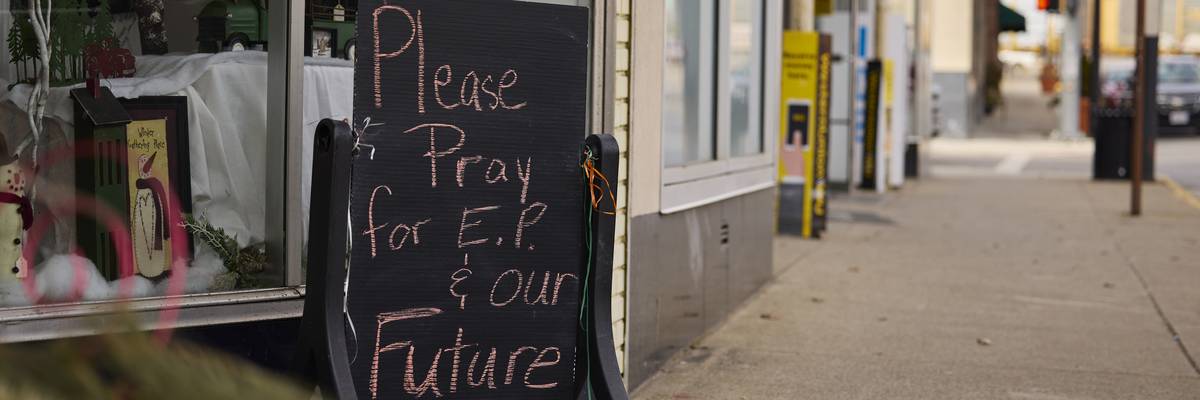
A handwritten sign is displayed outside a flower shop on February 14, 2023 in East Palestine, Ohio.
"Why are people getting sick if there's nothing in the air or the water?" asked one town hall attendee.
Anxious and angry residents of East Palestine, Ohio gathered for a town hall Wednesday night hoping to get answers about the potential health impacts of a massive train derailment and chemical spill that put their small village in the national spotlight.
But those who wanted to hear directly from the company at the center of the toxic disaster—Norfolk Southern—pulled out of the event hours before it began, expressing concerns about "the growing physical threat to our employees and members of the community... stemming from the increasing likelihood of the participation of outside parties."
News that company officials would be a no-show infuriated East Palestine residents who are worried about the health and safety of their families in the wake of the train crash—and the subsequent release of hazardous chemicals such as the carcinogen vinyl chloride into the atmosphere and waterways.
"We are all excited for this town hall meeting, and it is just a slap in the face because the people who put us out are too afraid to show up to the meeting," said Nate Velez, a resident whose family is currently staying in rentals outside of East Palestine, unsure whether it's safe to return to their home half a mile away from the site of the fiery derailment.
“Most people did not want to go home, but they had to," Velez said of those who evacuated following the crash. "So, all the people who had to go home were complaining of smells, pains in their throat, headaches, sickness. I have gone back a few times, and the smell does make you sick. It hurts your head."
In addition to foul odors in the air, residents have reported strange-smelling and discolored water as well as sick or dead animals—accounts that have intensified the Ohio community's sense of alarm and demands for transparency from local authorities and Norfolk Southern, which has fought off safety regulations that could have helped prevent the crash on the Ohio-Pennsylvania border.
The office of Mike DeWine, Ohio's Republican governor, said in a news release Wednesday that the state Environmental Protection Agency has not detected any "contaminants in raw water from the five wells that feed into East Palestine's municipal water system."
"With these tests results, Ohio EPA is confident that the municipal water is safe to drink," the governor's office insisted, a claim Norfolk Southern has echoed.
Additionally, the federal EPA has been monitoring the area's air and water and assisting with individual home screenings.
"The National Transportation Security Board has also been on site for over a week to lead the investigation into the cause of the derailment," White House press secretary Karine Jean-Pierre told reporters earlier this week. "And the EPA will continue to conduct 24/7 air quality monitoring throughout the East Palestine community in the days to come."
But residents weren't satisfied with assurances from their representatives and Norfolk Southern.
"Why are people getting sick if there's nothing in the air or the water?" one town hall attendee shouted Wednesday.
"Is it OK to still be here?" another asked. "Are my kids safe? Are the people safe? Is the future of this community safe? We all know the severity of that question. What's at stake?"
Others have openly questioned Norfolk Southern's commitment to the emergency response and recovery effort. Speaking to reporters at Wednesday's town hall, one resident dismissed Norfolk Southern's $1,000 payments to those impacted by the crash—so-called "inconvenience checks"—as "insulting."
Trent Conaway, East Palestine's mayor, directly addressed community members during Wednesday's town hall and pledged to do all he can to ensure that Norfolk Southern lives up to its promise of a safe and thorough clean-up—while acknowledging that's a difficult task for a small-town official.
"I'm a mayor of a town of 4,700 people," Conaway said. "You think I can fight against the railroad or fight against the EPA or fight against anything like that?"
Echoing his constituents' anger over Norfolk Southern's no-show Wednesday night, Conaway said, "They screwed up our town. They're going to fix it."
Norfolk Southern's handling of the disaster—which rail workers say was a predictable consequence of Wall Street-backed policy changes that have cut costs and undermined safety—has also drawn growing scrutiny from state and federal lawmakers.
Earlier this week, Pennsylvania Gov. Josh Shapiro sent a letter to Norfolk Southern CEO Alan Shaw raising "serious concerns" about the corporation's handling of the February 3 train derailment.
Specifically, Shapiro noted that soon after the crash, "Norfolk Southern personnel separated themselves from the rest of the incident management structure... to conduct separate operational and tactical planning, forcing state and local response agencies to react to tactics that were developed unilaterally and without the combined input of key state agencies."
Shapiro added that the company's "unwillingness to explore or articulate alternate courses of action to their proposed vent and burn [of toxic chemicals] limited state and local leaders' ability to respond effectively."
"Norfolk Southern failed to explore all potential courses of action, including some that may have kept the rail line closed longer but could have resulted in a safer overall approach for first responders, residents, and the environment," Shapiro wrote. "Norfolk Southern's well-known opposition to modernized regulations require further scrutiny and investigation to limit the devastating effects of future accidents."
"While regulation of the railroad industry is largely the purview of our federal partners," Shapiro continued, nodding toward U.S. Transportation Secretary Pete Buttigieg, "we plan to take direct action here in the Commonwealth of Pennsylvania."
Dear Common Dreams reader, It’s been nearly 30 years since I co-founded Common Dreams with my late wife, Lina Newhouser. We had the radical notion that journalism should serve the public good, not corporate profits. It was clear to us from the outset what it would take to build such a project. No paid advertisements. No corporate sponsors. No millionaire publisher telling us what to think or do. Many people said we wouldn't last a year, but we proved those doubters wrong. Together with a tremendous team of journalists and dedicated staff, we built an independent media outlet free from the constraints of profits and corporate control. Our mission has always been simple: To inform. To inspire. To ignite change for the common good. Building Common Dreams was not easy. Our survival was never guaranteed. When you take on the most powerful forces—Wall Street greed, fossil fuel industry destruction, Big Tech lobbyists, and uber-rich oligarchs who have spent billions upon billions rigging the economy and democracy in their favor—the only bulwark you have is supporters who believe in your work. But here’s the urgent message from me today. It's never been this bad out there. And it's never been this hard to keep us going. At the very moment Common Dreams is most needed, the threats we face are intensifying. We need your support now more than ever. We don't accept corporate advertising and never will. We don't have a paywall because we don't think people should be blocked from critical news based on their ability to pay. Everything we do is funded by the donations of readers like you. When everyone does the little they can afford, we are strong. But if that support retreats or dries up, so do we. Will you donate now to make sure Common Dreams not only survives but thrives? —Craig Brown, Co-founder |
Anxious and angry residents of East Palestine, Ohio gathered for a town hall Wednesday night hoping to get answers about the potential health impacts of a massive train derailment and chemical spill that put their small village in the national spotlight.
But those who wanted to hear directly from the company at the center of the toxic disaster—Norfolk Southern—pulled out of the event hours before it began, expressing concerns about "the growing physical threat to our employees and members of the community... stemming from the increasing likelihood of the participation of outside parties."
News that company officials would be a no-show infuriated East Palestine residents who are worried about the health and safety of their families in the wake of the train crash—and the subsequent release of hazardous chemicals such as the carcinogen vinyl chloride into the atmosphere and waterways.
"We are all excited for this town hall meeting, and it is just a slap in the face because the people who put us out are too afraid to show up to the meeting," said Nate Velez, a resident whose family is currently staying in rentals outside of East Palestine, unsure whether it's safe to return to their home half a mile away from the site of the fiery derailment.
“Most people did not want to go home, but they had to," Velez said of those who evacuated following the crash. "So, all the people who had to go home were complaining of smells, pains in their throat, headaches, sickness. I have gone back a few times, and the smell does make you sick. It hurts your head."
In addition to foul odors in the air, residents have reported strange-smelling and discolored water as well as sick or dead animals—accounts that have intensified the Ohio community's sense of alarm and demands for transparency from local authorities and Norfolk Southern, which has fought off safety regulations that could have helped prevent the crash on the Ohio-Pennsylvania border.
The office of Mike DeWine, Ohio's Republican governor, said in a news release Wednesday that the state Environmental Protection Agency has not detected any "contaminants in raw water from the five wells that feed into East Palestine's municipal water system."
"With these tests results, Ohio EPA is confident that the municipal water is safe to drink," the governor's office insisted, a claim Norfolk Southern has echoed.
Additionally, the federal EPA has been monitoring the area's air and water and assisting with individual home screenings.
"The National Transportation Security Board has also been on site for over a week to lead the investigation into the cause of the derailment," White House press secretary Karine Jean-Pierre told reporters earlier this week. "And the EPA will continue to conduct 24/7 air quality monitoring throughout the East Palestine community in the days to come."
But residents weren't satisfied with assurances from their representatives and Norfolk Southern.
"Why are people getting sick if there's nothing in the air or the water?" one town hall attendee shouted Wednesday.
"Is it OK to still be here?" another asked. "Are my kids safe? Are the people safe? Is the future of this community safe? We all know the severity of that question. What's at stake?"
Others have openly questioned Norfolk Southern's commitment to the emergency response and recovery effort. Speaking to reporters at Wednesday's town hall, one resident dismissed Norfolk Southern's $1,000 payments to those impacted by the crash—so-called "inconvenience checks"—as "insulting."
Trent Conaway, East Palestine's mayor, directly addressed community members during Wednesday's town hall and pledged to do all he can to ensure that Norfolk Southern lives up to its promise of a safe and thorough clean-up—while acknowledging that's a difficult task for a small-town official.
"I'm a mayor of a town of 4,700 people," Conaway said. "You think I can fight against the railroad or fight against the EPA or fight against anything like that?"
Echoing his constituents' anger over Norfolk Southern's no-show Wednesday night, Conaway said, "They screwed up our town. They're going to fix it."
Norfolk Southern's handling of the disaster—which rail workers say was a predictable consequence of Wall Street-backed policy changes that have cut costs and undermined safety—has also drawn growing scrutiny from state and federal lawmakers.
Earlier this week, Pennsylvania Gov. Josh Shapiro sent a letter to Norfolk Southern CEO Alan Shaw raising "serious concerns" about the corporation's handling of the February 3 train derailment.
Specifically, Shapiro noted that soon after the crash, "Norfolk Southern personnel separated themselves from the rest of the incident management structure... to conduct separate operational and tactical planning, forcing state and local response agencies to react to tactics that were developed unilaterally and without the combined input of key state agencies."
Shapiro added that the company's "unwillingness to explore or articulate alternate courses of action to their proposed vent and burn [of toxic chemicals] limited state and local leaders' ability to respond effectively."
"Norfolk Southern failed to explore all potential courses of action, including some that may have kept the rail line closed longer but could have resulted in a safer overall approach for first responders, residents, and the environment," Shapiro wrote. "Norfolk Southern's well-known opposition to modernized regulations require further scrutiny and investigation to limit the devastating effects of future accidents."
"While regulation of the railroad industry is largely the purview of our federal partners," Shapiro continued, nodding toward U.S. Transportation Secretary Pete Buttigieg, "we plan to take direct action here in the Commonwealth of Pennsylvania."
Anxious and angry residents of East Palestine, Ohio gathered for a town hall Wednesday night hoping to get answers about the potential health impacts of a massive train derailment and chemical spill that put their small village in the national spotlight.
But those who wanted to hear directly from the company at the center of the toxic disaster—Norfolk Southern—pulled out of the event hours before it began, expressing concerns about "the growing physical threat to our employees and members of the community... stemming from the increasing likelihood of the participation of outside parties."
News that company officials would be a no-show infuriated East Palestine residents who are worried about the health and safety of their families in the wake of the train crash—and the subsequent release of hazardous chemicals such as the carcinogen vinyl chloride into the atmosphere and waterways.
"We are all excited for this town hall meeting, and it is just a slap in the face because the people who put us out are too afraid to show up to the meeting," said Nate Velez, a resident whose family is currently staying in rentals outside of East Palestine, unsure whether it's safe to return to their home half a mile away from the site of the fiery derailment.
“Most people did not want to go home, but they had to," Velez said of those who evacuated following the crash. "So, all the people who had to go home were complaining of smells, pains in their throat, headaches, sickness. I have gone back a few times, and the smell does make you sick. It hurts your head."
In addition to foul odors in the air, residents have reported strange-smelling and discolored water as well as sick or dead animals—accounts that have intensified the Ohio community's sense of alarm and demands for transparency from local authorities and Norfolk Southern, which has fought off safety regulations that could have helped prevent the crash on the Ohio-Pennsylvania border.
The office of Mike DeWine, Ohio's Republican governor, said in a news release Wednesday that the state Environmental Protection Agency has not detected any "contaminants in raw water from the five wells that feed into East Palestine's municipal water system."
"With these tests results, Ohio EPA is confident that the municipal water is safe to drink," the governor's office insisted, a claim Norfolk Southern has echoed.
Additionally, the federal EPA has been monitoring the area's air and water and assisting with individual home screenings.
"The National Transportation Security Board has also been on site for over a week to lead the investigation into the cause of the derailment," White House press secretary Karine Jean-Pierre told reporters earlier this week. "And the EPA will continue to conduct 24/7 air quality monitoring throughout the East Palestine community in the days to come."
But residents weren't satisfied with assurances from their representatives and Norfolk Southern.
"Why are people getting sick if there's nothing in the air or the water?" one town hall attendee shouted Wednesday.
"Is it OK to still be here?" another asked. "Are my kids safe? Are the people safe? Is the future of this community safe? We all know the severity of that question. What's at stake?"
Others have openly questioned Norfolk Southern's commitment to the emergency response and recovery effort. Speaking to reporters at Wednesday's town hall, one resident dismissed Norfolk Southern's $1,000 payments to those impacted by the crash—so-called "inconvenience checks"—as "insulting."
Trent Conaway, East Palestine's mayor, directly addressed community members during Wednesday's town hall and pledged to do all he can to ensure that Norfolk Southern lives up to its promise of a safe and thorough clean-up—while acknowledging that's a difficult task for a small-town official.
"I'm a mayor of a town of 4,700 people," Conaway said. "You think I can fight against the railroad or fight against the EPA or fight against anything like that?"
Echoing his constituents' anger over Norfolk Southern's no-show Wednesday night, Conaway said, "They screwed up our town. They're going to fix it."
Norfolk Southern's handling of the disaster—which rail workers say was a predictable consequence of Wall Street-backed policy changes that have cut costs and undermined safety—has also drawn growing scrutiny from state and federal lawmakers.
Earlier this week, Pennsylvania Gov. Josh Shapiro sent a letter to Norfolk Southern CEO Alan Shaw raising "serious concerns" about the corporation's handling of the February 3 train derailment.
Specifically, Shapiro noted that soon after the crash, "Norfolk Southern personnel separated themselves from the rest of the incident management structure... to conduct separate operational and tactical planning, forcing state and local response agencies to react to tactics that were developed unilaterally and without the combined input of key state agencies."
Shapiro added that the company's "unwillingness to explore or articulate alternate courses of action to their proposed vent and burn [of toxic chemicals] limited state and local leaders' ability to respond effectively."
"Norfolk Southern failed to explore all potential courses of action, including some that may have kept the rail line closed longer but could have resulted in a safer overall approach for first responders, residents, and the environment," Shapiro wrote. "Norfolk Southern's well-known opposition to modernized regulations require further scrutiny and investigation to limit the devastating effects of future accidents."
"While regulation of the railroad industry is largely the purview of our federal partners," Shapiro continued, nodding toward U.S. Transportation Secretary Pete Buttigieg, "we plan to take direct action here in the Commonwealth of Pennsylvania."