

SUBSCRIBE TO OUR FREE NEWSLETTER
Daily news & progressive opinion—funded by the people, not the corporations—delivered straight to your inbox.
5
#000000
#FFFFFF
To donate by check, phone, or other method, see our More Ways to Give page.
Daily news & progressive opinion—funded by the people, not the corporations—delivered straight to your inbox.
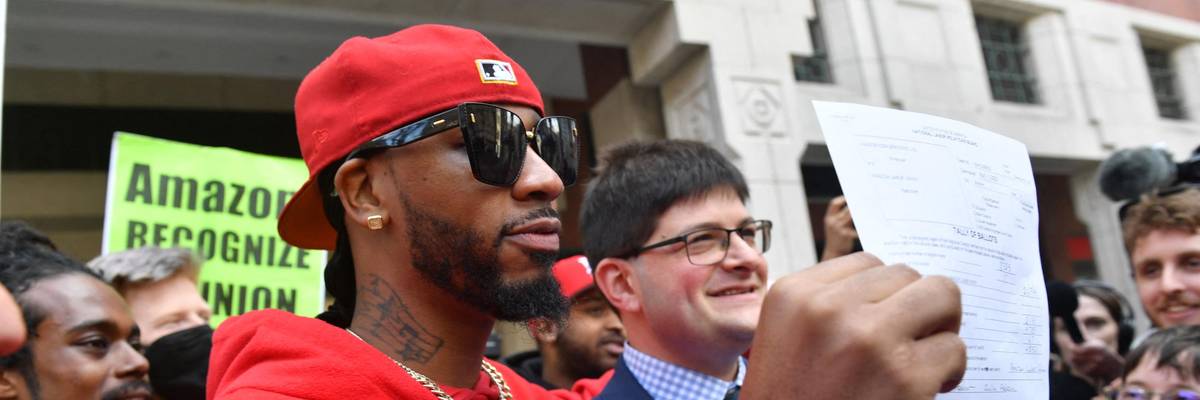
Union organizer Christian Smalls celebrates with Amazon workers following the vote to unionize a Staten Island, New York warehouse on April 1, 2022. (Photo: Andrea Renault/AFP via Getty Images)
Amazon warehouse workers in Staten Island, New York won their election Friday to form the retail giant's first-ever union in the United States, a landmark victory for the labor movement in the face of aggressive union-busting efforts from one of the world's most powerful companies.
According to an initial tally released by the National Labor Relations Board (NLRB), there were 2,654 votes in favor of recognizing a union and 2,131 against. The number of disputed ballots, 67, is not nearly enough to change the outcome.
The historic unionization drive at the JFK8 fulfillment center was spearheaded by the Amazon Labor Union (ALU), a worker-led group not affiliated with any established union. Christian Smalls, the president of ALU, was fired by Amazon in 2020 after he led a protest against the company's poor workplace safety standards in the early stages of the coronavirus pandemic.
"When Covid-19 came into play, Amazon failed us," Smalls said during a press conference after the union victory was announced. "We want to thank Jeff Bezos for going to space, because when he was up there, we were signing people up."
Long-time labor journalist Steven Greenhouse wrote Friday that "the unionization victory at the Amazon warehouse in Staten Island is by far the biggest, beating-the-odds, David-versus-Goliath unionization win I've seen."
"America's wealthiest, most powerful, most seemingly indispensable company has lost to a pop-up coalition of workers," Greenhouse added. "A generation, the younger generation, is stirring."
Amazon, which spent $4.3 million on anti-union consultants in 2021 alone, worked hard to crush the unionization effort, forcing employees to attend hundreds of captive-audience meetings and threatening workers with pay cuts and other potential consequences.
But the company's union-busting campaign wasn't enough to overcome the upstart revolt led by ALU, which was founded just months ago.
Derrick Palmer, a co-founder of ALU and an employee at the Staten Island warehouse, said he expects Friday's victory to be one of many. The election still must be certified by the NLRB.
"This will be the first union," said Palmer, "but moving forward, that will motivate other workers to get on board with us."
In a statement, Amazon said it is "disappointed" by the results and signaled it may file formal objections claiming "inappropriate and undue influence by the NLRB." Just last month, the NLRB sued Amazon in federal court, alleging the corporation unlawfully fired a Staten Island warehouse employee in retaliation for workplace organizing.
The board asked the court to force Amazon to fix its "flagrant unfair labor practices" ahead of the Staten Island union election. On Friday, Amazon pointed to a U.S. Chamber of Commerce blog post characterizing the NLRB's legal action as "curiously timed."
Widespread celebration followed the official announcement of the union's election win on Friday, with progressive lawmakers and activists hailing the victory as a potential watershed moment for the U.S. labor movement, which has struggled for decades amid corporate America's relentless assault. Union membership in the U.S. declined by 241,000 workers in 2021, according to Labor Department figures.
"The organizing victory at Amazon on Staten Island is a signal that American workers will no longer accept exploitation," Sen. Bernie Sanders (I-Vt.) tweeted Friday. "They're tired of working longer hours for lower wages. They want an economy that works for all, not just Jeff Bezos."
The union has much difficult work ahead. As HuffPost labor reporter Dave Jamieson noted, it must negotiate "a first collective bargaining agreement with one of the most powerful companies in the world."
"It can take years for a union to secure a first contract, and some never manage to," Jamieson wrote. "Amazon would have a strong incentive not to offer the union a decent deal, for fear it would only encourage more unionization elsewhere."
Correction: An earlier version of this article misstated a quote from Christian Smalls.
Dear Common Dreams reader, It’s been nearly 30 years since I co-founded Common Dreams with my late wife, Lina Newhouser. We had the radical notion that journalism should serve the public good, not corporate profits. It was clear to us from the outset what it would take to build such a project. No paid advertisements. No corporate sponsors. No millionaire publisher telling us what to think or do. Many people said we wouldn't last a year, but we proved those doubters wrong. Together with a tremendous team of journalists and dedicated staff, we built an independent media outlet free from the constraints of profits and corporate control. Our mission has always been simple: To inform. To inspire. To ignite change for the common good. Building Common Dreams was not easy. Our survival was never guaranteed. When you take on the most powerful forces—Wall Street greed, fossil fuel industry destruction, Big Tech lobbyists, and uber-rich oligarchs who have spent billions upon billions rigging the economy and democracy in their favor—the only bulwark you have is supporters who believe in your work. But here’s the urgent message from me today. It's never been this bad out there. And it's never been this hard to keep us going. At the very moment Common Dreams is most needed, the threats we face are intensifying. We need your support now more than ever. We don't accept corporate advertising and never will. We don't have a paywall because we don't think people should be blocked from critical news based on their ability to pay. Everything we do is funded by the donations of readers like you. When everyone does the little they can afford, we are strong. But if that support retreats or dries up, so do we. Will you donate now to make sure Common Dreams not only survives but thrives? —Craig Brown, Co-founder |
Amazon warehouse workers in Staten Island, New York won their election Friday to form the retail giant's first-ever union in the United States, a landmark victory for the labor movement in the face of aggressive union-busting efforts from one of the world's most powerful companies.
According to an initial tally released by the National Labor Relations Board (NLRB), there were 2,654 votes in favor of recognizing a union and 2,131 against. The number of disputed ballots, 67, is not nearly enough to change the outcome.
The historic unionization drive at the JFK8 fulfillment center was spearheaded by the Amazon Labor Union (ALU), a worker-led group not affiliated with any established union. Christian Smalls, the president of ALU, was fired by Amazon in 2020 after he led a protest against the company's poor workplace safety standards in the early stages of the coronavirus pandemic.
"When Covid-19 came into play, Amazon failed us," Smalls said during a press conference after the union victory was announced. "We want to thank Jeff Bezos for going to space, because when he was up there, we were signing people up."
Long-time labor journalist Steven Greenhouse wrote Friday that "the unionization victory at the Amazon warehouse in Staten Island is by far the biggest, beating-the-odds, David-versus-Goliath unionization win I've seen."
"America's wealthiest, most powerful, most seemingly indispensable company has lost to a pop-up coalition of workers," Greenhouse added. "A generation, the younger generation, is stirring."
Amazon, which spent $4.3 million on anti-union consultants in 2021 alone, worked hard to crush the unionization effort, forcing employees to attend hundreds of captive-audience meetings and threatening workers with pay cuts and other potential consequences.
But the company's union-busting campaign wasn't enough to overcome the upstart revolt led by ALU, which was founded just months ago.
Derrick Palmer, a co-founder of ALU and an employee at the Staten Island warehouse, said he expects Friday's victory to be one of many. The election still must be certified by the NLRB.
"This will be the first union," said Palmer, "but moving forward, that will motivate other workers to get on board with us."
In a statement, Amazon said it is "disappointed" by the results and signaled it may file formal objections claiming "inappropriate and undue influence by the NLRB." Just last month, the NLRB sued Amazon in federal court, alleging the corporation unlawfully fired a Staten Island warehouse employee in retaliation for workplace organizing.
The board asked the court to force Amazon to fix its "flagrant unfair labor practices" ahead of the Staten Island union election. On Friday, Amazon pointed to a U.S. Chamber of Commerce blog post characterizing the NLRB's legal action as "curiously timed."
Widespread celebration followed the official announcement of the union's election win on Friday, with progressive lawmakers and activists hailing the victory as a potential watershed moment for the U.S. labor movement, which has struggled for decades amid corporate America's relentless assault. Union membership in the U.S. declined by 241,000 workers in 2021, according to Labor Department figures.
"The organizing victory at Amazon on Staten Island is a signal that American workers will no longer accept exploitation," Sen. Bernie Sanders (I-Vt.) tweeted Friday. "They're tired of working longer hours for lower wages. They want an economy that works for all, not just Jeff Bezos."
The union has much difficult work ahead. As HuffPost labor reporter Dave Jamieson noted, it must negotiate "a first collective bargaining agreement with one of the most powerful companies in the world."
"It can take years for a union to secure a first contract, and some never manage to," Jamieson wrote. "Amazon would have a strong incentive not to offer the union a decent deal, for fear it would only encourage more unionization elsewhere."
Correction: An earlier version of this article misstated a quote from Christian Smalls.
Amazon warehouse workers in Staten Island, New York won their election Friday to form the retail giant's first-ever union in the United States, a landmark victory for the labor movement in the face of aggressive union-busting efforts from one of the world's most powerful companies.
According to an initial tally released by the National Labor Relations Board (NLRB), there were 2,654 votes in favor of recognizing a union and 2,131 against. The number of disputed ballots, 67, is not nearly enough to change the outcome.
The historic unionization drive at the JFK8 fulfillment center was spearheaded by the Amazon Labor Union (ALU), a worker-led group not affiliated with any established union. Christian Smalls, the president of ALU, was fired by Amazon in 2020 after he led a protest against the company's poor workplace safety standards in the early stages of the coronavirus pandemic.
"When Covid-19 came into play, Amazon failed us," Smalls said during a press conference after the union victory was announced. "We want to thank Jeff Bezos for going to space, because when he was up there, we were signing people up."
Long-time labor journalist Steven Greenhouse wrote Friday that "the unionization victory at the Amazon warehouse in Staten Island is by far the biggest, beating-the-odds, David-versus-Goliath unionization win I've seen."
"America's wealthiest, most powerful, most seemingly indispensable company has lost to a pop-up coalition of workers," Greenhouse added. "A generation, the younger generation, is stirring."
Amazon, which spent $4.3 million on anti-union consultants in 2021 alone, worked hard to crush the unionization effort, forcing employees to attend hundreds of captive-audience meetings and threatening workers with pay cuts and other potential consequences.
But the company's union-busting campaign wasn't enough to overcome the upstart revolt led by ALU, which was founded just months ago.
Derrick Palmer, a co-founder of ALU and an employee at the Staten Island warehouse, said he expects Friday's victory to be one of many. The election still must be certified by the NLRB.
"This will be the first union," said Palmer, "but moving forward, that will motivate other workers to get on board with us."
In a statement, Amazon said it is "disappointed" by the results and signaled it may file formal objections claiming "inappropriate and undue influence by the NLRB." Just last month, the NLRB sued Amazon in federal court, alleging the corporation unlawfully fired a Staten Island warehouse employee in retaliation for workplace organizing.
The board asked the court to force Amazon to fix its "flagrant unfair labor practices" ahead of the Staten Island union election. On Friday, Amazon pointed to a U.S. Chamber of Commerce blog post characterizing the NLRB's legal action as "curiously timed."
Widespread celebration followed the official announcement of the union's election win on Friday, with progressive lawmakers and activists hailing the victory as a potential watershed moment for the U.S. labor movement, which has struggled for decades amid corporate America's relentless assault. Union membership in the U.S. declined by 241,000 workers in 2021, according to Labor Department figures.
"The organizing victory at Amazon on Staten Island is a signal that American workers will no longer accept exploitation," Sen. Bernie Sanders (I-Vt.) tweeted Friday. "They're tired of working longer hours for lower wages. They want an economy that works for all, not just Jeff Bezos."
The union has much difficult work ahead. As HuffPost labor reporter Dave Jamieson noted, it must negotiate "a first collective bargaining agreement with one of the most powerful companies in the world."
"It can take years for a union to secure a first contract, and some never manage to," Jamieson wrote. "Amazon would have a strong incentive not to offer the union a decent deal, for fear it would only encourage more unionization elsewhere."
Correction: An earlier version of this article misstated a quote from Christian Smalls.

