SUBSCRIBE TO OUR FREE NEWSLETTER
Daily news & progressive opinion—funded by the people, not the corporations—delivered straight to your inbox.
5
#000000
#FFFFFF
To donate by check, phone, or other method, see our More Ways to Give page.

Three scientists on Tuesday were awarded the 2021 Nobel Prize in Physics for their "revolutionary contributions" to the world's understanding of the climate--and how human activity, such as the emission of carbon dioxide, impacts it.
"The discoveries being recognized this year demonstrate that our knowledge about the climate rests on a solid scientific foundation."
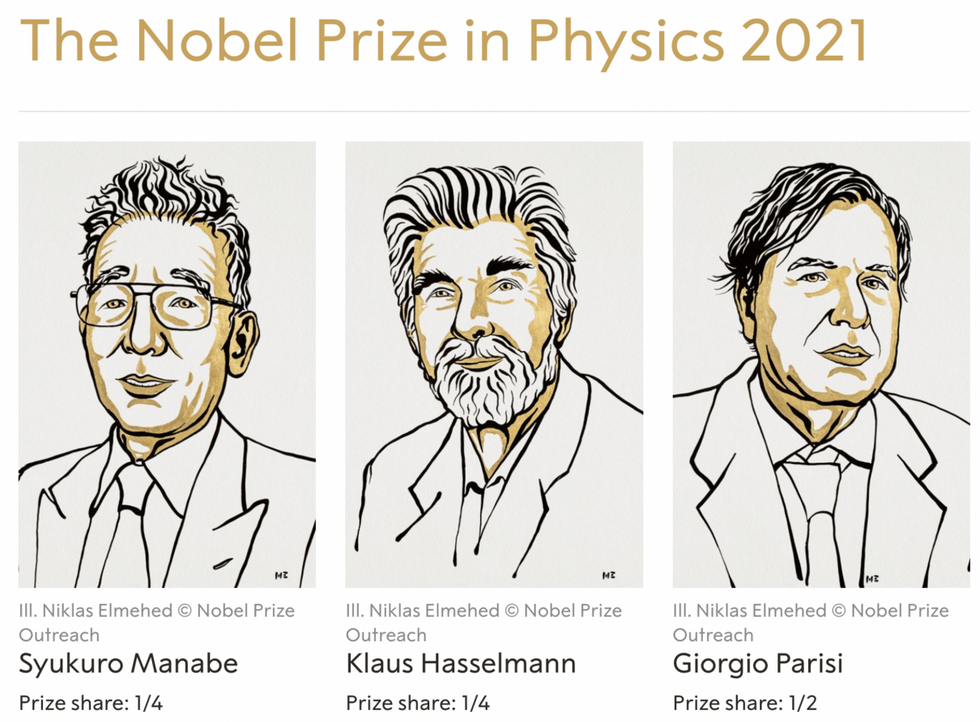
Syukuro Manabe of Princeton University and Klaus Hasselmann of the Max Planck Institute for Meteorology in Hamburg, Germany were jointly awarded half of the prize for their work on "the physical modeling of Earth's climate, quantifying variability, and reliably predicting global warming," the Royal Swedish Academy of Sciences said in a press release.
Giorgio Parisi, a theoretical physicist at the Sapienza University of Rome, was awarded the other half of the prize for "the discovery of the interplay of disorder and fluctuations in physical systems from atomic to planetary scales."
Thors Hans Hansson, chair of the Nobel Committee for Physics, said in a statement that "the discoveries being recognized this year demonstrate that our knowledge about the climate rests on a solid scientific foundation, based on a rigorous analysis of observations."
"This year's laureates have all contributed to us gaining deeper insight into the properties and evolution of complex physical systems," Hansson added.
The Royal Swedish Academy of Sciences, which awards the Nobel Prizes for physics and chemistry, summarized the three scientists' contributions:
Syukuro Manabe demonstrated how increased levels of carbon dioxide in the atmosphere lead to increased temperatures at the surface of the Earth. In the 1960s, he led the development of physical models of the Earth's climate and was the first person to explore the interaction between radiation balance and the vertical transport of air masses. His work laid the foundation for the development of current climate models.
About ten years later, Klaus Hasselmann created a model that links together weather and climate, thus answering the question of why climate models can be reliable despite weather being changeable and chaotic. He also developed methods for identifying specific signals, fingerprints, that both natural phenomena and human activities imprint in he climate. His methods have been used to prove that the increased temperature in the atmosphere is due to human emissions of carbon dioxide.
Around 1980, Giorgio Parisi discovered hidden patterns in disordered complex materials. His discoveries are among the most important contributions to the theory of complex systems. They make it possible to understand and describe many different and apparently entirely random materials and phenomena, not only in physics but also in other, very different areas, such as mathematics, biology, neuroscience, and machine learning.
Asked during a press conference Tuesday whether he has a message for world leaders ahead of the pivotal COP26 climate summit in Glasgow, Scotland later this month, Parisi said that "it is very urgent that we take a very strong decision and move at a very strong pace" to tackle the planetary crisis.
"It's clear that for the future generations," Parisi added, "we have to act now in a very fast way."
Three scientists on Tuesday were awarded the 2021 Nobel Prize in Physics for their "revolutionary contributions" to the world's understanding of the climate--and how human activity, such as the emission of carbon dioxide, impacts it.
"The discoveries being recognized this year demonstrate that our knowledge about the climate rests on a solid scientific foundation."
Syukuro Manabe of Princeton University and Klaus Hasselmann of the Max Planck Institute for Meteorology in Hamburg, Germany were jointly awarded half of the prize for their work on "the physical modeling of Earth's climate, quantifying variability, and reliably predicting global warming," the Royal Swedish Academy of Sciences said in a press release.
Giorgio Parisi, a theoretical physicist at the Sapienza University of Rome, was awarded the other half of the prize for "the discovery of the interplay of disorder and fluctuations in physical systems from atomic to planetary scales."
Thors Hans Hansson, chair of the Nobel Committee for Physics, said in a statement that "the discoveries being recognized this year demonstrate that our knowledge about the climate rests on a solid scientific foundation, based on a rigorous analysis of observations."
"This year's laureates have all contributed to us gaining deeper insight into the properties and evolution of complex physical systems," Hansson added.
The Royal Swedish Academy of Sciences, which awards the Nobel Prizes for physics and chemistry, summarized the three scientists' contributions:
Syukuro Manabe demonstrated how increased levels of carbon dioxide in the atmosphere lead to increased temperatures at the surface of the Earth. In the 1960s, he led the development of physical models of the Earth's climate and was the first person to explore the interaction between radiation balance and the vertical transport of air masses. His work laid the foundation for the development of current climate models.
About ten years later, Klaus Hasselmann created a model that links together weather and climate, thus answering the question of why climate models can be reliable despite weather being changeable and chaotic. He also developed methods for identifying specific signals, fingerprints, that both natural phenomena and human activities imprint in he climate. His methods have been used to prove that the increased temperature in the atmosphere is due to human emissions of carbon dioxide.
Around 1980, Giorgio Parisi discovered hidden patterns in disordered complex materials. His discoveries are among the most important contributions to the theory of complex systems. They make it possible to understand and describe many different and apparently entirely random materials and phenomena, not only in physics but also in other, very different areas, such as mathematics, biology, neuroscience, and machine learning.
Asked during a press conference Tuesday whether he has a message for world leaders ahead of the pivotal COP26 climate summit in Glasgow, Scotland later this month, Parisi said that "it is very urgent that we take a very strong decision and move at a very strong pace" to tackle the planetary crisis.
"It's clear that for the future generations," Parisi added, "we have to act now in a very fast way."
Three scientists on Tuesday were awarded the 2021 Nobel Prize in Physics for their "revolutionary contributions" to the world's understanding of the climate--and how human activity, such as the emission of carbon dioxide, impacts it.
"The discoveries being recognized this year demonstrate that our knowledge about the climate rests on a solid scientific foundation."
Syukuro Manabe of Princeton University and Klaus Hasselmann of the Max Planck Institute for Meteorology in Hamburg, Germany were jointly awarded half of the prize for their work on "the physical modeling of Earth's climate, quantifying variability, and reliably predicting global warming," the Royal Swedish Academy of Sciences said in a press release.
Giorgio Parisi, a theoretical physicist at the Sapienza University of Rome, was awarded the other half of the prize for "the discovery of the interplay of disorder and fluctuations in physical systems from atomic to planetary scales."
Thors Hans Hansson, chair of the Nobel Committee for Physics, said in a statement that "the discoveries being recognized this year demonstrate that our knowledge about the climate rests on a solid scientific foundation, based on a rigorous analysis of observations."
"This year's laureates have all contributed to us gaining deeper insight into the properties and evolution of complex physical systems," Hansson added.
The Royal Swedish Academy of Sciences, which awards the Nobel Prizes for physics and chemistry, summarized the three scientists' contributions:
Syukuro Manabe demonstrated how increased levels of carbon dioxide in the atmosphere lead to increased temperatures at the surface of the Earth. In the 1960s, he led the development of physical models of the Earth's climate and was the first person to explore the interaction between radiation balance and the vertical transport of air masses. His work laid the foundation for the development of current climate models.
About ten years later, Klaus Hasselmann created a model that links together weather and climate, thus answering the question of why climate models can be reliable despite weather being changeable and chaotic. He also developed methods for identifying specific signals, fingerprints, that both natural phenomena and human activities imprint in he climate. His methods have been used to prove that the increased temperature in the atmosphere is due to human emissions of carbon dioxide.
Around 1980, Giorgio Parisi discovered hidden patterns in disordered complex materials. His discoveries are among the most important contributions to the theory of complex systems. They make it possible to understand and describe many different and apparently entirely random materials and phenomena, not only in physics but also in other, very different areas, such as mathematics, biology, neuroscience, and machine learning.
Asked during a press conference Tuesday whether he has a message for world leaders ahead of the pivotal COP26 climate summit in Glasgow, Scotland later this month, Parisi said that "it is very urgent that we take a very strong decision and move at a very strong pace" to tackle the planetary crisis.
"It's clear that for the future generations," Parisi added, "we have to act now in a very fast way."