SUBSCRIBE TO OUR FREE NEWSLETTER
Daily news & progressive opinion—funded by the people, not the corporations—delivered straight to your inbox.
5
#000000
#FFFFFF
To donate by check, phone, or other method, see our More Ways to Give page.
Daily news & progressive opinion—funded by the people, not the corporations—delivered straight to your inbox.
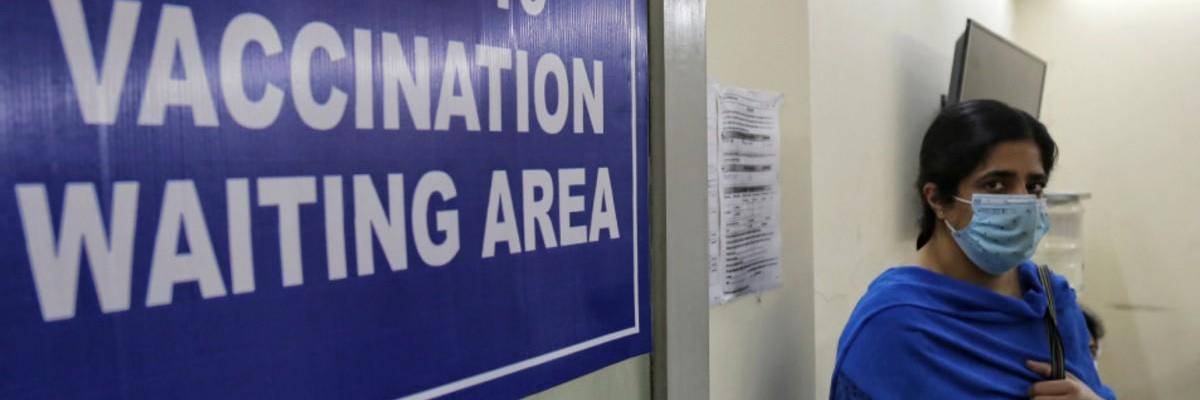
A woman waits during a Covid-19 vaccination drive on March 13, 2021 in New Delhi, India. (Photo: Sanchit Khanna/Hindustan Times via Getty Images)
More than a dozen Indian civil society organizations on Thursday implored U.S. President Joe Biden to use his authority to compel Johnson & Johnson to share its single-dose vaccine recipe with qualified manufacturers across the globe, a move the groups said would show he is "indeed serious about vaccinating the world."
"His administration has the moral, legal, and if necessary, financial power to lift intellectual property barriers and persuade J&J to license its vaccine, with technology and assistance included, to every manufacturer currently engaged in making the Sputnik-V vaccine," the 14 organizations wrote in a letter, referring to the inoculation produced by Russia.
"Even if a few companies... were put to work and given what they need, the world could have billions more J&J vaccine doses."
The groups argue that because the Sputnik-V and J&J shots are both adenovirus vaccines that rely on similar technology, the dozens of manufacturers around the world that are currently producing Russia's vaccine could pivot to making the J&J shot with relative ease and speed.
"Of those manufacturers, 34 are based outside Russia, in countries ranging from India to Argentina and South Korea," the letter notes. "Even if a few companies from this long list were put to work and given what they need, the world could have billions more J&J vaccine doses to use in the pandemic. And finally, if licensed as we suggest here, the J&J vaccine would be made at the licensee's cost, as manufacturers have done before with the Sputnik-V vaccine, thus solving both J&J's problems and the world's."
J&J, which is headquartered in New Jersey, has voluntarily licensed its vaccine technology to the Serum Institute of India and is currently in talks to license Aspen Pharmacare, the largest drug company in Africa.
Despite growing pressure from public health advocates and experts, the Biden administration has refused to take steps to force U.S.-based pharmaceutical giants to broadly share their vaccine recipes and technological know-how. The White House has preferred instead to focus largely on vaccine donations to low-income countries and bilateral licensing arrangements.
But critics have long argued that such deals are insufficient to meet global vaccine production and distribution needs, which remain dire as billions of people in low-income countries still lack access to shots. The global humanitarian group Doctors Without Borders warned in a recent report (pdf) that "voluntary licensing contains inherent limitations for its dependence on companies' willingness to set up the terms and conditions, and often come up with limiting factors."
"More than one year into the Covid-19 pandemic," the group added, "it is evident that relying on the willingness of multinational pharmaceutical companies does not guarantee supply diversity and global equity in access."
Achal Prabhala, an author on the new open letter and a coordinator at the India-based initiative AccessIBSA, told Nature that the "real barrier" preventing adequate vaccine production and equitable access is "an unwillingness on the part of Western pharmaceutical companies to relinquish control over their patents and technology, even at the cost of millions of lives."
The coalition of Indian civil society organizations warned that under a current agreement between J&J and the Indian firm Biological E, 600 million doses of the J&J vaccine "will likely be exported to the European Union and the United States, where more than 50% of adults have been fully vaccinated, instead of going to India, which has only vaccinated 13% of its population to date, or to the African continent, where the equivalent figure is 3%."
A similar contract arrangement between J&J and South Africa's Aspen Pharmacare sparked outrage last month. Just two weeks after the New York Times reported the details of the contract, South African officials announced that the deal had been suspended.
In their letter on Wednesday, the civil society organizations argued that Johnson & Johnson's "unwillingness to license other manufacturers around the world" is "both inexcusable and inexplicable."
"J&J must send these 600 million vaccines, some of which are ready, to where they are most needed and not where they can make the most money," the letter reads.
Dear Common Dreams reader, It’s been nearly 30 years since I co-founded Common Dreams with my late wife, Lina Newhouser. We had the radical notion that journalism should serve the public good, not corporate profits. It was clear to us from the outset what it would take to build such a project. No paid advertisements. No corporate sponsors. No millionaire publisher telling us what to think or do. Many people said we wouldn't last a year, but we proved those doubters wrong. Together with a tremendous team of journalists and dedicated staff, we built an independent media outlet free from the constraints of profits and corporate control. Our mission has always been simple: To inform. To inspire. To ignite change for the common good. Building Common Dreams was not easy. Our survival was never guaranteed. When you take on the most powerful forces—Wall Street greed, fossil fuel industry destruction, Big Tech lobbyists, and uber-rich oligarchs who have spent billions upon billions rigging the economy and democracy in their favor—the only bulwark you have is supporters who believe in your work. But here’s the urgent message from me today. It's never been this bad out there. And it's never been this hard to keep us going. At the very moment Common Dreams is most needed, the threats we face are intensifying. We need your support now more than ever. We don't accept corporate advertising and never will. We don't have a paywall because we don't think people should be blocked from critical news based on their ability to pay. Everything we do is funded by the donations of readers like you. When everyone does the little they can afford, we are strong. But if that support retreats or dries up, so do we. Will you donate now to make sure Common Dreams not only survives but thrives? —Craig Brown, Co-founder |
More than a dozen Indian civil society organizations on Thursday implored U.S. President Joe Biden to use his authority to compel Johnson & Johnson to share its single-dose vaccine recipe with qualified manufacturers across the globe, a move the groups said would show he is "indeed serious about vaccinating the world."
"His administration has the moral, legal, and if necessary, financial power to lift intellectual property barriers and persuade J&J to license its vaccine, with technology and assistance included, to every manufacturer currently engaged in making the Sputnik-V vaccine," the 14 organizations wrote in a letter, referring to the inoculation produced by Russia.
"Even if a few companies... were put to work and given what they need, the world could have billions more J&J vaccine doses."
The groups argue that because the Sputnik-V and J&J shots are both adenovirus vaccines that rely on similar technology, the dozens of manufacturers around the world that are currently producing Russia's vaccine could pivot to making the J&J shot with relative ease and speed.
"Of those manufacturers, 34 are based outside Russia, in countries ranging from India to Argentina and South Korea," the letter notes. "Even if a few companies from this long list were put to work and given what they need, the world could have billions more J&J vaccine doses to use in the pandemic. And finally, if licensed as we suggest here, the J&J vaccine would be made at the licensee's cost, as manufacturers have done before with the Sputnik-V vaccine, thus solving both J&J's problems and the world's."
J&J, which is headquartered in New Jersey, has voluntarily licensed its vaccine technology to the Serum Institute of India and is currently in talks to license Aspen Pharmacare, the largest drug company in Africa.
Despite growing pressure from public health advocates and experts, the Biden administration has refused to take steps to force U.S.-based pharmaceutical giants to broadly share their vaccine recipes and technological know-how. The White House has preferred instead to focus largely on vaccine donations to low-income countries and bilateral licensing arrangements.
But critics have long argued that such deals are insufficient to meet global vaccine production and distribution needs, which remain dire as billions of people in low-income countries still lack access to shots. The global humanitarian group Doctors Without Borders warned in a recent report (pdf) that "voluntary licensing contains inherent limitations for its dependence on companies' willingness to set up the terms and conditions, and often come up with limiting factors."
"More than one year into the Covid-19 pandemic," the group added, "it is evident that relying on the willingness of multinational pharmaceutical companies does not guarantee supply diversity and global equity in access."
Achal Prabhala, an author on the new open letter and a coordinator at the India-based initiative AccessIBSA, told Nature that the "real barrier" preventing adequate vaccine production and equitable access is "an unwillingness on the part of Western pharmaceutical companies to relinquish control over their patents and technology, even at the cost of millions of lives."
The coalition of Indian civil society organizations warned that under a current agreement between J&J and the Indian firm Biological E, 600 million doses of the J&J vaccine "will likely be exported to the European Union and the United States, where more than 50% of adults have been fully vaccinated, instead of going to India, which has only vaccinated 13% of its population to date, or to the African continent, where the equivalent figure is 3%."
A similar contract arrangement between J&J and South Africa's Aspen Pharmacare sparked outrage last month. Just two weeks after the New York Times reported the details of the contract, South African officials announced that the deal had been suspended.
In their letter on Wednesday, the civil society organizations argued that Johnson & Johnson's "unwillingness to license other manufacturers around the world" is "both inexcusable and inexplicable."
"J&J must send these 600 million vaccines, some of which are ready, to where they are most needed and not where they can make the most money," the letter reads.
More than a dozen Indian civil society organizations on Thursday implored U.S. President Joe Biden to use his authority to compel Johnson & Johnson to share its single-dose vaccine recipe with qualified manufacturers across the globe, a move the groups said would show he is "indeed serious about vaccinating the world."
"His administration has the moral, legal, and if necessary, financial power to lift intellectual property barriers and persuade J&J to license its vaccine, with technology and assistance included, to every manufacturer currently engaged in making the Sputnik-V vaccine," the 14 organizations wrote in a letter, referring to the inoculation produced by Russia.
"Even if a few companies... were put to work and given what they need, the world could have billions more J&J vaccine doses."
The groups argue that because the Sputnik-V and J&J shots are both adenovirus vaccines that rely on similar technology, the dozens of manufacturers around the world that are currently producing Russia's vaccine could pivot to making the J&J shot with relative ease and speed.
"Of those manufacturers, 34 are based outside Russia, in countries ranging from India to Argentina and South Korea," the letter notes. "Even if a few companies from this long list were put to work and given what they need, the world could have billions more J&J vaccine doses to use in the pandemic. And finally, if licensed as we suggest here, the J&J vaccine would be made at the licensee's cost, as manufacturers have done before with the Sputnik-V vaccine, thus solving both J&J's problems and the world's."
J&J, which is headquartered in New Jersey, has voluntarily licensed its vaccine technology to the Serum Institute of India and is currently in talks to license Aspen Pharmacare, the largest drug company in Africa.
Despite growing pressure from public health advocates and experts, the Biden administration has refused to take steps to force U.S.-based pharmaceutical giants to broadly share their vaccine recipes and technological know-how. The White House has preferred instead to focus largely on vaccine donations to low-income countries and bilateral licensing arrangements.
But critics have long argued that such deals are insufficient to meet global vaccine production and distribution needs, which remain dire as billions of people in low-income countries still lack access to shots. The global humanitarian group Doctors Without Borders warned in a recent report (pdf) that "voluntary licensing contains inherent limitations for its dependence on companies' willingness to set up the terms and conditions, and often come up with limiting factors."
"More than one year into the Covid-19 pandemic," the group added, "it is evident that relying on the willingness of multinational pharmaceutical companies does not guarantee supply diversity and global equity in access."
Achal Prabhala, an author on the new open letter and a coordinator at the India-based initiative AccessIBSA, told Nature that the "real barrier" preventing adequate vaccine production and equitable access is "an unwillingness on the part of Western pharmaceutical companies to relinquish control over their patents and technology, even at the cost of millions of lives."
The coalition of Indian civil society organizations warned that under a current agreement between J&J and the Indian firm Biological E, 600 million doses of the J&J vaccine "will likely be exported to the European Union and the United States, where more than 50% of adults have been fully vaccinated, instead of going to India, which has only vaccinated 13% of its population to date, or to the African continent, where the equivalent figure is 3%."
A similar contract arrangement between J&J and South Africa's Aspen Pharmacare sparked outrage last month. Just two weeks after the New York Times reported the details of the contract, South African officials announced that the deal had been suspended.
In their letter on Wednesday, the civil society organizations argued that Johnson & Johnson's "unwillingness to license other manufacturers around the world" is "both inexcusable and inexplicable."
"J&J must send these 600 million vaccines, some of which are ready, to where they are most needed and not where they can make the most money," the letter reads.