SUBSCRIBE TO OUR FREE NEWSLETTER
Daily news & progressive opinion—funded by the people, not the corporations—delivered straight to your inbox.
5
#000000
#FFFFFF
To donate by check, phone, or other method, see our More Ways to Give page.
Daily news & progressive opinion—funded by the people, not the corporations—delivered straight to your inbox.
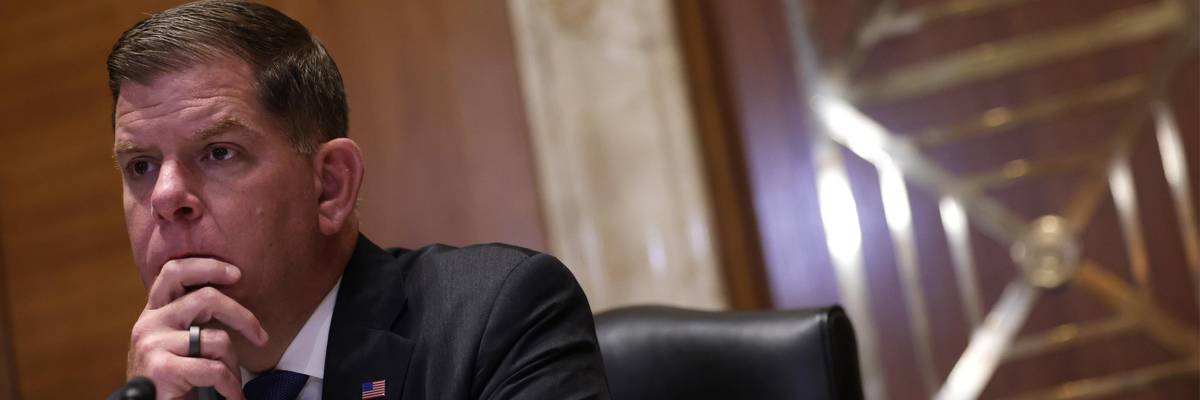
U.S. Secretary of Labor Marty Walsh testifies during a hearing at the Dirksen Senate Office Building on July 14, 2021 in Washington, D.C. (Photo: Alex Wong/Getty Images)
With nearly eight million people set to lose federal unemployment benefits in just over two weeks, the Biden administration on Thursday made clear that it supports allowing the pandemic-related jobless aid programs to expire, even as the highly transmissible Delta variant wreaks havoc across the United States.
In a letter to congressional leaders, Labor Secretary Marty Walsh and Treasury Secretary Janet Yellen acknowledged that the Delta mutation of the coronavirus may "pose short-term challenges to local economies and labor markets." Nevertheless, they argued it is "appropriate" for the $300-per-week federal unemployment insurance (UI) supplement to expire on September 6, which happens to be Labor Day.
"Cutting off benefits now is clearly premature and almost certainly counterproductive to the macroeconomic recovery."
--Matt Bruenig, People's Policy Project
"In addition, President [Joe] Biden believes that the conditions exist in many states such that the other emergency UI programs (the extended-length benefits and the coverage of individuals not otherwise within the scope of UI) can end on the date set in the American Rescue Plan," Walsh and Yellen wrote, adding that some struggling states could use previously approved federal aid to continue providing enhanced jobless benefits beyond September 6.
If nothing is done to extend the emergency UI programs, roughly 7.5 million unemployed workers will completely lose the federal benefits on Labor Day, according to a recent analysis by The Century Foundation (TCF). That would represent "the largest cutoff of unemployment benefits" in U.S. history, TCF's Andrew Stettner warned earlier this month.
"Ending UI benefits while the pandemic still rages is cruel, period," Unemployed Action, a project of the Center for Popular Democracy, tweeted Thursday.
Twenty-six U.S. states--each led by Republican governors except Louisiana--have already cut off the emergency federal UI benefits for their residents, prematurely depriving millions of jobless workers of crucial aid as the economy remains a long way from full recovery. The Biden administration refused to intervene to prevent the states from cutting off the extra $300 per week in UI aid, even though a pandemic relief law enacted last year explicitly requires the federal government to continue distributing the benefits.
While state leaders justified their actions with the widely disputed claim that federal UI benefits were constraining hiring, research published Friday indicates that ending the aid early did not result in a hiring boom--but it did cause a major income decline among affected workers.
According to a new paper (pdf) authored by six academics, "ending pandemic UI increased employment by 4.4 percentage points while reducing UI recipiency by 35 percentage points among workers who were unemployed and receiving UI at the end of April 2021."
"Through the first week of August, average UI benefits for these workers fell by $278 per week and earnings rose by $14 per week, offsetting only 5% of the loss in income," the researchers found. "Spending fell by $145 per week, as the loss of benefits led to a large immediate decline in consumption."
Arindrajit Dube, a professor of economics at the University of Massachusetts Amherst and one of the paper's authors, noted on Twitter that for every eight people who lost UI benefits in states that slashed the aid early, just one found a job by August.
Additionally, the new paper warns that allowing the federal unemployment aid to expire nationally could result in "$8 billion in reduced spending during September and October," potentially hampering the economic recovery.
"The spending losses are likely to continue further as additional workers take time to enter the workforce," the researchers note.
Pointing to the new paper, Matt Bruenig of the People's Policy Project argued Friday that Congress must act "to avoid needless economic devastation that dramatically cuts income and consumer spending while having virtually no impact on employment."
In their letter on Thursday, Walsh and Yellen wrote that Biden "believes that the pandemic has exposed serious problems in our UI system that require immediate reform."
"Accordingly, he is calling on Congress to take up the issue of long-term UI reform as part of the reconciliation process, when Congress returns from recess," the pair added.
Thus far, however, there is little indication that Democratic members of Congress plan to include any kind of federal unemployment insurance extension or fix in their sprawling $3.5 trillion budget reconciliation package. Sen. Joe Manchin (D-W.Va.), a key swing vote, said earlier this month that he would oppose any extension of the emergency federal UI benefits.
In his blog post on Friday, Bruenig noted that "at the start of the pandemic, 152.5 million people were employed. That number is currently 146.8 million people."
"If employment continues to increase at around 900,000 per month, the gap between current employment and pre-pandemic employment will be closed in six months," Bruenig wrote. "Cutting off benefits now is clearly premature and almost certainly counterproductive to the macroeconomic recovery."
Dear Common Dreams reader, It’s been nearly 30 years since I co-founded Common Dreams with my late wife, Lina Newhouser. We had the radical notion that journalism should serve the public good, not corporate profits. It was clear to us from the outset what it would take to build such a project. No paid advertisements. No corporate sponsors. No millionaire publisher telling us what to think or do. Many people said we wouldn't last a year, but we proved those doubters wrong. Together with a tremendous team of journalists and dedicated staff, we built an independent media outlet free from the constraints of profits and corporate control. Our mission has always been simple: To inform. To inspire. To ignite change for the common good. Building Common Dreams was not easy. Our survival was never guaranteed. When you take on the most powerful forces—Wall Street greed, fossil fuel industry destruction, Big Tech lobbyists, and uber-rich oligarchs who have spent billions upon billions rigging the economy and democracy in their favor—the only bulwark you have is supporters who believe in your work. But here’s the urgent message from me today. It's never been this bad out there. And it's never been this hard to keep us going. At the very moment Common Dreams is most needed, the threats we face are intensifying. We need your support now more than ever. We don't accept corporate advertising and never will. We don't have a paywall because we don't think people should be blocked from critical news based on their ability to pay. Everything we do is funded by the donations of readers like you. When everyone does the little they can afford, we are strong. But if that support retreats or dries up, so do we. Will you donate now to make sure Common Dreams not only survives but thrives? —Craig Brown, Co-founder |
With nearly eight million people set to lose federal unemployment benefits in just over two weeks, the Biden administration on Thursday made clear that it supports allowing the pandemic-related jobless aid programs to expire, even as the highly transmissible Delta variant wreaks havoc across the United States.
In a letter to congressional leaders, Labor Secretary Marty Walsh and Treasury Secretary Janet Yellen acknowledged that the Delta mutation of the coronavirus may "pose short-term challenges to local economies and labor markets." Nevertheless, they argued it is "appropriate" for the $300-per-week federal unemployment insurance (UI) supplement to expire on September 6, which happens to be Labor Day.
"Cutting off benefits now is clearly premature and almost certainly counterproductive to the macroeconomic recovery."
--Matt Bruenig, People's Policy Project
"In addition, President [Joe] Biden believes that the conditions exist in many states such that the other emergency UI programs (the extended-length benefits and the coverage of individuals not otherwise within the scope of UI) can end on the date set in the American Rescue Plan," Walsh and Yellen wrote, adding that some struggling states could use previously approved federal aid to continue providing enhanced jobless benefits beyond September 6.
If nothing is done to extend the emergency UI programs, roughly 7.5 million unemployed workers will completely lose the federal benefits on Labor Day, according to a recent analysis by The Century Foundation (TCF). That would represent "the largest cutoff of unemployment benefits" in U.S. history, TCF's Andrew Stettner warned earlier this month.
"Ending UI benefits while the pandemic still rages is cruel, period," Unemployed Action, a project of the Center for Popular Democracy, tweeted Thursday.
Twenty-six U.S. states--each led by Republican governors except Louisiana--have already cut off the emergency federal UI benefits for their residents, prematurely depriving millions of jobless workers of crucial aid as the economy remains a long way from full recovery. The Biden administration refused to intervene to prevent the states from cutting off the extra $300 per week in UI aid, even though a pandemic relief law enacted last year explicitly requires the federal government to continue distributing the benefits.
While state leaders justified their actions with the widely disputed claim that federal UI benefits were constraining hiring, research published Friday indicates that ending the aid early did not result in a hiring boom--but it did cause a major income decline among affected workers.
According to a new paper (pdf) authored by six academics, "ending pandemic UI increased employment by 4.4 percentage points while reducing UI recipiency by 35 percentage points among workers who were unemployed and receiving UI at the end of April 2021."
"Through the first week of August, average UI benefits for these workers fell by $278 per week and earnings rose by $14 per week, offsetting only 5% of the loss in income," the researchers found. "Spending fell by $145 per week, as the loss of benefits led to a large immediate decline in consumption."
Arindrajit Dube, a professor of economics at the University of Massachusetts Amherst and one of the paper's authors, noted on Twitter that for every eight people who lost UI benefits in states that slashed the aid early, just one found a job by August.
Additionally, the new paper warns that allowing the federal unemployment aid to expire nationally could result in "$8 billion in reduced spending during September and October," potentially hampering the economic recovery.
"The spending losses are likely to continue further as additional workers take time to enter the workforce," the researchers note.
Pointing to the new paper, Matt Bruenig of the People's Policy Project argued Friday that Congress must act "to avoid needless economic devastation that dramatically cuts income and consumer spending while having virtually no impact on employment."
In their letter on Thursday, Walsh and Yellen wrote that Biden "believes that the pandemic has exposed serious problems in our UI system that require immediate reform."
"Accordingly, he is calling on Congress to take up the issue of long-term UI reform as part of the reconciliation process, when Congress returns from recess," the pair added.
Thus far, however, there is little indication that Democratic members of Congress plan to include any kind of federal unemployment insurance extension or fix in their sprawling $3.5 trillion budget reconciliation package. Sen. Joe Manchin (D-W.Va.), a key swing vote, said earlier this month that he would oppose any extension of the emergency federal UI benefits.
In his blog post on Friday, Bruenig noted that "at the start of the pandemic, 152.5 million people were employed. That number is currently 146.8 million people."
"If employment continues to increase at around 900,000 per month, the gap between current employment and pre-pandemic employment will be closed in six months," Bruenig wrote. "Cutting off benefits now is clearly premature and almost certainly counterproductive to the macroeconomic recovery."
With nearly eight million people set to lose federal unemployment benefits in just over two weeks, the Biden administration on Thursday made clear that it supports allowing the pandemic-related jobless aid programs to expire, even as the highly transmissible Delta variant wreaks havoc across the United States.
In a letter to congressional leaders, Labor Secretary Marty Walsh and Treasury Secretary Janet Yellen acknowledged that the Delta mutation of the coronavirus may "pose short-term challenges to local economies and labor markets." Nevertheless, they argued it is "appropriate" for the $300-per-week federal unemployment insurance (UI) supplement to expire on September 6, which happens to be Labor Day.
"Cutting off benefits now is clearly premature and almost certainly counterproductive to the macroeconomic recovery."
--Matt Bruenig, People's Policy Project
"In addition, President [Joe] Biden believes that the conditions exist in many states such that the other emergency UI programs (the extended-length benefits and the coverage of individuals not otherwise within the scope of UI) can end on the date set in the American Rescue Plan," Walsh and Yellen wrote, adding that some struggling states could use previously approved federal aid to continue providing enhanced jobless benefits beyond September 6.
If nothing is done to extend the emergency UI programs, roughly 7.5 million unemployed workers will completely lose the federal benefits on Labor Day, according to a recent analysis by The Century Foundation (TCF). That would represent "the largest cutoff of unemployment benefits" in U.S. history, TCF's Andrew Stettner warned earlier this month.
"Ending UI benefits while the pandemic still rages is cruel, period," Unemployed Action, a project of the Center for Popular Democracy, tweeted Thursday.
Twenty-six U.S. states--each led by Republican governors except Louisiana--have already cut off the emergency federal UI benefits for their residents, prematurely depriving millions of jobless workers of crucial aid as the economy remains a long way from full recovery. The Biden administration refused to intervene to prevent the states from cutting off the extra $300 per week in UI aid, even though a pandemic relief law enacted last year explicitly requires the federal government to continue distributing the benefits.
While state leaders justified their actions with the widely disputed claim that federal UI benefits were constraining hiring, research published Friday indicates that ending the aid early did not result in a hiring boom--but it did cause a major income decline among affected workers.
According to a new paper (pdf) authored by six academics, "ending pandemic UI increased employment by 4.4 percentage points while reducing UI recipiency by 35 percentage points among workers who were unemployed and receiving UI at the end of April 2021."
"Through the first week of August, average UI benefits for these workers fell by $278 per week and earnings rose by $14 per week, offsetting only 5% of the loss in income," the researchers found. "Spending fell by $145 per week, as the loss of benefits led to a large immediate decline in consumption."
Arindrajit Dube, a professor of economics at the University of Massachusetts Amherst and one of the paper's authors, noted on Twitter that for every eight people who lost UI benefits in states that slashed the aid early, just one found a job by August.
Additionally, the new paper warns that allowing the federal unemployment aid to expire nationally could result in "$8 billion in reduced spending during September and October," potentially hampering the economic recovery.
"The spending losses are likely to continue further as additional workers take time to enter the workforce," the researchers note.
Pointing to the new paper, Matt Bruenig of the People's Policy Project argued Friday that Congress must act "to avoid needless economic devastation that dramatically cuts income and consumer spending while having virtually no impact on employment."
In their letter on Thursday, Walsh and Yellen wrote that Biden "believes that the pandemic has exposed serious problems in our UI system that require immediate reform."
"Accordingly, he is calling on Congress to take up the issue of long-term UI reform as part of the reconciliation process, when Congress returns from recess," the pair added.
Thus far, however, there is little indication that Democratic members of Congress plan to include any kind of federal unemployment insurance extension or fix in their sprawling $3.5 trillion budget reconciliation package. Sen. Joe Manchin (D-W.Va.), a key swing vote, said earlier this month that he would oppose any extension of the emergency federal UI benefits.
In his blog post on Friday, Bruenig noted that "at the start of the pandemic, 152.5 million people were employed. That number is currently 146.8 million people."
"If employment continues to increase at around 900,000 per month, the gap between current employment and pre-pandemic employment will be closed in six months," Bruenig wrote. "Cutting off benefits now is clearly premature and almost certainly counterproductive to the macroeconomic recovery."