SUBSCRIBE TO OUR FREE NEWSLETTER
Daily news & progressive opinion—funded by the people, not the corporations—delivered straight to your inbox.
5
#000000
#FFFFFF
To donate by check, phone, or other method, see our More Ways to Give page.
Daily news & progressive opinion—funded by the people, not the corporations—delivered straight to your inbox.
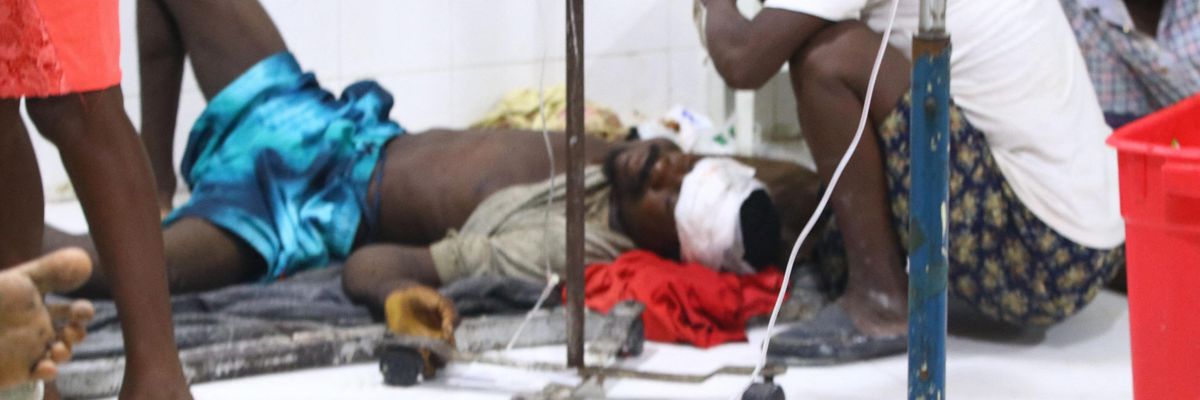
Earthquake victims lie on the ground at the Cayes General Hospital on August 14, 2021 in Les Cayes, southwest Haiti. Rescue workers scrambled to find survivors after a powerful 7.2-magnitude earthquake struck Haiti early Saturday, killing hundreds and toppling buildings in the disaster-plagued Caribbean nation still recovering from a devastating 2010 quake. (Photo: Stanley Louis / AFP via Getty Images)
More than 700 people were confirmed dead Sunday and many thousands more injured and left homeless due to the large earthquake which struck Haiti on Saturday.
The Haitian government has declared a state of emergency following the 7.2 quake and the Office of Civil Protection put the official death toll Sunday afternoon at 724 individuals with approximately 2,800 injured--though both numbers are almost certain to rise.
According to the Guardian:
Aftershocks were felt throughout the day and through the night. Many people left homeless or frightened that their fractured homes would collapse stayed in the streets to sleep - if their nerves allowed.
In the badly damaged coastal town of Les Cayes, some families salvaged their few belongings and spent the night at an open-air football pitch. On Sunday morning, people lined up to buy what little was available: bananas, avocados and water at a local street market.
The prime minister, Ariel Henry, said he was rushing aid to areas where towns were destroyed and hospitals overwhelmed with patients.
As the search for survivors continued on Sunday, fears grew that Tropical Storm Grace--currently on a path towards Haiti--could hamper rescue and recovery efforts in the coming days.
Prime Minister Ariel Henry, recently appointed following last month's assassination of President Jovenel Moise, has ordered an assessment of the damage but said he will not be requesting official international assistance until the full scope of the disaster is understood.
"When it comes to medical needs, this is our biggest urgency," Henry said Sunday. "We have started to send medications and medical personnel to the facilities that are affected. For the people who need urgent special care, we have evacuated a certain number of them, and we will evacuate some more today and tomorrow."
Amid the devastation, many expressed caution over any misguided foreign interventions and interference--notably from the U.S., which has a long history of putting its own strategic interests above those of the Haitian people.
And as the Washington Post noted in its reporting:
As foreign charities, nongovernmental organizations and volunteer groups dispatched people, supplies and equipment to Haiti, Haitan authorities reiterated their insistence that all aid be channeled and cleared through them. Edmond said the government wants to avoid a repeat of massive amounts spent--and misspent--in Haiti after the 2010 earthquake.
Speaking to reporters in the capital of Port-au-Prince, Prime Minister said, "All aid must be coordinated through the Civil Protection to prevent the errors of 2010."
Dear Common Dreams reader, It’s been nearly 30 years since I co-founded Common Dreams with my late wife, Lina Newhouser. We had the radical notion that journalism should serve the public good, not corporate profits. It was clear to us from the outset what it would take to build such a project. No paid advertisements. No corporate sponsors. No millionaire publisher telling us what to think or do. Many people said we wouldn't last a year, but we proved those doubters wrong. Together with a tremendous team of journalists and dedicated staff, we built an independent media outlet free from the constraints of profits and corporate control. Our mission has always been simple: To inform. To inspire. To ignite change for the common good. Building Common Dreams was not easy. Our survival was never guaranteed. When you take on the most powerful forces—Wall Street greed, fossil fuel industry destruction, Big Tech lobbyists, and uber-rich oligarchs who have spent billions upon billions rigging the economy and democracy in their favor—the only bulwark you have is supporters who believe in your work. But here’s the urgent message from me today. It's never been this bad out there. And it's never been this hard to keep us going. At the very moment Common Dreams is most needed, the threats we face are intensifying. We need your support now more than ever. We don't accept corporate advertising and never will. We don't have a paywall because we don't think people should be blocked from critical news based on their ability to pay. Everything we do is funded by the donations of readers like you. When everyone does the little they can afford, we are strong. But if that support retreats or dries up, so do we. Will you donate now to make sure Common Dreams not only survives but thrives? —Craig Brown, Co-founder |
More than 700 people were confirmed dead Sunday and many thousands more injured and left homeless due to the large earthquake which struck Haiti on Saturday.
The Haitian government has declared a state of emergency following the 7.2 quake and the Office of Civil Protection put the official death toll Sunday afternoon at 724 individuals with approximately 2,800 injured--though both numbers are almost certain to rise.
According to the Guardian:
Aftershocks were felt throughout the day and through the night. Many people left homeless or frightened that their fractured homes would collapse stayed in the streets to sleep - if their nerves allowed.
In the badly damaged coastal town of Les Cayes, some families salvaged their few belongings and spent the night at an open-air football pitch. On Sunday morning, people lined up to buy what little was available: bananas, avocados and water at a local street market.
The prime minister, Ariel Henry, said he was rushing aid to areas where towns were destroyed and hospitals overwhelmed with patients.
As the search for survivors continued on Sunday, fears grew that Tropical Storm Grace--currently on a path towards Haiti--could hamper rescue and recovery efforts in the coming days.
Prime Minister Ariel Henry, recently appointed following last month's assassination of President Jovenel Moise, has ordered an assessment of the damage but said he will not be requesting official international assistance until the full scope of the disaster is understood.
"When it comes to medical needs, this is our biggest urgency," Henry said Sunday. "We have started to send medications and medical personnel to the facilities that are affected. For the people who need urgent special care, we have evacuated a certain number of them, and we will evacuate some more today and tomorrow."
Amid the devastation, many expressed caution over any misguided foreign interventions and interference--notably from the U.S., which has a long history of putting its own strategic interests above those of the Haitian people.
And as the Washington Post noted in its reporting:
As foreign charities, nongovernmental organizations and volunteer groups dispatched people, supplies and equipment to Haiti, Haitan authorities reiterated their insistence that all aid be channeled and cleared through them. Edmond said the government wants to avoid a repeat of massive amounts spent--and misspent--in Haiti after the 2010 earthquake.
Speaking to reporters in the capital of Port-au-Prince, Prime Minister said, "All aid must be coordinated through the Civil Protection to prevent the errors of 2010."
More than 700 people were confirmed dead Sunday and many thousands more injured and left homeless due to the large earthquake which struck Haiti on Saturday.
The Haitian government has declared a state of emergency following the 7.2 quake and the Office of Civil Protection put the official death toll Sunday afternoon at 724 individuals with approximately 2,800 injured--though both numbers are almost certain to rise.
According to the Guardian:
Aftershocks were felt throughout the day and through the night. Many people left homeless or frightened that their fractured homes would collapse stayed in the streets to sleep - if their nerves allowed.
In the badly damaged coastal town of Les Cayes, some families salvaged their few belongings and spent the night at an open-air football pitch. On Sunday morning, people lined up to buy what little was available: bananas, avocados and water at a local street market.
The prime minister, Ariel Henry, said he was rushing aid to areas where towns were destroyed and hospitals overwhelmed with patients.
As the search for survivors continued on Sunday, fears grew that Tropical Storm Grace--currently on a path towards Haiti--could hamper rescue and recovery efforts in the coming days.
Prime Minister Ariel Henry, recently appointed following last month's assassination of President Jovenel Moise, has ordered an assessment of the damage but said he will not be requesting official international assistance until the full scope of the disaster is understood.
"When it comes to medical needs, this is our biggest urgency," Henry said Sunday. "We have started to send medications and medical personnel to the facilities that are affected. For the people who need urgent special care, we have evacuated a certain number of them, and we will evacuate some more today and tomorrow."
Amid the devastation, many expressed caution over any misguided foreign interventions and interference--notably from the U.S., which has a long history of putting its own strategic interests above those of the Haitian people.
And as the Washington Post noted in its reporting:
As foreign charities, nongovernmental organizations and volunteer groups dispatched people, supplies and equipment to Haiti, Haitan authorities reiterated their insistence that all aid be channeled and cleared through them. Edmond said the government wants to avoid a repeat of massive amounts spent--and misspent--in Haiti after the 2010 earthquake.
Speaking to reporters in the capital of Port-au-Prince, Prime Minister said, "All aid must be coordinated through the Civil Protection to prevent the errors of 2010."