SUBSCRIBE TO OUR FREE NEWSLETTER
Daily news & progressive opinion—funded by the people, not the corporations—delivered straight to your inbox.
5
#000000
#FFFFFF
To donate by check, phone, or other method, see our More Ways to Give page.
Daily news & progressive opinion—funded by the people, not the corporations—delivered straight to your inbox.
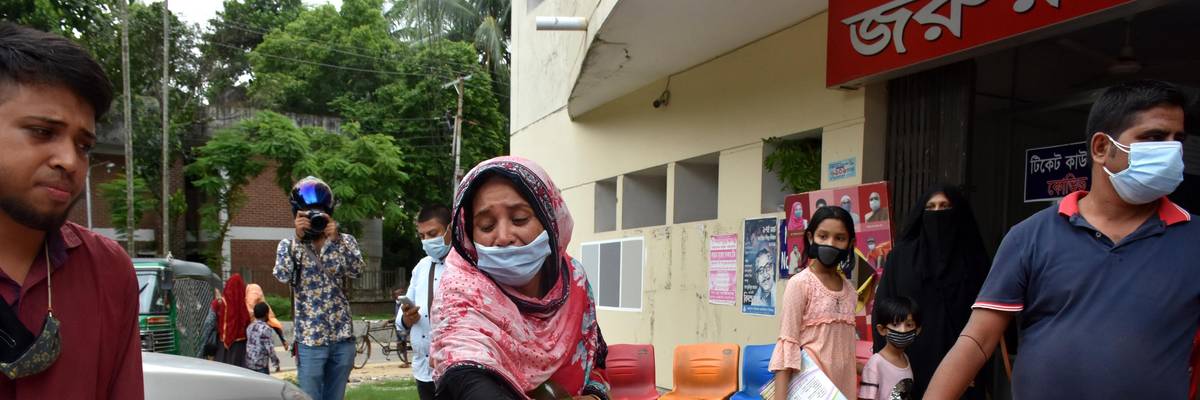
A Covid-19 victim lies on a stretcher outside of Chittagong Medical College Hospital in Chattogram, Bangladesh on July 5, 2021. (Photo: Mohammad Shajahan/Anadolu Agency via Getty Images)
The rapid global spread of the so-called Delta variant--a highly contagious strain of Covid-19 now present in nearly 100 countries--has public health experts and advocates demanding immediate international action to distribute vaccines to unprotected populations amid growing concerns that the deadly virus is mutating more quickly than nations can administer shots.
"Our volunteers are working alongside health authorities to accelerate vaccinations, but a crippling shortage in supply is hurting progress."
--Feroz Salah Uddin, Bangladesh Red Crescent Society
"Vaccine equity is urgent," Madhukar Pai, an epidemiologist at McGill University in Montreal, said Monday, pointing to data showing that coronavirus cases are surging in Asian nations such as Bangladesh, Thailand, and Indonesia--countries that have fully vaccinated less than 6% of their populations.
Experts are attributing the ongoing infection spike in Asia, Africa, South America, and other regions to the Delta variant, which is believed to be 60% more transmissible than the previously dominant Alpha mutation. First detected in India in December, the Delta strain has since been found in 98 countries and is running roughshod through unvaccinated communities, including pockets of the United States.
"The recent spike of Covid-19 infections in Bangladesh is deeply alarming and it is being fueled by the more infectious and deadly Delta strain, with hundreds of people dying a week," Feroz Salah Uddin, secretary general of the Bangladesh Red Crescent Society, said in a statement Tuesday. "Our volunteers are working alongside health authorities to accelerate vaccinations, but a crippling shortage in supply is hurting progress."
Sanjeev Kafely, head of the International Federation of Red Cross and Red Crescent Societies' Bangladesh delegation, stressed that "mass vaccination is the key to ending the spiraling deaths, infections, and hardships caused by this virus in Bangladesh and everywhere around the world."
"It's critical that richer countries share more vaccines with Bangladesh in the coming days and weeks to help avoid the horrors caused by Covid-19 in India," Kafely added.
Scientists have been warning for months that failure to quickly redress massive inequities in vaccine distribution between rich and poor nations would leave fertile ground for coronavirus mutations to emerge and spread, first hammering developing countries before reaching the wealthy parts of the world that have hoarded vaccine doses and blocked efforts to boost supply.
That nightmare scenario appears to be playing out, experts fear, as rich countries offer paltry vaccine donations while standing in the way of a proposed vaccine patent waiver, which aims to suspend intellectual property rules that are preventing manufacturers from mass-producing generic vaccines for poor nations. The waiver remains mired in negotiations at the World Trade Organization as powerful European countries continue to stonewall the proposal and the Biden administration fails to push harder on the issue after endorsing the waiver in May.
"In those countries with low vaccination coverage, terrible scenes of hospitals overflowing are again becoming the norm. But no country is out of the woods yet."
--Dr. Tedros Adhanom Ghebreyesus, World Health Organization
"Unvaccinated people are potential variant factories," Dr. William Schaffner, a professor in the Division of Infectious Diseases at Vanderbilt University Medical Center, told CNN in an interview on Friday. "The more unvaccinated people there are, the more opportunities for the virus to multiply. When it does, it mutates, and it could throw off a variant mutation that is even more serious down the road."
According to Our World in Data, just 1% of people in low-income countries have received at least one dose of the coronavirus vaccine, and 80% of the 3.25 billion doses administered thus far have gone to rich nations.
Dr. Tedros Adhanom Ghebreyesus, director general of the World Health Organization (WHO), warned in a speech last week that vaccine sharing by rich nations is "still only a trickle, which is being outpaced by variants." In addition to Delta, experts are watching with alarm as the Lambda strain--first detected in Peru--spreads in dozens of countries.
"Compounded by more transmissible variants, like Delta, which is quickly becoming the dominant strain in many countries, we are in a very dangerous period of this pandemic," said Tedros. "In those countries with low vaccination coverage, terrible scenes of hospitals overflowing are again becoming the norm. But no country is out of the woods yet. The Delta variant is dangerous and is continuing to evolve and mutate, which requires constant evaluation and careful adjustment of the public health response."
On Tuesday, WHO experts cautioned countries against prematurely lifting coronavirus-related restrictions amid the Delta surge.
"All of the countries of the Americas, we still have nearly one million cases a week," he said. "And the same in Europe... with half a million cases a week. It's not like this thing has gone away," said Dr. Mike Ryan, head of the WHO's Health Emergencies Programme. "It isn't over."
Raising concerns about the ability of new variants to evade vaccines, a preliminary study conducted in Israel found that the two-dose BioNTech/Pfizer vaccine is 64% effective in preventing Delta infection, compared to a 94% effectiveness against other strains. The research also indicated that the vaccine is 93% effective in preventing serious illness and hospitalization from the Delta mutation.
As with other strains, Delta poses the greatest threat to populations that have either struggled to obtain access to vaccines or refused to participate in inoculation drives.
"With so few people in developing countries vaccinated, their point of maximum danger is ahead," James Naismith, director of the Rosalind Franklin Institute in Oxford, told The Guardian. "Once Delta gets going, it will overwhelm healthcare systems very rapidly unless vaccination improves."
Unvaccinated people in rich nations are also at risk. USA Today reported Monday that "Covid-19 cases were up in nearly half of U.S. states heading into the July 4 weekend."
"Alaska and Arkansas more than doubled cases in just the last week. South Carolina and Kansas are up more than 50%," the outlet noted. "In Missouri, the number of hospitalized Covid-19 patients jumped by nearly 30% over the Fourth of July weekend in a hard-hit area where immunization rates are low, leading to a temporary ventilator shortage and a public call for help from respiratory therapists."
Public health officials in Mississippi--the U.S. state with the lowest vaccination rate--said that 95% of residents who have recently been hospitalized due to Covid-19 have not been vaccinated. According to an analysis by the Associated Press, 99% of recent coronavirus deaths in the U.S. have been among unvaccinated people.
Dear Common Dreams reader, It’s been nearly 30 years since I co-founded Common Dreams with my late wife, Lina Newhouser. We had the radical notion that journalism should serve the public good, not corporate profits. It was clear to us from the outset what it would take to build such a project. No paid advertisements. No corporate sponsors. No millionaire publisher telling us what to think or do. Many people said we wouldn't last a year, but we proved those doubters wrong. Together with a tremendous team of journalists and dedicated staff, we built an independent media outlet free from the constraints of profits and corporate control. Our mission has always been simple: To inform. To inspire. To ignite change for the common good. Building Common Dreams was not easy. Our survival was never guaranteed. When you take on the most powerful forces—Wall Street greed, fossil fuel industry destruction, Big Tech lobbyists, and uber-rich oligarchs who have spent billions upon billions rigging the economy and democracy in their favor—the only bulwark you have is supporters who believe in your work. But here’s the urgent message from me today. It's never been this bad out there. And it's never been this hard to keep us going. At the very moment Common Dreams is most needed, the threats we face are intensifying. We need your support now more than ever. We don't accept corporate advertising and never will. We don't have a paywall because we don't think people should be blocked from critical news based on their ability to pay. Everything we do is funded by the donations of readers like you. When everyone does the little they can afford, we are strong. But if that support retreats or dries up, so do we. Will you donate now to make sure Common Dreams not only survives but thrives? —Craig Brown, Co-founder |
The rapid global spread of the so-called Delta variant--a highly contagious strain of Covid-19 now present in nearly 100 countries--has public health experts and advocates demanding immediate international action to distribute vaccines to unprotected populations amid growing concerns that the deadly virus is mutating more quickly than nations can administer shots.
"Our volunteers are working alongside health authorities to accelerate vaccinations, but a crippling shortage in supply is hurting progress."
--Feroz Salah Uddin, Bangladesh Red Crescent Society
"Vaccine equity is urgent," Madhukar Pai, an epidemiologist at McGill University in Montreal, said Monday, pointing to data showing that coronavirus cases are surging in Asian nations such as Bangladesh, Thailand, and Indonesia--countries that have fully vaccinated less than 6% of their populations.
Experts are attributing the ongoing infection spike in Asia, Africa, South America, and other regions to the Delta variant, which is believed to be 60% more transmissible than the previously dominant Alpha mutation. First detected in India in December, the Delta strain has since been found in 98 countries and is running roughshod through unvaccinated communities, including pockets of the United States.
"The recent spike of Covid-19 infections in Bangladesh is deeply alarming and it is being fueled by the more infectious and deadly Delta strain, with hundreds of people dying a week," Feroz Salah Uddin, secretary general of the Bangladesh Red Crescent Society, said in a statement Tuesday. "Our volunteers are working alongside health authorities to accelerate vaccinations, but a crippling shortage in supply is hurting progress."
Sanjeev Kafely, head of the International Federation of Red Cross and Red Crescent Societies' Bangladesh delegation, stressed that "mass vaccination is the key to ending the spiraling deaths, infections, and hardships caused by this virus in Bangladesh and everywhere around the world."
"It's critical that richer countries share more vaccines with Bangladesh in the coming days and weeks to help avoid the horrors caused by Covid-19 in India," Kafely added.
Scientists have been warning for months that failure to quickly redress massive inequities in vaccine distribution between rich and poor nations would leave fertile ground for coronavirus mutations to emerge and spread, first hammering developing countries before reaching the wealthy parts of the world that have hoarded vaccine doses and blocked efforts to boost supply.
That nightmare scenario appears to be playing out, experts fear, as rich countries offer paltry vaccine donations while standing in the way of a proposed vaccine patent waiver, which aims to suspend intellectual property rules that are preventing manufacturers from mass-producing generic vaccines for poor nations. The waiver remains mired in negotiations at the World Trade Organization as powerful European countries continue to stonewall the proposal and the Biden administration fails to push harder on the issue after endorsing the waiver in May.
"In those countries with low vaccination coverage, terrible scenes of hospitals overflowing are again becoming the norm. But no country is out of the woods yet."
--Dr. Tedros Adhanom Ghebreyesus, World Health Organization
"Unvaccinated people are potential variant factories," Dr. William Schaffner, a professor in the Division of Infectious Diseases at Vanderbilt University Medical Center, told CNN in an interview on Friday. "The more unvaccinated people there are, the more opportunities for the virus to multiply. When it does, it mutates, and it could throw off a variant mutation that is even more serious down the road."
According to Our World in Data, just 1% of people in low-income countries have received at least one dose of the coronavirus vaccine, and 80% of the 3.25 billion doses administered thus far have gone to rich nations.
Dr. Tedros Adhanom Ghebreyesus, director general of the World Health Organization (WHO), warned in a speech last week that vaccine sharing by rich nations is "still only a trickle, which is being outpaced by variants." In addition to Delta, experts are watching with alarm as the Lambda strain--first detected in Peru--spreads in dozens of countries.
"Compounded by more transmissible variants, like Delta, which is quickly becoming the dominant strain in many countries, we are in a very dangerous period of this pandemic," said Tedros. "In those countries with low vaccination coverage, terrible scenes of hospitals overflowing are again becoming the norm. But no country is out of the woods yet. The Delta variant is dangerous and is continuing to evolve and mutate, which requires constant evaluation and careful adjustment of the public health response."
On Tuesday, WHO experts cautioned countries against prematurely lifting coronavirus-related restrictions amid the Delta surge.
"All of the countries of the Americas, we still have nearly one million cases a week," he said. "And the same in Europe... with half a million cases a week. It's not like this thing has gone away," said Dr. Mike Ryan, head of the WHO's Health Emergencies Programme. "It isn't over."
Raising concerns about the ability of new variants to evade vaccines, a preliminary study conducted in Israel found that the two-dose BioNTech/Pfizer vaccine is 64% effective in preventing Delta infection, compared to a 94% effectiveness against other strains. The research also indicated that the vaccine is 93% effective in preventing serious illness and hospitalization from the Delta mutation.
As with other strains, Delta poses the greatest threat to populations that have either struggled to obtain access to vaccines or refused to participate in inoculation drives.
"With so few people in developing countries vaccinated, their point of maximum danger is ahead," James Naismith, director of the Rosalind Franklin Institute in Oxford, told The Guardian. "Once Delta gets going, it will overwhelm healthcare systems very rapidly unless vaccination improves."
Unvaccinated people in rich nations are also at risk. USA Today reported Monday that "Covid-19 cases were up in nearly half of U.S. states heading into the July 4 weekend."
"Alaska and Arkansas more than doubled cases in just the last week. South Carolina and Kansas are up more than 50%," the outlet noted. "In Missouri, the number of hospitalized Covid-19 patients jumped by nearly 30% over the Fourth of July weekend in a hard-hit area where immunization rates are low, leading to a temporary ventilator shortage and a public call for help from respiratory therapists."
Public health officials in Mississippi--the U.S. state with the lowest vaccination rate--said that 95% of residents who have recently been hospitalized due to Covid-19 have not been vaccinated. According to an analysis by the Associated Press, 99% of recent coronavirus deaths in the U.S. have been among unvaccinated people.
The rapid global spread of the so-called Delta variant--a highly contagious strain of Covid-19 now present in nearly 100 countries--has public health experts and advocates demanding immediate international action to distribute vaccines to unprotected populations amid growing concerns that the deadly virus is mutating more quickly than nations can administer shots.
"Our volunteers are working alongside health authorities to accelerate vaccinations, but a crippling shortage in supply is hurting progress."
--Feroz Salah Uddin, Bangladesh Red Crescent Society
"Vaccine equity is urgent," Madhukar Pai, an epidemiologist at McGill University in Montreal, said Monday, pointing to data showing that coronavirus cases are surging in Asian nations such as Bangladesh, Thailand, and Indonesia--countries that have fully vaccinated less than 6% of their populations.
Experts are attributing the ongoing infection spike in Asia, Africa, South America, and other regions to the Delta variant, which is believed to be 60% more transmissible than the previously dominant Alpha mutation. First detected in India in December, the Delta strain has since been found in 98 countries and is running roughshod through unvaccinated communities, including pockets of the United States.
"The recent spike of Covid-19 infections in Bangladesh is deeply alarming and it is being fueled by the more infectious and deadly Delta strain, with hundreds of people dying a week," Feroz Salah Uddin, secretary general of the Bangladesh Red Crescent Society, said in a statement Tuesday. "Our volunteers are working alongside health authorities to accelerate vaccinations, but a crippling shortage in supply is hurting progress."
Sanjeev Kafely, head of the International Federation of Red Cross and Red Crescent Societies' Bangladesh delegation, stressed that "mass vaccination is the key to ending the spiraling deaths, infections, and hardships caused by this virus in Bangladesh and everywhere around the world."
"It's critical that richer countries share more vaccines with Bangladesh in the coming days and weeks to help avoid the horrors caused by Covid-19 in India," Kafely added.
Scientists have been warning for months that failure to quickly redress massive inequities in vaccine distribution between rich and poor nations would leave fertile ground for coronavirus mutations to emerge and spread, first hammering developing countries before reaching the wealthy parts of the world that have hoarded vaccine doses and blocked efforts to boost supply.
That nightmare scenario appears to be playing out, experts fear, as rich countries offer paltry vaccine donations while standing in the way of a proposed vaccine patent waiver, which aims to suspend intellectual property rules that are preventing manufacturers from mass-producing generic vaccines for poor nations. The waiver remains mired in negotiations at the World Trade Organization as powerful European countries continue to stonewall the proposal and the Biden administration fails to push harder on the issue after endorsing the waiver in May.
"In those countries with low vaccination coverage, terrible scenes of hospitals overflowing are again becoming the norm. But no country is out of the woods yet."
--Dr. Tedros Adhanom Ghebreyesus, World Health Organization
"Unvaccinated people are potential variant factories," Dr. William Schaffner, a professor in the Division of Infectious Diseases at Vanderbilt University Medical Center, told CNN in an interview on Friday. "The more unvaccinated people there are, the more opportunities for the virus to multiply. When it does, it mutates, and it could throw off a variant mutation that is even more serious down the road."
According to Our World in Data, just 1% of people in low-income countries have received at least one dose of the coronavirus vaccine, and 80% of the 3.25 billion doses administered thus far have gone to rich nations.
Dr. Tedros Adhanom Ghebreyesus, director general of the World Health Organization (WHO), warned in a speech last week that vaccine sharing by rich nations is "still only a trickle, which is being outpaced by variants." In addition to Delta, experts are watching with alarm as the Lambda strain--first detected in Peru--spreads in dozens of countries.
"Compounded by more transmissible variants, like Delta, which is quickly becoming the dominant strain in many countries, we are in a very dangerous period of this pandemic," said Tedros. "In those countries with low vaccination coverage, terrible scenes of hospitals overflowing are again becoming the norm. But no country is out of the woods yet. The Delta variant is dangerous and is continuing to evolve and mutate, which requires constant evaluation and careful adjustment of the public health response."
On Tuesday, WHO experts cautioned countries against prematurely lifting coronavirus-related restrictions amid the Delta surge.
"All of the countries of the Americas, we still have nearly one million cases a week," he said. "And the same in Europe... with half a million cases a week. It's not like this thing has gone away," said Dr. Mike Ryan, head of the WHO's Health Emergencies Programme. "It isn't over."
Raising concerns about the ability of new variants to evade vaccines, a preliminary study conducted in Israel found that the two-dose BioNTech/Pfizer vaccine is 64% effective in preventing Delta infection, compared to a 94% effectiveness against other strains. The research also indicated that the vaccine is 93% effective in preventing serious illness and hospitalization from the Delta mutation.
As with other strains, Delta poses the greatest threat to populations that have either struggled to obtain access to vaccines or refused to participate in inoculation drives.
"With so few people in developing countries vaccinated, their point of maximum danger is ahead," James Naismith, director of the Rosalind Franklin Institute in Oxford, told The Guardian. "Once Delta gets going, it will overwhelm healthcare systems very rapidly unless vaccination improves."
Unvaccinated people in rich nations are also at risk. USA Today reported Monday that "Covid-19 cases were up in nearly half of U.S. states heading into the July 4 weekend."
"Alaska and Arkansas more than doubled cases in just the last week. South Carolina and Kansas are up more than 50%," the outlet noted. "In Missouri, the number of hospitalized Covid-19 patients jumped by nearly 30% over the Fourth of July weekend in a hard-hit area where immunization rates are low, leading to a temporary ventilator shortage and a public call for help from respiratory therapists."
Public health officials in Mississippi--the U.S. state with the lowest vaccination rate--said that 95% of residents who have recently been hospitalized due to Covid-19 have not been vaccinated. According to an analysis by the Associated Press, 99% of recent coronavirus deaths in the U.S. have been among unvaccinated people.