SUBSCRIBE TO OUR FREE NEWSLETTER
Daily news & progressive opinion—funded by the people, not the corporations—delivered straight to your inbox.
5
#000000
#FFFFFF
To donate by check, phone, or other method, see our More Ways to Give page.
Daily news & progressive opinion—funded by the people, not the corporations—delivered straight to your inbox.
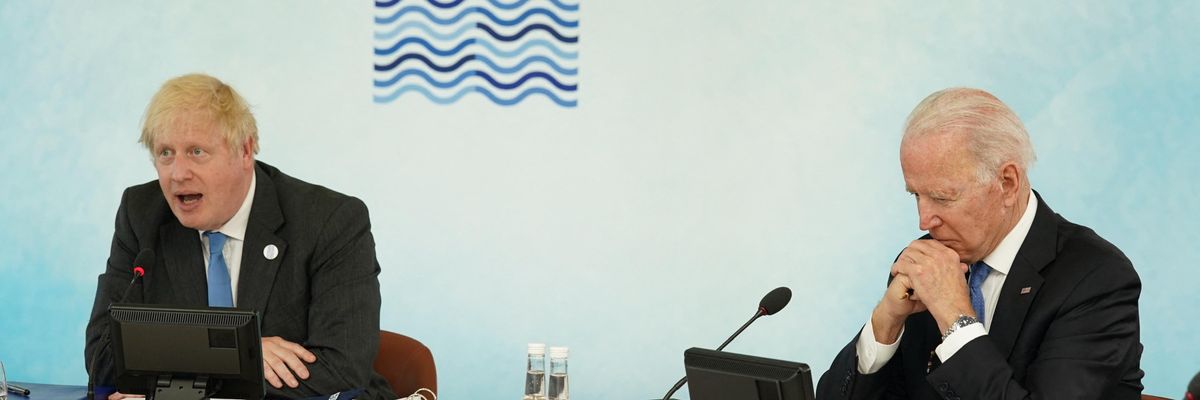
Britain's Prime Minister Boris Johnson and U.S. President Joe Biden attend a working session at the G7 summit in Carbis Bay, Cornwall on June 11, 2021. (Photo: Kevin Lamarque/Pool/AFP via Getty Images)
A group of the world's richest nations vowed Sunday to collectively donate at least 1 billion coronavirus vaccine doses to developing nations over the next year, but a closer look reveals that the pledge includes just 613 million new doses--a paltry sum compared to the 11 billion doses that experts say will be needed to inoculate 70% of the global population.
"The G7 response to the scale of the challenge is just embarrassing."
--Heidi Chow, Global Justice Now
Bloomberg's Josh Wingrove and Alberto Nardelli reported that in order to reach the promised 1 billion-dose figure, G7 leaders "included pledges made starting back in February."
"So far, the G7 countries have promised 613 million truly new doses--including some funded in part by previously announced aid," Wingrove and Nardelli noted. "If doses already announced in recent weeks by G7 and E.U. nations are included, the tally grows to roughly 870 million doses."
"The 500 million doses pledged by the U.S. will be funded in part by $2 billion that Biden had initially promised for Covax, the World Health Organization-backed initiative aimed at facilitating equitable global distribution. Biden will claw that money back and buy doses directly, then work with Covax to distribute them," the pair continued. "The Canadian pledge includes 13 million directly donated doses as well as a previously announced C$440 million ($361.9 million) pledge to Covax. Counting that money, Canada framed its donation as up to 100 million doses total, though only the 13 million are new."
Already outraged by the inadequacy of the 1 billion-dose commitment--which, if fulfilled, would provide enough shots to protect just 11% of the world's unvaccinated population--public health campaigners said the G7 countries' inflation of their pledge with older promises further underscores the failure of the closely watched summit in Cornwall, England over the weekend. The gathering took place as developing nations in Africa, South America, and Asia are experiencing deadly Covid-19 waves as they struggle to get their vaccination campaigns off the ground.
"Donations were never going to be enough, but the 1 billion doses promised by the G7 turns out to be just 613 million new doses and some through clawed back Covax financial donations," said Heidi Chow, senior policy and campaigns manager with the U.K.-based advocacy group Global Justice Now. "The G7 response to the scale of the challenge is just embarrassing."
Global Justice Now's director Nick Dearden echoed that message early Monday, tweeting that "G7 leaders went to Cornwall and all the world got was 600 million truly new vaccine doses."
"A single factory could produce this number in a year if you waived patents," Dearden added.
The G7 summit came amid ongoing negotiations over India and South Africa's patent waiver proposal at the World Trade Organization. While the waiver is backed by more than 100 countries, the opposition of a small group of wealthy nations has prevented approval of the measure, which would temporarily lift intellectual property barriers that are stopping manufacturers around the world from producing generic vaccines.
The U.S. and France are the only two G7 nations that have endorsed the patent waiver.
"Dose-sharing is part of the solution if done immediately, but charity is not going to fix the colossal vaccine supply crisis," said Anna Marriott, health policy manager at Oxfam International. "In order to ramp up production, the G7 should break the pharmaceutical monopolies and insist that the vaccine science and know-how is shared with qualified manufacturers around the world."
"The lives of millions of people in developing countries should never be dependent on the good will of rich nations and profit-hungry pharmaceutical corporations," Marriott added.
Dear Common Dreams reader, It’s been nearly 30 years since I co-founded Common Dreams with my late wife, Lina Newhouser. We had the radical notion that journalism should serve the public good, not corporate profits. It was clear to us from the outset what it would take to build such a project. No paid advertisements. No corporate sponsors. No millionaire publisher telling us what to think or do. Many people said we wouldn't last a year, but we proved those doubters wrong. Together with a tremendous team of journalists and dedicated staff, we built an independent media outlet free from the constraints of profits and corporate control. Our mission has always been simple: To inform. To inspire. To ignite change for the common good. Building Common Dreams was not easy. Our survival was never guaranteed. When you take on the most powerful forces—Wall Street greed, fossil fuel industry destruction, Big Tech lobbyists, and uber-rich oligarchs who have spent billions upon billions rigging the economy and democracy in their favor—the only bulwark you have is supporters who believe in your work. But here’s the urgent message from me today. It's never been this bad out there. And it's never been this hard to keep us going. At the very moment Common Dreams is most needed, the threats we face are intensifying. We need your support now more than ever. We don't accept corporate advertising and never will. We don't have a paywall because we don't think people should be blocked from critical news based on their ability to pay. Everything we do is funded by the donations of readers like you. When everyone does the little they can afford, we are strong. But if that support retreats or dries up, so do we. Will you donate now to make sure Common Dreams not only survives but thrives? —Craig Brown, Co-founder |
A group of the world's richest nations vowed Sunday to collectively donate at least 1 billion coronavirus vaccine doses to developing nations over the next year, but a closer look reveals that the pledge includes just 613 million new doses--a paltry sum compared to the 11 billion doses that experts say will be needed to inoculate 70% of the global population.
"The G7 response to the scale of the challenge is just embarrassing."
--Heidi Chow, Global Justice Now
Bloomberg's Josh Wingrove and Alberto Nardelli reported that in order to reach the promised 1 billion-dose figure, G7 leaders "included pledges made starting back in February."
"So far, the G7 countries have promised 613 million truly new doses--including some funded in part by previously announced aid," Wingrove and Nardelli noted. "If doses already announced in recent weeks by G7 and E.U. nations are included, the tally grows to roughly 870 million doses."
"The 500 million doses pledged by the U.S. will be funded in part by $2 billion that Biden had initially promised for Covax, the World Health Organization-backed initiative aimed at facilitating equitable global distribution. Biden will claw that money back and buy doses directly, then work with Covax to distribute them," the pair continued. "The Canadian pledge includes 13 million directly donated doses as well as a previously announced C$440 million ($361.9 million) pledge to Covax. Counting that money, Canada framed its donation as up to 100 million doses total, though only the 13 million are new."
Already outraged by the inadequacy of the 1 billion-dose commitment--which, if fulfilled, would provide enough shots to protect just 11% of the world's unvaccinated population--public health campaigners said the G7 countries' inflation of their pledge with older promises further underscores the failure of the closely watched summit in Cornwall, England over the weekend. The gathering took place as developing nations in Africa, South America, and Asia are experiencing deadly Covid-19 waves as they struggle to get their vaccination campaigns off the ground.
"Donations were never going to be enough, but the 1 billion doses promised by the G7 turns out to be just 613 million new doses and some through clawed back Covax financial donations," said Heidi Chow, senior policy and campaigns manager with the U.K.-based advocacy group Global Justice Now. "The G7 response to the scale of the challenge is just embarrassing."
Global Justice Now's director Nick Dearden echoed that message early Monday, tweeting that "G7 leaders went to Cornwall and all the world got was 600 million truly new vaccine doses."
"A single factory could produce this number in a year if you waived patents," Dearden added.
The G7 summit came amid ongoing negotiations over India and South Africa's patent waiver proposal at the World Trade Organization. While the waiver is backed by more than 100 countries, the opposition of a small group of wealthy nations has prevented approval of the measure, which would temporarily lift intellectual property barriers that are stopping manufacturers around the world from producing generic vaccines.
The U.S. and France are the only two G7 nations that have endorsed the patent waiver.
"Dose-sharing is part of the solution if done immediately, but charity is not going to fix the colossal vaccine supply crisis," said Anna Marriott, health policy manager at Oxfam International. "In order to ramp up production, the G7 should break the pharmaceutical monopolies and insist that the vaccine science and know-how is shared with qualified manufacturers around the world."
"The lives of millions of people in developing countries should never be dependent on the good will of rich nations and profit-hungry pharmaceutical corporations," Marriott added.
A group of the world's richest nations vowed Sunday to collectively donate at least 1 billion coronavirus vaccine doses to developing nations over the next year, but a closer look reveals that the pledge includes just 613 million new doses--a paltry sum compared to the 11 billion doses that experts say will be needed to inoculate 70% of the global population.
"The G7 response to the scale of the challenge is just embarrassing."
--Heidi Chow, Global Justice Now
Bloomberg's Josh Wingrove and Alberto Nardelli reported that in order to reach the promised 1 billion-dose figure, G7 leaders "included pledges made starting back in February."
"So far, the G7 countries have promised 613 million truly new doses--including some funded in part by previously announced aid," Wingrove and Nardelli noted. "If doses already announced in recent weeks by G7 and E.U. nations are included, the tally grows to roughly 870 million doses."
"The 500 million doses pledged by the U.S. will be funded in part by $2 billion that Biden had initially promised for Covax, the World Health Organization-backed initiative aimed at facilitating equitable global distribution. Biden will claw that money back and buy doses directly, then work with Covax to distribute them," the pair continued. "The Canadian pledge includes 13 million directly donated doses as well as a previously announced C$440 million ($361.9 million) pledge to Covax. Counting that money, Canada framed its donation as up to 100 million doses total, though only the 13 million are new."
Already outraged by the inadequacy of the 1 billion-dose commitment--which, if fulfilled, would provide enough shots to protect just 11% of the world's unvaccinated population--public health campaigners said the G7 countries' inflation of their pledge with older promises further underscores the failure of the closely watched summit in Cornwall, England over the weekend. The gathering took place as developing nations in Africa, South America, and Asia are experiencing deadly Covid-19 waves as they struggle to get their vaccination campaigns off the ground.
"Donations were never going to be enough, but the 1 billion doses promised by the G7 turns out to be just 613 million new doses and some through clawed back Covax financial donations," said Heidi Chow, senior policy and campaigns manager with the U.K.-based advocacy group Global Justice Now. "The G7 response to the scale of the challenge is just embarrassing."
Global Justice Now's director Nick Dearden echoed that message early Monday, tweeting that "G7 leaders went to Cornwall and all the world got was 600 million truly new vaccine doses."
"A single factory could produce this number in a year if you waived patents," Dearden added.
The G7 summit came amid ongoing negotiations over India and South Africa's patent waiver proposal at the World Trade Organization. While the waiver is backed by more than 100 countries, the opposition of a small group of wealthy nations has prevented approval of the measure, which would temporarily lift intellectual property barriers that are stopping manufacturers around the world from producing generic vaccines.
The U.S. and France are the only two G7 nations that have endorsed the patent waiver.
"Dose-sharing is part of the solution if done immediately, but charity is not going to fix the colossal vaccine supply crisis," said Anna Marriott, health policy manager at Oxfam International. "In order to ramp up production, the G7 should break the pharmaceutical monopolies and insist that the vaccine science and know-how is shared with qualified manufacturers around the world."
"The lives of millions of people in developing countries should never be dependent on the good will of rich nations and profit-hungry pharmaceutical corporations," Marriott added.