SUBSCRIBE TO OUR FREE NEWSLETTER
Daily news & progressive opinion—funded by the people, not the corporations—delivered straight to your inbox.
5
#000000
#FFFFFF
To donate by check, phone, or other method, see our More Ways to Give page.
Daily news & progressive opinion—funded by the people, not the corporations—delivered straight to your inbox.
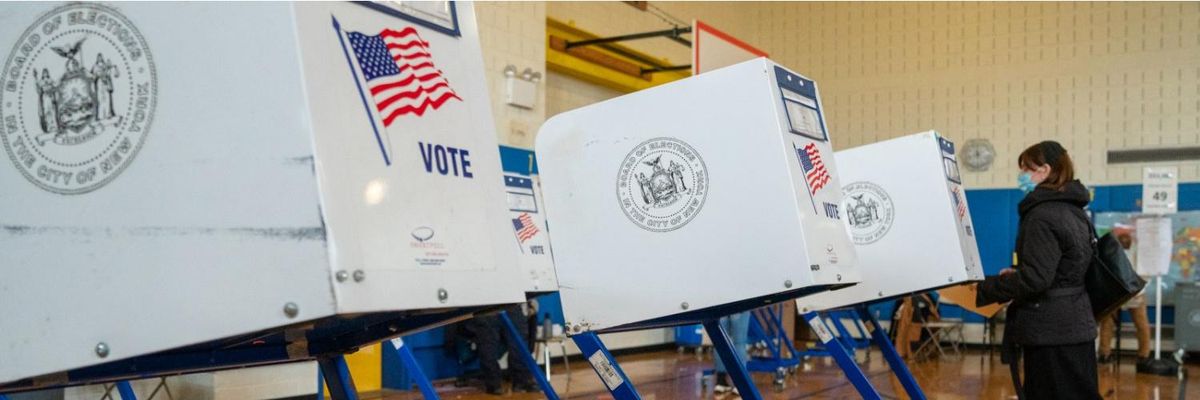
A voter walks to a booth to fill out their ballot at Public School 160 on November 3, 2020 in the Brooklyn borough of New York City. (Photo: David Dee Delgado/Getty Images)
Amid a wave of GOP attacks on voting rights in legislatures across the United States, activists applauded the Democrat-controlled New York State Assembly on Wednesday for passing a bill to end the disenfranchisement of New Yorkers on parole and called on Democratic Gov. Andrew Cuomo to swiftly sign the measure into law.
"Outdated, racist voter suppression laws that disenfranchise the formerly incarcerated have no place in New York. No one should be excluded from our democracy because of Jim Crow-relic voting laws or as a result of our deeply broken criminal justice system," said the progressive advocacy group Stand Up America in a statement.
"We applaud the activists who brought attention to this injustice and the state lawmakers who voted for this critical bill," the group added, thanking state Sens. Leroy Comrie (D-14) and Zellnor Myrie (D-20) as well as Reps. Daniel O'Donnell (D-69) and Latrice Walker (D-55) "for championing this bill through both chambers."
Stand Up America joined with Alliance of Families for Justice, the Brennan Center for Justice at the New York University School of Law, Brooklyn Voter Alliance, Citizen Action of New York, Parole Preparation Project, VOCAL-NY, and other organizations to advocate for the bill.
Sean Morales-Doyle, deputy director of the Brennan Center's Voting Rights and Elections Program, said in a statement that "by passing this bill, the state Assembly has sent a clear message: If you live in the community, you should be able to vote."
"For decades, New York law has denied tens of thousands of New Yorkers living, working, and paying taxes in their communities the right to vote only because they are on parole. That's wrong," he said. "They should be able to participate in democracy and the decisions that affect their lives."
Morales-Doyle noted that "because of the racial disparities plaguing New York state's criminal justice system, the prohibition on voting for people on parole has had an enormous impact on Black and Latino New Yorkers, who make up nearly three-quarters of the people on parole in New York state."
"Disenfranchising people on parole is a vestige of Jim Crow," he declared. "We look forward to the governor putting an end to it by signing S. 830 into law."
The state Assembly's vote came after the Senate passed A. 4448/S. 830 in February. Highlighting how long this fight has dragged on, O'Donnell--former chair of the Assembly's Standing Committee on Correction--told CNN on Wednesday that the first version of the bill was drafted in 2005.
"Parole disenfranchisement in New York was designed to prevent Black men from voting, and we see the legacy of these laws in the largely Black and Latinx parolee population today," O'Donnell said in a statement.
"With the passage of this bill, we are one step closer to dismantling the vestiges of segregation-era felony disenfranchisement in New York," he continued. "We are sending a clear message to the rest of the country: the right to vote is foundational to our democracy and should be expanded, not restricted."
"Someone who is successfully on parole, they are living a law-abiding life," he added. "Why can't they participate?"
Though it's unclear if or when Cuomo will sign the bill, he did begin using his pardon power to restore voting rights to New York residents on parole in 2018. At the time, he said, "The right to vote is fundamental and it is unconscionable to deny that basic right of citizenship to New Yorkers who have paid their debt to society."
The progress on expanding voting rights in New York comes as GOP policymakers in several states including Georgia and Texas have proposed or passed legislation to restrict ballot box access. According to the Brennan Center, Republicans across 47 states this year have introduced at least 361 bills with restrictive voting provisions.
Dear Common Dreams reader, It’s been nearly 30 years since I co-founded Common Dreams with my late wife, Lina Newhouser. We had the radical notion that journalism should serve the public good, not corporate profits. It was clear to us from the outset what it would take to build such a project. No paid advertisements. No corporate sponsors. No millionaire publisher telling us what to think or do. Many people said we wouldn't last a year, but we proved those doubters wrong. Together with a tremendous team of journalists and dedicated staff, we built an independent media outlet free from the constraints of profits and corporate control. Our mission has always been simple: To inform. To inspire. To ignite change for the common good. Building Common Dreams was not easy. Our survival was never guaranteed. When you take on the most powerful forces—Wall Street greed, fossil fuel industry destruction, Big Tech lobbyists, and uber-rich oligarchs who have spent billions upon billions rigging the economy and democracy in their favor—the only bulwark you have is supporters who believe in your work. But here’s the urgent message from me today. It's never been this bad out there. And it's never been this hard to keep us going. At the very moment Common Dreams is most needed, the threats we face are intensifying. We need your support now more than ever. We don't accept corporate advertising and never will. We don't have a paywall because we don't think people should be blocked from critical news based on their ability to pay. Everything we do is funded by the donations of readers like you. When everyone does the little they can afford, we are strong. But if that support retreats or dries up, so do we. Will you donate now to make sure Common Dreams not only survives but thrives? —Craig Brown, Co-founder |
Amid a wave of GOP attacks on voting rights in legislatures across the United States, activists applauded the Democrat-controlled New York State Assembly on Wednesday for passing a bill to end the disenfranchisement of New Yorkers on parole and called on Democratic Gov. Andrew Cuomo to swiftly sign the measure into law.
"Outdated, racist voter suppression laws that disenfranchise the formerly incarcerated have no place in New York. No one should be excluded from our democracy because of Jim Crow-relic voting laws or as a result of our deeply broken criminal justice system," said the progressive advocacy group Stand Up America in a statement.
"We applaud the activists who brought attention to this injustice and the state lawmakers who voted for this critical bill," the group added, thanking state Sens. Leroy Comrie (D-14) and Zellnor Myrie (D-20) as well as Reps. Daniel O'Donnell (D-69) and Latrice Walker (D-55) "for championing this bill through both chambers."
Stand Up America joined with Alliance of Families for Justice, the Brennan Center for Justice at the New York University School of Law, Brooklyn Voter Alliance, Citizen Action of New York, Parole Preparation Project, VOCAL-NY, and other organizations to advocate for the bill.
Sean Morales-Doyle, deputy director of the Brennan Center's Voting Rights and Elections Program, said in a statement that "by passing this bill, the state Assembly has sent a clear message: If you live in the community, you should be able to vote."
"For decades, New York law has denied tens of thousands of New Yorkers living, working, and paying taxes in their communities the right to vote only because they are on parole. That's wrong," he said. "They should be able to participate in democracy and the decisions that affect their lives."
Morales-Doyle noted that "because of the racial disparities plaguing New York state's criminal justice system, the prohibition on voting for people on parole has had an enormous impact on Black and Latino New Yorkers, who make up nearly three-quarters of the people on parole in New York state."
"Disenfranchising people on parole is a vestige of Jim Crow," he declared. "We look forward to the governor putting an end to it by signing S. 830 into law."
The state Assembly's vote came after the Senate passed A. 4448/S. 830 in February. Highlighting how long this fight has dragged on, O'Donnell--former chair of the Assembly's Standing Committee on Correction--told CNN on Wednesday that the first version of the bill was drafted in 2005.
"Parole disenfranchisement in New York was designed to prevent Black men from voting, and we see the legacy of these laws in the largely Black and Latinx parolee population today," O'Donnell said in a statement.
"With the passage of this bill, we are one step closer to dismantling the vestiges of segregation-era felony disenfranchisement in New York," he continued. "We are sending a clear message to the rest of the country: the right to vote is foundational to our democracy and should be expanded, not restricted."
"Someone who is successfully on parole, they are living a law-abiding life," he added. "Why can't they participate?"
Though it's unclear if or when Cuomo will sign the bill, he did begin using his pardon power to restore voting rights to New York residents on parole in 2018. At the time, he said, "The right to vote is fundamental and it is unconscionable to deny that basic right of citizenship to New Yorkers who have paid their debt to society."
The progress on expanding voting rights in New York comes as GOP policymakers in several states including Georgia and Texas have proposed or passed legislation to restrict ballot box access. According to the Brennan Center, Republicans across 47 states this year have introduced at least 361 bills with restrictive voting provisions.
Amid a wave of GOP attacks on voting rights in legislatures across the United States, activists applauded the Democrat-controlled New York State Assembly on Wednesday for passing a bill to end the disenfranchisement of New Yorkers on parole and called on Democratic Gov. Andrew Cuomo to swiftly sign the measure into law.
"Outdated, racist voter suppression laws that disenfranchise the formerly incarcerated have no place in New York. No one should be excluded from our democracy because of Jim Crow-relic voting laws or as a result of our deeply broken criminal justice system," said the progressive advocacy group Stand Up America in a statement.
"We applaud the activists who brought attention to this injustice and the state lawmakers who voted for this critical bill," the group added, thanking state Sens. Leroy Comrie (D-14) and Zellnor Myrie (D-20) as well as Reps. Daniel O'Donnell (D-69) and Latrice Walker (D-55) "for championing this bill through both chambers."
Stand Up America joined with Alliance of Families for Justice, the Brennan Center for Justice at the New York University School of Law, Brooklyn Voter Alliance, Citizen Action of New York, Parole Preparation Project, VOCAL-NY, and other organizations to advocate for the bill.
Sean Morales-Doyle, deputy director of the Brennan Center's Voting Rights and Elections Program, said in a statement that "by passing this bill, the state Assembly has sent a clear message: If you live in the community, you should be able to vote."
"For decades, New York law has denied tens of thousands of New Yorkers living, working, and paying taxes in their communities the right to vote only because they are on parole. That's wrong," he said. "They should be able to participate in democracy and the decisions that affect their lives."
Morales-Doyle noted that "because of the racial disparities plaguing New York state's criminal justice system, the prohibition on voting for people on parole has had an enormous impact on Black and Latino New Yorkers, who make up nearly three-quarters of the people on parole in New York state."
"Disenfranchising people on parole is a vestige of Jim Crow," he declared. "We look forward to the governor putting an end to it by signing S. 830 into law."
The state Assembly's vote came after the Senate passed A. 4448/S. 830 in February. Highlighting how long this fight has dragged on, O'Donnell--former chair of the Assembly's Standing Committee on Correction--told CNN on Wednesday that the first version of the bill was drafted in 2005.
"Parole disenfranchisement in New York was designed to prevent Black men from voting, and we see the legacy of these laws in the largely Black and Latinx parolee population today," O'Donnell said in a statement.
"With the passage of this bill, we are one step closer to dismantling the vestiges of segregation-era felony disenfranchisement in New York," he continued. "We are sending a clear message to the rest of the country: the right to vote is foundational to our democracy and should be expanded, not restricted."
"Someone who is successfully on parole, they are living a law-abiding life," he added. "Why can't they participate?"
Though it's unclear if or when Cuomo will sign the bill, he did begin using his pardon power to restore voting rights to New York residents on parole in 2018. At the time, he said, "The right to vote is fundamental and it is unconscionable to deny that basic right of citizenship to New Yorkers who have paid their debt to society."
The progress on expanding voting rights in New York comes as GOP policymakers in several states including Georgia and Texas have proposed or passed legislation to restrict ballot box access. According to the Brennan Center, Republicans across 47 states this year have introduced at least 361 bills with restrictive voting provisions.