SUBSCRIBE TO OUR FREE NEWSLETTER
Daily news & progressive opinion—funded by the people, not the corporations—delivered straight to your inbox.
5
#000000
#FFFFFF
To donate by check, phone, or other method, see our More Ways to Give page.
Daily news & progressive opinion—funded by the people, not the corporations—delivered straight to your inbox.
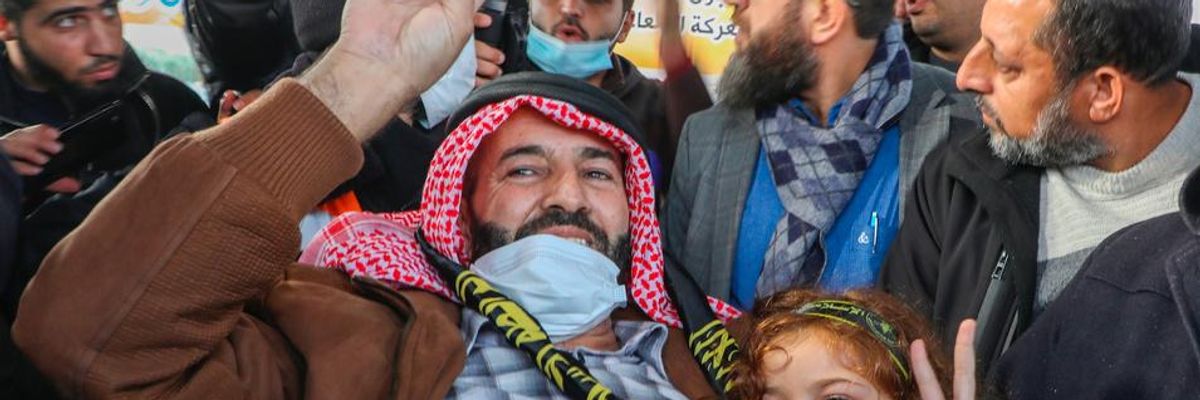
Palestinian prisoner Maher Al-Akhras and his daughter arrive at their home in the occupied West Bank village of Seylat al-Dhahr, south of Jenin city, following his release by Israeli authorities on November 26, 2020. (Photo: Jaafar Ashtiyeh/AFP/Getty Images)
Israeli authorities on Thursday released a jailed Palestinian man weeks after he ended a 103-day hunger strike to protest his imprisonment without charge.
Agence France-Presse reports Maher Al-Akhras, 49, was was transferred from a hospital in Tel Aviv, Israel to one in the illegally-occupied West Bank city of Nablus nearly three weeks after ending his hunger strike against Israeli administrative detention.
Watch| Maher al-Akhras,a Palestinian in Israeli jails who ended his 104day hunger strike earlier this month against detention without charge or trial, arrives at Najah Hospital in Nablus, north of the occupied West Bank,after being released today by Israeli occupation authorities pic.twitter.com/OHR6CNNwB6
-- Almanara (@almanaragroup48) November 26, 2020
"My freedom is the freedom of my people, and we have won over the occupation with our will and determination," Al-Akhras declared upon his release, according to Middle East Eye. The father of six added that his health is "fine."
"I feel pain in my joints, but I will be fine, inshallah," he said, using the common Arabic expression meaning "God willing."
Addameer, an advocacy group for Palestinian prisoners, says about 4,500 Palestinians were jailed by Israel as of last month, with around 370 of them held in administrative detention. According to the Israeli human rights group B'Tselem:
Administrative detention is incarceration without trial or charge, alleging that a person plans to commit a future offense. It has no time limit, and the evidence on which it is based is not disclosed. Israel employs this measure extensively and routinely, and has used it to hold thousands of Palestinians for lengthy periods of time. While detention orders are formally reviewed, this is merely a semblance of judicial oversight, as detainees cannot reasonably mount a defense against undisclosed allegations. Nevertheless, courts uphold the vast majority of orders.
The policy dates back to the period when Palestine--which includes all of what is today Israel--was ruled as a British colony and pro-independence Jewish militants carried out terrorist attacks against occupying forces and Palestinian Arabs.
Al-Akhras refused to eat or drink since he was arrested on July 27. Shin Bet, Israel's internal intelligence agency, claims he is a member of the Palestinian resistance group Islamic Jihad. Al-Akhras, who denies the allegations, has been imprisoned at least five times for a total of more than five years since he turned 18.
Dear Common Dreams reader, It’s been nearly 30 years since I co-founded Common Dreams with my late wife, Lina Newhouser. We had the radical notion that journalism should serve the public good, not corporate profits. It was clear to us from the outset what it would take to build such a project. No paid advertisements. No corporate sponsors. No millionaire publisher telling us what to think or do. Many people said we wouldn't last a year, but we proved those doubters wrong. Together with a tremendous team of journalists and dedicated staff, we built an independent media outlet free from the constraints of profits and corporate control. Our mission has always been simple: To inform. To inspire. To ignite change for the common good. Building Common Dreams was not easy. Our survival was never guaranteed. When you take on the most powerful forces—Wall Street greed, fossil fuel industry destruction, Big Tech lobbyists, and uber-rich oligarchs who have spent billions upon billions rigging the economy and democracy in their favor—the only bulwark you have is supporters who believe in your work. But here’s the urgent message from me today. It's never been this bad out there. And it's never been this hard to keep us going. At the very moment Common Dreams is most needed, the threats we face are intensifying. We need your support now more than ever. We don't accept corporate advertising and never will. We don't have a paywall because we don't think people should be blocked from critical news based on their ability to pay. Everything we do is funded by the donations of readers like you. When everyone does the little they can afford, we are strong. But if that support retreats or dries up, so do we. Will you donate now to make sure Common Dreams not only survives but thrives? —Craig Brown, Co-founder |
Israeli authorities on Thursday released a jailed Palestinian man weeks after he ended a 103-day hunger strike to protest his imprisonment without charge.
Agence France-Presse reports Maher Al-Akhras, 49, was was transferred from a hospital in Tel Aviv, Israel to one in the illegally-occupied West Bank city of Nablus nearly three weeks after ending his hunger strike against Israeli administrative detention.
Watch| Maher al-Akhras,a Palestinian in Israeli jails who ended his 104day hunger strike earlier this month against detention without charge or trial, arrives at Najah Hospital in Nablus, north of the occupied West Bank,after being released today by Israeli occupation authorities pic.twitter.com/OHR6CNNwB6
-- Almanara (@almanaragroup48) November 26, 2020
"My freedom is the freedom of my people, and we have won over the occupation with our will and determination," Al-Akhras declared upon his release, according to Middle East Eye. The father of six added that his health is "fine."
"I feel pain in my joints, but I will be fine, inshallah," he said, using the common Arabic expression meaning "God willing."
Addameer, an advocacy group for Palestinian prisoners, says about 4,500 Palestinians were jailed by Israel as of last month, with around 370 of them held in administrative detention. According to the Israeli human rights group B'Tselem:
Administrative detention is incarceration without trial or charge, alleging that a person plans to commit a future offense. It has no time limit, and the evidence on which it is based is not disclosed. Israel employs this measure extensively and routinely, and has used it to hold thousands of Palestinians for lengthy periods of time. While detention orders are formally reviewed, this is merely a semblance of judicial oversight, as detainees cannot reasonably mount a defense against undisclosed allegations. Nevertheless, courts uphold the vast majority of orders.
The policy dates back to the period when Palestine--which includes all of what is today Israel--was ruled as a British colony and pro-independence Jewish militants carried out terrorist attacks against occupying forces and Palestinian Arabs.
Al-Akhras refused to eat or drink since he was arrested on July 27. Shin Bet, Israel's internal intelligence agency, claims he is a member of the Palestinian resistance group Islamic Jihad. Al-Akhras, who denies the allegations, has been imprisoned at least five times for a total of more than five years since he turned 18.
Israeli authorities on Thursday released a jailed Palestinian man weeks after he ended a 103-day hunger strike to protest his imprisonment without charge.
Agence France-Presse reports Maher Al-Akhras, 49, was was transferred from a hospital in Tel Aviv, Israel to one in the illegally-occupied West Bank city of Nablus nearly three weeks after ending his hunger strike against Israeli administrative detention.
Watch| Maher al-Akhras,a Palestinian in Israeli jails who ended his 104day hunger strike earlier this month against detention without charge or trial, arrives at Najah Hospital in Nablus, north of the occupied West Bank,after being released today by Israeli occupation authorities pic.twitter.com/OHR6CNNwB6
-- Almanara (@almanaragroup48) November 26, 2020
"My freedom is the freedom of my people, and we have won over the occupation with our will and determination," Al-Akhras declared upon his release, according to Middle East Eye. The father of six added that his health is "fine."
"I feel pain in my joints, but I will be fine, inshallah," he said, using the common Arabic expression meaning "God willing."
Addameer, an advocacy group for Palestinian prisoners, says about 4,500 Palestinians were jailed by Israel as of last month, with around 370 of them held in administrative detention. According to the Israeli human rights group B'Tselem:
Administrative detention is incarceration without trial or charge, alleging that a person plans to commit a future offense. It has no time limit, and the evidence on which it is based is not disclosed. Israel employs this measure extensively and routinely, and has used it to hold thousands of Palestinians for lengthy periods of time. While detention orders are formally reviewed, this is merely a semblance of judicial oversight, as detainees cannot reasonably mount a defense against undisclosed allegations. Nevertheless, courts uphold the vast majority of orders.
The policy dates back to the period when Palestine--which includes all of what is today Israel--was ruled as a British colony and pro-independence Jewish militants carried out terrorist attacks against occupying forces and Palestinian Arabs.
Al-Akhras refused to eat or drink since he was arrested on July 27. Shin Bet, Israel's internal intelligence agency, claims he is a member of the Palestinian resistance group Islamic Jihad. Al-Akhras, who denies the allegations, has been imprisoned at least five times for a total of more than five years since he turned 18.