SUBSCRIBE TO OUR FREE NEWSLETTER
Daily news & progressive opinion—funded by the people, not the corporations—delivered straight to your inbox.
5
#000000
#FFFFFF
To donate by check, phone, or other method, see our More Ways to Give page.
Daily news & progressive opinion—funded by the people, not the corporations—delivered straight to your inbox.
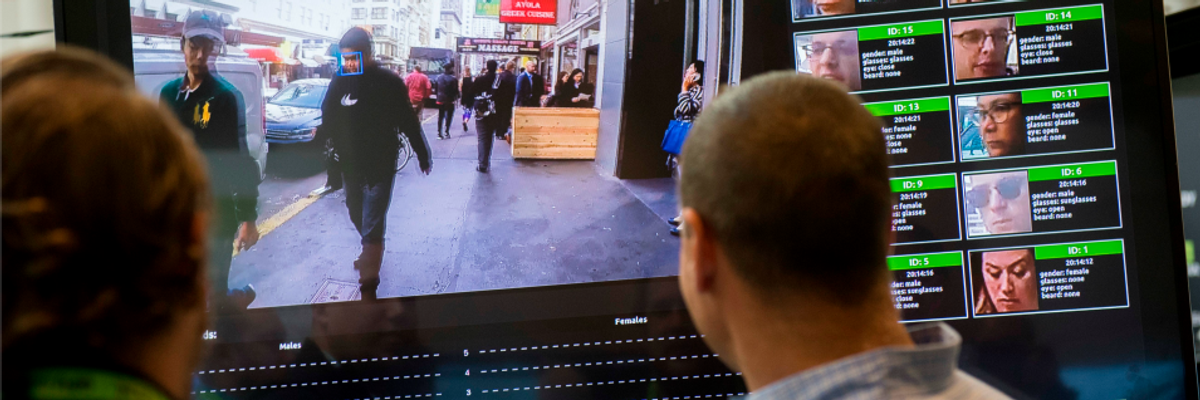
A display shows a facial recognition system for law enforcement during a conference in Washington, D.C. on November 1, 2017. (Photo: Saul Loeb/AFP via Getty Images)
Amazon's proclaimed commitment Wednesday to impose a one-year moratorium on police use of its facial recognition software was immediately criticized by rights groups as "nothing more than a public relations stunt" that doesn't address the fundamental privacy threats posed by the technology.
In a statement announcing the temporary ban, Amazon said it hopes "this one-year moratorium might give Congress enough time to implement appropriate rules, and we stand ready to help if requested." The tech company has come under fire in recent days for voicing support for nationwide protests against law enforcement abuses while simultaneously selling surveillance technology to police departments across the United States.
"Face recognition technology gives governments the unprecedented power to spy on us wherever we go. It fuels police abuse. This surveillance technology must be stopped."
--Nicole Ozer, ACLU of North Carolina
Evan Greer, deputy director of digital privacy group Fight for the Future, warned that Amazon is offering to help Congress craft new regulations "because they want their corporate lawyers to help write the legislation to ensure that it's friendly to their surveillance capitalist business model."
"Amazon knows that facial recognition software is dangerous," said Greer. "They know it's the perfect tool for tyranny. They know it's racist--and that in the hands of police it will simply exacerbate systemic discrimination in our criminal justice system."
"The reality is that facial recognition technology is too dangerous to be used at all," Greer added. "Like nuclear or biological weapons, it poses such a profound threat to the future of humanity that it should be banned outright. Lawmakers need to stop pandering to Big Tech companies and corrupt law enforcement agencies and do their jobs."
Amazon's announcement comes just days after tech giant IBM said it will no longer sell facial recognition software or research the technology, citing growing concerns about its use "for mass surveillance, racial profiling, violations of basic human rights and freedoms, or any purpose which is not consistent with our values."
In a 2018 test of Amazon's Rekognition service--which the company markets as "fast and accurate" facial recognition tool--the ACLU found that the "the software incorrectly matched 28 members of Congress, identifying them as other people who have been arrested for a crime."
"The false matches were disproportionately of people of color, including six members of the Congressional Black Caucus," the ACLU said. "These results demonstrate why Congress should join the ACLU in calling for a moratorium on law enforcement use of face surveillance."
Nicole Ozer, technology and civil liberties director with the ACLU of Northern California, said in a statement Wednesday that Amazon's one-year moratorium on police use of its technology is not nearly sufficient.
"This surveillance technology's threat to our civil rights and civil liberties will not disappear in a year," said Ozer. "Amazon must fully commit to a blanket moratorium on law enforcement use of face recognition until the dangers can be fully addressed, and it must press Congress and legislatures across the country to do the same. They should also commit to stop selling surveillance systems like Ring that fuel the over-policing of communities of color."
"Face recognition technology gives governments the unprecedented power to spy on us wherever we go," Ozer said. "It fuels police abuse. This surveillance technology must be stopped."
Dear Common Dreams reader, It’s been nearly 30 years since I co-founded Common Dreams with my late wife, Lina Newhouser. We had the radical notion that journalism should serve the public good, not corporate profits. It was clear to us from the outset what it would take to build such a project. No paid advertisements. No corporate sponsors. No millionaire publisher telling us what to think or do. Many people said we wouldn't last a year, but we proved those doubters wrong. Together with a tremendous team of journalists and dedicated staff, we built an independent media outlet free from the constraints of profits and corporate control. Our mission has always been simple: To inform. To inspire. To ignite change for the common good. Building Common Dreams was not easy. Our survival was never guaranteed. When you take on the most powerful forces—Wall Street greed, fossil fuel industry destruction, Big Tech lobbyists, and uber-rich oligarchs who have spent billions upon billions rigging the economy and democracy in their favor—the only bulwark you have is supporters who believe in your work. But here’s the urgent message from me today. It's never been this bad out there. And it's never been this hard to keep us going. At the very moment Common Dreams is most needed, the threats we face are intensifying. We need your support now more than ever. We don't accept corporate advertising and never will. We don't have a paywall because we don't think people should be blocked from critical news based on their ability to pay. Everything we do is funded by the donations of readers like you. When everyone does the little they can afford, we are strong. But if that support retreats or dries up, so do we. Will you donate now to make sure Common Dreams not only survives but thrives? —Craig Brown, Co-founder |
Amazon's proclaimed commitment Wednesday to impose a one-year moratorium on police use of its facial recognition software was immediately criticized by rights groups as "nothing more than a public relations stunt" that doesn't address the fundamental privacy threats posed by the technology.
In a statement announcing the temporary ban, Amazon said it hopes "this one-year moratorium might give Congress enough time to implement appropriate rules, and we stand ready to help if requested." The tech company has come under fire in recent days for voicing support for nationwide protests against law enforcement abuses while simultaneously selling surveillance technology to police departments across the United States.
"Face recognition technology gives governments the unprecedented power to spy on us wherever we go. It fuels police abuse. This surveillance technology must be stopped."
--Nicole Ozer, ACLU of North Carolina
Evan Greer, deputy director of digital privacy group Fight for the Future, warned that Amazon is offering to help Congress craft new regulations "because they want their corporate lawyers to help write the legislation to ensure that it's friendly to their surveillance capitalist business model."
"Amazon knows that facial recognition software is dangerous," said Greer. "They know it's the perfect tool for tyranny. They know it's racist--and that in the hands of police it will simply exacerbate systemic discrimination in our criminal justice system."
"The reality is that facial recognition technology is too dangerous to be used at all," Greer added. "Like nuclear or biological weapons, it poses such a profound threat to the future of humanity that it should be banned outright. Lawmakers need to stop pandering to Big Tech companies and corrupt law enforcement agencies and do their jobs."
Amazon's announcement comes just days after tech giant IBM said it will no longer sell facial recognition software or research the technology, citing growing concerns about its use "for mass surveillance, racial profiling, violations of basic human rights and freedoms, or any purpose which is not consistent with our values."
In a 2018 test of Amazon's Rekognition service--which the company markets as "fast and accurate" facial recognition tool--the ACLU found that the "the software incorrectly matched 28 members of Congress, identifying them as other people who have been arrested for a crime."
"The false matches were disproportionately of people of color, including six members of the Congressional Black Caucus," the ACLU said. "These results demonstrate why Congress should join the ACLU in calling for a moratorium on law enforcement use of face surveillance."
Nicole Ozer, technology and civil liberties director with the ACLU of Northern California, said in a statement Wednesday that Amazon's one-year moratorium on police use of its technology is not nearly sufficient.
"This surveillance technology's threat to our civil rights and civil liberties will not disappear in a year," said Ozer. "Amazon must fully commit to a blanket moratorium on law enforcement use of face recognition until the dangers can be fully addressed, and it must press Congress and legislatures across the country to do the same. They should also commit to stop selling surveillance systems like Ring that fuel the over-policing of communities of color."
"Face recognition technology gives governments the unprecedented power to spy on us wherever we go," Ozer said. "It fuels police abuse. This surveillance technology must be stopped."
Amazon's proclaimed commitment Wednesday to impose a one-year moratorium on police use of its facial recognition software was immediately criticized by rights groups as "nothing more than a public relations stunt" that doesn't address the fundamental privacy threats posed by the technology.
In a statement announcing the temporary ban, Amazon said it hopes "this one-year moratorium might give Congress enough time to implement appropriate rules, and we stand ready to help if requested." The tech company has come under fire in recent days for voicing support for nationwide protests against law enforcement abuses while simultaneously selling surveillance technology to police departments across the United States.
"Face recognition technology gives governments the unprecedented power to spy on us wherever we go. It fuels police abuse. This surveillance technology must be stopped."
--Nicole Ozer, ACLU of North Carolina
Evan Greer, deputy director of digital privacy group Fight for the Future, warned that Amazon is offering to help Congress craft new regulations "because they want their corporate lawyers to help write the legislation to ensure that it's friendly to their surveillance capitalist business model."
"Amazon knows that facial recognition software is dangerous," said Greer. "They know it's the perfect tool for tyranny. They know it's racist--and that in the hands of police it will simply exacerbate systemic discrimination in our criminal justice system."
"The reality is that facial recognition technology is too dangerous to be used at all," Greer added. "Like nuclear or biological weapons, it poses such a profound threat to the future of humanity that it should be banned outright. Lawmakers need to stop pandering to Big Tech companies and corrupt law enforcement agencies and do their jobs."
Amazon's announcement comes just days after tech giant IBM said it will no longer sell facial recognition software or research the technology, citing growing concerns about its use "for mass surveillance, racial profiling, violations of basic human rights and freedoms, or any purpose which is not consistent with our values."
In a 2018 test of Amazon's Rekognition service--which the company markets as "fast and accurate" facial recognition tool--the ACLU found that the "the software incorrectly matched 28 members of Congress, identifying them as other people who have been arrested for a crime."
"The false matches were disproportionately of people of color, including six members of the Congressional Black Caucus," the ACLU said. "These results demonstrate why Congress should join the ACLU in calling for a moratorium on law enforcement use of face surveillance."
Nicole Ozer, technology and civil liberties director with the ACLU of Northern California, said in a statement Wednesday that Amazon's one-year moratorium on police use of its technology is not nearly sufficient.
"This surveillance technology's threat to our civil rights and civil liberties will not disappear in a year," said Ozer. "Amazon must fully commit to a blanket moratorium on law enforcement use of face recognition until the dangers can be fully addressed, and it must press Congress and legislatures across the country to do the same. They should also commit to stop selling surveillance systems like Ring that fuel the over-policing of communities of color."
"Face recognition technology gives governments the unprecedented power to spy on us wherever we go," Ozer said. "It fuels police abuse. This surveillance technology must be stopped."