SUBSCRIBE TO OUR FREE NEWSLETTER
Daily news & progressive opinion—funded by the people, not the corporations—delivered straight to your inbox.
5
#000000
#FFFFFF
To donate by check, phone, or other method, see our More Ways to Give page.
Daily news & progressive opinion—funded by the people, not the corporations—delivered straight to your inbox.
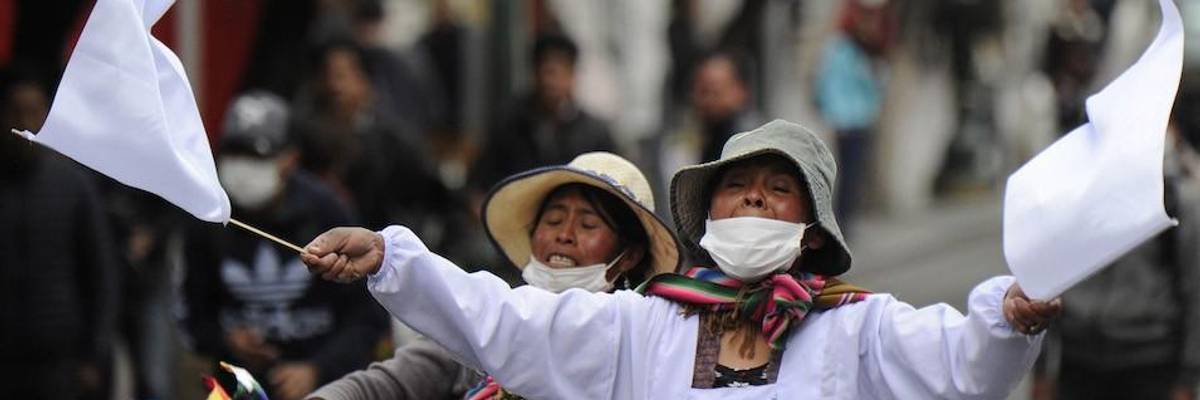
A supporter of Bolivian ex-President Evo Morales waves white flags during clashes with riot police following a protest in La Paz on November 13, 2019. (Photo: Jorge Bernl/AFP/Getty Images)
Seven years after former President Evo Morales expelled the organization from his country, claiming it was undermining his government, USAID is returning to Bolivia at the invitation of Jeanine Anez's coup government to monitor elections in the Latin American nation set for May 3.
Officials from USAID and the U.S.-dominated Organization for American States (OAS) arrived in Bolivia Thursday to "give technical aid to the election process in Bolivia."
Students of history should approach these developments with a critical eye, said Latin American historian Thomas Field.
"With USAID and OAS assisting in the May 2020 election, we can be sure its goal will be similar to Bolivia's 1966 election (following 64 coup), which CIA steered to ensure country returned to constitutionality in way that meshed U.S. interests," Field tweeted.
The Morales government expelled USAID from Bolivia on May 1, 2013 due to the U.S. agency's repeated actions conspiring "against the people and especially against the country" of Bolivia.
The right-wing Anez government, which unilaterally declared its own legitimacy in November after toppling the democratically-elected Morales, has focused on privatizating Bolivian resources like the country's vast lithium deposits, the rolling back of Morales-era reforms, and closer ties to the U.S.
In remarks Thursday, Anez claimed that the country was on the up and up following the coup that led to Morales' resignation in November.
"Bolivia is experiencing a process of democratic recovery," said Anez. "I was reviewing studies of social behavior and the level of optimism and hope of Bolivians has increased in the last month."
President Donald Trump's White House has welcomed the change in Bolivia, though critics of Anez urged caution from Washington with respect to supporting the new government in comments to the Associated Press.
"The Trump administration has clearly picked sides," Kathryn Ledebur, director of the Andean Information Network, told AP. "But it should also highlight concerns about human rights violations and erosion of democratic rights."
Progressives questioned the motivation of the White House to send aid in advance of the election.
"Trump recently described this initiative of now giving aid to Bolivia as 'vital to the national interests of the U.S.,'" said one activist, "so you know, nothing good."
Dear Common Dreams reader, It’s been nearly 30 years since I co-founded Common Dreams with my late wife, Lina Newhouser. We had the radical notion that journalism should serve the public good, not corporate profits. It was clear to us from the outset what it would take to build such a project. No paid advertisements. No corporate sponsors. No millionaire publisher telling us what to think or do. Many people said we wouldn't last a year, but we proved those doubters wrong. Together with a tremendous team of journalists and dedicated staff, we built an independent media outlet free from the constraints of profits and corporate control. Our mission has always been simple: To inform. To inspire. To ignite change for the common good. Building Common Dreams was not easy. Our survival was never guaranteed. When you take on the most powerful forces—Wall Street greed, fossil fuel industry destruction, Big Tech lobbyists, and uber-rich oligarchs who have spent billions upon billions rigging the economy and democracy in their favor—the only bulwark you have is supporters who believe in your work. But here’s the urgent message from me today. It's never been this bad out there. And it's never been this hard to keep us going. At the very moment Common Dreams is most needed, the threats we face are intensifying. We need your support now more than ever. We don't accept corporate advertising and never will. We don't have a paywall because we don't think people should be blocked from critical news based on their ability to pay. Everything we do is funded by the donations of readers like you. When everyone does the little they can afford, we are strong. But if that support retreats or dries up, so do we. Will you donate now to make sure Common Dreams not only survives but thrives? —Craig Brown, Co-founder |
Seven years after former President Evo Morales expelled the organization from his country, claiming it was undermining his government, USAID is returning to Bolivia at the invitation of Jeanine Anez's coup government to monitor elections in the Latin American nation set for May 3.
Officials from USAID and the U.S.-dominated Organization for American States (OAS) arrived in Bolivia Thursday to "give technical aid to the election process in Bolivia."
Students of history should approach these developments with a critical eye, said Latin American historian Thomas Field.
"With USAID and OAS assisting in the May 2020 election, we can be sure its goal will be similar to Bolivia's 1966 election (following 64 coup), which CIA steered to ensure country returned to constitutionality in way that meshed U.S. interests," Field tweeted.
The Morales government expelled USAID from Bolivia on May 1, 2013 due to the U.S. agency's repeated actions conspiring "against the people and especially against the country" of Bolivia.
The right-wing Anez government, which unilaterally declared its own legitimacy in November after toppling the democratically-elected Morales, has focused on privatizating Bolivian resources like the country's vast lithium deposits, the rolling back of Morales-era reforms, and closer ties to the U.S.
In remarks Thursday, Anez claimed that the country was on the up and up following the coup that led to Morales' resignation in November.
"Bolivia is experiencing a process of democratic recovery," said Anez. "I was reviewing studies of social behavior and the level of optimism and hope of Bolivians has increased in the last month."
President Donald Trump's White House has welcomed the change in Bolivia, though critics of Anez urged caution from Washington with respect to supporting the new government in comments to the Associated Press.
"The Trump administration has clearly picked sides," Kathryn Ledebur, director of the Andean Information Network, told AP. "But it should also highlight concerns about human rights violations and erosion of democratic rights."
Progressives questioned the motivation of the White House to send aid in advance of the election.
"Trump recently described this initiative of now giving aid to Bolivia as 'vital to the national interests of the U.S.,'" said one activist, "so you know, nothing good."
Seven years after former President Evo Morales expelled the organization from his country, claiming it was undermining his government, USAID is returning to Bolivia at the invitation of Jeanine Anez's coup government to monitor elections in the Latin American nation set for May 3.
Officials from USAID and the U.S.-dominated Organization for American States (OAS) arrived in Bolivia Thursday to "give technical aid to the election process in Bolivia."
Students of history should approach these developments with a critical eye, said Latin American historian Thomas Field.
"With USAID and OAS assisting in the May 2020 election, we can be sure its goal will be similar to Bolivia's 1966 election (following 64 coup), which CIA steered to ensure country returned to constitutionality in way that meshed U.S. interests," Field tweeted.
The Morales government expelled USAID from Bolivia on May 1, 2013 due to the U.S. agency's repeated actions conspiring "against the people and especially against the country" of Bolivia.
The right-wing Anez government, which unilaterally declared its own legitimacy in November after toppling the democratically-elected Morales, has focused on privatizating Bolivian resources like the country's vast lithium deposits, the rolling back of Morales-era reforms, and closer ties to the U.S.
In remarks Thursday, Anez claimed that the country was on the up and up following the coup that led to Morales' resignation in November.
"Bolivia is experiencing a process of democratic recovery," said Anez. "I was reviewing studies of social behavior and the level of optimism and hope of Bolivians has increased in the last month."
President Donald Trump's White House has welcomed the change in Bolivia, though critics of Anez urged caution from Washington with respect to supporting the new government in comments to the Associated Press.
"The Trump administration has clearly picked sides," Kathryn Ledebur, director of the Andean Information Network, told AP. "But it should also highlight concerns about human rights violations and erosion of democratic rights."
Progressives questioned the motivation of the White House to send aid in advance of the election.
"Trump recently described this initiative of now giving aid to Bolivia as 'vital to the national interests of the U.S.,'" said one activist, "so you know, nothing good."