SUBSCRIBE TO OUR FREE NEWSLETTER
Daily news & progressive opinion—funded by the people, not the corporations—delivered straight to your inbox.
5
#000000
#FFFFFF
To donate by check, phone, or other method, see our More Ways to Give page.
Daily news & progressive opinion—funded by the people, not the corporations—delivered straight to your inbox.
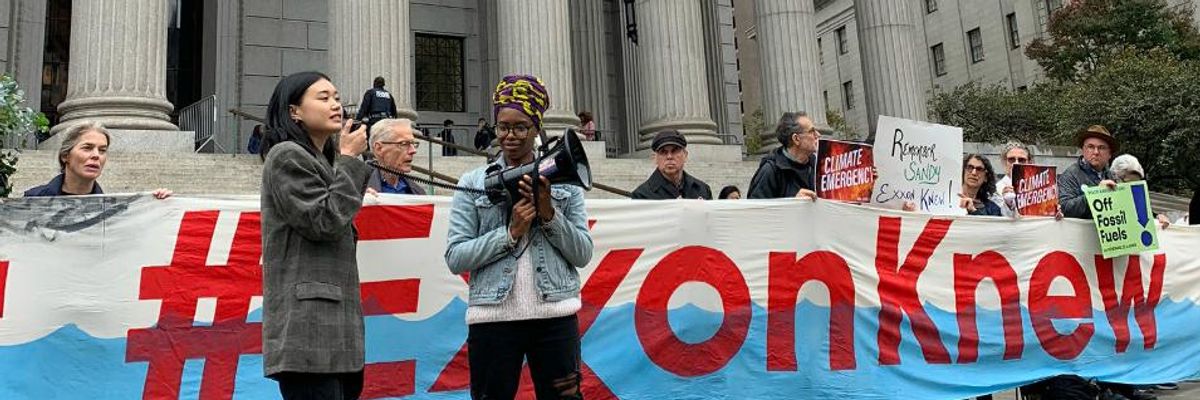
Supporters of the New York Attorney General's case against ExxonMobil gathered outside the New York County Supreme Court on Oct. 22. (Photo: Lindsay Meiman/Twitter)
Dozens of climate activists rallied outside the New York County Supreme Court Tuesday to support state Attorney General Letitia James on the first day of a nationally watched case that aims to hold ExxonMobil accountable for defrauding investors about the business risks of continuing to burn fossil fuels.
"This is Big Oil's Big Tobacco moment. And a warning for Big Polluters across the globe and the industries that continue to enable them in fueling the climate crisis."
--Sriram Madhusoodanan, Corporate Accountability
Supporters of the People of New York v. ExxonMobil trial, which is expected to last three weeks, carried a 100-foot long banner that read, "Climate Crisis / #ExxonKnew / Make Them Pay."
"We're here today in solidarity with Attorney General James, honoring all the Black women, people of color, and frontline communities fighting relentlessly for climate justice," Dominique Thomas, a New Yorker and Northeast field organizer for the environmental group 350.org, said in a statement.
"The likes of Exxon have put us on a first name with climate chaos: Sandy, Maria, Katrina, Paradise lost. The list goes on and on," Thomas added. "It's time to make them pay for their destruction."
James' predecessor Barbara Underwood filed suit against ExxonMobil in October of 2018, after New York state investigated the fossil fuel giant for more than three years. The lawsuit accuses (pdf) the company of engaging in a "longstanding fraudulent scheme" to deceive investors "concerning the company's management of the risks posed to its business by climate change."
Although the case isn't directly about ExxonMobil's contributions to the human-caused climate crisis, the state's investigation--launched by Underwood's predecessor Eric Schneiderman--became public in 2015, shortly after the Los Angeles Times and InsideClimate News published explosive reports detailing the company's decades of "manufacturing doubt about the scientific consensus that its own scientists had confirmed."
"Corporate deception regarding the impact of fossil fuels on the planet is a matter of life or death," Adelynne Dadivas, environmental coordinator for NYPIRG, said Tuesday. "Harm to investors is one small part of the gross harm being caused, which generations to come will have to pay for. We support Attorney General Letitia James and her efforts to hold Exxon accountable for decades of attacks on the science and deception peddled to the public."
ExxonMobil, The New York Times reported Tuesday, "has vigorously fought the charges, arguing that they were politically motivated and should have been thrown out; the company maintains that the government's theory of its financial tools is flawed at best and, at worst, disingenuous."
Kathy Mulvey, fossil fuel accountability campaign director at the Union of Concerned Scientists, said that "ExxonMobil pulled out all the stops in an effort to keep this trial from reaching the courtroom, and used its vast legal and financial resources to attempt to intimidate community leaders, elected officials, and advocacy groups."
New York state prosecutors, in August court filings, accused ExxonMobil of trying to discourage witnesses from testifying against the company. In response, 350.org executive director May Boeve declared, "We won't be intimidated."
As the trial began in the New York, ExxonMobil faced the prospect of a second suit: Bloomberg reported last week that after threatening litigation for more than three years, "Massachusetts Attorney General Maura Healey is poised to sue ExxonMobil Corp. for allegedly deceiving consumers about the climate-warming impacts of fossil fuels."
ExxonMobil is also named in various climate liability cases filed by cities, counties, and the state of Rhode Island that aim to make polluters pay for the local consequences of the planetary crisis, such as more devastating natural disasters and rising sea levels.
The multi-pronged fight to hold fossil fuel companies accountable for fueling the climate crisis has provoked comparisons to the U.S. Justice Department's multibillion-dollar racketeering case against the tobacco industry over the dangers of smoking cigarettes.
Recalling a conversation from four years ago with Sharon Eubanks, a former DOJ attorney who prosecuted the cigarette case, climate reporter Emily Atkin addressed "how Big Oil mimics Big Tobacco" in her newsletter HEATED on Monday:
The parallels were as clear then as they are today. "The cigarette companies actively denied the harm of cigarette smoking, and concealed the results of what their own research developed," Eubanks told me at the time. "The motivation was money, and to avoid regulation."
Documents revealed three years ago by the Center for International Environmental Law found that the oil and tobacco industries have been using not only the same strategy, but the the same people, to downplay the dangers of their products. "From the 1950s onward, the oil and tobacco firms were using not only the same PR firms and same research institutes, but many of the same researchers," CIEL President Carroll Muffett said in a statement. "Again and again we found both the PR firms and the researchers worked first for oil, then for tobacco. It was a pedigree the tobacco companies recognized and sought out."
And today, former tobacco people are back working in support of the oil industry--by helping to dismantle climate regulations within the Trump administration's Environmental Protection Agency.
As Sriram Madhusoodanan of Corporate Accountability put it Tuesday: "This is Big Oil's Big Tobacco moment. And a warning for Big Polluters across the globe and the industries that continue to enable them in fueling the climate crisis."
"It's time for people in the U.S. and around the world to stand with courageous leaders like AG James and demand true climate leadership of all our government officials," Madhusoodanan said. "It's time to make Big Polluters pay."
Dear Common Dreams reader, It’s been nearly 30 years since I co-founded Common Dreams with my late wife, Lina Newhouser. We had the radical notion that journalism should serve the public good, not corporate profits. It was clear to us from the outset what it would take to build such a project. No paid advertisements. No corporate sponsors. No millionaire publisher telling us what to think or do. Many people said we wouldn't last a year, but we proved those doubters wrong. Together with a tremendous team of journalists and dedicated staff, we built an independent media outlet free from the constraints of profits and corporate control. Our mission has always been simple: To inform. To inspire. To ignite change for the common good. Building Common Dreams was not easy. Our survival was never guaranteed. When you take on the most powerful forces—Wall Street greed, fossil fuel industry destruction, Big Tech lobbyists, and uber-rich oligarchs who have spent billions upon billions rigging the economy and democracy in their favor—the only bulwark you have is supporters who believe in your work. But here’s the urgent message from me today. It's never been this bad out there. And it's never been this hard to keep us going. At the very moment Common Dreams is most needed, the threats we face are intensifying. We need your support now more than ever. We don't accept corporate advertising and never will. We don't have a paywall because we don't think people should be blocked from critical news based on their ability to pay. Everything we do is funded by the donations of readers like you. When everyone does the little they can afford, we are strong. But if that support retreats or dries up, so do we. Will you donate now to make sure Common Dreams not only survives but thrives? —Craig Brown, Co-founder |
Dozens of climate activists rallied outside the New York County Supreme Court Tuesday to support state Attorney General Letitia James on the first day of a nationally watched case that aims to hold ExxonMobil accountable for defrauding investors about the business risks of continuing to burn fossil fuels.
"This is Big Oil's Big Tobacco moment. And a warning for Big Polluters across the globe and the industries that continue to enable them in fueling the climate crisis."
--Sriram Madhusoodanan, Corporate Accountability
Supporters of the People of New York v. ExxonMobil trial, which is expected to last three weeks, carried a 100-foot long banner that read, "Climate Crisis / #ExxonKnew / Make Them Pay."
"We're here today in solidarity with Attorney General James, honoring all the Black women, people of color, and frontline communities fighting relentlessly for climate justice," Dominique Thomas, a New Yorker and Northeast field organizer for the environmental group 350.org, said in a statement.
"The likes of Exxon have put us on a first name with climate chaos: Sandy, Maria, Katrina, Paradise lost. The list goes on and on," Thomas added. "It's time to make them pay for their destruction."
James' predecessor Barbara Underwood filed suit against ExxonMobil in October of 2018, after New York state investigated the fossil fuel giant for more than three years. The lawsuit accuses (pdf) the company of engaging in a "longstanding fraudulent scheme" to deceive investors "concerning the company's management of the risks posed to its business by climate change."
Although the case isn't directly about ExxonMobil's contributions to the human-caused climate crisis, the state's investigation--launched by Underwood's predecessor Eric Schneiderman--became public in 2015, shortly after the Los Angeles Times and InsideClimate News published explosive reports detailing the company's decades of "manufacturing doubt about the scientific consensus that its own scientists had confirmed."
"Corporate deception regarding the impact of fossil fuels on the planet is a matter of life or death," Adelynne Dadivas, environmental coordinator for NYPIRG, said Tuesday. "Harm to investors is one small part of the gross harm being caused, which generations to come will have to pay for. We support Attorney General Letitia James and her efforts to hold Exxon accountable for decades of attacks on the science and deception peddled to the public."
ExxonMobil, The New York Times reported Tuesday, "has vigorously fought the charges, arguing that they were politically motivated and should have been thrown out; the company maintains that the government's theory of its financial tools is flawed at best and, at worst, disingenuous."
Kathy Mulvey, fossil fuel accountability campaign director at the Union of Concerned Scientists, said that "ExxonMobil pulled out all the stops in an effort to keep this trial from reaching the courtroom, and used its vast legal and financial resources to attempt to intimidate community leaders, elected officials, and advocacy groups."
New York state prosecutors, in August court filings, accused ExxonMobil of trying to discourage witnesses from testifying against the company. In response, 350.org executive director May Boeve declared, "We won't be intimidated."
As the trial began in the New York, ExxonMobil faced the prospect of a second suit: Bloomberg reported last week that after threatening litigation for more than three years, "Massachusetts Attorney General Maura Healey is poised to sue ExxonMobil Corp. for allegedly deceiving consumers about the climate-warming impacts of fossil fuels."
ExxonMobil is also named in various climate liability cases filed by cities, counties, and the state of Rhode Island that aim to make polluters pay for the local consequences of the planetary crisis, such as more devastating natural disasters and rising sea levels.
The multi-pronged fight to hold fossil fuel companies accountable for fueling the climate crisis has provoked comparisons to the U.S. Justice Department's multibillion-dollar racketeering case against the tobacco industry over the dangers of smoking cigarettes.
Recalling a conversation from four years ago with Sharon Eubanks, a former DOJ attorney who prosecuted the cigarette case, climate reporter Emily Atkin addressed "how Big Oil mimics Big Tobacco" in her newsletter HEATED on Monday:
The parallels were as clear then as they are today. "The cigarette companies actively denied the harm of cigarette smoking, and concealed the results of what their own research developed," Eubanks told me at the time. "The motivation was money, and to avoid regulation."
Documents revealed three years ago by the Center for International Environmental Law found that the oil and tobacco industries have been using not only the same strategy, but the the same people, to downplay the dangers of their products. "From the 1950s onward, the oil and tobacco firms were using not only the same PR firms and same research institutes, but many of the same researchers," CIEL President Carroll Muffett said in a statement. "Again and again we found both the PR firms and the researchers worked first for oil, then for tobacco. It was a pedigree the tobacco companies recognized and sought out."
And today, former tobacco people are back working in support of the oil industry--by helping to dismantle climate regulations within the Trump administration's Environmental Protection Agency.
As Sriram Madhusoodanan of Corporate Accountability put it Tuesday: "This is Big Oil's Big Tobacco moment. And a warning for Big Polluters across the globe and the industries that continue to enable them in fueling the climate crisis."
"It's time for people in the U.S. and around the world to stand with courageous leaders like AG James and demand true climate leadership of all our government officials," Madhusoodanan said. "It's time to make Big Polluters pay."
Dozens of climate activists rallied outside the New York County Supreme Court Tuesday to support state Attorney General Letitia James on the first day of a nationally watched case that aims to hold ExxonMobil accountable for defrauding investors about the business risks of continuing to burn fossil fuels.
"This is Big Oil's Big Tobacco moment. And a warning for Big Polluters across the globe and the industries that continue to enable them in fueling the climate crisis."
--Sriram Madhusoodanan, Corporate Accountability
Supporters of the People of New York v. ExxonMobil trial, which is expected to last three weeks, carried a 100-foot long banner that read, "Climate Crisis / #ExxonKnew / Make Them Pay."
"We're here today in solidarity with Attorney General James, honoring all the Black women, people of color, and frontline communities fighting relentlessly for climate justice," Dominique Thomas, a New Yorker and Northeast field organizer for the environmental group 350.org, said in a statement.
"The likes of Exxon have put us on a first name with climate chaos: Sandy, Maria, Katrina, Paradise lost. The list goes on and on," Thomas added. "It's time to make them pay for their destruction."
James' predecessor Barbara Underwood filed suit against ExxonMobil in October of 2018, after New York state investigated the fossil fuel giant for more than three years. The lawsuit accuses (pdf) the company of engaging in a "longstanding fraudulent scheme" to deceive investors "concerning the company's management of the risks posed to its business by climate change."
Although the case isn't directly about ExxonMobil's contributions to the human-caused climate crisis, the state's investigation--launched by Underwood's predecessor Eric Schneiderman--became public in 2015, shortly after the Los Angeles Times and InsideClimate News published explosive reports detailing the company's decades of "manufacturing doubt about the scientific consensus that its own scientists had confirmed."
"Corporate deception regarding the impact of fossil fuels on the planet is a matter of life or death," Adelynne Dadivas, environmental coordinator for NYPIRG, said Tuesday. "Harm to investors is one small part of the gross harm being caused, which generations to come will have to pay for. We support Attorney General Letitia James and her efforts to hold Exxon accountable for decades of attacks on the science and deception peddled to the public."
ExxonMobil, The New York Times reported Tuesday, "has vigorously fought the charges, arguing that they were politically motivated and should have been thrown out; the company maintains that the government's theory of its financial tools is flawed at best and, at worst, disingenuous."
Kathy Mulvey, fossil fuel accountability campaign director at the Union of Concerned Scientists, said that "ExxonMobil pulled out all the stops in an effort to keep this trial from reaching the courtroom, and used its vast legal and financial resources to attempt to intimidate community leaders, elected officials, and advocacy groups."
New York state prosecutors, in August court filings, accused ExxonMobil of trying to discourage witnesses from testifying against the company. In response, 350.org executive director May Boeve declared, "We won't be intimidated."
As the trial began in the New York, ExxonMobil faced the prospect of a second suit: Bloomberg reported last week that after threatening litigation for more than three years, "Massachusetts Attorney General Maura Healey is poised to sue ExxonMobil Corp. for allegedly deceiving consumers about the climate-warming impacts of fossil fuels."
ExxonMobil is also named in various climate liability cases filed by cities, counties, and the state of Rhode Island that aim to make polluters pay for the local consequences of the planetary crisis, such as more devastating natural disasters and rising sea levels.
The multi-pronged fight to hold fossil fuel companies accountable for fueling the climate crisis has provoked comparisons to the U.S. Justice Department's multibillion-dollar racketeering case against the tobacco industry over the dangers of smoking cigarettes.
Recalling a conversation from four years ago with Sharon Eubanks, a former DOJ attorney who prosecuted the cigarette case, climate reporter Emily Atkin addressed "how Big Oil mimics Big Tobacco" in her newsletter HEATED on Monday:
The parallels were as clear then as they are today. "The cigarette companies actively denied the harm of cigarette smoking, and concealed the results of what their own research developed," Eubanks told me at the time. "The motivation was money, and to avoid regulation."
Documents revealed three years ago by the Center for International Environmental Law found that the oil and tobacco industries have been using not only the same strategy, but the the same people, to downplay the dangers of their products. "From the 1950s onward, the oil and tobacco firms were using not only the same PR firms and same research institutes, but many of the same researchers," CIEL President Carroll Muffett said in a statement. "Again and again we found both the PR firms and the researchers worked first for oil, then for tobacco. It was a pedigree the tobacco companies recognized and sought out."
And today, former tobacco people are back working in support of the oil industry--by helping to dismantle climate regulations within the Trump administration's Environmental Protection Agency.
As Sriram Madhusoodanan of Corporate Accountability put it Tuesday: "This is Big Oil's Big Tobacco moment. And a warning for Big Polluters across the globe and the industries that continue to enable them in fueling the climate crisis."
"It's time for people in the U.S. and around the world to stand with courageous leaders like AG James and demand true climate leadership of all our government officials," Madhusoodanan said. "It's time to make Big Polluters pay."