SUBSCRIBE TO OUR FREE NEWSLETTER
Daily news & progressive opinion—funded by the people, not the corporations—delivered straight to your inbox.
5
#000000
#FFFFFF
To donate by check, phone, or other method, see our More Ways to Give page.
Daily news & progressive opinion—funded by the people, not the corporations—delivered straight to your inbox.
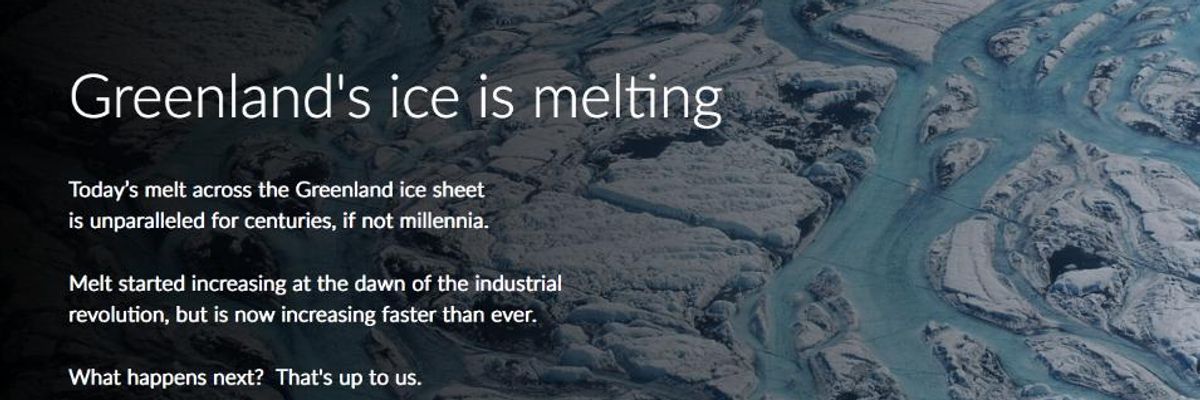
A team of researchers has published a paper in the British peer-reviewed journal Nature and put together a website detailing their findings from studying ice melt rates in Greenland. (Photo: greenlandmelt.pageflow.io)
Thanks to the human-made global climate crisis, Greenland's mile-thick ice sheet is melting at the fastest rate recorded for centuries, according to new research published in Nature on Wednesday--and the implications for sea-level rise have scientists more than concerned.
" Climate change is not a thing of the future. It's here now. It's clear."
--Dr. Luke Trusel, lead author
"The melting of the Greenland ice sheet is off the charts today," declared Dr. Luke Trusel, a professor of geology at Rowan University and lead author of the report.
"What we found with our ice cores is that it's melting today more than at any time within at least the last three and a half centuries," he said, "and probably, melting more today than any time in the last seven to eight thousand years."
Given that melting ice is significantly fueling sea-level rise, Trusel concluded: "How much Greenland melts matters. It matters to everyone living near a coastline. Climate change is not a thing of the future. It's here now. It's clear."
Trusel's team of international researchers analyzed ice cores extracted from Greenland, a massive island wedged between the Arctic and Atlantic Oceans. A primary takeaway from the study, Trusel said in a statement, is the speed of melting, especially over the past 25 years.
"It's not just increasing, it's accelerating," he explained. "That's a key concern for the future."
These latest findings, as Nature pointed out, "bolster a study published in March that found that West Greenland is melting faster than it has in at least 450 years." Erich Osterberg of Dartmouth College, who co-authored the earlier study, said the new paper expands that record to the whole ice sheet.
The new analysis, the journal noted, also suggests that thawing and refreezing on the ice sheet's top layer has led to
a vicious cycle: bright snow is replaced by darker patches of ice that absorb more heat from the sun, further warming Greenland. The melting and freezing cycle also makes ice below the surface less permeable, so more runoff is shunted to the ocean rather than trickling down into the ice sheet.
Runoff from Greenland's ice sheet hit a 350-year high in 2012, when it dumped--according to Nature--240 million Olympic swimming pools worth of water into the ocean.
"It's one more nail in the coffin of climate denial."
--Josh Willis, NASA
Despite mounting research on anthropogenic global warming and alarm among scientists about the closing window to avert climate catastrophe, the Trump administration and Republicans in Congress continue to push for fossil-fuel friendly policies and roll back regulations meant to curb planet-warming emissions.
Federal scientists, meanwhile, are among those warning about the climate crisis. Responding to Trusel's research, NASA oceanographer and Greenland expert Josh Willis told Mashable, "It's one more nail in the coffin of climate denial." He added, "I don't know how many more nails we need."
The new findings--also published on a publicly-accessible website--and experts' subsequent warnings follow a record-setting warm winter in the Arctic earlier this year that left researchers "staggered" and culminated in the area's oldest and thickest sea ice, off the northern coast of Greenland, breaking up for the first time on record.
Dear Common Dreams reader, It’s been nearly 30 years since I co-founded Common Dreams with my late wife, Lina Newhouser. We had the radical notion that journalism should serve the public good, not corporate profits. It was clear to us from the outset what it would take to build such a project. No paid advertisements. No corporate sponsors. No millionaire publisher telling us what to think or do. Many people said we wouldn't last a year, but we proved those doubters wrong. Together with a tremendous team of journalists and dedicated staff, we built an independent media outlet free from the constraints of profits and corporate control. Our mission has always been simple: To inform. To inspire. To ignite change for the common good. Building Common Dreams was not easy. Our survival was never guaranteed. When you take on the most powerful forces—Wall Street greed, fossil fuel industry destruction, Big Tech lobbyists, and uber-rich oligarchs who have spent billions upon billions rigging the economy and democracy in their favor—the only bulwark you have is supporters who believe in your work. But here’s the urgent message from me today. It's never been this bad out there. And it's never been this hard to keep us going. At the very moment Common Dreams is most needed, the threats we face are intensifying. We need your support now more than ever. We don't accept corporate advertising and never will. We don't have a paywall because we don't think people should be blocked from critical news based on their ability to pay. Everything we do is funded by the donations of readers like you. When everyone does the little they can afford, we are strong. But if that support retreats or dries up, so do we. Will you donate now to make sure Common Dreams not only survives but thrives? —Craig Brown, Co-founder |
Thanks to the human-made global climate crisis, Greenland's mile-thick ice sheet is melting at the fastest rate recorded for centuries, according to new research published in Nature on Wednesday--and the implications for sea-level rise have scientists more than concerned.
" Climate change is not a thing of the future. It's here now. It's clear."
--Dr. Luke Trusel, lead author
"The melting of the Greenland ice sheet is off the charts today," declared Dr. Luke Trusel, a professor of geology at Rowan University and lead author of the report.
"What we found with our ice cores is that it's melting today more than at any time within at least the last three and a half centuries," he said, "and probably, melting more today than any time in the last seven to eight thousand years."
Given that melting ice is significantly fueling sea-level rise, Trusel concluded: "How much Greenland melts matters. It matters to everyone living near a coastline. Climate change is not a thing of the future. It's here now. It's clear."
Trusel's team of international researchers analyzed ice cores extracted from Greenland, a massive island wedged between the Arctic and Atlantic Oceans. A primary takeaway from the study, Trusel said in a statement, is the speed of melting, especially over the past 25 years.
"It's not just increasing, it's accelerating," he explained. "That's a key concern for the future."
These latest findings, as Nature pointed out, "bolster a study published in March that found that West Greenland is melting faster than it has in at least 450 years." Erich Osterberg of Dartmouth College, who co-authored the earlier study, said the new paper expands that record to the whole ice sheet.
The new analysis, the journal noted, also suggests that thawing and refreezing on the ice sheet's top layer has led to
a vicious cycle: bright snow is replaced by darker patches of ice that absorb more heat from the sun, further warming Greenland. The melting and freezing cycle also makes ice below the surface less permeable, so more runoff is shunted to the ocean rather than trickling down into the ice sheet.
Runoff from Greenland's ice sheet hit a 350-year high in 2012, when it dumped--according to Nature--240 million Olympic swimming pools worth of water into the ocean.
"It's one more nail in the coffin of climate denial."
--Josh Willis, NASA
Despite mounting research on anthropogenic global warming and alarm among scientists about the closing window to avert climate catastrophe, the Trump administration and Republicans in Congress continue to push for fossil-fuel friendly policies and roll back regulations meant to curb planet-warming emissions.
Federal scientists, meanwhile, are among those warning about the climate crisis. Responding to Trusel's research, NASA oceanographer and Greenland expert Josh Willis told Mashable, "It's one more nail in the coffin of climate denial." He added, "I don't know how many more nails we need."
The new findings--also published on a publicly-accessible website--and experts' subsequent warnings follow a record-setting warm winter in the Arctic earlier this year that left researchers "staggered" and culminated in the area's oldest and thickest sea ice, off the northern coast of Greenland, breaking up for the first time on record.
Thanks to the human-made global climate crisis, Greenland's mile-thick ice sheet is melting at the fastest rate recorded for centuries, according to new research published in Nature on Wednesday--and the implications for sea-level rise have scientists more than concerned.
" Climate change is not a thing of the future. It's here now. It's clear."
--Dr. Luke Trusel, lead author
"The melting of the Greenland ice sheet is off the charts today," declared Dr. Luke Trusel, a professor of geology at Rowan University and lead author of the report.
"What we found with our ice cores is that it's melting today more than at any time within at least the last three and a half centuries," he said, "and probably, melting more today than any time in the last seven to eight thousand years."
Given that melting ice is significantly fueling sea-level rise, Trusel concluded: "How much Greenland melts matters. It matters to everyone living near a coastline. Climate change is not a thing of the future. It's here now. It's clear."
Trusel's team of international researchers analyzed ice cores extracted from Greenland, a massive island wedged between the Arctic and Atlantic Oceans. A primary takeaway from the study, Trusel said in a statement, is the speed of melting, especially over the past 25 years.
"It's not just increasing, it's accelerating," he explained. "That's a key concern for the future."
These latest findings, as Nature pointed out, "bolster a study published in March that found that West Greenland is melting faster than it has in at least 450 years." Erich Osterberg of Dartmouth College, who co-authored the earlier study, said the new paper expands that record to the whole ice sheet.
The new analysis, the journal noted, also suggests that thawing and refreezing on the ice sheet's top layer has led to
a vicious cycle: bright snow is replaced by darker patches of ice that absorb more heat from the sun, further warming Greenland. The melting and freezing cycle also makes ice below the surface less permeable, so more runoff is shunted to the ocean rather than trickling down into the ice sheet.
Runoff from Greenland's ice sheet hit a 350-year high in 2012, when it dumped--according to Nature--240 million Olympic swimming pools worth of water into the ocean.
"It's one more nail in the coffin of climate denial."
--Josh Willis, NASA
Despite mounting research on anthropogenic global warming and alarm among scientists about the closing window to avert climate catastrophe, the Trump administration and Republicans in Congress continue to push for fossil-fuel friendly policies and roll back regulations meant to curb planet-warming emissions.
Federal scientists, meanwhile, are among those warning about the climate crisis. Responding to Trusel's research, NASA oceanographer and Greenland expert Josh Willis told Mashable, "It's one more nail in the coffin of climate denial." He added, "I don't know how many more nails we need."
The new findings--also published on a publicly-accessible website--and experts' subsequent warnings follow a record-setting warm winter in the Arctic earlier this year that left researchers "staggered" and culminated in the area's oldest and thickest sea ice, off the northern coast of Greenland, breaking up for the first time on record.