SUBSCRIBE TO OUR FREE NEWSLETTER
Daily news & progressive opinion—funded by the people, not the corporations—delivered straight to your inbox.
5
#000000
#FFFFFF
To donate by check, phone, or other method, see our More Ways to Give page.
Daily news & progressive opinion—funded by the people, not the corporations—delivered straight to your inbox.
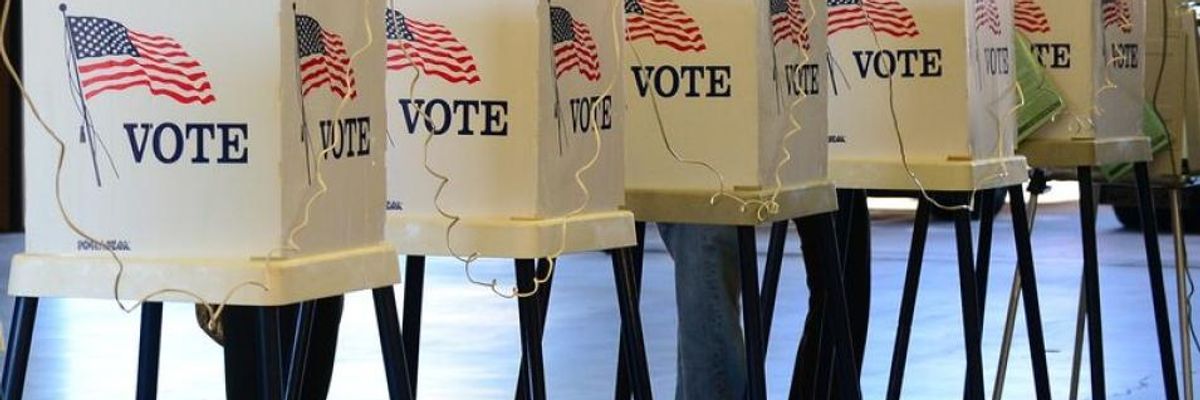
Maryland could become the 11th state to enact automatic voter registration. (Frederic Brown/AFP via Getty Images)
The Maryland legislature on Wednesday sent a bill to Republican Gov. Larry Hogan's desk in hopes of becoming the 11th state to automatically register all eligible citizens to vote when they interact with state agencies.
"Creating an automatic registration program that links voting to everyday activities, like getting a driver's license or collecting health benefits, ensures greater voter participation which is the essential ingredient for any thriving democracy."
--state Sen. Will C. Smith Jr.
The Secure and Accessible Registration Act (S.B.1048/H.B.152) would automatically register eligible voters who have official interactions with the state's Motor Vehicle Administration, healthcare exchange, or social services offices.
The bill was sponsored by state Delegate Eric Leudtke and Sen. Will C. Smith Jr., who said that with its passage, "Maryland has taken a profound step forward in expanding access to the ballot."
"Creating an automatic registration program that links voting to everyday activities, like getting a driver's license or collecting health benefits," Smith added, "ensures greater voter participation which is the essential ingredient for any thriving democracy."
An "ecstatic" Luedtke noted that the bill's success was the result of "four years of extraordinary work by a diverse coalition of legislators and advocates" who were determined to make Maryland "a national leader on breaking down barriers to voting."
The lawmakers and advocacy groups who pushed for the bill called on Hogan--who has not yet publicly weighed in--to urgently sign it into law.
"Maryland's move today is further proof that the momentum for automatic voter registration continues," observed Natalie E. Tennant, manager for state advocacy at the Brennan Center for Justice. "We urge Governor Hogan to sign the bill and not only expand access to voting, but make the process more practical and efficient in his state."
If the governor neglects to sign bill, the legislature is well positioned to override his veto.
The legislative victory came after state lawmakers passed a constitutional amendment on Monday to legalize same-day voter registration. The amendment will only take effect if it receives public approval as a ballot item in November.
Common Cause Maryland acting director Damon Effingham said the two measures "show Maryland's dedication to the foundational right to vote, and the broad support for protecting and expanding that right to all who are eligible."
These moves in Maryland come as more than a dozen other states are considering implementing similar programs, according to the Brennan Center. Amid renewed calls for other states to move forward with their proposals, Leudtke and others were quick to point to Maryland's bill as a model, because it is broader than some other registration measures that 10 states and D.C. have enacted in recent years.
Dear Common Dreams reader, It’s been nearly 30 years since I co-founded Common Dreams with my late wife, Lina Newhouser. We had the radical notion that journalism should serve the public good, not corporate profits. It was clear to us from the outset what it would take to build such a project. No paid advertisements. No corporate sponsors. No millionaire publisher telling us what to think or do. Many people said we wouldn't last a year, but we proved those doubters wrong. Together with a tremendous team of journalists and dedicated staff, we built an independent media outlet free from the constraints of profits and corporate control. Our mission has always been simple: To inform. To inspire. To ignite change for the common good. Building Common Dreams was not easy. Our survival was never guaranteed. When you take on the most powerful forces—Wall Street greed, fossil fuel industry destruction, Big Tech lobbyists, and uber-rich oligarchs who have spent billions upon billions rigging the economy and democracy in their favor—the only bulwark you have is supporters who believe in your work. But here’s the urgent message from me today. It's never been this bad out there. And it's never been this hard to keep us going. At the very moment Common Dreams is most needed, the threats we face are intensifying. We need your support now more than ever. We don't accept corporate advertising and never will. We don't have a paywall because we don't think people should be blocked from critical news based on their ability to pay. Everything we do is funded by the donations of readers like you. When everyone does the little they can afford, we are strong. But if that support retreats or dries up, so do we. Will you donate now to make sure Common Dreams not only survives but thrives? —Craig Brown, Co-founder |
The Maryland legislature on Wednesday sent a bill to Republican Gov. Larry Hogan's desk in hopes of becoming the 11th state to automatically register all eligible citizens to vote when they interact with state agencies.
"Creating an automatic registration program that links voting to everyday activities, like getting a driver's license or collecting health benefits, ensures greater voter participation which is the essential ingredient for any thriving democracy."
--state Sen. Will C. Smith Jr.
The Secure and Accessible Registration Act (S.B.1048/H.B.152) would automatically register eligible voters who have official interactions with the state's Motor Vehicle Administration, healthcare exchange, or social services offices.
The bill was sponsored by state Delegate Eric Leudtke and Sen. Will C. Smith Jr., who said that with its passage, "Maryland has taken a profound step forward in expanding access to the ballot."
"Creating an automatic registration program that links voting to everyday activities, like getting a driver's license or collecting health benefits," Smith added, "ensures greater voter participation which is the essential ingredient for any thriving democracy."
An "ecstatic" Luedtke noted that the bill's success was the result of "four years of extraordinary work by a diverse coalition of legislators and advocates" who were determined to make Maryland "a national leader on breaking down barriers to voting."
The lawmakers and advocacy groups who pushed for the bill called on Hogan--who has not yet publicly weighed in--to urgently sign it into law.
"Maryland's move today is further proof that the momentum for automatic voter registration continues," observed Natalie E. Tennant, manager for state advocacy at the Brennan Center for Justice. "We urge Governor Hogan to sign the bill and not only expand access to voting, but make the process more practical and efficient in his state."
If the governor neglects to sign bill, the legislature is well positioned to override his veto.
The legislative victory came after state lawmakers passed a constitutional amendment on Monday to legalize same-day voter registration. The amendment will only take effect if it receives public approval as a ballot item in November.
Common Cause Maryland acting director Damon Effingham said the two measures "show Maryland's dedication to the foundational right to vote, and the broad support for protecting and expanding that right to all who are eligible."
These moves in Maryland come as more than a dozen other states are considering implementing similar programs, according to the Brennan Center. Amid renewed calls for other states to move forward with their proposals, Leudtke and others were quick to point to Maryland's bill as a model, because it is broader than some other registration measures that 10 states and D.C. have enacted in recent years.
The Maryland legislature on Wednesday sent a bill to Republican Gov. Larry Hogan's desk in hopes of becoming the 11th state to automatically register all eligible citizens to vote when they interact with state agencies.
"Creating an automatic registration program that links voting to everyday activities, like getting a driver's license or collecting health benefits, ensures greater voter participation which is the essential ingredient for any thriving democracy."
--state Sen. Will C. Smith Jr.
The Secure and Accessible Registration Act (S.B.1048/H.B.152) would automatically register eligible voters who have official interactions with the state's Motor Vehicle Administration, healthcare exchange, or social services offices.
The bill was sponsored by state Delegate Eric Leudtke and Sen. Will C. Smith Jr., who said that with its passage, "Maryland has taken a profound step forward in expanding access to the ballot."
"Creating an automatic registration program that links voting to everyday activities, like getting a driver's license or collecting health benefits," Smith added, "ensures greater voter participation which is the essential ingredient for any thriving democracy."
An "ecstatic" Luedtke noted that the bill's success was the result of "four years of extraordinary work by a diverse coalition of legislators and advocates" who were determined to make Maryland "a national leader on breaking down barriers to voting."
The lawmakers and advocacy groups who pushed for the bill called on Hogan--who has not yet publicly weighed in--to urgently sign it into law.
"Maryland's move today is further proof that the momentum for automatic voter registration continues," observed Natalie E. Tennant, manager for state advocacy at the Brennan Center for Justice. "We urge Governor Hogan to sign the bill and not only expand access to voting, but make the process more practical and efficient in his state."
If the governor neglects to sign bill, the legislature is well positioned to override his veto.
The legislative victory came after state lawmakers passed a constitutional amendment on Monday to legalize same-day voter registration. The amendment will only take effect if it receives public approval as a ballot item in November.
Common Cause Maryland acting director Damon Effingham said the two measures "show Maryland's dedication to the foundational right to vote, and the broad support for protecting and expanding that right to all who are eligible."
These moves in Maryland come as more than a dozen other states are considering implementing similar programs, according to the Brennan Center. Amid renewed calls for other states to move forward with their proposals, Leudtke and others were quick to point to Maryland's bill as a model, because it is broader than some other registration measures that 10 states and D.C. have enacted in recent years.