
According to reports of the declaration, the military-appointed Interim president Adly Mansour, has "tasked the armed forces, in cooperation with the police, to take all necessary measures to maintain security and order and to protect public and private property and the lives of citizens."
CNN International interviewed a doctor who says army soldiers raided the field hospital where the dead and dying had been brought and forced all medical personel to leave at gunpoint, leaving the wounded behind.
Journalists and witness were reporting scenes of chaos and carnage in and around the Rabaa camp, where most of the violence was concentrated. The Guardian's Patrick Kingsley sent this ominous tweet:
Twitter reports, including photos, from correspondents and witnesses on the ground in Cairo continued to provide the most up-to-date coverage of events. :
Tweets from @jonqueally/from-cairo
Reporting on the response to the "state-of-emergency" edict, Kingsley reports from Cairo:
At the Rabaa al-Adawiya camp, the immediate reaction to the emergency law has been one of derision.
"On 25 January 2011, we went out and refused the Mubarak - and one of the things we refused was his emergency law," said Ahmed Khadr, an engineer on the fringes of the sit-in who said he supported the protesters, but not Morsi's presidency.
"We continue to refuse it, and all other forms of oppression. The people enforcing it are Mubarak's men."
Nearby, Amar Ali - a former network administrator in Morsi's office, prior to his overthrow - promised to reject the law's restrictions.
"We will remain on the streets regardless of the emergency law. The law will make people angrier."
Journalists killed reporting military crackdown
Al-Jazeera reports:
Two journalists were also killed while covering the violence. Mick Deane, a cameraman for the UK-based Sky News channel, and Habiba Abd Elaziz, a reporter for the UAE-based Xpress newspaper, died from gunshot wounds.
ElBaradei resigns as vice president of interim government:
Mohamed ElBaradei, part of the leftist coalition that once backed the coup against Morsi and was appointed to serve as Vice President of the interim government, has now resigned from the post in protest of today's violent crackdown and the imposition of the 'state of emergency.'
According to Reuters:
In a resignation letter to Interim President Adly Mansour, ElBaradei said that "the beneficiaries of what happened today are those who call for violence, terrorism and the most extreme groups".
"As you know, I saw that there were peaceful ways to end this clash in society, there were proposed and acceptable solutions for beginnings that would take us to national consensus," he wrote.
"It has become difficult for me to continue bearing responsibility for decisions that I do not agree with and whose consequences I fear. I cannot bear the responsibility for one drop of blood."
EARLIER: Scores reported dead as Egyptian military violently clears pro-Morsi sit-ins with tear gas and gun fire
Reporters on the ground in Cairo describe "pools of blood," "near constant gunfire" and being targeted themselves by Egyptian security forces as violence gripped the city on Wednesday.
The number reported dead is fluctuating from "scores" to "hundreds" after the Egyptian military and security forces followed through with their threats to clear protest encampments set up by supporters of the ousted President Mohamed Morsi.
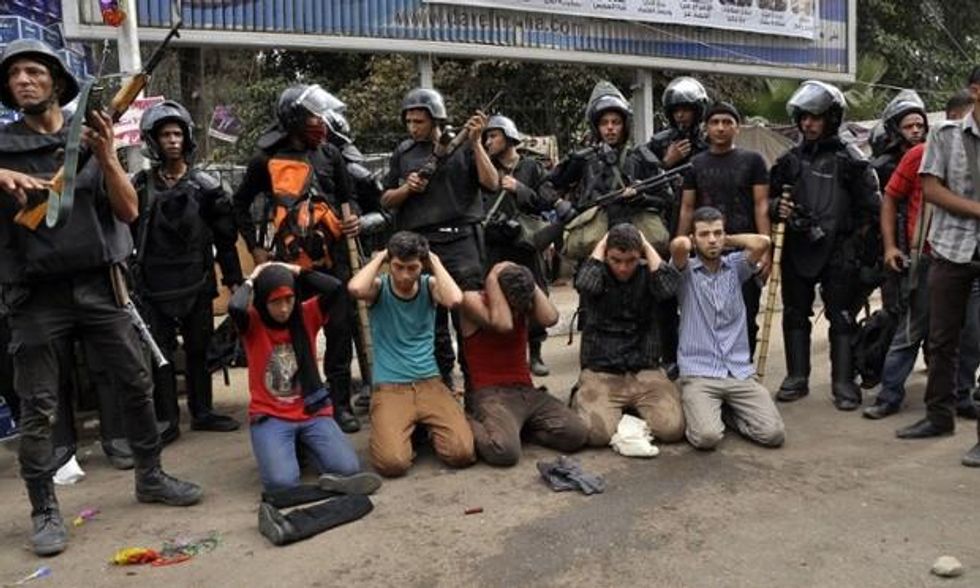
Attacking the sit-in camps with bulldozers, tear gas, and live fire, security forces were reported to have shot unarmed protesters as they tried to escape behind barricades or flee.
Agence France Presse and Reuters put the number at over forty people killed, but the Independent quotes members of the Muslim Brotherhood, the target of the violence, at several hundred with thousands wounded.
At least one field hospital near the Rabaa protest camp had been turned into a morgue, as the Independent's correspondent Alastair Beach documents in this tweet .
According to Reuters:
[A witness] saw soldiers fire at protesters as they tried to enter the besieged Rabaa camp insolidarity with other Morsi supporters. At least 20 were shot in the legs. Television pictures showed security forces shooting from nearby rooftops.
"Tear gas (canisters) were falling from the sky like rain. There are no ambulances inside. They closed every entrance," said protester Khaled Ahmed, 20, a university student wearing a hard hat with tears streaming down his face.
"There are women and children in there. God help them. This is a siege, a military attack on a civilian protest camp."
A Reuters correspondent saw dozens of people lying in the street with bullet and birdshot wounds. Pools of blood were everywhere.
"At 7 a.m. they came. Helicopters from the top and bulldozers from below. They smashed through our walls. Police and soldiers, they fired tear gas at children," said teacher Saleh Abdulaziz, 39, clutching a bleeding wound on his head.
"They continued to fire at protesters even when we begged them to stop."
The Guardian is live-blogging here.
_________________________________
According to reports of the declaration, the military-appointed Interim president Adly Mansour, has "tasked the armed forces, in cooperation with the police, to take all necessary measures to maintain security and order and to protect public and private property and the lives of citizens."
CNN International interviewed a doctor who says army soldiers raided the field hospital where the dead and dying had been brought and forced all medical personel to leave at gunpoint, leaving the wounded behind.
Journalists and witness were reporting scenes of chaos and carnage in and around the Rabaa camp, where most of the violence was concentrated. The Guardian's Patrick Kingsley sent this ominous tweet:
Twitter reports, including photos, from correspondents and witnesses on the ground in Cairo continued to provide the most up-to-date coverage of events. :
Tweets from @jonqueally/from-cairo
Reporting on the response to the "state-of-emergency" edict, Kingsley reports from Cairo:
At the Rabaa al-Adawiya camp, the immediate reaction to the emergency law has been one of derision.
"On 25 January 2011, we went out and refused the Mubarak - and one of the things we refused was his emergency law," said Ahmed Khadr, an engineer on the fringes of the sit-in who said he supported the protesters, but not Morsi's presidency.
"We continue to refuse it, and all other forms of oppression. The people enforcing it are Mubarak's men."
Nearby, Amar Ali - a former network administrator in Morsi's office, prior to his overthrow - promised to reject the law's restrictions.
"We will remain on the streets regardless of the emergency law. The law will make people angrier."
Journalists killed reporting military crackdown
Al-Jazeera reports:
Two journalists were also killed while covering the violence. Mick Deane, a cameraman for the UK-based Sky News channel, and Habiba Abd Elaziz, a reporter for the UAE-based Xpress newspaper, died from gunshot wounds.
ElBaradei resigns as vice president of interim government:
Mohamed ElBaradei, part of the leftist coalition that once backed the coup against Morsi and was appointed to serve as Vice President of the interim government, has now resigned from the post in protest of today's violent crackdown and the imposition of the 'state of emergency.'
According to Reuters:
In a resignation letter to Interim President Adly Mansour, ElBaradei said that "the beneficiaries of what happened today are those who call for violence, terrorism and the most extreme groups".
"As you know, I saw that there were peaceful ways to end this clash in society, there were proposed and acceptable solutions for beginnings that would take us to national consensus," he wrote.
"It has become difficult for me to continue bearing responsibility for decisions that I do not agree with and whose consequences I fear. I cannot bear the responsibility for one drop of blood."
EARLIER: Scores reported dead as Egyptian military violently clears pro-Morsi sit-ins with tear gas and gun fire
Reporters on the ground in Cairo describe "pools of blood," "near constant gunfire" and being targeted themselves by Egyptian security forces as violence gripped the city on Wednesday.
The number reported dead is fluctuating from "scores" to "hundreds" after the Egyptian military and security forces followed through with their threats to clear protest encampments set up by supporters of the ousted President Mohamed Morsi.
Attacking the sit-in camps with bulldozers, tear gas, and live fire, security forces were reported to have shot unarmed protesters as they tried to escape behind barricades or flee.
Agence France Presse and Reuters put the number at over forty people killed, but the Independent quotes members of the Muslim Brotherhood, the target of the violence, at several hundred with thousands wounded.
At least one field hospital near the Rabaa protest camp had been turned into a morgue, as the Independent's correspondent Alastair Beach documents in this tweet .
According to Reuters:
[A witness] saw soldiers fire at protesters as they tried to enter the besieged Rabaa camp insolidarity with other Morsi supporters. At least 20 were shot in the legs. Television pictures showed security forces shooting from nearby rooftops.
"Tear gas (canisters) were falling from the sky like rain. There are no ambulances inside. They closed every entrance," said protester Khaled Ahmed, 20, a university student wearing a hard hat with tears streaming down his face.
"There are women and children in there. God help them. This is a siege, a military attack on a civilian protest camp."
A Reuters correspondent saw dozens of people lying in the street with bullet and birdshot wounds. Pools of blood were everywhere.
"At 7 a.m. they came. Helicopters from the top and bulldozers from below. They smashed through our walls. Police and soldiers, they fired tear gas at children," said teacher Saleh Abdulaziz, 39, clutching a bleeding wound on his head.
"They continued to fire at protesters even when we begged them to stop."
The Guardian is live-blogging here.
_________________________________
According to reports of the declaration, the military-appointed Interim president Adly Mansour, has "tasked the armed forces, in cooperation with the police, to take all necessary measures to maintain security and order and to protect public and private property and the lives of citizens."
CNN International interviewed a doctor who says army soldiers raided the field hospital where the dead and dying had been brought and forced all medical personel to leave at gunpoint, leaving the wounded behind.
Journalists and witness were reporting scenes of chaos and carnage in and around the Rabaa camp, where most of the violence was concentrated. The Guardian's Patrick Kingsley sent this ominous tweet:
Twitter reports, including photos, from correspondents and witnesses on the ground in Cairo continued to provide the most up-to-date coverage of events. :
Tweets from @jonqueally/from-cairo
Reporting on the response to the "state-of-emergency" edict, Kingsley reports from Cairo:
At the Rabaa al-Adawiya camp, the immediate reaction to the emergency law has been one of derision.
"On 25 January 2011, we went out and refused the Mubarak - and one of the things we refused was his emergency law," said Ahmed Khadr, an engineer on the fringes of the sit-in who said he supported the protesters, but not Morsi's presidency.
"We continue to refuse it, and all other forms of oppression. The people enforcing it are Mubarak's men."
Nearby, Amar Ali - a former network administrator in Morsi's office, prior to his overthrow - promised to reject the law's restrictions.
"We will remain on the streets regardless of the emergency law. The law will make people angrier."
Journalists killed reporting military crackdown
Al-Jazeera reports:
Two journalists were also killed while covering the violence. Mick Deane, a cameraman for the UK-based Sky News channel, and Habiba Abd Elaziz, a reporter for the UAE-based Xpress newspaper, died from gunshot wounds.
ElBaradei resigns as vice president of interim government:
Mohamed ElBaradei, part of the leftist coalition that once backed the coup against Morsi and was appointed to serve as Vice President of the interim government, has now resigned from the post in protest of today's violent crackdown and the imposition of the 'state of emergency.'
According to Reuters:
In a resignation letter to Interim President Adly Mansour, ElBaradei said that "the beneficiaries of what happened today are those who call for violence, terrorism and the most extreme groups".
"As you know, I saw that there were peaceful ways to end this clash in society, there were proposed and acceptable solutions for beginnings that would take us to national consensus," he wrote.
"It has become difficult for me to continue bearing responsibility for decisions that I do not agree with and whose consequences I fear. I cannot bear the responsibility for one drop of blood."
EARLIER: Scores reported dead as Egyptian military violently clears pro-Morsi sit-ins with tear gas and gun fire
Reporters on the ground in Cairo describe "pools of blood," "near constant gunfire" and being targeted themselves by Egyptian security forces as violence gripped the city on Wednesday.
The number reported dead is fluctuating from "scores" to "hundreds" after the Egyptian military and security forces followed through with their threats to clear protest encampments set up by supporters of the ousted President Mohamed Morsi.
Attacking the sit-in camps with bulldozers, tear gas, and live fire, security forces were reported to have shot unarmed protesters as they tried to escape behind barricades or flee.
Agence France Presse and Reuters put the number at over forty people killed, but the Independent quotes members of the Muslim Brotherhood, the target of the violence, at several hundred with thousands wounded.
At least one field hospital near the Rabaa protest camp had been turned into a morgue, as the Independent's correspondent Alastair Beach documents in this tweet .
According to Reuters:
[A witness] saw soldiers fire at protesters as they tried to enter the besieged Rabaa camp insolidarity with other Morsi supporters. At least 20 were shot in the legs. Television pictures showed security forces shooting from nearby rooftops.
"Tear gas (canisters) were falling from the sky like rain. There are no ambulances inside. They closed every entrance," said protester Khaled Ahmed, 20, a university student wearing a hard hat with tears streaming down his face.
"There are women and children in there. God help them. This is a siege, a military attack on a civilian protest camp."
A Reuters correspondent saw dozens of people lying in the street with bullet and birdshot wounds. Pools of blood were everywhere.
"At 7 a.m. they came. Helicopters from the top and bulldozers from below. They smashed through our walls. Police and soldiers, they fired tear gas at children," said teacher Saleh Abdulaziz, 39, clutching a bleeding wound on his head.
"They continued to fire at protesters even when we begged them to stop."
The Guardian is live-blogging here.
_________________________________