SUBSCRIBE TO OUR FREE NEWSLETTER
Daily news & progressive opinion—funded by the people, not the corporations—delivered straight to your inbox.
5
#000000
#FFFFFF
To donate by check, phone, or other method, see our More Ways to Give page.
The news agency reports:
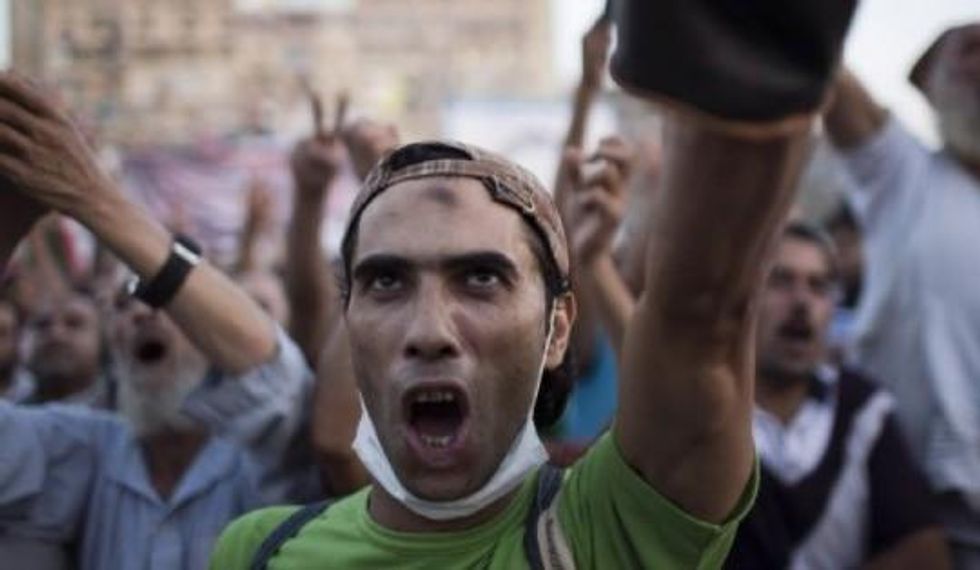
Clashes broke out in central Cairo on Tuesday when supporters of ousted President Mohamed Morsi came under attack as they marched to the Interior Ministry, a Reuters reporter said.
Supporters of the new military-installed government hurled stones at the marchers and threw bottles at them from balconies. Police then fired tear gas at the pro-Morsi protesters.
A few thousand pro-Morsi protesters were taking part in the march when the trouble erupted. Local residents taunted them, calling them terrorists and saying they were not welcome. They then began throwing stones at them.
The Morsi supporters responded by also hurling rocks.
Women and children marchers fled the scene in panic. Two men wielding machetes were seen chasing marchers.
Ongoing developments were being conveyed on Twitter:
[Twitter temporarily down. Please check back.]
Meanwhile, offering context for the pro-Morsi sit-ins and encampments, the Guardian's Patrick Kingsley reports:
Since the end of June, tens of thousands of supporters of the deposed Egyptian president Mohamed Morsi have camped on two sites in Egypt's capital, one near the city's university, west of the Nile, and the other across town at Rabaa. At first, the protesters were mostly from Morsi's Muslim Brotherhood, and they gathered to demand his rule continued; once Morsi was overthrown by the army on 3 July, after days of mass protests, they then pushed for his reinstatement.
As the weeks passed without Morsi's release from detention, this demand has seemed increasingly unlikely to be realised - and the protesters increasingly in danger. State officials have promised to forcibly disperse the camps for a fortnight, prompting fears of a third state-tolerated mass killing of Morsi supporters in a month. Fears grew on Sunday, as rumours swirled that the crackdown would happen at dawn on Monday, but the camp was untouched.
Despite the constant threat of an attack, the camps have become increasingly organised and entrenched - becoming more like tent cities.
_________________________________________________________
The news agency reports:
Clashes broke out in central Cairo on Tuesday when supporters of ousted President Mohamed Morsi came under attack as they marched to the Interior Ministry, a Reuters reporter said.
Supporters of the new military-installed government hurled stones at the marchers and threw bottles at them from balconies. Police then fired tear gas at the pro-Morsi protesters.
A few thousand pro-Morsi protesters were taking part in the march when the trouble erupted. Local residents taunted them, calling them terrorists and saying they were not welcome. They then began throwing stones at them.
The Morsi supporters responded by also hurling rocks.
Women and children marchers fled the scene in panic. Two men wielding machetes were seen chasing marchers.
Ongoing developments were being conveyed on Twitter:
[Twitter temporarily down. Please check back.]
Meanwhile, offering context for the pro-Morsi sit-ins and encampments, the Guardian's Patrick Kingsley reports:
Since the end of June, tens of thousands of supporters of the deposed Egyptian president Mohamed Morsi have camped on two sites in Egypt's capital, one near the city's university, west of the Nile, and the other across town at Rabaa. At first, the protesters were mostly from Morsi's Muslim Brotherhood, and they gathered to demand his rule continued; once Morsi was overthrown by the army on 3 July, after days of mass protests, they then pushed for his reinstatement.
As the weeks passed without Morsi's release from detention, this demand has seemed increasingly unlikely to be realised - and the protesters increasingly in danger. State officials have promised to forcibly disperse the camps for a fortnight, prompting fears of a third state-tolerated mass killing of Morsi supporters in a month. Fears grew on Sunday, as rumours swirled that the crackdown would happen at dawn on Monday, but the camp was untouched.
Despite the constant threat of an attack, the camps have become increasingly organised and entrenched - becoming more like tent cities.
_________________________________________________________
The news agency reports:
Clashes broke out in central Cairo on Tuesday when supporters of ousted President Mohamed Morsi came under attack as they marched to the Interior Ministry, a Reuters reporter said.
Supporters of the new military-installed government hurled stones at the marchers and threw bottles at them from balconies. Police then fired tear gas at the pro-Morsi protesters.
A few thousand pro-Morsi protesters were taking part in the march when the trouble erupted. Local residents taunted them, calling them terrorists and saying they were not welcome. They then began throwing stones at them.
The Morsi supporters responded by also hurling rocks.
Women and children marchers fled the scene in panic. Two men wielding machetes were seen chasing marchers.
Ongoing developments were being conveyed on Twitter:
[Twitter temporarily down. Please check back.]
Meanwhile, offering context for the pro-Morsi sit-ins and encampments, the Guardian's Patrick Kingsley reports:
Since the end of June, tens of thousands of supporters of the deposed Egyptian president Mohamed Morsi have camped on two sites in Egypt's capital, one near the city's university, west of the Nile, and the other across town at Rabaa. At first, the protesters were mostly from Morsi's Muslim Brotherhood, and they gathered to demand his rule continued; once Morsi was overthrown by the army on 3 July, after days of mass protests, they then pushed for his reinstatement.
As the weeks passed without Morsi's release from detention, this demand has seemed increasingly unlikely to be realised - and the protesters increasingly in danger. State officials have promised to forcibly disperse the camps for a fortnight, prompting fears of a third state-tolerated mass killing of Morsi supporters in a month. Fears grew on Sunday, as rumours swirled that the crackdown would happen at dawn on Monday, but the camp was untouched.
Despite the constant threat of an attack, the camps have become increasingly organised and entrenched - becoming more like tent cities.
_________________________________________________________