SUBSCRIBE TO OUR FREE NEWSLETTER
Daily news & progressive opinion—funded by the people, not the corporations—delivered straight to your inbox.
5
#000000
#FFFFFF
To donate by check, phone, or other method, see our More Ways to Give page.


Daily news & progressive opinion—funded by the people, not the corporations—delivered straight to your inbox.
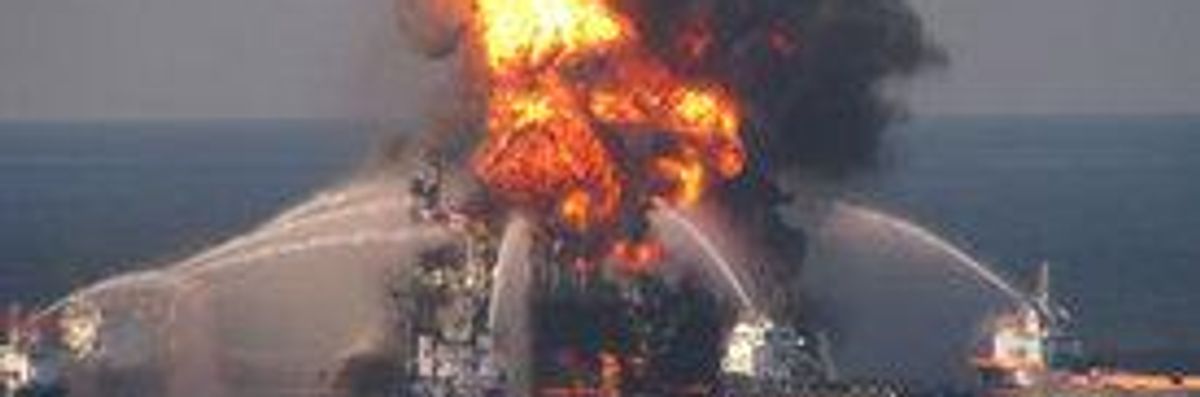
Oil giant BP announced late on Friday that is has reached an out of court settlement with thousands of individuals who were injured financially or physically by the Deepwater Horizon oil spill in 2010. The spill, caused by poor drilling practices and seemingly defective equipment, was the largest in US history.
Oil giant BP announced late on Friday that is has reached an out of court settlement with thousands of individuals who were injured financially or physically by the Deepwater Horizon oil spill in 2010. The spill, caused by poor drilling practices and seemingly defective equipment, was the largest in US history. The estimated figure of the settlement is $7.8 billion, but there is no cap, and the money will be disbursed by an independent claims administrator. The deal does not the mark the end of BP's legal challenges, nor will it please everyone in the Gulf.
Meanwhile, as BP settlement details emerge, Al Jazeera has spotted a large oil sheen near the infamous Macondo 252 well.
If the settlement figure sounds at all impressive, note that in just nine months of 2011 BP posted profits of $15.9 billion.
According to the Associated Press, "BP said it expects the money to come from the $20 billion compensation fund that it previously set out. According to the Deepwater Horizon Oil Spill Trust, current total trust assets are approximately $9.5 billion."
Suzanne Goldenberg reporting for The Guardian, writes, "With one major settlement achieved, BP will probably redouble its efforts to reach a deal with the federal government over fines related to the spill."
"I'd like to make sure this never happens again. Somebody has got to hold BP's feet to the fire. They have just gotten away with throwing money at problems, but that doesn't get rid of the problems." -Dean Blanchard, Louisiana Shrimper
BP said the $7.8 billion would include $2.3 billion for the Gulf's seafood industry.
It is those fishermen and the communities built around the industry that have been most devastated. They are the least pleased with BP and the announced settlement. Dean Blanchard has been an outspoken critic and advocate for the crippled industry, as the BBC reports:
Mr Blanchard spent 30 years building up a business that sold ice and diesel to boats, then bought and sold the shrimp they harvested.
They year 2010 was to be a bumper harvest: he had seen off local and international competition, bought new ice machines and the price of shrimp was good.
But things did not work out.
"There's only one reason to come down here: to fish, and there's no more fish. BP killed the fish," he says.
"We're down to one restaurant and one gas station. And the gas station shuts on Tuesdays. I've never seen this place like this before, never."
Quick Money, Delayed Impacts
Environmentalists join fisherman in their disappointment as they warn that the full impact of the oil spill may not be realized for years, and the premature settlements are the way for oil companies like BP to escape responsibility for future claims that consider the full damage wrought by the spill. Again, the BBC:
How long BP's environmental responsibilities will last here is anybody's guess. When the Exxon Valdez tanker dumped million of gallons of oil onto the Alaskan shoreline in 1989, 13,000 miles of coast was despoiled.
That did not happen in Louisiana. In a desperate attempt to protect Gulf beaches - and, say critics, BP's bottom line - dispersants were dumped on the spilt oil here before it made land.
"Honestly, we don't know," says Aaron Viles, deputy director of the Gulf Restoration Network, of the prospects for recovery. "If you look at the Exxon Valdez, which is the only thing we can really compare to when it comes to the volume of oil, what we do know is that it took four seasons for their big herring fishery to collapse commercially.
"It didn't happen immediately. It takes a while for these sub-lethal impacts to work their way through the ecosystem and to have an impact. So we are watching very anxiously."
And Blanchard, speaking to Goldenberg, worries that the punitive aspect is lost on an oil company awash in cash.
"I want my day in court," he said. "If they can get off with just paying the money - well, they've got plenty of money, they are not really going to learn a lesson.
"I'd like to make sure this never happens again. Somebody has got to hold BP's feet to the fire. They have just gotten away with throwing money at problems, but that doesn't get rid of the problems."
But, as Goldenberg continues, BP is not out of the woods yet.
The federal government, and the state governments of Louisiana and Alabama, are also pursuing claims, although the federal government is believed to be actively negotiating with BP to reach a deal over civilian fines for environmental damage done during the spill. If BP is found guilty of gross negligence those fines could reach $17bn.
BP is in a legal battle with the other companies that were involved in the runaway well: Transocean, which owned the oil rig, and Halliburton, which cemented the well. Those legal brawls, over the share of the costs of covering those damages, could continue even after the claims have settled.
###
Dear Common Dreams reader, The U.S. is on a fast track to authoritarianism like nothing I've ever seen. Meanwhile, corporate news outlets are utterly capitulating to Trump, twisting their coverage to avoid drawing his ire while lining up to stuff cash in his pockets. That's why I believe that Common Dreams is doing the best and most consequential reporting that we've ever done. Our small but mighty team is a progressive reporting powerhouse, covering the news every day that the corporate media never will. Our mission has always been simple: To inform. To inspire. And to ignite change for the common good. Now here's the key piece that I want all our readers to understand: None of this would be possible without your financial support. That's not just some fundraising cliche. It's the absolute and literal truth. We don't accept corporate advertising and never will. We don't have a paywall because we don't think people should be blocked from critical news based on their ability to pay. Everything we do is funded by the donations of readers like you. Will you donate now to help power the nonprofit, independent reporting of Common Dreams? Thank you for being a vital member of our community. Together, we can keep independent journalism alive when it’s needed most. - Craig Brown, Co-founder |
Oil giant BP announced late on Friday that is has reached an out of court settlement with thousands of individuals who were injured financially or physically by the Deepwater Horizon oil spill in 2010. The spill, caused by poor drilling practices and seemingly defective equipment, was the largest in US history. The estimated figure of the settlement is $7.8 billion, but there is no cap, and the money will be disbursed by an independent claims administrator. The deal does not the mark the end of BP's legal challenges, nor will it please everyone in the Gulf.
Meanwhile, as BP settlement details emerge, Al Jazeera has spotted a large oil sheen near the infamous Macondo 252 well.
If the settlement figure sounds at all impressive, note that in just nine months of 2011 BP posted profits of $15.9 billion.
According to the Associated Press, "BP said it expects the money to come from the $20 billion compensation fund that it previously set out. According to the Deepwater Horizon Oil Spill Trust, current total trust assets are approximately $9.5 billion."
Suzanne Goldenberg reporting for The Guardian, writes, "With one major settlement achieved, BP will probably redouble its efforts to reach a deal with the federal government over fines related to the spill."
"I'd like to make sure this never happens again. Somebody has got to hold BP's feet to the fire. They have just gotten away with throwing money at problems, but that doesn't get rid of the problems." -Dean Blanchard, Louisiana Shrimper
BP said the $7.8 billion would include $2.3 billion for the Gulf's seafood industry.
It is those fishermen and the communities built around the industry that have been most devastated. They are the least pleased with BP and the announced settlement. Dean Blanchard has been an outspoken critic and advocate for the crippled industry, as the BBC reports:
Mr Blanchard spent 30 years building up a business that sold ice and diesel to boats, then bought and sold the shrimp they harvested.
They year 2010 was to be a bumper harvest: he had seen off local and international competition, bought new ice machines and the price of shrimp was good.
But things did not work out.
"There's only one reason to come down here: to fish, and there's no more fish. BP killed the fish," he says.
"We're down to one restaurant and one gas station. And the gas station shuts on Tuesdays. I've never seen this place like this before, never."
Quick Money, Delayed Impacts
Environmentalists join fisherman in their disappointment as they warn that the full impact of the oil spill may not be realized for years, and the premature settlements are the way for oil companies like BP to escape responsibility for future claims that consider the full damage wrought by the spill. Again, the BBC:
How long BP's environmental responsibilities will last here is anybody's guess. When the Exxon Valdez tanker dumped million of gallons of oil onto the Alaskan shoreline in 1989, 13,000 miles of coast was despoiled.
That did not happen in Louisiana. In a desperate attempt to protect Gulf beaches - and, say critics, BP's bottom line - dispersants were dumped on the spilt oil here before it made land.
"Honestly, we don't know," says Aaron Viles, deputy director of the Gulf Restoration Network, of the prospects for recovery. "If you look at the Exxon Valdez, which is the only thing we can really compare to when it comes to the volume of oil, what we do know is that it took four seasons for their big herring fishery to collapse commercially.
"It didn't happen immediately. It takes a while for these sub-lethal impacts to work their way through the ecosystem and to have an impact. So we are watching very anxiously."
And Blanchard, speaking to Goldenberg, worries that the punitive aspect is lost on an oil company awash in cash.
"I want my day in court," he said. "If they can get off with just paying the money - well, they've got plenty of money, they are not really going to learn a lesson.
"I'd like to make sure this never happens again. Somebody has got to hold BP's feet to the fire. They have just gotten away with throwing money at problems, but that doesn't get rid of the problems."
But, as Goldenberg continues, BP is not out of the woods yet.
The federal government, and the state governments of Louisiana and Alabama, are also pursuing claims, although the federal government is believed to be actively negotiating with BP to reach a deal over civilian fines for environmental damage done during the spill. If BP is found guilty of gross negligence those fines could reach $17bn.
BP is in a legal battle with the other companies that were involved in the runaway well: Transocean, which owned the oil rig, and Halliburton, which cemented the well. Those legal brawls, over the share of the costs of covering those damages, could continue even after the claims have settled.
###
Oil giant BP announced late on Friday that is has reached an out of court settlement with thousands of individuals who were injured financially or physically by the Deepwater Horizon oil spill in 2010. The spill, caused by poor drilling practices and seemingly defective equipment, was the largest in US history. The estimated figure of the settlement is $7.8 billion, but there is no cap, and the money will be disbursed by an independent claims administrator. The deal does not the mark the end of BP's legal challenges, nor will it please everyone in the Gulf.
Meanwhile, as BP settlement details emerge, Al Jazeera has spotted a large oil sheen near the infamous Macondo 252 well.
If the settlement figure sounds at all impressive, note that in just nine months of 2011 BP posted profits of $15.9 billion.
According to the Associated Press, "BP said it expects the money to come from the $20 billion compensation fund that it previously set out. According to the Deepwater Horizon Oil Spill Trust, current total trust assets are approximately $9.5 billion."
Suzanne Goldenberg reporting for The Guardian, writes, "With one major settlement achieved, BP will probably redouble its efforts to reach a deal with the federal government over fines related to the spill."
"I'd like to make sure this never happens again. Somebody has got to hold BP's feet to the fire. They have just gotten away with throwing money at problems, but that doesn't get rid of the problems." -Dean Blanchard, Louisiana Shrimper
BP said the $7.8 billion would include $2.3 billion for the Gulf's seafood industry.
It is those fishermen and the communities built around the industry that have been most devastated. They are the least pleased with BP and the announced settlement. Dean Blanchard has been an outspoken critic and advocate for the crippled industry, as the BBC reports:
Mr Blanchard spent 30 years building up a business that sold ice and diesel to boats, then bought and sold the shrimp they harvested.
They year 2010 was to be a bumper harvest: he had seen off local and international competition, bought new ice machines and the price of shrimp was good.
But things did not work out.
"There's only one reason to come down here: to fish, and there's no more fish. BP killed the fish," he says.
"We're down to one restaurant and one gas station. And the gas station shuts on Tuesdays. I've never seen this place like this before, never."
Quick Money, Delayed Impacts
Environmentalists join fisherman in their disappointment as they warn that the full impact of the oil spill may not be realized for years, and the premature settlements are the way for oil companies like BP to escape responsibility for future claims that consider the full damage wrought by the spill. Again, the BBC:
How long BP's environmental responsibilities will last here is anybody's guess. When the Exxon Valdez tanker dumped million of gallons of oil onto the Alaskan shoreline in 1989, 13,000 miles of coast was despoiled.
That did not happen in Louisiana. In a desperate attempt to protect Gulf beaches - and, say critics, BP's bottom line - dispersants were dumped on the spilt oil here before it made land.
"Honestly, we don't know," says Aaron Viles, deputy director of the Gulf Restoration Network, of the prospects for recovery. "If you look at the Exxon Valdez, which is the only thing we can really compare to when it comes to the volume of oil, what we do know is that it took four seasons for their big herring fishery to collapse commercially.
"It didn't happen immediately. It takes a while for these sub-lethal impacts to work their way through the ecosystem and to have an impact. So we are watching very anxiously."
And Blanchard, speaking to Goldenberg, worries that the punitive aspect is lost on an oil company awash in cash.
"I want my day in court," he said. "If they can get off with just paying the money - well, they've got plenty of money, they are not really going to learn a lesson.
"I'd like to make sure this never happens again. Somebody has got to hold BP's feet to the fire. They have just gotten away with throwing money at problems, but that doesn't get rid of the problems."
But, as Goldenberg continues, BP is not out of the woods yet.
The federal government, and the state governments of Louisiana and Alabama, are also pursuing claims, although the federal government is believed to be actively negotiating with BP to reach a deal over civilian fines for environmental damage done during the spill. If BP is found guilty of gross negligence those fines could reach $17bn.
BP is in a legal battle with the other companies that were involved in the runaway well: Transocean, which owned the oil rig, and Halliburton, which cemented the well. Those legal brawls, over the share of the costs of covering those damages, could continue even after the claims have settled.
###