

SUBSCRIBE TO OUR FREE NEWSLETTER
Daily news & progressive opinion—funded by the people, not the corporations—delivered straight to your inbox.
5
#000000
#FFFFFF
To donate by check, phone, or other method, see our More Ways to Give page.

We can forget, but the news Jimmy Carter is nearing the end of his righteous life reminds us there has been, and perhaps will be, good on this earth. A "thoroughly decent man" and "steadfast champion of humanity," Carter spoke up for racial justice, economic equity, prison reform, the rights of Palestinians, and hard truths the rich and powerful didn't want to hear. A "man of great faith who led by example," he taught us how to live with dignity. And now how to die.
While acknowledging that, "No one leading the US empire can have an impeccable moral record," many progressives argue Carter, now 98, was "as decent & principled as a president can be." His one term from 1977 to 1981 is mostly remembered for "the events that overwhelmed it" - energy "malaise," war in Afghanistan, the hostage crisis in Iran, to which his "honest but gloomy" response - he just wanted them home alive - likely contributed to voters replacing him with Reagan's "telegenic optimism." Atypically, Carter is best known for America's longest, finest, most big-hearted post-presidency, building over 40 years a purposeful life of service that became his greatest legacy. He and his wife Rosalynn (now of 76 years) founded The Carter Center - "Wage Peace, Fight Disease, Build Hope" - aimed at "improving the lives of people around the world"; they worked with Habitat for Humanity helping build or repair over 4,000 homes; Carter won the Nobel Peace Prize, in part for the Camp David Accord between Israel and Egypt, and wrote 30 books, including one that, amidst much furor, charged Israel with "apartheid"; he spoke up for Julian Assange - "The revelation of the truth, even if it's unpleasant, is beneficial" - and blasted George Bush's reign as "the worst in history" for its preemptive war in Iraq, "overt reversal of America’s basic values," and abandonment of peace talks with Israel, environmental and nuclear arms control efforts and, notably for a man of faith, separation of church and state.
Early on, Carter displayed a level of candor and integrity unusual in American politics. Though he liked to describe himself as an aw-shucks peanut farmer - he grew up the son of one - he was also an engineer, nuclear physicist and lifelong Sunday School teacher who often played on people's underestimations of him. Thus, as governor, did he open a May 1974 speech at the venerable University of Georgia's Law Day, honoring the achievements of law students, alumni and distinguished national guests by jokingly noting tickets to hear keynote speaker Ted Kennedy cost more ($10) than those to hear him. But listening to Kennedy, he'd decided to change his speech for an off-the-cuff tirade about systemic inequalities in America best exemplified by those seated before him. To the rich and powerful, he unleashed a blistering critique of the rich and powerful - lawyers, judges, pols, corporate lobbyists who'd “carved out for themselves (a) privileged position" in an incestuous, deeply corrupt legal and legislative system designed to perpetuate inequities while leaving too many behind. He recalled his first speech, when he'd cited 30 questions "we had so proudly evolved as a subterfuge, with a great deal of smirking, to keep black citizens from voting" - questions "nobody in this room could answer." He charged half the people in Georgia's prisons - "a disgrace" - don't belong there: "They're there because they're poor." “I don’t know,” he drawled. “It may be that poor people are the only ones who commit crimes. I don’t think so. But they’re the only ones that serve prison sentences.” "I don't want to go on and on," he added. "I'm part of it." No wonder his presidency "failed."
Carter's speech might have been forgotten as "the ravings of a peanut farmer" if not for Hunter Thompson, master of Gonzo journalism, who was there covering Kennedy for Rolling Stone but was blown away by "a king hell bastard of a speech that rang every bell in the room" - especially after Carter quoted "a friend of mine, a poet named Bob Dylan," along with social ethicist Reinhold Niebuhr, as sources for his own sense of justice. Carter "connected with the fact that these artists are truth tellers - that's one of the things (he) was known for," said the director of Jimmy Carter: Rock ’n’ Roll President.” "He told America the truth even when they didn't want to hear it.” Thompson's subsequent coverage of that "ruthless" speech and Carter's "Great Leap of Faith," some argue, helped propel him into the White House 18 months later. With the news of Carter now in hospice care, Sen. Raphael Warnock joined a flood of well-wishers celebrating "a rare man of faith, courage, generosity and humility." "Across life's seasons, Jimmy Carter, a man of faith, has walked with God," Warnock wrote. "In this tender time of transitioning, God is surely walking with him." Many joined in praising an upright man and "blessed soul" who "exemplified humanity," who "used his time on earth to be of service to others - this is called leadership," who has "done so much for so many," who "made a difference on this planet." "The course of human events," Carter ended his memorable Law Day speech, "are controlled by the combined wisdom and courage and commitment and discernment and unselfishness and compassion and love and idealism of the common ordinary people." Well done, good and faithful servant.
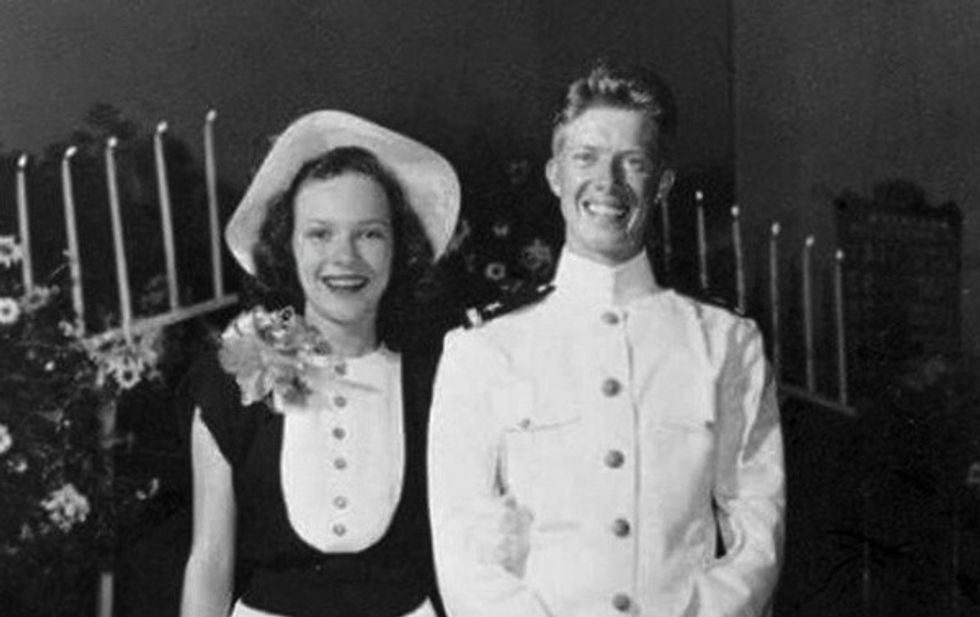 The Carters' wedding.Family photo
We can forget, but the news Jimmy Carter is nearing the end of his righteous life reminds us there has been, and perhaps will be, good on this earth. A "thoroughly decent man" and "steadfast champion of humanity," Carter spoke up for racial justice, economic equity, prison reform, the rights of Palestinians, and hard truths the rich and powerful didn't want to hear. A "man of great faith who led by example," he taught us how to live with dignity. And now how to die.
While acknowledging that, "No one leading the US empire can have an impeccable moral record," many progressives argue Carter, now 98, was "as decent & principled as a president can be." His one term from 1977 to 1981 is mostly remembered for "the events that overwhelmed it" - energy "malaise," war in Afghanistan, the hostage crisis in Iran, to which his "honest but gloomy" response - he just wanted them home alive - likely contributed to voters replacing him with Reagan's "telegenic optimism." Atypically, Carter is best known for America's longest, finest, most big-hearted post-presidency, building over 40 years a purposeful life of service that became his greatest legacy. He and his wife Rosalynn (now of 76 years) founded The Carter Center - "Wage Peace, Fight Disease, Build Hope" - aimed at "improving the lives of people around the world"; they worked with Habitat for Humanity helping build or repair over 4,000 homes; Carter won the Nobel Peace Prize, in part for the Camp David Accord between Israel and Egypt, and wrote 30 books, including one that, amidst much furor, charged Israel with "apartheid"; he spoke up for Julian Assange - "The revelation of the truth, even if it's unpleasant, is beneficial" - and blasted George Bush's reign as "the worst in history" for its preemptive war in Iraq, "overt reversal of America’s basic values," and abandonment of peace talks with Israel, environmental and nuclear arms control efforts and, notably for a man of faith, separation of church and state.
Early on, Carter displayed a level of candor and integrity unusual in American politics. Though he liked to describe himself as an aw-shucks peanut farmer - he grew up the son of one - he was also an engineer, nuclear physicist and lifelong Sunday School teacher who often played on people's underestimations of him. Thus, as governor, did he open a May 1974 speech at the venerable University of Georgia's Law Day, honoring the achievements of law students, alumni and distinguished national guests by jokingly noting tickets to hear keynote speaker Ted Kennedy cost more ($10) than those to hear him. But listening to Kennedy, he'd decided to change his speech for an off-the-cuff tirade about systemic inequalities in America best exemplified by those seated before him. To the rich and powerful, he unleashed a blistering critique of the rich and powerful - lawyers, judges, pols, corporate lobbyists who'd “carved out for themselves (a) privileged position" in an incestuous, deeply corrupt legal and legislative system designed to perpetuate inequities while leaving too many behind. He recalled his first speech, when he'd cited 30 questions "we had so proudly evolved as a subterfuge, with a great deal of smirking, to keep black citizens from voting" - questions "nobody in this room could answer." He charged half the people in Georgia's prisons - "a disgrace" - don't belong there: "They're there because they're poor." “I don’t know,” he drawled. “It may be that poor people are the only ones who commit crimes. I don’t think so. But they’re the only ones that serve prison sentences.” "I don't want to go on and on," he added. "I'm part of it." No wonder his presidency "failed."
Carter's speech might have been forgotten as "the ravings of a peanut farmer" if not for Hunter Thompson, master of Gonzo journalism, who was there covering Kennedy for Rolling Stone but was blown away by "a king hell bastard of a speech that rang every bell in the room" - especially after Carter quoted "a friend of mine, a poet named Bob Dylan," along with social ethicist Reinhold Niebuhr, as sources for his own sense of justice. Carter "connected with the fact that these artists are truth tellers - that's one of the things (he) was known for," said the director of Jimmy Carter: Rock ’n’ Roll President.” "He told America the truth even when they didn't want to hear it.” Thompson's subsequent coverage of that "ruthless" speech and Carter's "Great Leap of Faith," some argue, helped propel him into the White House 18 months later. With the news of Carter now in hospice care, Sen. Raphael Warnock joined a flood of well-wishers celebrating "a rare man of faith, courage, generosity and humility." "Across life's seasons, Jimmy Carter, a man of faith, has walked with God," Warnock wrote. "In this tender time of transitioning, God is surely walking with him." Many joined in praising an upright man and "blessed soul" who "exemplified humanity," who "used his time on earth to be of service to others - this is called leadership," who has "done so much for so many," who "made a difference on this planet." "The course of human events," Carter ended his memorable Law Day speech, "are controlled by the combined wisdom and courage and commitment and discernment and unselfishness and compassion and love and idealism of the common ordinary people." Well done, good and faithful servant.
The Carters' wedding.Family photo
We can forget, but the news Jimmy Carter is nearing the end of his righteous life reminds us there has been, and perhaps will be, good on this earth. A "thoroughly decent man" and "steadfast champion of humanity," Carter spoke up for racial justice, economic equity, prison reform, the rights of Palestinians, and hard truths the rich and powerful didn't want to hear. A "man of great faith who led by example," he taught us how to live with dignity. And now how to die.
While acknowledging that, "No one leading the US empire can have an impeccable moral record," many progressives argue Carter, now 98, was "as decent & principled as a president can be." His one term from 1977 to 1981 is mostly remembered for "the events that overwhelmed it" - energy "malaise," war in Afghanistan, the hostage crisis in Iran, to which his "honest but gloomy" response - he just wanted them home alive - likely contributed to voters replacing him with Reagan's "telegenic optimism." Atypically, Carter is best known for America's longest, finest, most big-hearted post-presidency, building over 40 years a purposeful life of service that became his greatest legacy. He and his wife Rosalynn (now of 76 years) founded The Carter Center - "Wage Peace, Fight Disease, Build Hope" - aimed at "improving the lives of people around the world"; they worked with Habitat for Humanity helping build or repair over 4,000 homes; Carter won the Nobel Peace Prize, in part for the Camp David Accord between Israel and Egypt, and wrote 30 books, including one that, amidst much furor, charged Israel with "apartheid"; he spoke up for Julian Assange - "The revelation of the truth, even if it's unpleasant, is beneficial" - and blasted George Bush's reign as "the worst in history" for its preemptive war in Iraq, "overt reversal of America’s basic values," and abandonment of peace talks with Israel, environmental and nuclear arms control efforts and, notably for a man of faith, separation of church and state.
Early on, Carter displayed a level of candor and integrity unusual in American politics. Though he liked to describe himself as an aw-shucks peanut farmer - he grew up the son of one - he was also an engineer, nuclear physicist and lifelong Sunday School teacher who often played on people's underestimations of him. Thus, as governor, did he open a May 1974 speech at the venerable University of Georgia's Law Day, honoring the achievements of law students, alumni and distinguished national guests by jokingly noting tickets to hear keynote speaker Ted Kennedy cost more ($10) than those to hear him. But listening to Kennedy, he'd decided to change his speech for an off-the-cuff tirade about systemic inequalities in America best exemplified by those seated before him. To the rich and powerful, he unleashed a blistering critique of the rich and powerful - lawyers, judges, pols, corporate lobbyists who'd “carved out for themselves (a) privileged position" in an incestuous, deeply corrupt legal and legislative system designed to perpetuate inequities while leaving too many behind. He recalled his first speech, when he'd cited 30 questions "we had so proudly evolved as a subterfuge, with a great deal of smirking, to keep black citizens from voting" - questions "nobody in this room could answer." He charged half the people in Georgia's prisons - "a disgrace" - don't belong there: "They're there because they're poor." “I don’t know,” he drawled. “It may be that poor people are the only ones who commit crimes. I don’t think so. But they’re the only ones that serve prison sentences.” "I don't want to go on and on," he added. "I'm part of it." No wonder his presidency "failed."
Carter's speech might have been forgotten as "the ravings of a peanut farmer" if not for Hunter Thompson, master of Gonzo journalism, who was there covering Kennedy for Rolling Stone but was blown away by "a king hell bastard of a speech that rang every bell in the room" - especially after Carter quoted "a friend of mine, a poet named Bob Dylan," along with social ethicist Reinhold Niebuhr, as sources for his own sense of justice. Carter "connected with the fact that these artists are truth tellers - that's one of the things (he) was known for," said the director of Jimmy Carter: Rock ’n’ Roll President.” "He told America the truth even when they didn't want to hear it.” Thompson's subsequent coverage of that "ruthless" speech and Carter's "Great Leap of Faith," some argue, helped propel him into the White House 18 months later. With the news of Carter now in hospice care, Sen. Raphael Warnock joined a flood of well-wishers celebrating "a rare man of faith, courage, generosity and humility." "Across life's seasons, Jimmy Carter, a man of faith, has walked with God," Warnock wrote. "In this tender time of transitioning, God is surely walking with him." Many joined in praising an upright man and "blessed soul" who "exemplified humanity," who "used his time on earth to be of service to others - this is called leadership," who has "done so much for so many," who "made a difference on this planet." "The course of human events," Carter ended his memorable Law Day speech, "are controlled by the combined wisdom and courage and commitment and discernment and unselfishness and compassion and love and idealism of the common ordinary people." Well done, good and faithful servant.
The Carters' wedding.Family photo