SUBSCRIBE TO OUR FREE NEWSLETTER
Daily news & progressive opinion—funded by the people, not the corporations—delivered straight to your inbox.
5
#000000
#FFFFFF
To donate by check, phone, or other method, see our More Ways to Give page.
Daily news & progressive opinion—funded by the people, not the corporations—delivered straight to your inbox.
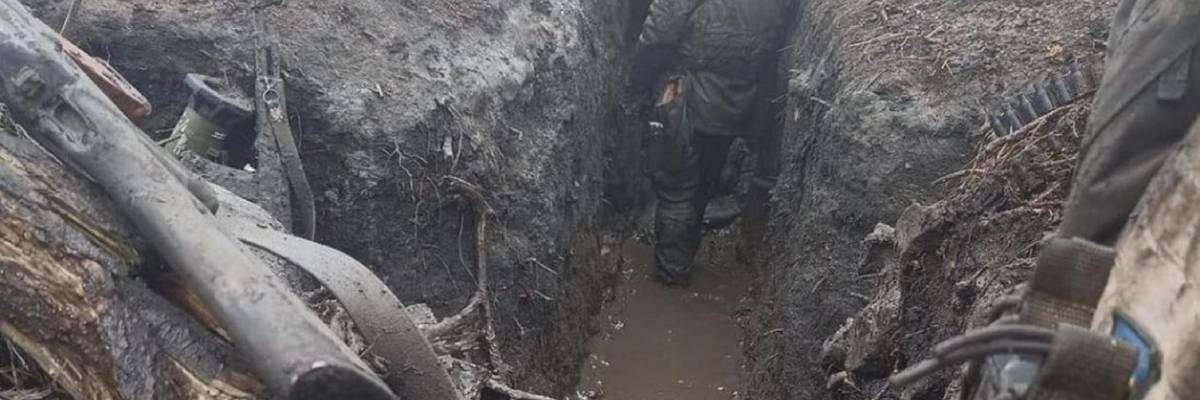
Some are comparing the cold, deadly trench warfare in Bakhmut, Ukraine to the First World War's grim Battle of Passchendaele, where British and Canadian forces suffered 300,000 casualties; German forces lost almost as many. Photo by Viktor Borinets/ Twitter.
As Russia's brutal, little-heeded war against Ukraine lurches on, grim images have emerged on social media of Ukrainian soldiers caught in the bloody quagmire around Bakhmut, an eastern city that has devolved into a ravaged landscape of ghostly trees, artillery craters, besieged elderly civilians and on-edge forces hunched under endless barrages in a muddy, freezing, deadlocked trench warfare that some have called "the new Passchendaele." Over 100 years ago, H.G. Wells trumpeted "the war that will end war." "We are resolved," he said. "That foolery shall end! It is the last war." Alas, not.
This weekend, as Russia's brutal, pointless, little-heeded war against Ukraine lurched on, grim images emerged on social media of Ukrainian soldiers caught in the bloody quagmire around Bakhmut, an eastern city that after months of fighting has devolved into a ravaged landscape of splintered, shell-torn trees, yawning artillery craters, strewn dead bodies, and sodden Ukrainian forces hunched in a muddy, freezing, deadlocked trench warfare against relentless enemy barrages that in its desolation and destruction some have likened to "the new Passchendaele." That infamous 1917 clash, also known as the Third Battle of Ypres, saw the Allies suffer roughly 300,000 casualties and inflict almost that many on the Germans in one of the most costly battles of World War One; it is remembered not only for its horrific loss of life but its freezing, sucking mud, "a monster," that drew soldiers to their deaths.
In "a bloody vortex for two militaries," Russian leaders desperate for a victory have been focused on moving reinforcements to the killing fields of Bakhmut. After so many reverses for their elite units, fighting has reportedly fallen to a mix of separatist militias, mercenaries and newly mobilized, ill-trained conscripts backed by massive artillery barrages, often aided by drones to make them particularly, lethally accurate. Amidst reports of Russian assaults on a "World War One hellscape," observers cite Russia's stunning disregard for their own troops, with commanders sending "single use" soldiers out in waves "like meat" to find Ukrainian positions; with Russian losses estimated at up to 300 a day, Ukraine "has become one giant graveyard" for them. Others say Ukraine's wet, cold winter is "the biggest killer" for "under-trained, under-supplied, ambivalently led" recruits lacking proper food, gear, boots or shelter, with dozens freezing to death.
For many, Putin's bloody debacle in Ukraine reflects a system "in which medievalism meets Stalinism meets dark farce," the "barbarism to which Russia's 'new normal' has sunk... part horror movie and part theater of the absurd" in which leaders rant about a "holy war" against Satan and even the few surviving protests have a touch of the surreal. But the remaining, mostly elderly residents of Bakhmut, who make up perhaps 10% of its pre-war population of 80,000, have more concrete concerns: Sheltering in wet basements, they face a winter without adequate power, water, heat, food. Intrepid volunteers have mobilized to deliver wood stoves, chop firewood, gather warm clothes and other necessities; harrowing videos show them evacuating, often under heavy shelling, the ill and infirm. Those who stay are pissed. "Why is Putin so stupid?" asks one woman. "Doesn't he have enough land?"
Over a century ago, H.G. Wells described the First World War as "the war that will end war," though over time the term has morphed into, "the war to end all wars." It was used first hopefully, then desperately, for a conflagration that began for no truly coherent reason in September 1914, lasted over four years, and ended with roughly 40 million casualties, about evenly divided between dead and wounded. Wells believed the conflict would create a new world order in which future conflicts would be impossible, and a world government would protect individual human rights regardless of sex, creed or color. By crushing the Kaiser's German empire, and the Austro-Hungarian and Ottoman empires, the Allies would serve as not just soldiers in war but "crusaders against war." "There shall be no more Kaisers," he wrote. "We are resolved. That foolery shall end! It is the last war." Oh, what a falling off was there.
"War will only end when people so realize its horrors (that) they prefer to refrain from fighting even when they believe that they have a just cause." - Bertrand Russell on the "more calm and equable courage" peace requires.
Dear Common Dreams reader, It’s been nearly 30 years since I co-founded Common Dreams with my late wife, Lina Newhouser. We had the radical notion that journalism should serve the public good, not corporate profits. It was clear to us from the outset what it would take to build such a project. No paid advertisements. No corporate sponsors. No millionaire publisher telling us what to think or do. Many people said we wouldn't last a year, but we proved those doubters wrong. Together with a tremendous team of journalists and dedicated staff, we built an independent media outlet free from the constraints of profits and corporate control. Our mission has always been simple: To inform. To inspire. To ignite change for the common good. Building Common Dreams was not easy. Our survival was never guaranteed. When you take on the most powerful forces—Wall Street greed, fossil fuel industry destruction, Big Tech lobbyists, and uber-rich oligarchs who have spent billions upon billions rigging the economy and democracy in their favor—the only bulwark you have is supporters who believe in your work. But here’s the urgent message from me today. It's never been this bad out there. And it's never been this hard to keep us going. At the very moment Common Dreams is most needed, the threats we face are intensifying. We need your support now more than ever. We don't accept corporate advertising and never will. We don't have a paywall because we don't think people should be blocked from critical news based on their ability to pay. Everything we do is funded by the donations of readers like you. When everyone does the little they can afford, we are strong. But if that support retreats or dries up, so do we. Will you donate now to make sure Common Dreams not only survives but thrives? —Craig Brown, Co-founder |
This weekend, as Russia's brutal, pointless, little-heeded war against Ukraine lurched on, grim images emerged on social media of Ukrainian soldiers caught in the bloody quagmire around Bakhmut, an eastern city that after months of fighting has devolved into a ravaged landscape of splintered, shell-torn trees, yawning artillery craters, strewn dead bodies, and sodden Ukrainian forces hunched in a muddy, freezing, deadlocked trench warfare against relentless enemy barrages that in its desolation and destruction some have likened to "the new Passchendaele." That infamous 1917 clash, also known as the Third Battle of Ypres, saw the Allies suffer roughly 300,000 casualties and inflict almost that many on the Germans in one of the most costly battles of World War One; it is remembered not only for its horrific loss of life but its freezing, sucking mud, "a monster," that drew soldiers to their deaths.
In "a bloody vortex for two militaries," Russian leaders desperate for a victory have been focused on moving reinforcements to the killing fields of Bakhmut. After so many reverses for their elite units, fighting has reportedly fallen to a mix of separatist militias, mercenaries and newly mobilized, ill-trained conscripts backed by massive artillery barrages, often aided by drones to make them particularly, lethally accurate. Amidst reports of Russian assaults on a "World War One hellscape," observers cite Russia's stunning disregard for their own troops, with commanders sending "single use" soldiers out in waves "like meat" to find Ukrainian positions; with Russian losses estimated at up to 300 a day, Ukraine "has become one giant graveyard" for them. Others say Ukraine's wet, cold winter is "the biggest killer" for "under-trained, under-supplied, ambivalently led" recruits lacking proper food, gear, boots or shelter, with dozens freezing to death.
For many, Putin's bloody debacle in Ukraine reflects a system "in which medievalism meets Stalinism meets dark farce," the "barbarism to which Russia's 'new normal' has sunk... part horror movie and part theater of the absurd" in which leaders rant about a "holy war" against Satan and even the few surviving protests have a touch of the surreal. But the remaining, mostly elderly residents of Bakhmut, who make up perhaps 10% of its pre-war population of 80,000, have more concrete concerns: Sheltering in wet basements, they face a winter without adequate power, water, heat, food. Intrepid volunteers have mobilized to deliver wood stoves, chop firewood, gather warm clothes and other necessities; harrowing videos show them evacuating, often under heavy shelling, the ill and infirm. Those who stay are pissed. "Why is Putin so stupid?" asks one woman. "Doesn't he have enough land?"
Over a century ago, H.G. Wells described the First World War as "the war that will end war," though over time the term has morphed into, "the war to end all wars." It was used first hopefully, then desperately, for a conflagration that began for no truly coherent reason in September 1914, lasted over four years, and ended with roughly 40 million casualties, about evenly divided between dead and wounded. Wells believed the conflict would create a new world order in which future conflicts would be impossible, and a world government would protect individual human rights regardless of sex, creed or color. By crushing the Kaiser's German empire, and the Austro-Hungarian and Ottoman empires, the Allies would serve as not just soldiers in war but "crusaders against war." "There shall be no more Kaisers," he wrote. "We are resolved. That foolery shall end! It is the last war." Oh, what a falling off was there.
"War will only end when people so realize its horrors (that) they prefer to refrain from fighting even when they believe that they have a just cause." - Bertrand Russell on the "more calm and equable courage" peace requires.
This weekend, as Russia's brutal, pointless, little-heeded war against Ukraine lurched on, grim images emerged on social media of Ukrainian soldiers caught in the bloody quagmire around Bakhmut, an eastern city that after months of fighting has devolved into a ravaged landscape of splintered, shell-torn trees, yawning artillery craters, strewn dead bodies, and sodden Ukrainian forces hunched in a muddy, freezing, deadlocked trench warfare against relentless enemy barrages that in its desolation and destruction some have likened to "the new Passchendaele." That infamous 1917 clash, also known as the Third Battle of Ypres, saw the Allies suffer roughly 300,000 casualties and inflict almost that many on the Germans in one of the most costly battles of World War One; it is remembered not only for its horrific loss of life but its freezing, sucking mud, "a monster," that drew soldiers to their deaths.
In "a bloody vortex for two militaries," Russian leaders desperate for a victory have been focused on moving reinforcements to the killing fields of Bakhmut. After so many reverses for their elite units, fighting has reportedly fallen to a mix of separatist militias, mercenaries and newly mobilized, ill-trained conscripts backed by massive artillery barrages, often aided by drones to make them particularly, lethally accurate. Amidst reports of Russian assaults on a "World War One hellscape," observers cite Russia's stunning disregard for their own troops, with commanders sending "single use" soldiers out in waves "like meat" to find Ukrainian positions; with Russian losses estimated at up to 300 a day, Ukraine "has become one giant graveyard" for them. Others say Ukraine's wet, cold winter is "the biggest killer" for "under-trained, under-supplied, ambivalently led" recruits lacking proper food, gear, boots or shelter, with dozens freezing to death.
For many, Putin's bloody debacle in Ukraine reflects a system "in which medievalism meets Stalinism meets dark farce," the "barbarism to which Russia's 'new normal' has sunk... part horror movie and part theater of the absurd" in which leaders rant about a "holy war" against Satan and even the few surviving protests have a touch of the surreal. But the remaining, mostly elderly residents of Bakhmut, who make up perhaps 10% of its pre-war population of 80,000, have more concrete concerns: Sheltering in wet basements, they face a winter without adequate power, water, heat, food. Intrepid volunteers have mobilized to deliver wood stoves, chop firewood, gather warm clothes and other necessities; harrowing videos show them evacuating, often under heavy shelling, the ill and infirm. Those who stay are pissed. "Why is Putin so stupid?" asks one woman. "Doesn't he have enough land?"
Over a century ago, H.G. Wells described the First World War as "the war that will end war," though over time the term has morphed into, "the war to end all wars." It was used first hopefully, then desperately, for a conflagration that began for no truly coherent reason in September 1914, lasted over four years, and ended with roughly 40 million casualties, about evenly divided between dead and wounded. Wells believed the conflict would create a new world order in which future conflicts would be impossible, and a world government would protect individual human rights regardless of sex, creed or color. By crushing the Kaiser's German empire, and the Austro-Hungarian and Ottoman empires, the Allies would serve as not just soldiers in war but "crusaders against war." "There shall be no more Kaisers," he wrote. "We are resolved. That foolery shall end! It is the last war." Oh, what a falling off was there.
"War will only end when people so realize its horrors (that) they prefer to refrain from fighting even when they believe that they have a just cause." - Bertrand Russell on the "more calm and equable courage" peace requires.