

SUBSCRIBE TO OUR FREE NEWSLETTER
Daily news & progressive opinion—funded by the people, not the corporations—delivered straight to your inbox.
5
#000000
#FFFFFF
To donate by check, phone, or other method, see our More Ways to Give page.
Daily news & progressive opinion—funded by the people, not the corporations—delivered straight to your inbox.
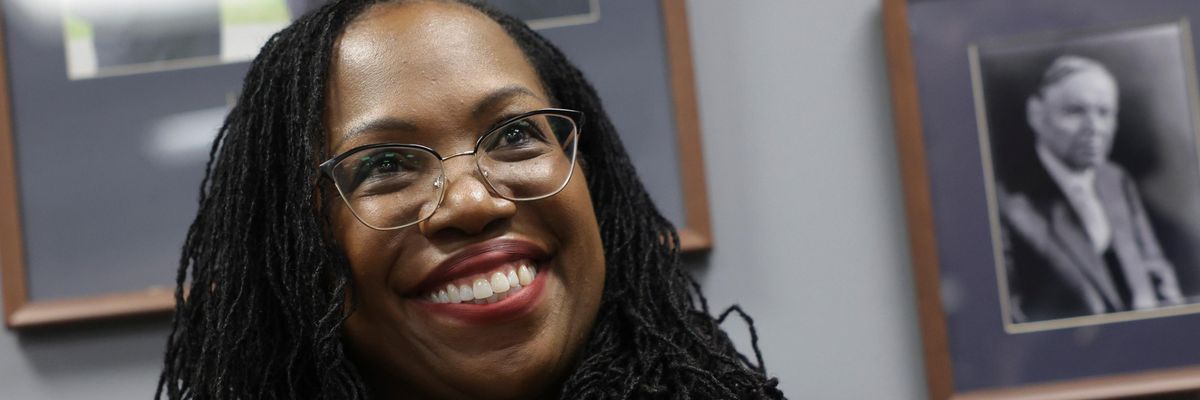
Ketanji Brown Jackson has been confirmed as the first black woman justice on the Supreme Court. Photo by Kevin Dietsch/Getty Images
In a move not just years but generations overdue, the Senate confirmed Judge Ketanji Brown Jackson as the first black woman and first public defender to serve on a Supreme Court that, for the first time in 233 years, will no longer have a majority of white men. Not even the churlish antics of the GOP's Klan drama queens could rob the historic occasion - made sweeter by presiding officer VP Kamala Harris, trying not to smile - of its joy. In honor of many both present and missing, RBG and John Lewis among them, we declare it a good day. May there be more.
In a blessed move acknowledged by Chuck Schumer as not just years but generations overdue, the Senate confirmed eminently qualified Judge Ketanji Brown Jackson as the first black woman and first public defender to serve on the Supreme Court; her confirmation will also mark a tipping point for a Court that will now, for the first time in its 233-year history, no longer have a majority of white men. The well-earned ascendance of Jackson, in a final tally of 53-47, was made just a bit sweeter by being presided over by Kamala Harris, this country's first female Vice-President of color; you could see her trying not to smile at the vision of women of color taking over the whole damn joint, and not a moment too soon. Harris later said the occasion made "an important statement about who we are as a nation," or at least, perhaps more accurately, who we aspire to be. Many others likewise rejoiced, from a beaming Cory Booker to members of the Black Caucus in "Black Women Are Supreme" t-shirts to Rep. Ayanna Pressley celebrating the signal to black girls that, "We belong everywhere."
When the vote was announced, the Chamber, or that side of it inhabited by sentient human beings, erupted in cheers. On the other side, the 47 Republicans who'd voted against Jackson in their unending quest to live and die on the wrong side of history huffily marched out, a churlish parade of rude Klan drama queens throwing a graceless, despicable hissy fit. Among them, only Mitt Romney was enough of a mensch to stand and clap like the rest of the world, while three of his pettiest cohorts - Rand Paul, Lindsey Graham, Jim Inhofe - voted from the Senate cloakroom after refusing to wear a tie. (That'll show the libs.) Still, not even their moronic, vindictive antics could rob the historic occasion of its joy, which was profound, and pervasive. For a still-emotional Cory Booker, Jackson's success promises to "plant the seeds of dreams in kids' hearts," to "heal the hurt a little bit" of growing up black, or female, or other in a still often-hostile country. In that hope, he echoes many, both present and absent. In honor of two who would have cherished Jackson's triumph - RBG and John Lewis, the Prince of Good Trouble - we declare it a good day. May there be more.
Heather Cox Richardson compares Jackson's confirmation to the 1865 passage of the 13th Amendment ending slavery. She quotes from the New York Times: "Thereupon rose a general shout of applause. The members on the floor huzzaed in chorus with deafening and equally emphatic cheers...The ladies in the dense assemblage waved their handkerchiefs (with) clapping of hands and exclamations of 'Hurrah for freedom,' 'Glory enough for one day'... Never was a scene of such a joyous character before witnessed."
Dear Common Dreams reader, It’s been nearly 30 years since I co-founded Common Dreams with my late wife, Lina Newhouser. We had the radical notion that journalism should serve the public good, not corporate profits. It was clear to us from the outset what it would take to build such a project. No paid advertisements. No corporate sponsors. No millionaire publisher telling us what to think or do. Many people said we wouldn't last a year, but we proved those doubters wrong. Together with a tremendous team of journalists and dedicated staff, we built an independent media outlet free from the constraints of profits and corporate control. Our mission has always been simple: To inform. To inspire. To ignite change for the common good. Building Common Dreams was not easy. Our survival was never guaranteed. When you take on the most powerful forces—Wall Street greed, fossil fuel industry destruction, Big Tech lobbyists, and uber-rich oligarchs who have spent billions upon billions rigging the economy and democracy in their favor—the only bulwark you have is supporters who believe in your work. But here’s the urgent message from me today. It's never been this bad out there. And it's never been this hard to keep us going. At the very moment Common Dreams is most needed, the threats we face are intensifying. We need your support now more than ever. We don't accept corporate advertising and never will. We don't have a paywall because we don't think people should be blocked from critical news based on their ability to pay. Everything we do is funded by the donations of readers like you. When everyone does the little they can afford, we are strong. But if that support retreats or dries up, so do we. Will you donate now to make sure Common Dreams not only survives but thrives? —Craig Brown, Co-founder |
In a blessed move acknowledged by Chuck Schumer as not just years but generations overdue, the Senate confirmed eminently qualified Judge Ketanji Brown Jackson as the first black woman and first public defender to serve on the Supreme Court; her confirmation will also mark a tipping point for a Court that will now, for the first time in its 233-year history, no longer have a majority of white men. The well-earned ascendance of Jackson, in a final tally of 53-47, was made just a bit sweeter by being presided over by Kamala Harris, this country's first female Vice-President of color; you could see her trying not to smile at the vision of women of color taking over the whole damn joint, and not a moment too soon. Harris later said the occasion made "an important statement about who we are as a nation," or at least, perhaps more accurately, who we aspire to be. Many others likewise rejoiced, from a beaming Cory Booker to members of the Black Caucus in "Black Women Are Supreme" t-shirts to Rep. Ayanna Pressley celebrating the signal to black girls that, "We belong everywhere."
When the vote was announced, the Chamber, or that side of it inhabited by sentient human beings, erupted in cheers. On the other side, the 47 Republicans who'd voted against Jackson in their unending quest to live and die on the wrong side of history huffily marched out, a churlish parade of rude Klan drama queens throwing a graceless, despicable hissy fit. Among them, only Mitt Romney was enough of a mensch to stand and clap like the rest of the world, while three of his pettiest cohorts - Rand Paul, Lindsey Graham, Jim Inhofe - voted from the Senate cloakroom after refusing to wear a tie. (That'll show the libs.) Still, not even their moronic, vindictive antics could rob the historic occasion of its joy, which was profound, and pervasive. For a still-emotional Cory Booker, Jackson's success promises to "plant the seeds of dreams in kids' hearts," to "heal the hurt a little bit" of growing up black, or female, or other in a still often-hostile country. In that hope, he echoes many, both present and absent. In honor of two who would have cherished Jackson's triumph - RBG and John Lewis, the Prince of Good Trouble - we declare it a good day. May there be more.
Heather Cox Richardson compares Jackson's confirmation to the 1865 passage of the 13th Amendment ending slavery. She quotes from the New York Times: "Thereupon rose a general shout of applause. The members on the floor huzzaed in chorus with deafening and equally emphatic cheers...The ladies in the dense assemblage waved their handkerchiefs (with) clapping of hands and exclamations of 'Hurrah for freedom,' 'Glory enough for one day'... Never was a scene of such a joyous character before witnessed."
In a blessed move acknowledged by Chuck Schumer as not just years but generations overdue, the Senate confirmed eminently qualified Judge Ketanji Brown Jackson as the first black woman and first public defender to serve on the Supreme Court; her confirmation will also mark a tipping point for a Court that will now, for the first time in its 233-year history, no longer have a majority of white men. The well-earned ascendance of Jackson, in a final tally of 53-47, was made just a bit sweeter by being presided over by Kamala Harris, this country's first female Vice-President of color; you could see her trying not to smile at the vision of women of color taking over the whole damn joint, and not a moment too soon. Harris later said the occasion made "an important statement about who we are as a nation," or at least, perhaps more accurately, who we aspire to be. Many others likewise rejoiced, from a beaming Cory Booker to members of the Black Caucus in "Black Women Are Supreme" t-shirts to Rep. Ayanna Pressley celebrating the signal to black girls that, "We belong everywhere."
When the vote was announced, the Chamber, or that side of it inhabited by sentient human beings, erupted in cheers. On the other side, the 47 Republicans who'd voted against Jackson in their unending quest to live and die on the wrong side of history huffily marched out, a churlish parade of rude Klan drama queens throwing a graceless, despicable hissy fit. Among them, only Mitt Romney was enough of a mensch to stand and clap like the rest of the world, while three of his pettiest cohorts - Rand Paul, Lindsey Graham, Jim Inhofe - voted from the Senate cloakroom after refusing to wear a tie. (That'll show the libs.) Still, not even their moronic, vindictive antics could rob the historic occasion of its joy, which was profound, and pervasive. For a still-emotional Cory Booker, Jackson's success promises to "plant the seeds of dreams in kids' hearts," to "heal the hurt a little bit" of growing up black, or female, or other in a still often-hostile country. In that hope, he echoes many, both present and absent. In honor of two who would have cherished Jackson's triumph - RBG and John Lewis, the Prince of Good Trouble - we declare it a good day. May there be more.
Heather Cox Richardson compares Jackson's confirmation to the 1865 passage of the 13th Amendment ending slavery. She quotes from the New York Times: "Thereupon rose a general shout of applause. The members on the floor huzzaed in chorus with deafening and equally emphatic cheers...The ladies in the dense assemblage waved their handkerchiefs (with) clapping of hands and exclamations of 'Hurrah for freedom,' 'Glory enough for one day'... Never was a scene of such a joyous character before witnessed."