
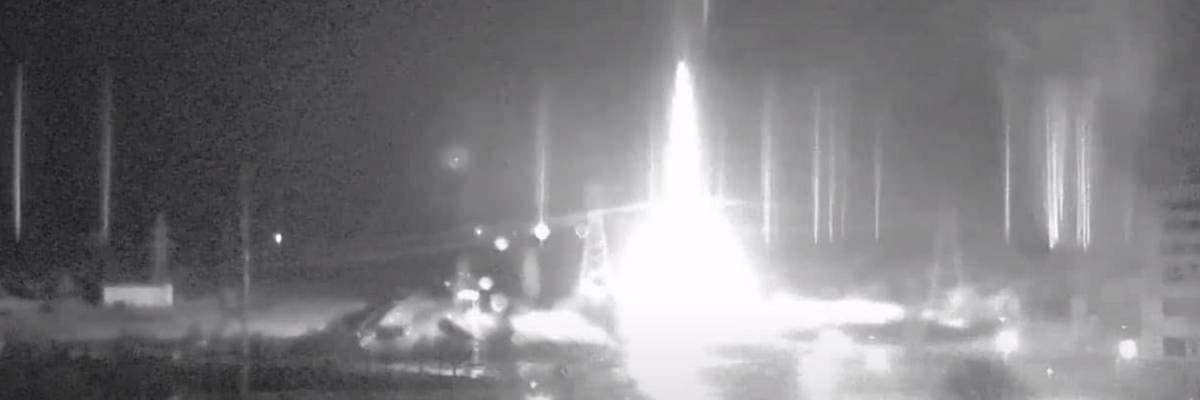
Screenshot of fire at Ukraine's Zaporizhzhya Nuclear Power Plant
The End of the World Hasn't Arrived Just Yet, But We're Working On It
We were writing about GOP idiocy at home when news broke of the fire at Ukraine's Zaporizhzhya Nuclear Power Plant, which stopped us cold. Such is relativity: Any other God-awful news pales before a nuclear plant on fire amidst a madman's war. Updates: After Russians reportedly blocked them, emergency crews put out the fire, it didn't affect "essential" equipment, it caused no radiation leaks, and these reactors, with robust containment structures and fire protection, are deemed "a lot safer" than those at Chernobyl. In the fraught here and now, this passes for good news.
We were in the middle of writing about GOP idiocy at home when news broke of the fire at Ukraine's Zaporizhzhya Nuclear Power Plant, the largest in Europe, which stopped us cold. Such is relativity: Even the most heinous of God-awful news somehow pales before the specter of a nuclear plant on fire amidst a madman's mindless war against a besieged civilian population. News of the latest catastrophe prompted a ragged, emotional Ukrainian President Volodymyr Zelensky to declare, "The end for everyone, the end for Europe" - an entirely understandable conclusion, given the brutal insanity of the last few weeks.But according to multiple reports and updates, thanks to better technology and perhaps the last living splinter of reason in otherwise deranged minds, we wish we could be glad to report: Probably not yet, possibly getting there.
The fire at the Zaporizhzhya plant, which contains six 950 megawatt pressurized-water nuclear reactors, apparently began from Russian shelling; it burned for several hours, reportedly across several floors of a five-story training complex. Earlier reports said Russian troops were blocking Ukrainian emergency teams: "The occupiers do not allow (us) to start eliminating (the) fire." Later, Ukrainian officials confirmed crews were on site and working to put out the fire; they told the International Atomic Energy Agency the fire had not affected "essential" equipment, and they had seen "no elevated radiation readings." In their latest update, Ukraine's State Emergency Services said the fire was extinguished, and "there were no victims."
Even before the fire had been put out, various experts had weighed in on the dangers this plant posed compared to the 1986 disaster at Chernobyl. Many said the Zaporizhzhya reactors are "a lot safer," arguing the chances of explosion, nuclear meltdown or radiactive release were far lower thanks to the plant's "robust containment structures," back-up emergency cooling systems and built-in fire protection systems - though one expert did concede, "Obviously, it's not a good idea if you start shooting massive missiles at reactors." In the fraught here and now, the experts' assurances did little to calm a world on edge, and a nation fighting for its life. A sign in Ukrainian at a burned-out Russian tank on a rubble-strewn city street said it best: "Welcome to Hell." If they still lurk, may better angels prevail.
We are at a crossroads
This country and this world are at a monumental crossroads. In a few short weeks, US voters will have an opportunity to beat back the forces of fascism and confront the billionaires who are rigging the economy, our media system, and our democracy, making it increasingly impossible for ordinary people to get by. We’re not just talking about the election. We’re talking about what must be done once these fascist elements are vanquished from power. We need a bolder set of solutions than what either major party has so far been willing to offer and a working-class movement ready to fight like hell for it. Trump didn't emerge from nowhere. The conditions that fueled MAGA authoritarianism were created by decades of radical neoliberal economic policies and a corrupt political system dominated by corporate interests. They slashed taxes on the super-rich, promising that the benefits would trickle down. They said giveaways to the corporate titans would make life more affordable for the rest of us. It was all bullshit. And when a bitter, betrayed populace searches for someone to blame, right-wing demagogues have little trouble finding scapegoats. People know when they're being lied to, but you won't hear any of this from the corporate media. Only independent journalism—powered and funded by people who believe in building a better world—can deliver truly trustworthy daily news. Our Fall Campaign is underway, and we need your help. To power our newsroom through the rest of the year, we need to raise $125,000 by midnight on October 31. So if you share our vision, please contribute whatever you can to sustain our work. |
We were in the middle of writing about GOP idiocy at home when news broke of the fire at Ukraine's Zaporizhzhya Nuclear Power Plant, the largest in Europe, which stopped us cold. Such is relativity: Even the most heinous of God-awful news somehow pales before the specter of a nuclear plant on fire amidst a madman's mindless war against a besieged civilian population. News of the latest catastrophe prompted a ragged, emotional Ukrainian President Volodymyr Zelensky to declare, "The end for everyone, the end for Europe" - an entirely understandable conclusion, given the brutal insanity of the last few weeks.But according to multiple reports and updates, thanks to better technology and perhaps the last living splinter of reason in otherwise deranged minds, we wish we could be glad to report: Probably not yet, possibly getting there.
The fire at the Zaporizhzhya plant, which contains six 950 megawatt pressurized-water nuclear reactors, apparently began from Russian shelling; it burned for several hours, reportedly across several floors of a five-story training complex. Earlier reports said Russian troops were blocking Ukrainian emergency teams: "The occupiers do not allow (us) to start eliminating (the) fire." Later, Ukrainian officials confirmed crews were on site and working to put out the fire; they told the International Atomic Energy Agency the fire had not affected "essential" equipment, and they had seen "no elevated radiation readings." In their latest update, Ukraine's State Emergency Services said the fire was extinguished, and "there were no victims."
Even before the fire had been put out, various experts had weighed in on the dangers this plant posed compared to the 1986 disaster at Chernobyl. Many said the Zaporizhzhya reactors are "a lot safer," arguing the chances of explosion, nuclear meltdown or radiactive release were far lower thanks to the plant's "robust containment structures," back-up emergency cooling systems and built-in fire protection systems - though one expert did concede, "Obviously, it's not a good idea if you start shooting massive missiles at reactors." In the fraught here and now, the experts' assurances did little to calm a world on edge, and a nation fighting for its life. A sign in Ukrainian at a burned-out Russian tank on a rubble-strewn city street said it best: "Welcome to Hell." If they still lurk, may better angels prevail.
We were in the middle of writing about GOP idiocy at home when news broke of the fire at Ukraine's Zaporizhzhya Nuclear Power Plant, the largest in Europe, which stopped us cold. Such is relativity: Even the most heinous of God-awful news somehow pales before the specter of a nuclear plant on fire amidst a madman's mindless war against a besieged civilian population. News of the latest catastrophe prompted a ragged, emotional Ukrainian President Volodymyr Zelensky to declare, "The end for everyone, the end for Europe" - an entirely understandable conclusion, given the brutal insanity of the last few weeks.But according to multiple reports and updates, thanks to better technology and perhaps the last living splinter of reason in otherwise deranged minds, we wish we could be glad to report: Probably not yet, possibly getting there.
The fire at the Zaporizhzhya plant, which contains six 950 megawatt pressurized-water nuclear reactors, apparently began from Russian shelling; it burned for several hours, reportedly across several floors of a five-story training complex. Earlier reports said Russian troops were blocking Ukrainian emergency teams: "The occupiers do not allow (us) to start eliminating (the) fire." Later, Ukrainian officials confirmed crews were on site and working to put out the fire; they told the International Atomic Energy Agency the fire had not affected "essential" equipment, and they had seen "no elevated radiation readings." In their latest update, Ukraine's State Emergency Services said the fire was extinguished, and "there were no victims."
Even before the fire had been put out, various experts had weighed in on the dangers this plant posed compared to the 1986 disaster at Chernobyl. Many said the Zaporizhzhya reactors are "a lot safer," arguing the chances of explosion, nuclear meltdown or radiactive release were far lower thanks to the plant's "robust containment structures," back-up emergency cooling systems and built-in fire protection systems - though one expert did concede, "Obviously, it's not a good idea if you start shooting massive missiles at reactors." In the fraught here and now, the experts' assurances did little to calm a world on edge, and a nation fighting for its life. A sign in Ukrainian at a burned-out Russian tank on a rubble-strewn city street said it best: "Welcome to Hell." If they still lurk, may better angels prevail.