

SUBSCRIBE TO OUR FREE NEWSLETTER
Daily news & progressive opinion—funded by the people, not the corporations—delivered straight to your inbox.
5
#000000
#FFFFFF
To donate by check, phone, or other method, see our More Ways to Give page.
Daily news & progressive opinion—funded by the people, not the corporations—delivered straight to your inbox.
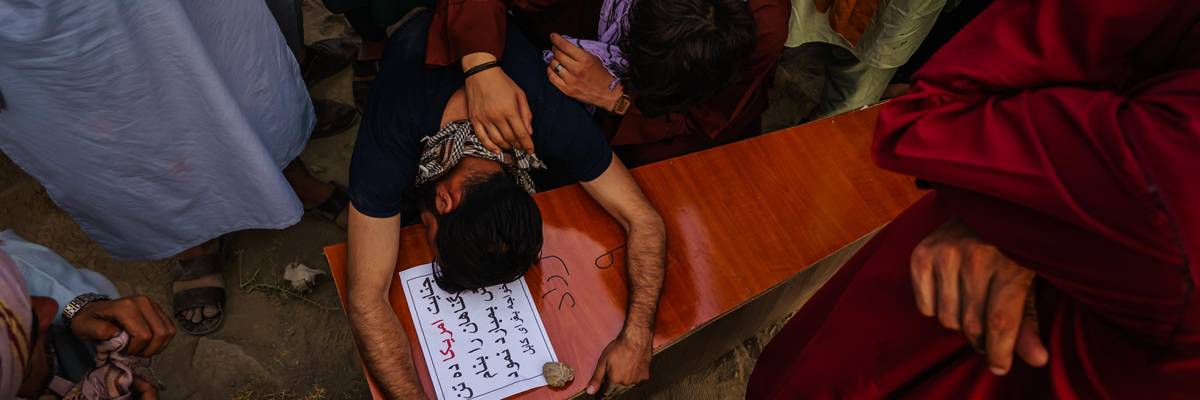
A man weeps during the mass funeral for members of a family killed in the latest U.S. drone airstrike, in Kabul, Afghanistan. Photo by Marcus Yam/Los Angeles Times/Getty.
America's forever war - misbegotten, intractable, awash in imperial hubris - is over. Contrary to self-righteous fulminating on the right, the mayhem it left behind belongs not to Biden, but to decades of ruinous decisions by U.S. leaders chasing empire. Confirming our long folly, it ended with a bleakly emblematic airstrike that killed 10 members of an extended Afghan family, 7 of them kids as they were learning to drive for their avowed move to America. For grieving relatives, its final savage lesson was clear: "If you can't manage to hit the right target, leave Afghanistan to the Afghans."
America's forever war - misbegotten, intractable, fatally awash in hubris - is over. Contrary to "incandescently self-righteous" fulminating on the right, the mayhem left in its horrific wake belongs not to Biden, but to 20 years - 60, really - of ruinous decisions by political and military leaders chasing delusional empire, "Never mind the facts. Never mind the losses. Never mind the lessons." The largest non-combatant evacuation in U.S. military history - over 122,000 people, most in under two weeks - ended Monday night, soon after Islamic State fighters in one of the world's poorest nations reportedly attacked the airport with jerry-rigged rockets mounted on the back seats of a four-door sedan. Despite charges by the hawkish likes of Wall Street Journal of "a botched" withdrawal" from a place we never should have been that damaged U.S. "honor and credibility" - like, really, is there any left? - many noted "there is no graceful way to evacuate vulnerable people from a country at war. There are better ways & worse ways, but none look good from the outside (or inside)." Up to the end, a network of veterans and other volunteers frantically worked to help get out those who had helped them. "It's the most hopeless, helpless, frustrating, infuriating experience," said one. "It's, 'If I can get him out, it won't have been for nothing.'" At a minute before midnight, the final U.S. flight took off, and was met with celebratory gunfire from the Taliban. "I especially came here at midnight to watch the last soldier leaving our country, with bowed heads, with defeat wounds," said Mujahid Rahmanin, a Taliban commander in Ghazni province, who said he "prostrated in thanksgiving" and threw dirt after the last few planes. "One more advice: Don't intervene anymore anywhere in the Islamic world." On Tuesday, Biden echoed the sentiment, saying the withdrawal signified "ending an era of major military operations to remake other countries" - which, given our long, bloody history of undertaking just those profit-driven efforts, remains to be seen.
The "omnishambles" of the American experience in what's long been deemed "the graveyard of empires" should come as no surprise in "a land of tribes and clans," with its "tangle of intrigues too ancient and too complex to be unraveled" and its deeply felt resistance to occupation. But despite a belated recognition by the military of the disaster unfolding - in The Afghanistan Papers, military officials admit "We didn't have the foggiest notion of what we were undertaking" - the media is now often turning to the still-in-denial liars and warmongerers who created that disaster to explain what went wrong. "Instead of a reckoning, the very architects of the war are getting the final word on its legacy," writes In These Times on the "Kafkaesque conclusion." "We mustn't let the Boltons and Petraeuses of the world get the final say on what we have learned" - especially with the vast number of Afghans left, as usual, the victims. According to the UN, "the humanitarian crisis is just beginning," with about 3.5 million people displaced by the violence, 2.2 million refugees in camps elsewhere, and the country's tragedy, once the TV cameras leave, "still a daily reality for millions of Afghans." Meanwhile, outsiders who spent years there are now watching the chaos with emotions "both swirling and yet leaden - the grief, the anger, the sense of futility," and wondering if those in power have learned anything from "a two-decade-long fiasco." In a searing essay, Sarah Chayes outlined fundamental but long-ignored realities on the ground - Afghan and U.S. corruption, Pakistani involvement, the self-delusion of American officials who kept insisting on imaginary "steady progress" - and wondered, still and all, "What else are we deluding ourselves about?"
It's a vital question, especially given the bleakly emblematic way our long folly ended. In one last mark of our imperial hubris, the U.S. military said it conducted a final "self-defense" air strike on a vehicle in Kabul, "eliminating an imminent ISIS-K threat." In ghastly fact, the strike killed ten members of an "ordinary" extended Afghan family, seven of them children, including two 2-year-old girls. Because two of the adults' work for the government had earned them Special Immigrant visas, the family had packed their things and were awaiting word to be airlifted out of Kabul to the U.S. One report said that, in excited preparation for the move, the kids had crowded into their car to learn to drive; another said they may have been killed by secondary explosions. For bitter, grieving relatives, the harsh lesson was the same: "If you can't manage to hit the right target, leave Afghanistan to the Afghans." On the first day of Taliban rule, that message resonated across a stunned country where "everything is crying, including trees, birds, rivers, mountains and people." In once-relatively-liberal Kabul, one young woman said she burned her jeans while her brother went out to buy her a burqa. "I was crying and burning them," she said. "I burned my hopes with them...An absolute feeling of depression is all over the city." "My generation lost everything in a matter of hours," said an engineer. "People are broken." As residents described beards or clothing, like going out to exercise in shorts and t-shirt, as "a life-threatening struggle," anguish often mixed with rage. "I had studied for my entire life to do something for this land, but these people have buried my hopes," said one. "Not only the Taliban but also the international community...Why did they come if they wanted to leave us like this?"
Dear Common Dreams reader, It’s been nearly 30 years since I co-founded Common Dreams with my late wife, Lina Newhouser. We had the radical notion that journalism should serve the public good, not corporate profits. It was clear to us from the outset what it would take to build such a project. No paid advertisements. No corporate sponsors. No millionaire publisher telling us what to think or do. Many people said we wouldn't last a year, but we proved those doubters wrong. Together with a tremendous team of journalists and dedicated staff, we built an independent media outlet free from the constraints of profits and corporate control. Our mission has always been simple: To inform. To inspire. To ignite change for the common good. Building Common Dreams was not easy. Our survival was never guaranteed. When you take on the most powerful forces—Wall Street greed, fossil fuel industry destruction, Big Tech lobbyists, and uber-rich oligarchs who have spent billions upon billions rigging the economy and democracy in their favor—the only bulwark you have is supporters who believe in your work. But here’s the urgent message from me today. It's never been this bad out there. And it's never been this hard to keep us going. At the very moment Common Dreams is most needed, the threats we face are intensifying. We need your support now more than ever. We don't accept corporate advertising and never will. We don't have a paywall because we don't think people should be blocked from critical news based on their ability to pay. Everything we do is funded by the donations of readers like you. When everyone does the little they can afford, we are strong. But if that support retreats or dries up, so do we. Will you donate now to make sure Common Dreams not only survives but thrives? —Craig Brown, Co-founder |
America's forever war - misbegotten, intractable, fatally awash in hubris - is over. Contrary to "incandescently self-righteous" fulminating on the right, the mayhem left in its horrific wake belongs not to Biden, but to 20 years - 60, really - of ruinous decisions by political and military leaders chasing delusional empire, "Never mind the facts. Never mind the losses. Never mind the lessons." The largest non-combatant evacuation in U.S. military history - over 122,000 people, most in under two weeks - ended Monday night, soon after Islamic State fighters in one of the world's poorest nations reportedly attacked the airport with jerry-rigged rockets mounted on the back seats of a four-door sedan. Despite charges by the hawkish likes of Wall Street Journal of "a botched" withdrawal" from a place we never should have been that damaged U.S. "honor and credibility" - like, really, is there any left? - many noted "there is no graceful way to evacuate vulnerable people from a country at war. There are better ways & worse ways, but none look good from the outside (or inside)." Up to the end, a network of veterans and other volunteers frantically worked to help get out those who had helped them. "It's the most hopeless, helpless, frustrating, infuriating experience," said one. "It's, 'If I can get him out, it won't have been for nothing.'" At a minute before midnight, the final U.S. flight took off, and was met with celebratory gunfire from the Taliban. "I especially came here at midnight to watch the last soldier leaving our country, with bowed heads, with defeat wounds," said Mujahid Rahmanin, a Taliban commander in Ghazni province, who said he "prostrated in thanksgiving" and threw dirt after the last few planes. "One more advice: Don't intervene anymore anywhere in the Islamic world." On Tuesday, Biden echoed the sentiment, saying the withdrawal signified "ending an era of major military operations to remake other countries" - which, given our long, bloody history of undertaking just those profit-driven efforts, remains to be seen.
The "omnishambles" of the American experience in what's long been deemed "the graveyard of empires" should come as no surprise in "a land of tribes and clans," with its "tangle of intrigues too ancient and too complex to be unraveled" and its deeply felt resistance to occupation. But despite a belated recognition by the military of the disaster unfolding - in The Afghanistan Papers, military officials admit "We didn't have the foggiest notion of what we were undertaking" - the media is now often turning to the still-in-denial liars and warmongerers who created that disaster to explain what went wrong. "Instead of a reckoning, the very architects of the war are getting the final word on its legacy," writes In These Times on the "Kafkaesque conclusion." "We mustn't let the Boltons and Petraeuses of the world get the final say on what we have learned" - especially with the vast number of Afghans left, as usual, the victims. According to the UN, "the humanitarian crisis is just beginning," with about 3.5 million people displaced by the violence, 2.2 million refugees in camps elsewhere, and the country's tragedy, once the TV cameras leave, "still a daily reality for millions of Afghans." Meanwhile, outsiders who spent years there are now watching the chaos with emotions "both swirling and yet leaden - the grief, the anger, the sense of futility," and wondering if those in power have learned anything from "a two-decade-long fiasco." In a searing essay, Sarah Chayes outlined fundamental but long-ignored realities on the ground - Afghan and U.S. corruption, Pakistani involvement, the self-delusion of American officials who kept insisting on imaginary "steady progress" - and wondered, still and all, "What else are we deluding ourselves about?"
It's a vital question, especially given the bleakly emblematic way our long folly ended. In one last mark of our imperial hubris, the U.S. military said it conducted a final "self-defense" air strike on a vehicle in Kabul, "eliminating an imminent ISIS-K threat." In ghastly fact, the strike killed ten members of an "ordinary" extended Afghan family, seven of them children, including two 2-year-old girls. Because two of the adults' work for the government had earned them Special Immigrant visas, the family had packed their things and were awaiting word to be airlifted out of Kabul to the U.S. One report said that, in excited preparation for the move, the kids had crowded into their car to learn to drive; another said they may have been killed by secondary explosions. For bitter, grieving relatives, the harsh lesson was the same: "If you can't manage to hit the right target, leave Afghanistan to the Afghans." On the first day of Taliban rule, that message resonated across a stunned country where "everything is crying, including trees, birds, rivers, mountains and people." In once-relatively-liberal Kabul, one young woman said she burned her jeans while her brother went out to buy her a burqa. "I was crying and burning them," she said. "I burned my hopes with them...An absolute feeling of depression is all over the city." "My generation lost everything in a matter of hours," said an engineer. "People are broken." As residents described beards or clothing, like going out to exercise in shorts and t-shirt, as "a life-threatening struggle," anguish often mixed with rage. "I had studied for my entire life to do something for this land, but these people have buried my hopes," said one. "Not only the Taliban but also the international community...Why did they come if they wanted to leave us like this?"
America's forever war - misbegotten, intractable, fatally awash in hubris - is over. Contrary to "incandescently self-righteous" fulminating on the right, the mayhem left in its horrific wake belongs not to Biden, but to 20 years - 60, really - of ruinous decisions by political and military leaders chasing delusional empire, "Never mind the facts. Never mind the losses. Never mind the lessons." The largest non-combatant evacuation in U.S. military history - over 122,000 people, most in under two weeks - ended Monday night, soon after Islamic State fighters in one of the world's poorest nations reportedly attacked the airport with jerry-rigged rockets mounted on the back seats of a four-door sedan. Despite charges by the hawkish likes of Wall Street Journal of "a botched" withdrawal" from a place we never should have been that damaged U.S. "honor and credibility" - like, really, is there any left? - many noted "there is no graceful way to evacuate vulnerable people from a country at war. There are better ways & worse ways, but none look good from the outside (or inside)." Up to the end, a network of veterans and other volunteers frantically worked to help get out those who had helped them. "It's the most hopeless, helpless, frustrating, infuriating experience," said one. "It's, 'If I can get him out, it won't have been for nothing.'" At a minute before midnight, the final U.S. flight took off, and was met with celebratory gunfire from the Taliban. "I especially came here at midnight to watch the last soldier leaving our country, with bowed heads, with defeat wounds," said Mujahid Rahmanin, a Taliban commander in Ghazni province, who said he "prostrated in thanksgiving" and threw dirt after the last few planes. "One more advice: Don't intervene anymore anywhere in the Islamic world." On Tuesday, Biden echoed the sentiment, saying the withdrawal signified "ending an era of major military operations to remake other countries" - which, given our long, bloody history of undertaking just those profit-driven efforts, remains to be seen.
The "omnishambles" of the American experience in what's long been deemed "the graveyard of empires" should come as no surprise in "a land of tribes and clans," with its "tangle of intrigues too ancient and too complex to be unraveled" and its deeply felt resistance to occupation. But despite a belated recognition by the military of the disaster unfolding - in The Afghanistan Papers, military officials admit "We didn't have the foggiest notion of what we were undertaking" - the media is now often turning to the still-in-denial liars and warmongerers who created that disaster to explain what went wrong. "Instead of a reckoning, the very architects of the war are getting the final word on its legacy," writes In These Times on the "Kafkaesque conclusion." "We mustn't let the Boltons and Petraeuses of the world get the final say on what we have learned" - especially with the vast number of Afghans left, as usual, the victims. According to the UN, "the humanitarian crisis is just beginning," with about 3.5 million people displaced by the violence, 2.2 million refugees in camps elsewhere, and the country's tragedy, once the TV cameras leave, "still a daily reality for millions of Afghans." Meanwhile, outsiders who spent years there are now watching the chaos with emotions "both swirling and yet leaden - the grief, the anger, the sense of futility," and wondering if those in power have learned anything from "a two-decade-long fiasco." In a searing essay, Sarah Chayes outlined fundamental but long-ignored realities on the ground - Afghan and U.S. corruption, Pakistani involvement, the self-delusion of American officials who kept insisting on imaginary "steady progress" - and wondered, still and all, "What else are we deluding ourselves about?"
It's a vital question, especially given the bleakly emblematic way our long folly ended. In one last mark of our imperial hubris, the U.S. military said it conducted a final "self-defense" air strike on a vehicle in Kabul, "eliminating an imminent ISIS-K threat." In ghastly fact, the strike killed ten members of an "ordinary" extended Afghan family, seven of them children, including two 2-year-old girls. Because two of the adults' work for the government had earned them Special Immigrant visas, the family had packed their things and were awaiting word to be airlifted out of Kabul to the U.S. One report said that, in excited preparation for the move, the kids had crowded into their car to learn to drive; another said they may have been killed by secondary explosions. For bitter, grieving relatives, the harsh lesson was the same: "If you can't manage to hit the right target, leave Afghanistan to the Afghans." On the first day of Taliban rule, that message resonated across a stunned country where "everything is crying, including trees, birds, rivers, mountains and people." In once-relatively-liberal Kabul, one young woman said she burned her jeans while her brother went out to buy her a burqa. "I was crying and burning them," she said. "I burned my hopes with them...An absolute feeling of depression is all over the city." "My generation lost everything in a matter of hours," said an engineer. "People are broken." As residents described beards or clothing, like going out to exercise in shorts and t-shirt, as "a life-threatening struggle," anguish often mixed with rage. "I had studied for my entire life to do something for this land, but these people have buried my hopes," said one. "Not only the Taliban but also the international community...Why did they come if they wanted to leave us like this?"