SUBSCRIBE TO OUR FREE NEWSLETTER
Daily news & progressive opinion—funded by the people, not the corporations—delivered straight to your inbox.
5
#000000
#FFFFFF
To donate by check, phone, or other method, see our More Ways to Give page.
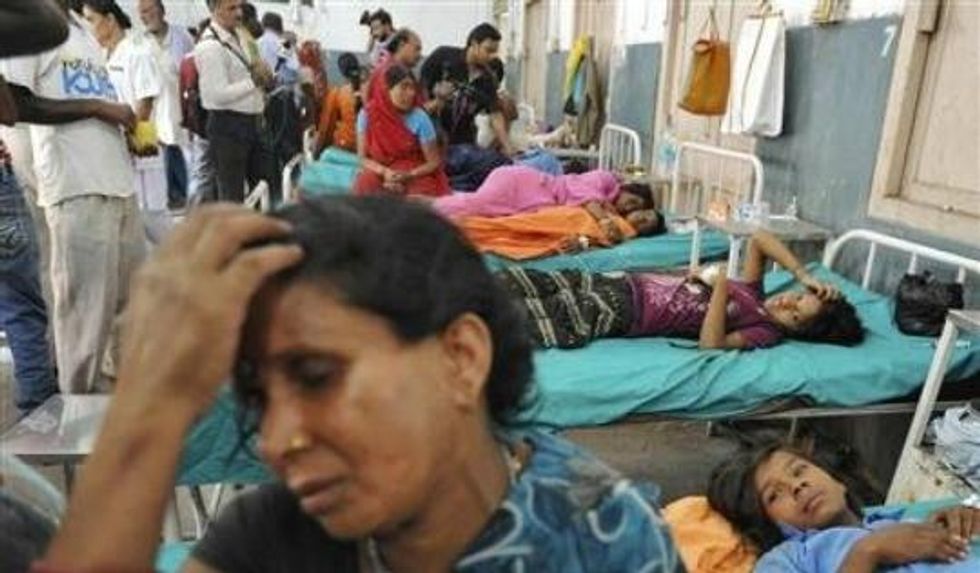
As of Wednesday it was still unclear as to whether the insecticide was intentionally doused on the food or if the poisoning was the result of unwashed produce and a pesticide-heavy farming industry.
"We prepared antidotes and treated the children for organophosphorous poisoning," said R.K. Singh, medical superintendent at the children's hospital in state capital Patna. Organophosphate is an insecticide typically used on rice and wheat crops.
"It appears to be a case of poisoning but we will have to wait for forensic reports ... Had it been a case of (natural) food poisoning, so many children would not have died," Poonam Kumari, local government administrator at the village, told Reuters by phone from Mashrakh.
Reports vary on the total amount of deaths so far but dozens of the children, between the ages of four to twelve, remained hospitalized in the eastern state of Bihar on Wednesday after initially falling ill on Tuesday.
The school provides meals for the children through the world's largest school feeding program, India's decades-old Mid-Day Meal Scheme, which feeds roughly 120 million children across the country.
Protesters in the region along with parties in opposition to the Janata Dal party-led government reportedly took to the streets following the catastrophe, accusing the government of acting too slowly to hospitalize the children among other complaints of corruption.
Authorities have suspended an official in charge of the meal program in the school and have filed a charge of criminal negligence against the school headmaster.
The school headmaster, however, reportedly fled shortly after the children began to show signs of sickness.
_______________________
As of Wednesday it was still unclear as to whether the insecticide was intentionally doused on the food or if the poisoning was the result of unwashed produce and a pesticide-heavy farming industry.
"We prepared antidotes and treated the children for organophosphorous poisoning," said R.K. Singh, medical superintendent at the children's hospital in state capital Patna. Organophosphate is an insecticide typically used on rice and wheat crops.
"It appears to be a case of poisoning but we will have to wait for forensic reports ... Had it been a case of (natural) food poisoning, so many children would not have died," Poonam Kumari, local government administrator at the village, told Reuters by phone from Mashrakh.
Reports vary on the total amount of deaths so far but dozens of the children, between the ages of four to twelve, remained hospitalized in the eastern state of Bihar on Wednesday after initially falling ill on Tuesday.
The school provides meals for the children through the world's largest school feeding program, India's decades-old Mid-Day Meal Scheme, which feeds roughly 120 million children across the country.
Protesters in the region along with parties in opposition to the Janata Dal party-led government reportedly took to the streets following the catastrophe, accusing the government of acting too slowly to hospitalize the children among other complaints of corruption.
Authorities have suspended an official in charge of the meal program in the school and have filed a charge of criminal negligence against the school headmaster.
The school headmaster, however, reportedly fled shortly after the children began to show signs of sickness.
_______________________
As of Wednesday it was still unclear as to whether the insecticide was intentionally doused on the food or if the poisoning was the result of unwashed produce and a pesticide-heavy farming industry.
"We prepared antidotes and treated the children for organophosphorous poisoning," said R.K. Singh, medical superintendent at the children's hospital in state capital Patna. Organophosphate is an insecticide typically used on rice and wheat crops.
"It appears to be a case of poisoning but we will have to wait for forensic reports ... Had it been a case of (natural) food poisoning, so many children would not have died," Poonam Kumari, local government administrator at the village, told Reuters by phone from Mashrakh.
Reports vary on the total amount of deaths so far but dozens of the children, between the ages of four to twelve, remained hospitalized in the eastern state of Bihar on Wednesday after initially falling ill on Tuesday.
The school provides meals for the children through the world's largest school feeding program, India's decades-old Mid-Day Meal Scheme, which feeds roughly 120 million children across the country.
Protesters in the region along with parties in opposition to the Janata Dal party-led government reportedly took to the streets following the catastrophe, accusing the government of acting too slowly to hospitalize the children among other complaints of corruption.
Authorities have suspended an official in charge of the meal program in the school and have filed a charge of criminal negligence against the school headmaster.
The school headmaster, however, reportedly fled shortly after the children began to show signs of sickness.
_______________________