SUBSCRIBE TO OUR FREE NEWSLETTER
Daily news & progressive opinion—funded by the people, not the corporations—delivered straight to your inbox.
5
#000000
#FFFFFF
To donate by check, phone, or other method, see our More Ways to Give page.
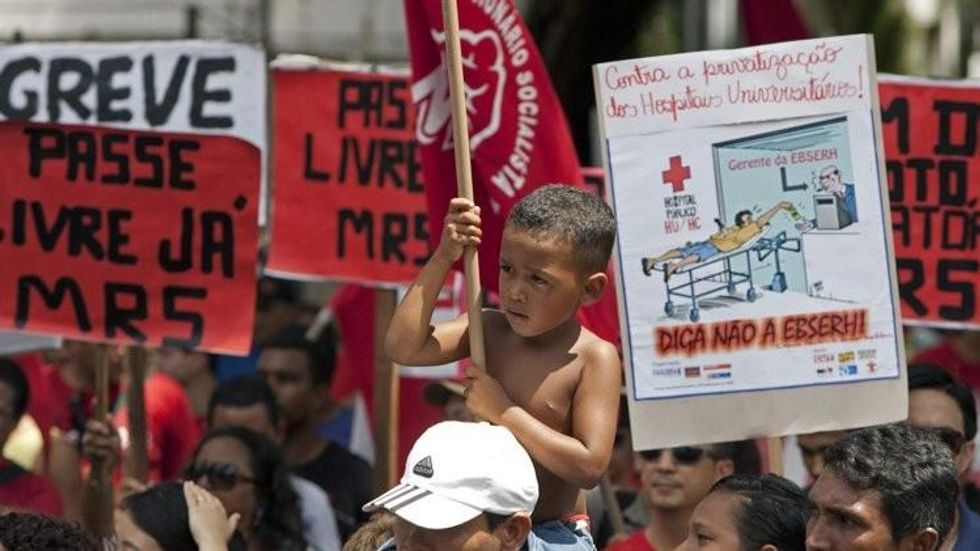
Metalworkers, construction workers, teachers, doctors, and other civil servants took part in the day of strikes coined the "Day of Struggle," which was organized by the country's five leading labor federations.
"I haven't had a pay rise in 14 years. "
Throughout the day, strikers demonstrated in all 27 Brazilian states--at times blockading over 80 sections of highway across the country.
According to Al Jazeera, "The strikers are demanding better public transit, health and education services as well as agriculture reform and a reduced work week."
"I haven't had a pay rise in 14 years. I earn 1,900 reals (PS553) net a month," Roberto Salim, a doctor in a public hospital, told reporters.
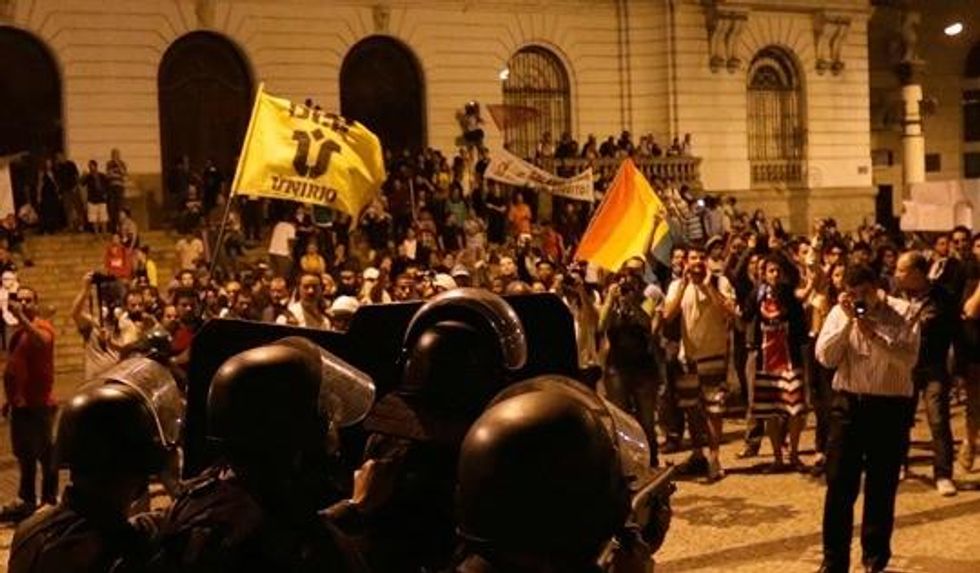
As the largely peaceful protests moved into the evening, violence broke out as police used teargas and stun bombs on a group of demonstrators in central Rio, which had followed a 20,000 strong march organized by trade unionists.
Numerous protests that have shaken Brazil over the past several weeks have seen brutal police crackdowns--sparking vast popular discontent. Particular fury over a lack in public service funding--amidst government corruption and police brutality--saw the largest of the protests on June 19th, with over a million demonstrators in the city of Rio de Janiero and hundreds of thousands of others in cities across the country.
_______________________
Metalworkers, construction workers, teachers, doctors, and other civil servants took part in the day of strikes coined the "Day of Struggle," which was organized by the country's five leading labor federations.
"I haven't had a pay rise in 14 years. "
Throughout the day, strikers demonstrated in all 27 Brazilian states--at times blockading over 80 sections of highway across the country.
According to Al Jazeera, "The strikers are demanding better public transit, health and education services as well as agriculture reform and a reduced work week."
"I haven't had a pay rise in 14 years. I earn 1,900 reals (PS553) net a month," Roberto Salim, a doctor in a public hospital, told reporters.
As the largely peaceful protests moved into the evening, violence broke out as police used teargas and stun bombs on a group of demonstrators in central Rio, which had followed a 20,000 strong march organized by trade unionists.
Numerous protests that have shaken Brazil over the past several weeks have seen brutal police crackdowns--sparking vast popular discontent. Particular fury over a lack in public service funding--amidst government corruption and police brutality--saw the largest of the protests on June 19th, with over a million demonstrators in the city of Rio de Janiero and hundreds of thousands of others in cities across the country.
_______________________
Metalworkers, construction workers, teachers, doctors, and other civil servants took part in the day of strikes coined the "Day of Struggle," which was organized by the country's five leading labor federations.
"I haven't had a pay rise in 14 years. "
Throughout the day, strikers demonstrated in all 27 Brazilian states--at times blockading over 80 sections of highway across the country.
According to Al Jazeera, "The strikers are demanding better public transit, health and education services as well as agriculture reform and a reduced work week."
"I haven't had a pay rise in 14 years. I earn 1,900 reals (PS553) net a month," Roberto Salim, a doctor in a public hospital, told reporters.
As the largely peaceful protests moved into the evening, violence broke out as police used teargas and stun bombs on a group of demonstrators in central Rio, which had followed a 20,000 strong march organized by trade unionists.
Numerous protests that have shaken Brazil over the past several weeks have seen brutal police crackdowns--sparking vast popular discontent. Particular fury over a lack in public service funding--amidst government corruption and police brutality--saw the largest of the protests on June 19th, with over a million demonstrators in the city of Rio de Janiero and hundreds of thousands of others in cities across the country.
_______________________