SUBSCRIBE TO OUR FREE NEWSLETTER
Daily news & progressive opinion—funded by the people, not the corporations—delivered straight to your inbox.
5
#000000
#FFFFFF
To donate by check, phone, or other method, see our More Ways to Give page.
Daily news & progressive opinion—funded by the people, not the corporations—delivered straight to your inbox.
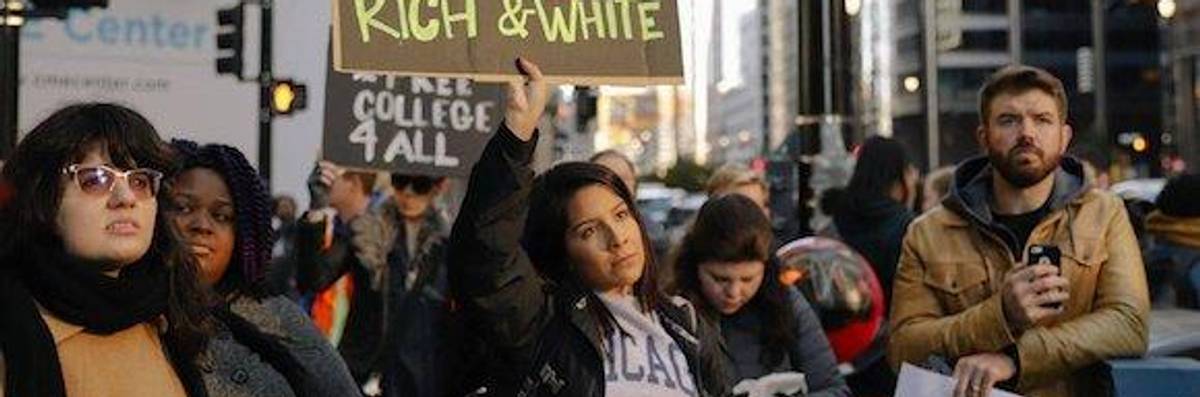
Students held direct actions, rallies, and teach-ins to send a clear message that education is a right, not a privilege. (Photo: People's Action Blog)
44 million people in the US owe nearly $1.5 trillion in student debt, a total that grows larger every day. Students often choose between eating three meals a day, paying rent, and buying textbooks. For many of us, the excitement of graduating is tempered by the fear of never being able to pay off student loans.
My peers and I belong to a generation that faces unprecedented barriers to quality higher education. The cost of college has risen four times faster than inflation, but our universities continuously fail to meet the needs of marginalized students.
This is a national economic crisis, and one that disproportionately affects women and students of color.
That's why on October 15th, college students across the country held a National Day of Action, demanding free public higher education as part of the #FreeCollege4All campaign.
" Working class, first-generation students like myself grew up envisioning college as an out-of-reach luxury," said Nicole Reyes, a student at University of Illinois-Chicago. "Now I face mounting student debt, which I am forced to prioritize over my already difficult living expenses."
Nicole and I were two of the students who filled Chicago's downtown streets on Monday to protest the rising costs of higher education. Chanting over the blaring sounds of rush-hour traffic, protesters marched down South Wacker Drive from Bank of America to Wells Fargo and Fannie Mae, three of the top issuers of student debt.
Nicole is also the lead organizer on her campus for Student Action, a network of student groups at 35 schools in 9 states that is part of the People's Action family of grassroots groups, that fights for justice on issues that affect students on their campuses and in their communities.
Student Action organizers believe that quality education for all is a key step towards solving the global problems facing our generation: catastrophic climate change and staggering racial, gender, and economic inequality.
Student Action joined the Young Democratic Socialists of America in organizing Monday's student protests, which took place simultaneously in states across the country, and drew participation from over 15 campuses. Students held direct actions, rallies, and teach-ins to send a clear message that education is a right, not a privilege.
"This is just the beginning of a national student movement that centers on poor students and students of color," said Brooke Adams, Student Action's organizing director. "We're putting candidates on notice that if they want students' support, they have to get behind a progressive platform that includes free college for all."
For us, free public higher education means that all college students will be guaranteed access to a quality education, regardless of citizenship status, economic standing, race, geographic location, or former or present incarceration status.
Today, women hold two thirds of all national debt, and students of color face a higher risk of defaulting on loans. Undocumented students and students with criminal records are often unable to even apply for aid. A truly accessible free college policy must address these disparities.
In Ames, Iowa, students from throughout the state blocked the street in front of what will soon be Iowa State University's new Student Innovation Center. This $84 million dollar development project was approved by the school's board of regents last year at the exact same time that they announced a seven percent tuition hike.
Forgiving student loans and passing free public higher education would free 44 million people in the United States from the growing total of $1.5 trillion in debt. This can be achieved with progressive tax measures such as estate taxes or financial transaction fees.
While the protests in Chicago and elsewhere were the culmination of months of work, we are only at the beginning of our #FreeCollege4All campaign. Student Action will continue this fight until we win a world where college need never be considered a luxury. There is more to come.
Dear Common Dreams reader, It’s been nearly 30 years since I co-founded Common Dreams with my late wife, Lina Newhouser. We had the radical notion that journalism should serve the public good, not corporate profits. It was clear to us from the outset what it would take to build such a project. No paid advertisements. No corporate sponsors. No millionaire publisher telling us what to think or do. Many people said we wouldn't last a year, but we proved those doubters wrong. Together with a tremendous team of journalists and dedicated staff, we built an independent media outlet free from the constraints of profits and corporate control. Our mission has always been simple: To inform. To inspire. To ignite change for the common good. Building Common Dreams was not easy. Our survival was never guaranteed. When you take on the most powerful forces—Wall Street greed, fossil fuel industry destruction, Big Tech lobbyists, and uber-rich oligarchs who have spent billions upon billions rigging the economy and democracy in their favor—the only bulwark you have is supporters who believe in your work. But here’s the urgent message from me today. It's never been this bad out there. And it's never been this hard to keep us going. At the very moment Common Dreams is most needed, the threats we face are intensifying. We need your support now more than ever. We don't accept corporate advertising and never will. We don't have a paywall because we don't think people should be blocked from critical news based on their ability to pay. Everything we do is funded by the donations of readers like you. When everyone does the little they can afford, we are strong. But if that support retreats or dries up, so do we. Will you donate now to make sure Common Dreams not only survives but thrives? —Craig Brown, Co-founder |
44 million people in the US owe nearly $1.5 trillion in student debt, a total that grows larger every day. Students often choose between eating three meals a day, paying rent, and buying textbooks. For many of us, the excitement of graduating is tempered by the fear of never being able to pay off student loans.
My peers and I belong to a generation that faces unprecedented barriers to quality higher education. The cost of college has risen four times faster than inflation, but our universities continuously fail to meet the needs of marginalized students.
This is a national economic crisis, and one that disproportionately affects women and students of color.
That's why on October 15th, college students across the country held a National Day of Action, demanding free public higher education as part of the #FreeCollege4All campaign.
" Working class, first-generation students like myself grew up envisioning college as an out-of-reach luxury," said Nicole Reyes, a student at University of Illinois-Chicago. "Now I face mounting student debt, which I am forced to prioritize over my already difficult living expenses."
Nicole and I were two of the students who filled Chicago's downtown streets on Monday to protest the rising costs of higher education. Chanting over the blaring sounds of rush-hour traffic, protesters marched down South Wacker Drive from Bank of America to Wells Fargo and Fannie Mae, three of the top issuers of student debt.
Nicole is also the lead organizer on her campus for Student Action, a network of student groups at 35 schools in 9 states that is part of the People's Action family of grassroots groups, that fights for justice on issues that affect students on their campuses and in their communities.
Student Action organizers believe that quality education for all is a key step towards solving the global problems facing our generation: catastrophic climate change and staggering racial, gender, and economic inequality.
Student Action joined the Young Democratic Socialists of America in organizing Monday's student protests, which took place simultaneously in states across the country, and drew participation from over 15 campuses. Students held direct actions, rallies, and teach-ins to send a clear message that education is a right, not a privilege.
"This is just the beginning of a national student movement that centers on poor students and students of color," said Brooke Adams, Student Action's organizing director. "We're putting candidates on notice that if they want students' support, they have to get behind a progressive platform that includes free college for all."
For us, free public higher education means that all college students will be guaranteed access to a quality education, regardless of citizenship status, economic standing, race, geographic location, or former or present incarceration status.
Today, women hold two thirds of all national debt, and students of color face a higher risk of defaulting on loans. Undocumented students and students with criminal records are often unable to even apply for aid. A truly accessible free college policy must address these disparities.
In Ames, Iowa, students from throughout the state blocked the street in front of what will soon be Iowa State University's new Student Innovation Center. This $84 million dollar development project was approved by the school's board of regents last year at the exact same time that they announced a seven percent tuition hike.
Forgiving student loans and passing free public higher education would free 44 million people in the United States from the growing total of $1.5 trillion in debt. This can be achieved with progressive tax measures such as estate taxes or financial transaction fees.
While the protests in Chicago and elsewhere were the culmination of months of work, we are only at the beginning of our #FreeCollege4All campaign. Student Action will continue this fight until we win a world where college need never be considered a luxury. There is more to come.
44 million people in the US owe nearly $1.5 trillion in student debt, a total that grows larger every day. Students often choose between eating three meals a day, paying rent, and buying textbooks. For many of us, the excitement of graduating is tempered by the fear of never being able to pay off student loans.
My peers and I belong to a generation that faces unprecedented barriers to quality higher education. The cost of college has risen four times faster than inflation, but our universities continuously fail to meet the needs of marginalized students.
This is a national economic crisis, and one that disproportionately affects women and students of color.
That's why on October 15th, college students across the country held a National Day of Action, demanding free public higher education as part of the #FreeCollege4All campaign.
" Working class, first-generation students like myself grew up envisioning college as an out-of-reach luxury," said Nicole Reyes, a student at University of Illinois-Chicago. "Now I face mounting student debt, which I am forced to prioritize over my already difficult living expenses."
Nicole and I were two of the students who filled Chicago's downtown streets on Monday to protest the rising costs of higher education. Chanting over the blaring sounds of rush-hour traffic, protesters marched down South Wacker Drive from Bank of America to Wells Fargo and Fannie Mae, three of the top issuers of student debt.
Nicole is also the lead organizer on her campus for Student Action, a network of student groups at 35 schools in 9 states that is part of the People's Action family of grassroots groups, that fights for justice on issues that affect students on their campuses and in their communities.
Student Action organizers believe that quality education for all is a key step towards solving the global problems facing our generation: catastrophic climate change and staggering racial, gender, and economic inequality.
Student Action joined the Young Democratic Socialists of America in organizing Monday's student protests, which took place simultaneously in states across the country, and drew participation from over 15 campuses. Students held direct actions, rallies, and teach-ins to send a clear message that education is a right, not a privilege.
"This is just the beginning of a national student movement that centers on poor students and students of color," said Brooke Adams, Student Action's organizing director. "We're putting candidates on notice that if they want students' support, they have to get behind a progressive platform that includes free college for all."
For us, free public higher education means that all college students will be guaranteed access to a quality education, regardless of citizenship status, economic standing, race, geographic location, or former or present incarceration status.
Today, women hold two thirds of all national debt, and students of color face a higher risk of defaulting on loans. Undocumented students and students with criminal records are often unable to even apply for aid. A truly accessible free college policy must address these disparities.
In Ames, Iowa, students from throughout the state blocked the street in front of what will soon be Iowa State University's new Student Innovation Center. This $84 million dollar development project was approved by the school's board of regents last year at the exact same time that they announced a seven percent tuition hike.
Forgiving student loans and passing free public higher education would free 44 million people in the United States from the growing total of $1.5 trillion in debt. This can be achieved with progressive tax measures such as estate taxes or financial transaction fees.
While the protests in Chicago and elsewhere were the culmination of months of work, we are only at the beginning of our #FreeCollege4All campaign. Student Action will continue this fight until we win a world where college need never be considered a luxury. There is more to come.