

Hosni Mubarak, our 84-year old ousted dictator, has spent another night outside the prison cell where he's been sentenced to spend whatever remains of his life. A health scare that began as a stroke, according to state-controlled media, but ended up being attributed by his lawyer to a "slip in the bathroom", ensured that he was moved into the welcoming environs of a military hospital.
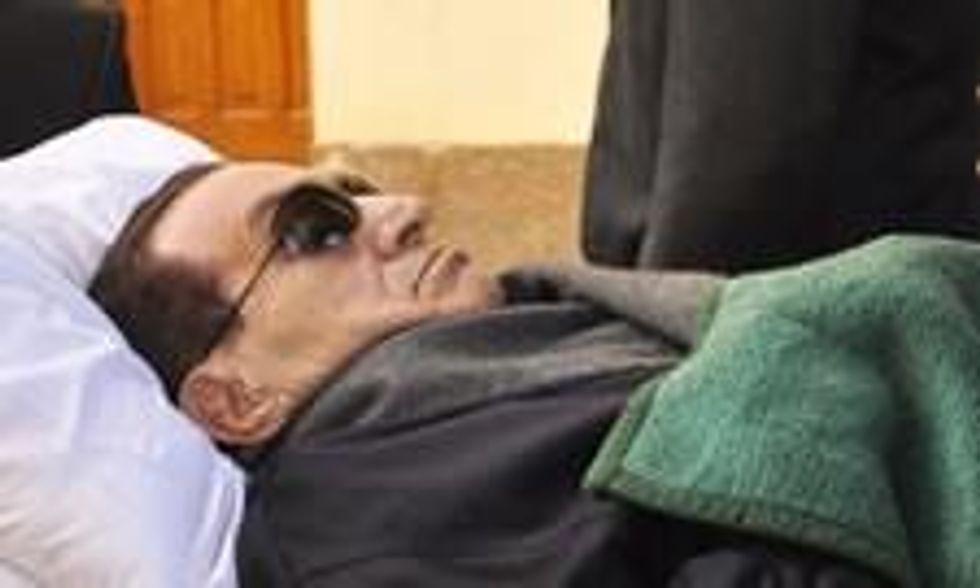
It might sound heartless to brush off an old man's maybe-maybe-not health issues but our hearts have been smashed, worn out and driven to the verge of death countless times by the 19 Mubaraks who comprise the Supreme Council of Armed Forces, the military junta that took over the country after the revolution forced Mubarak to step down on 11 February 2011. Mubarak might be on his back but his regime is very much on its legs, upright and determined to crush our revolution, never mind our hearts.
The miracle isn't that several times a month Mubarak falls into and out of near-death health scares, it is the Egyptians' ability to have survived the past 60 years of a military rule that has snuffed out so much of what used to make Egypt such a vibrant heart of the Arab world. Ever since a group of army officers staged a coup in 1952 and allowed one of their own to put aside his military garb and wear a suit instead to serve as our civilian dictator, the aging generals at the helm thrive and live in comfort at the expense of our young - the majority of Egyptians are younger than 30.
When Mubarak does die, he will be remembered as the most bland of those military men turned dictators: compare him with Gamal Abdel-Nasser and Anwar Sadat. The legacies most associated with him are a network of bridges and highways and "stability". The revolution ousted him but one of its main goals was to end military rule so our fight against him is a fight against his regime.
It is not just Mubarak who is supposedly fighting for his life; that military rule too is determined to hold on. A series of blatant power grabs over the past couple of weeks that have dissolved parliament and attempt to curb the powers of whoever is our next president, are also reminders that the military junta feels the need to remind us that it's in charge.
The Muslim Brotherhood movement - whose heart, let's be honest, was never fully into the revolution but whose candidate Mohamed Morsi might be that next president - has since Mubarak's ouster been busy with its own power grabbing and on-again-off-again ability or willingness to stand up to the military junta and for the goals of our revolution: bread, liberty and social justice.
So you'll excuse us if Mubarak's health "scares" are less significant to most people here in Egypt than they are to the foreign media. The man whose regime crushed the dreams and futures of so many Egyptians is very much alive and kicking.
For a more poignant reminder, look beyond the rollercoaster of presidential election results and rumors and witness the resumption of a trial on Monday that sets into tragic relief the price the revolution has exacted.
As Mubarak enjoys the comfort of military hospital instead of jail, eight young men will testify in the latest session of the trial of 73 suspects accused of involvement in the Port Said football disaster. On 1 February, at least 74 football fans were killed in violence after a match between Cairo team Ahly and Masry of Port Said.
Many of us believe the Ahly football fans were set upon deliberately - as police and security did nothing to end the violence - to punish their fan club the ultras for taking part in the revolution. Many people entered the stadium with weapons, the stadium's steel doors were locked during the massacre and the lights were turned off.
A survivor has described to me seeing seven of his friends being killed in front of him and carrying out 12 corpses. Many of those who died were in their late teens or early 20s. "If our hearts were crushed before Port Said, they died at the stadium," another survivor told me.
So once again, you'll excuse us if the on-again off-again health issues of an octogenarian are not our priority.
Hosni Mubarak, our 84-year old ousted dictator, has spent another night outside the prison cell where he's been sentenced to spend whatever remains of his life. A health scare that began as a stroke, according to state-controlled media, but ended up being attributed by his lawyer to a "slip in the bathroom", ensured that he was moved into the welcoming environs of a military hospital.
It might sound heartless to brush off an old man's maybe-maybe-not health issues but our hearts have been smashed, worn out and driven to the verge of death countless times by the 19 Mubaraks who comprise the Supreme Council of Armed Forces, the military junta that took over the country after the revolution forced Mubarak to step down on 11 February 2011. Mubarak might be on his back but his regime is very much on its legs, upright and determined to crush our revolution, never mind our hearts.
The miracle isn't that several times a month Mubarak falls into and out of near-death health scares, it is the Egyptians' ability to have survived the past 60 years of a military rule that has snuffed out so much of what used to make Egypt such a vibrant heart of the Arab world. Ever since a group of army officers staged a coup in 1952 and allowed one of their own to put aside his military garb and wear a suit instead to serve as our civilian dictator, the aging generals at the helm thrive and live in comfort at the expense of our young - the majority of Egyptians are younger than 30.
When Mubarak does die, he will be remembered as the most bland of those military men turned dictators: compare him with Gamal Abdel-Nasser and Anwar Sadat. The legacies most associated with him are a network of bridges and highways and "stability". The revolution ousted him but one of its main goals was to end military rule so our fight against him is a fight against his regime.
It is not just Mubarak who is supposedly fighting for his life; that military rule too is determined to hold on. A series of blatant power grabs over the past couple of weeks that have dissolved parliament and attempt to curb the powers of whoever is our next president, are also reminders that the military junta feels the need to remind us that it's in charge.
The Muslim Brotherhood movement - whose heart, let's be honest, was never fully into the revolution but whose candidate Mohamed Morsi might be that next president - has since Mubarak's ouster been busy with its own power grabbing and on-again-off-again ability or willingness to stand up to the military junta and for the goals of our revolution: bread, liberty and social justice.
So you'll excuse us if Mubarak's health "scares" are less significant to most people here in Egypt than they are to the foreign media. The man whose regime crushed the dreams and futures of so many Egyptians is very much alive and kicking.
For a more poignant reminder, look beyond the rollercoaster of presidential election results and rumors and witness the resumption of a trial on Monday that sets into tragic relief the price the revolution has exacted.
As Mubarak enjoys the comfort of military hospital instead of jail, eight young men will testify in the latest session of the trial of 73 suspects accused of involvement in the Port Said football disaster. On 1 February, at least 74 football fans were killed in violence after a match between Cairo team Ahly and Masry of Port Said.
Many of us believe the Ahly football fans were set upon deliberately - as police and security did nothing to end the violence - to punish their fan club the ultras for taking part in the revolution. Many people entered the stadium with weapons, the stadium's steel doors were locked during the massacre and the lights were turned off.
A survivor has described to me seeing seven of his friends being killed in front of him and carrying out 12 corpses. Many of those who died were in their late teens or early 20s. "If our hearts were crushed before Port Said, they died at the stadium," another survivor told me.
So once again, you'll excuse us if the on-again off-again health issues of an octogenarian are not our priority.
Hosni Mubarak, our 84-year old ousted dictator, has spent another night outside the prison cell where he's been sentenced to spend whatever remains of his life. A health scare that began as a stroke, according to state-controlled media, but ended up being attributed by his lawyer to a "slip in the bathroom", ensured that he was moved into the welcoming environs of a military hospital.
It might sound heartless to brush off an old man's maybe-maybe-not health issues but our hearts have been smashed, worn out and driven to the verge of death countless times by the 19 Mubaraks who comprise the Supreme Council of Armed Forces, the military junta that took over the country after the revolution forced Mubarak to step down on 11 February 2011. Mubarak might be on his back but his regime is very much on its legs, upright and determined to crush our revolution, never mind our hearts.
The miracle isn't that several times a month Mubarak falls into and out of near-death health scares, it is the Egyptians' ability to have survived the past 60 years of a military rule that has snuffed out so much of what used to make Egypt such a vibrant heart of the Arab world. Ever since a group of army officers staged a coup in 1952 and allowed one of their own to put aside his military garb and wear a suit instead to serve as our civilian dictator, the aging generals at the helm thrive and live in comfort at the expense of our young - the majority of Egyptians are younger than 30.
When Mubarak does die, he will be remembered as the most bland of those military men turned dictators: compare him with Gamal Abdel-Nasser and Anwar Sadat. The legacies most associated with him are a network of bridges and highways and "stability". The revolution ousted him but one of its main goals was to end military rule so our fight against him is a fight against his regime.
It is not just Mubarak who is supposedly fighting for his life; that military rule too is determined to hold on. A series of blatant power grabs over the past couple of weeks that have dissolved parliament and attempt to curb the powers of whoever is our next president, are also reminders that the military junta feels the need to remind us that it's in charge.
The Muslim Brotherhood movement - whose heart, let's be honest, was never fully into the revolution but whose candidate Mohamed Morsi might be that next president - has since Mubarak's ouster been busy with its own power grabbing and on-again-off-again ability or willingness to stand up to the military junta and for the goals of our revolution: bread, liberty and social justice.
So you'll excuse us if Mubarak's health "scares" are less significant to most people here in Egypt than they are to the foreign media. The man whose regime crushed the dreams and futures of so many Egyptians is very much alive and kicking.
For a more poignant reminder, look beyond the rollercoaster of presidential election results and rumors and witness the resumption of a trial on Monday that sets into tragic relief the price the revolution has exacted.
As Mubarak enjoys the comfort of military hospital instead of jail, eight young men will testify in the latest session of the trial of 73 suspects accused of involvement in the Port Said football disaster. On 1 February, at least 74 football fans were killed in violence after a match between Cairo team Ahly and Masry of Port Said.
Many of us believe the Ahly football fans were set upon deliberately - as police and security did nothing to end the violence - to punish their fan club the ultras for taking part in the revolution. Many people entered the stadium with weapons, the stadium's steel doors were locked during the massacre and the lights were turned off.
A survivor has described to me seeing seven of his friends being killed in front of him and carrying out 12 corpses. Many of those who died were in their late teens or early 20s. "If our hearts were crushed before Port Said, they died at the stadium," another survivor told me.
So once again, you'll excuse us if the on-again off-again health issues of an octogenarian are not our priority.