SUBSCRIBE TO OUR FREE NEWSLETTER
Daily news & progressive opinion—funded by the people, not the corporations—delivered straight to your inbox.
5
#000000
#FFFFFF
To donate by check, phone, or other method, see our More Ways to Give page.
Daily news & progressive opinion—funded by the people, not the corporations—delivered straight to your inbox.
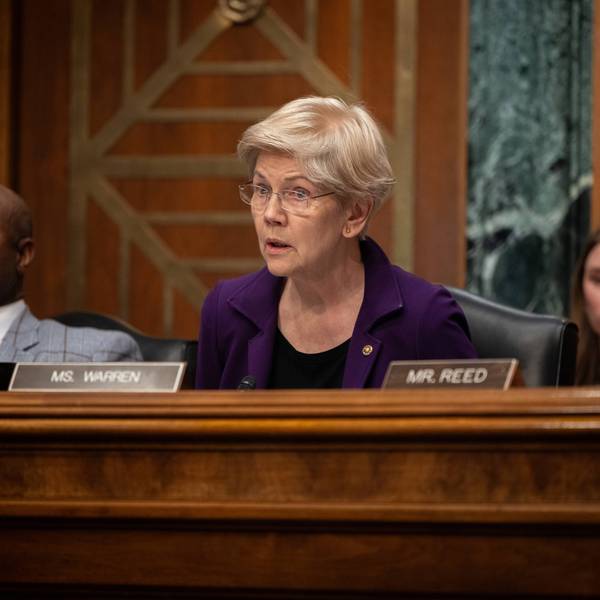
Consumer advocate Elizabeth Warren announced that she was running against Scott Brown for a U.S. Senate seat in Massachusetts on the eve of the anniversary of the Lehman Brothers collapse. For many, Lehman's unthinkable bankruptcy September 15th, 2008 marks the day when the wheels came off the bus and the U.S. economy went over a cliff.
With 30 million Americans unemployed and underemployed, Social Security, Medicare and public workers under attack, Warren's video announcement got straight to the point.
"Middle-class families have been chipped at, hacked at, squeezed and hammered for a generation now, and I don't think Washington gets it. Washington is rigged for big corporations that hire armies of lobbyists," she continued. "A big company like GE pays nothing in taxes and we're asking college students to take on even more debt to get an education, we're telling seniors they may have to learn to live on less? It isn't right, and it's the reason I'm running for the U.S. Senate."
Warren spoke directly to Bay Staters when she said: "I have stood up to some pretty powerful interests. Those interests are going to line up against this campaign and that is why I need you."
This may be the understatement of the year.
Warren has been described as "Wall Street's worst nightmare" by reporters. How did this soft-spoken mom, who appears to wear JC Penny off the rack, earn such an appellation?
For 20 years, Warren has been a professor at Harvard University, where she specializes in bankruptcy and commercial law. She is the author of nine books, two of them best sellers. Instead of staying in her ivory tower, Warren has emerged time and time again as a feisty voice for consumers in a shark-infested marketplace. She rose to prominence during the financial crisis as someone who was smart enough to go on TV and take on the Wall Street wizards, to battle for common sense and common people.
When Congress was asked by President Bush to pass the TARP bank bailout bill, Warren was tapped by Congressional Democrats to run the TARP oversight committee to birddog the bailout on behalf of the American people. In that role, she slammed Republican Treasury Secretary Hank Paulson for propping up banks by buying assets under par (assets she demonstrated were worth far less than Paulson claimed), she grilled Democratic Treasury Secretary Tim Geithner for the Fed's backdoor bailout of Goldman Sachs, for not attaching any strings to the bank bailout, for failing to make the HAMP program work to help average home owners. In numerous TV appearances, her oft-repeated theme was "we bailed out the top and left the rest to fend for themselves."
But she is best know for her advocacy for the newly created Consumer Financial Protection Bureau which opened its doors in July 2011 after a herculean battle with the big banks during the Dodd-Frank Wall Street reform bill debates. According to Americans for Financial Reform, the financial service industry spent $1.4 billion between 2008-2010 trying to kill reform and have spent $238,000 already this year with the same goal.
Warren had hoped to head the agency that she helped create, but opposition from the banks and their friends in Congress made it impossible for the president to move her nomination forward.
U.S. Senator Scott Brown has a different relationship with the big banks. He was elected to office after Ted Kennedy died, largely with a huge infusion of $442,000 from Wall Street firms. He quickly returned the favor by killing a $19 billion bank tax to pay for policing the banks in the Dodd-Frank Wall Street reform bill. Today he has $10 million in his campaign coffer. According to the Center for Responsive Politics, he is the number one recipient of hedge fund money, number one recipient of venture capital money, number two recipient for private equity and securities and investment firms.
Fidelity Bank, Goldman Sach and New York Mellon are big backers. No wonder Forbes magazine dubbed him one of "Wall Street's favorite Congressmen."
Big banks are not Warren's only problem. A poll conducted by a Boston NPR affiliate this month showed Brown leading Warren 44-35 in a potential matchup. Off the record, some Democrats admit that Scott Brown is charismatic, charming and well-liked. He is also well-known for quality constituent work.
One Lindfield resident who has been struggling to get a mortgage modification from Bank of America for years has gotten some helpful assistance from Scott Brown's office. "I like everything I know about Scott Brown, I may not know the whole story, but I like the progress he has made as a Senator and I like that he just went to Afghanistan," said George Mahoney.
In other words, Warren has her work cut out for her.
Lehman Brothers Holdings declared bankruptcy three years ago today. Prior to its collapse, Lehman was the fourth largest and the oldest of the five major global financial-services firms. Lehman was leveraged at 44-1 in 2007 when housing prices started to collapse. When Treasury Secretary Hank Paulson decided to let the firm go under as a lesson in moral hazard, the bank's demise rocked the world and froze global credit markets.
The U.S. has still not recovered from the Wall Street meltdown, yet after a bailout we now know was larger than ever disclosed ($4.7 trillion according to our latest count), Wall Street is bouncing back while Main Street is dead in the water with zero new job growth.
Warren gets it: "I'm willing to throw my body in front of a bus to try to stop bad ideas that are going to be harmful to the middle class."
There will certainly be plenty of those where she is headed.
This country and this world are at a monumental crossroads. US voters have an opportunity to beat back the forces of fascism and confront the billionaires who are rigging the economy, our media system, and our democracy, making it increasingly impossible for ordinary people to get by. We’re not just talking about the election. We’re talking about what must be done once these fascist elements are vanquished from power. We need a bolder set of solutions than what either major party has so far been willing to offer and a working-class movement ready to fight like hell for it. Trump didn't emerge from nowhere. The conditions that fueled MAGA authoritarianism were created by decades of radical neoliberal economic policies and a corrupt political system dominated by corporate interests. They slashed taxes on the super-rich, promising that the benefits would trickle down. They said giveaways to the corporate titans would make life more affordable for the rest of us. It was all bullshit. And when a bitter, betrayed populace searches for someone to blame, right-wing demagogues have little trouble finding scapegoats. People know when they're being lied to, but you won't hear any of this from the corporate media. Only independent journalism—powered and funded by people who believe in building a better world—can deliver truly trustworthy daily news. If you share our vision, please contribute whatever you can to sustain our work. |
Consumer advocate Elizabeth Warren announced that she was running against Scott Brown for a U.S. Senate seat in Massachusetts on the eve of the anniversary of the Lehman Brothers collapse. For many, Lehman's unthinkable bankruptcy September 15th, 2008 marks the day when the wheels came off the bus and the U.S. economy went over a cliff.
With 30 million Americans unemployed and underemployed, Social Security, Medicare and public workers under attack, Warren's video announcement got straight to the point.
"Middle-class families have been chipped at, hacked at, squeezed and hammered for a generation now, and I don't think Washington gets it. Washington is rigged for big corporations that hire armies of lobbyists," she continued. "A big company like GE pays nothing in taxes and we're asking college students to take on even more debt to get an education, we're telling seniors they may have to learn to live on less? It isn't right, and it's the reason I'm running for the U.S. Senate."
Warren spoke directly to Bay Staters when she said: "I have stood up to some pretty powerful interests. Those interests are going to line up against this campaign and that is why I need you."
This may be the understatement of the year.
Warren has been described as "Wall Street's worst nightmare" by reporters. How did this soft-spoken mom, who appears to wear JC Penny off the rack, earn such an appellation?
For 20 years, Warren has been a professor at Harvard University, where she specializes in bankruptcy and commercial law. She is the author of nine books, two of them best sellers. Instead of staying in her ivory tower, Warren has emerged time and time again as a feisty voice for consumers in a shark-infested marketplace. She rose to prominence during the financial crisis as someone who was smart enough to go on TV and take on the Wall Street wizards, to battle for common sense and common people.
When Congress was asked by President Bush to pass the TARP bank bailout bill, Warren was tapped by Congressional Democrats to run the TARP oversight committee to birddog the bailout on behalf of the American people. In that role, she slammed Republican Treasury Secretary Hank Paulson for propping up banks by buying assets under par (assets she demonstrated were worth far less than Paulson claimed), she grilled Democratic Treasury Secretary Tim Geithner for the Fed's backdoor bailout of Goldman Sachs, for not attaching any strings to the bank bailout, for failing to make the HAMP program work to help average home owners. In numerous TV appearances, her oft-repeated theme was "we bailed out the top and left the rest to fend for themselves."
But she is best know for her advocacy for the newly created Consumer Financial Protection Bureau which opened its doors in July 2011 after a herculean battle with the big banks during the Dodd-Frank Wall Street reform bill debates. According to Americans for Financial Reform, the financial service industry spent $1.4 billion between 2008-2010 trying to kill reform and have spent $238,000 already this year with the same goal.
Warren had hoped to head the agency that she helped create, but opposition from the banks and their friends in Congress made it impossible for the president to move her nomination forward.
U.S. Senator Scott Brown has a different relationship with the big banks. He was elected to office after Ted Kennedy died, largely with a huge infusion of $442,000 from Wall Street firms. He quickly returned the favor by killing a $19 billion bank tax to pay for policing the banks in the Dodd-Frank Wall Street reform bill. Today he has $10 million in his campaign coffer. According to the Center for Responsive Politics, he is the number one recipient of hedge fund money, number one recipient of venture capital money, number two recipient for private equity and securities and investment firms.
Fidelity Bank, Goldman Sach and New York Mellon are big backers. No wonder Forbes magazine dubbed him one of "Wall Street's favorite Congressmen."
Big banks are not Warren's only problem. A poll conducted by a Boston NPR affiliate this month showed Brown leading Warren 44-35 in a potential matchup. Off the record, some Democrats admit that Scott Brown is charismatic, charming and well-liked. He is also well-known for quality constituent work.
One Lindfield resident who has been struggling to get a mortgage modification from Bank of America for years has gotten some helpful assistance from Scott Brown's office. "I like everything I know about Scott Brown, I may not know the whole story, but I like the progress he has made as a Senator and I like that he just went to Afghanistan," said George Mahoney.
In other words, Warren has her work cut out for her.
Lehman Brothers Holdings declared bankruptcy three years ago today. Prior to its collapse, Lehman was the fourth largest and the oldest of the five major global financial-services firms. Lehman was leveraged at 44-1 in 2007 when housing prices started to collapse. When Treasury Secretary Hank Paulson decided to let the firm go under as a lesson in moral hazard, the bank's demise rocked the world and froze global credit markets.
The U.S. has still not recovered from the Wall Street meltdown, yet after a bailout we now know was larger than ever disclosed ($4.7 trillion according to our latest count), Wall Street is bouncing back while Main Street is dead in the water with zero new job growth.
Warren gets it: "I'm willing to throw my body in front of a bus to try to stop bad ideas that are going to be harmful to the middle class."
There will certainly be plenty of those where she is headed.