

SUBSCRIBE TO OUR FREE NEWSLETTER
Daily news & progressive opinion—funded by the people, not the corporations—delivered straight to your inbox.
5
#000000
#FFFFFF
To donate by check, phone, or other method, see our More Ways to Give page.
Daily news & progressive opinion—funded by the people, not the corporations—delivered straight to your inbox.
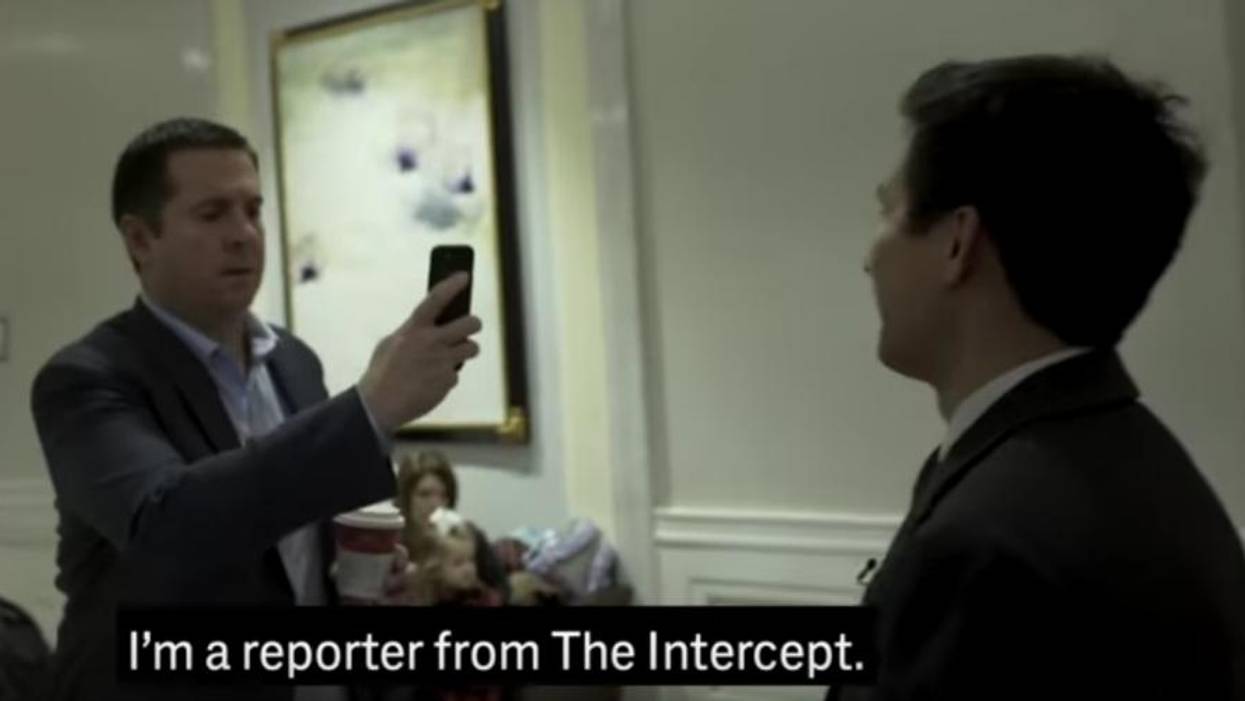
Rep. Devin Nunes, the top Republican on the House Intelligence Committee, claimed Sunday that he was "stalked" at a $15,000-per-plate GOP fundraiser at the luxury Lotte New York Palace Hotel in Manhattan.
In reality, Nunes was approached at the GOP event Saturday by The Intercept's Lee Fang, who asked basic questions about the California Republican's role in President Donald Trump's efforts to pressure the Ukrainian government to investigate former Vice President Joe Biden's son, Hunter.
"I walked up calmly and asked a simple news question to the congressman. You can see everything I actually said and Nunes' trembling hand while he silently took my picture in the video I posted."
--Lee Fang, The Intercept
"Hey, Congressman Nunes. I just wanted to ask you really quickly: What were your calls with Lev Parnas about?" Fang said, referring to an indicted associate of Trump's personal attorney Rudy Giuliani. "Were you asking about the effort to investigate Hunter Biden?"
Nunes walked away without responding to the questions.
When Fang approached Nunes a second time, the congressman pulled out his cell phone and appeared to take photos of Fang and The Intercept's cameraman.
Fang identified himself as a reporter from The Intercept and asked once again about the contents of his conversations with Parnas, which were disclosed for the first time last week in call records released by Democrats on the House Intelligence Committee.
"Were you part of this effort to pressure the Ukrainian government to investigate Hunter Biden?" Fang asked. Nunes once again walked away without responding to the questions.
Sunday afternoon, Nunes posted a photo of Fang on Twitter and claimed the reporter "stalked" him at the GOP fundraiser.
"Maybe he was in Vienna with CNN," Nunes wrote, apparently referring to a CNN report that the California Republican traveled to Vienna last year to meet with a former Ukrainian prosecutor to discuss the effort to dig up dirt on Biden. Last Tuesday, Nunes filed a lawsuit seeking $435,350,000 in damages from CNN for publishing the story.
Fang was quick to respond to Nunes, calling the congressman's description of the event "weird" and "defamatory."
"I walked up calmly and asked a simple news question to the congressman," Fang tweeted. "You can see everything I actually said and Nunes' trembling hand while he silently took my picture in the video I posted."
"This was an event with many, many members of the House Republican caucus. Several lawmakers spoke to us as they arrived or left the hotel for the NRCC fundraiser upstairs. No one was 'stalked,'" Fang added. "Shortly after this brief interaction with Nunes, he had a Capitol Police officer stationed at the event ask hotel staff for us to leave the hotel, which we obliged without hesitation. The man with the beard seen next to Nunes then left the hotel and followed us around the block."
As Fang and Paul Abowd reported for The Intercept Sunday, "Nunes has struggled to explain his rationale for concealing his communications with the men involved in the alleged pressure campaign in Ukraine at the height of their effort, which reportedly included a bid to withhold military assistance and the firing of an ambassador viewed as an obstacle to the strategy."
In addition to his conversations with Parnas, call records released by the House Intelligence Committee showed Nunes also spoke with Giuliani in April.
Nunes was widely ridiculed for claiming he was "stalked" after being confronted with basic questions about his role in Trump's Ukraine scheme, which is at the heart of the House impeachment probe against the president.
"This video depicts a journalist politely asking reasonable questions of Devin Nunes about his flagrantly corrupt conduct," tweeted Greg Sargent of the Washington Post. "Based on this video, Nunes' depiction is an outrageous smear. Nunes is out of control. He's a public servant. He's functioning as Trump's servant."
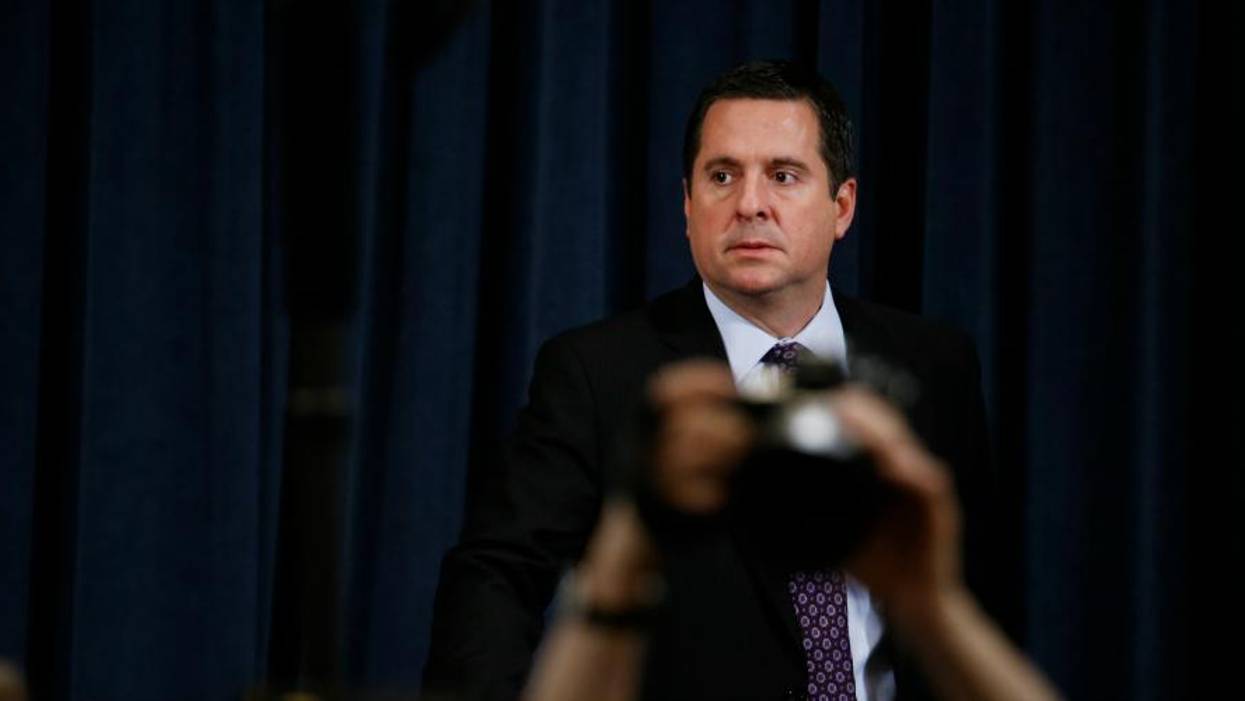
The House Intelligence Committee's 300-page impeachment report released Tuesday made public previously undisclosed and "hugely incriminating" phone records that showed Rep. Devin Nunes, the top Republican on the committee, spoke with President Donald Trump's personal attorney Rudy Giuliani multiple times amid the Trump administration's scheme to dig up dirt on Joe Biden.
According to the records, Nunes was also in contact with Lev Parnas, a Giuliani associate who was indicted in October on campaign finance charges.
Communications between Nunes--a fervent defender of the president--and individuals at the center of the Trump administration's months-long effort to pressure Ukraine to investigate Biden were viewed as "far and away the most damning" revelation in the Intelligence Committee's sprawling impeachment report, which accuses the president of attempting to "use the powers of his office to solicit foreign interference on his behalf in the 2020 election."
"I think he has a lot of explaining to do," Rep. Ted Lieu (D-Calif.), a member of the House Judiciary Committee, said of Nunes.
The Intelligence Committee report states that the calls between Nunes, Giuliani, and Parnas came on the heels of an April 7 column in The Hill by right-wing writer John Solomon, who alleged "wrongdoing by American Democrats and their allies in Kiev."
"Over the course of the four days following the April 7 article, phone records show contacts between Mr. Giuliani, Mr. Parnas, Representative Devin Nunes, and Mr. Solomon," the report says. "Specifically, Mr. Giuliani and Mr. Parnas were in contact with one another, as well as with Mr. Solomon."
"Phone records also show contacts on April 10 between Mr. Giuliani and Rep. Nunes, consisting of three short calls in rapid succession, followed by a text message, and ending with a nearly three minute call," the report continues. "Later that same day, Mr. Parnas and Mr. Solomon had a four minute, 39 second call."
As The Daily Beast's Lachlan Markay noted, the phone records show that Nunes--who has repeatedly attempted to discredit the impeachment probe into Trump by alleging improper conduct by House Democrats--"had engaged in his own behind-the-scenes communications with the very people at issue in the whistleblower complaint."
"Nunes never revealed those communications during the weeks of committee testimony," Markay pointed out.
In an interview with Fox News' Sean Hannity Tuesday night, Nunes said he doesn't recall talking to Parnas, who said last month he is prepared to testify that Nunes met with a former Ukrainian prosecutor in Vienna last year to dig up damaging information on Biden.
Late Tuesday, Nunes filed a lawsuit seeking $435,350,000 in damages from CNN for publishing a story on his alleged meeting in Vienna.
Asked on Tuesday about Nunes' appearance in the call records, House Intelligence Committee chairman Rep. Adam Schiff (D-Calif.) said "it is deeply concerning that at a time when the president of the United States was using the power of his office to dig up dirt on a political rival, that there may be evidence that there were members of Congress complicit in that activity."
Late Tuesday, the Intelligence Committee voted along party lines to send the report to the House Judiciary Committee, which is holding its first public impeachment hearing on Wednesday.
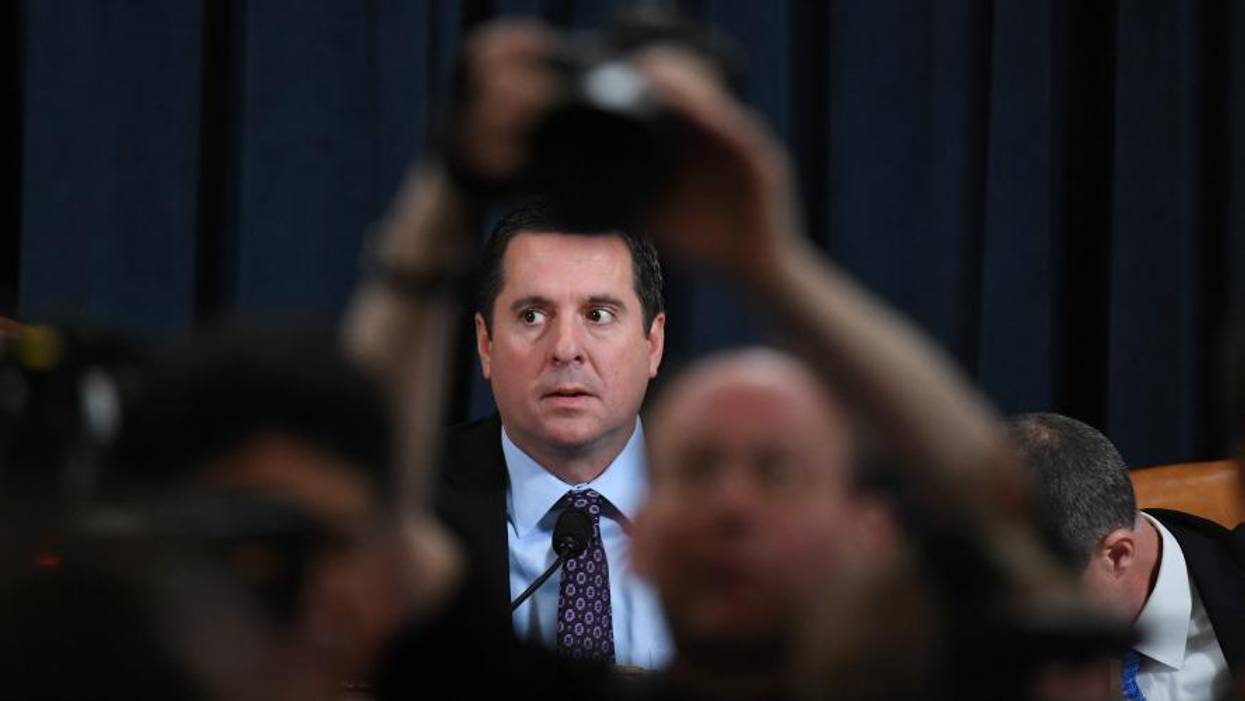
Calls for Republican Rep. Devin Nunes to resign spread rapidly on social media Friday night following reports that Lev Parnas, an indicted associate of President Donald Trump's personal attorney Rudy Giuliani, is willing to testify to House impeachment investigators that Nunes met with a former Ukrainian prosecutor in an effort to dig up dirt on former Vice President Joe Biden.
Parnas' attorney Joseph Bondy told CNN Friday that his client "learned from former Ukrainian Prosecutor General Victor Shokin that Nunes had met with Shokin in Vienna last December," news that sparked the trending Twitter hashtag #NunesResign.
According to CNN, Parnas and Nunes, the top Republican on the House Intelligence Committee and a fervent Trump defender, "began communicating around the time of the Vienna trip."
"Parnas says he worked to put Nunes in touch with Ukrainians who could help Nunes dig up dirt on Biden and Democrats in Ukraine," CNN reported. "That information would likely be of great interest to House Democrats given its overlap with the current impeachment inquiry into President Trump, and could put Nunes in a difficult spot. Bondy tells CNN his client is willing to comply with a congressional subpoena for documents and testimony."
Nunes has repeatedly claimed during public impeachment hearings that Ukraine may have meddled in the 2016 election in an effort to harm Trump's campaign.
"President Trump had good reason to be wary of Ukrainian election meddling against his campaign," Nunes said Thursday.
Fiona Hill, a former member of Trump's National Security Council, testified Thursday that Nunes' claim of Ukraine election meddling is a "harmful" fiction.
CNN story came days after The Daily Beast reported that Parnas, who was indicted last month on campaign finance charges, "helped arrange meetings and calls in Europe" for Nunes.
In a statement to far-right outlet Breitbart News, Nunes accused CNN and The Daily Beast of "defamation" and said he plans to sue both publications.
"I look forward to prosecuting these cases, including the media outlets, as well as the sources of their fake stories, to the fullest extent of the law," Nunes said. "I intend to hold The Daily Beast and CNN accountable for their actions. They will find themselves in court soon after Thanksgiving."
When CNN asked Nunes earlier this month about the reported Vienna trip, Nunes refused to answer.
"I don't talk to you in this lifetime or the next lifetime," the California Republican said. "At any time. On any question."
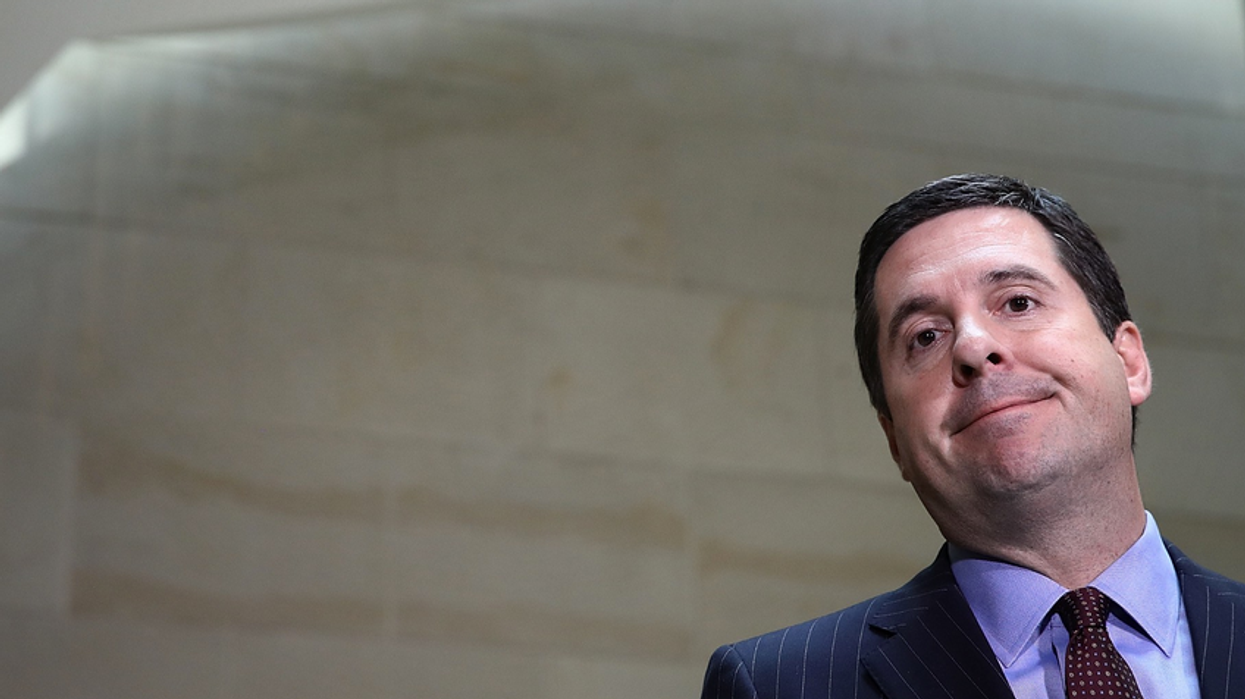
California Rep. Devin Nunes opened himself up to widespread ridicule across the internet yesterday after he reportedly filed a lawsuit against Twitter, a conservative strategist, and two parody accounts -- including one called "Devin Nunes' cow," which purports to be, well, an online manifestation of the Republican congressman's livestock.
Speaking about the lawsuit with Fox News later that day, Nunes claimed that critical comments posted online were part of "an orchestrated effort" to smear his name. He is suing Twitter and the individual critics for "negligence," "libel," and "insulting words."
Paradoxically, at various points in the complaint, Nunes accuses Twitter of censoring conservatives, then demands that the platform censor his critics' speech. The complaint only devolves further from there:
The full scope of the conspiracy, including the names of all participants and the level of involvement of donors and members of the Democratic Party, is unknown at this time and will be the subject of discovery in this action.
Nunes' lawsuit will almost certainly be thrown out. But while some aspects of the lawsuit lean toward the comical -- "Devin Nunes' cow" has seen its follower count skyrocket from about 1,000 pre-lawsuit to more than 450,000; "Devin Nunes' Alt-Mom" now has some 33,000 followers -- there are also some ominous implications here, namely for free speech protections.
The United States has among the best libel protections for critics in the world. Since the Supreme Court's landmark New York Times Company v. Sullivan decision in 1964, public figures have had to overcome an incredibly high bar of "actual malice" to win a libel suit in court.
It's a standard that has allowed free speech to flourish in the United States and gives anyone the right to criticize, mock, and even insult public officials. Parody and hyperbolic statements are also strongly protected by the Supreme Court, thanks to Hustler Magazine, Inc. v. Falwell, a case that saw televangelist Jerry Falwell aggrieved at a parody piece about him that ran in Hustler. (While I haven't read every single one of the cow's tweets, I'm pretty sure we can assume no reasonable person is going to believe @DevinCow was actually Nunes' cow, or that another account was in fact Nunes' mother, as it claimed to be.)
Even so, those free speech protections are currently under attack from a variety of angles. Nunes' ally in the White House, Donald Trump, has repeatedly said the United States needs to "open up" the country's libel laws to improve the plausibility of filing a suit. It's been easy in the past to dismiss the president's threats and to mock them: There is no federal "libel law"; our libel protections come from the First Amendment, interpreted by the Supreme Court. But those remarks became all the more real last month, when conservative Justice Clarence Thomas revisited New York Times Company v. Sullivan. The longer Trump is in office and the more influence he has over Supreme Court nominees, the likelier it will become that libel protections will be overturned by the court.
Even with our current libel protections still in place, Nunes still has one advantage: He can make his critics pay--literally. This is a classic "strategic lawsuit against public participation" (SLAPP) case. Powerful people or corporations who are terrified of scrutiny can file a lawsuit they likely know they will lose. They'll do so in an attempt to drain their critics' bank accounts, knowing their opponents will have to spend a fortune on lawyers to defend themselves, which means defendants are essentially punished for speech protected under the Constitution. News organizations know SLAPP suits well and indeed are particularly susceptible to them.
Nunes and Twitter are both based in California, but as Techdirt's Mike Masnick pointed out, Nunes filed his lawsuit in Virginia, which has a much weaker anti-SLAPP law than California. This means he can probably drag out his losing lawsuit longer and may be able to force the defendants to spend more money. (It's unclear at this time how Nunes is financing the lawsuit.)
Strong anti-SLAPP laws allow defendants to get these types of frivolous lawsuits dismissed quickly. There remains no federal anti-SLAPP law on the books, and any momentum to pass one has been stalled. It's possible that the defendants will now shell out ungodly sums to defend themselves in court.
The right to anonymity is a longstanding feature of the First Amendment, and this case is a prime example of why such protections are still important. Here we have @DevinCow, a critic of a powerful individual, who likely feared retribution if their identity was uncovered. Lo and behold, Nunes is trying to do just that. Hopefully the judge in this case will see through it and throw the case out before ordering the person's identity to be disclosed.
Yet the protection of anonymous speakers online has taken a hit in recent years -- despite its many benefits to free speech. Commentators have called for tech companies to do away with user anonymity entirely in the name of fighting trolls who hide behind pseudonyms. Some have even proposed laws to curtail it. With powerful lawmakers not just criticizing social media companies but also suing them, the chances that platforms like Twitter will continue to offer people anonymity may further deteriorate.
In suing Twitter itself, Nunes made a point of listing the social media platform as the "first" entity named in the lawsuit, because he thinks the company is primarily responsible. Twitter, however, is protected from being sued in this case by a law known as Section 230 of the Communications Decency Act.
Section 230 grants internet platforms like Twitter immunity for potentially libelous posts published by its users. Given that billions of tweets are posted every day, it would be impossible for Twitter to preemptively fact-check all of them. (And really, the internet as we know it would cease to exist without those Section 230 protections.)
Nunes' argument against Section 230 is hard to grasp. He essentially says that Twitter somehow "encourages" offensive content, and therefore Section 230 protections should not apply. (To be clear, it's not Twitter itself running these anonymous parody accounts.)
Twitter has plenty of lawyers, and legal experts have already torn Nunes' Section 230 arguments to shreds. (His lawyer either does not understand the law or is willfully misrepresenting it.)
Again, Nunes will inevitably lose. But Section 230 has come under attack in recent years from other lawmakers as well. Congress already carved out an exception to Section 230 last year, when it passed the Stop Enabling Sex Traffickers Act (SESTA), which was supposedly meant to combat online sex trafficking but met with vehement opposition from both free speech experts and sex workers' rights advocates.
Tech companies now must proactively take down posts that touch on sex work, a policy that has led to numerous examples of heavy-handed censorship, including against people the law intended to protect. As soon as SESTA was passed, in early 2018, websites like Google, Reddit, and Twitter began censoring posts that might bump up against the law, "not because... the sites actually were promoting ads for prostitutes," as Vox's Aja Romano put it, "but because policing them against the outside possibility that they might was just too hard."
Laugh at Nunes and his farcical lawsuit all you want. Just know that many of the wild theories to which he ascribes are increasingly held by pundits and lawmakers. These serious efforts to undermine online free speech deserve our ridicule, but also our vigilance.
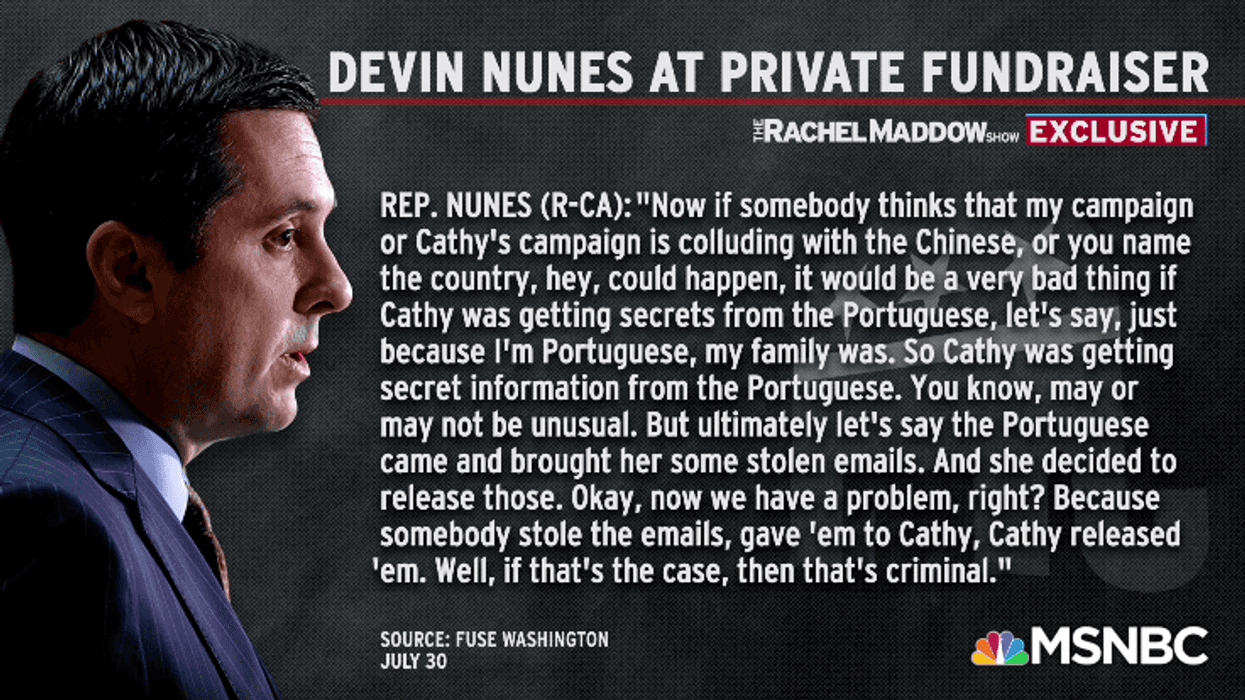
After obtaining the secretly-recorded comments made at a private congressional fundraiser last week, MSNBC's Rachel Maddow on Wednesday night aired the words of Rep. Devin Nunes, the powerful California Republican who chairs the House Intelligence Committee, as he explained to donors that one of the key reasons the GOP have not yet moved aggressively to impeach Deputy Attorney General Rod Rosenstein--currently overseeing the probe of Special Counsel Robert Mueller--is because they don't want it to gum up the works on getting President Donald Trump's right-wing Supreme Court nominee Brett Kavanaugh confirmed.
"Under our Constitution, the duty of Congress is not to clear the President... Devin Nunes should resign for perverting the oath he took." --Rep. Ted Lieu (D-Calif.)In the series of recordings, as Maddow lays out in detail, Nunes also admits that a U.S. politician running for office who accepts and then releases, "let's say," the stolen emails from a foreign entity, that would be "criminal" activity.
In response to what Nunes is heard saying on the tapes, Rep. Ted Lieu (D-Calif.) said the comments should be disqualifying for an elected member of Congress.
"Under our Constitution, the duty of Congress is not to clear the President," Lieu tweeted. "The duty of Congress is to be a check and balance on the Executive Branch, and to pursue the facts wherever they may lead. Devin Nunes should resign for perverting the oath he took."
Watch:
Below, directly from TRMS, are the transcripts of the portions aired during Wednesday night's segment:
Clip #1:
REP. NUNES (R-CA): "So therein lies, so it's like your classic Catch-22 situation where we were at a - this puts us in such a tough spot. If Sessions won't unrecuse and Mueller won't clear the president, we're the only ones. Which is really the danger. That's why I keep, and thank you for saying it by the way, I mean we have to keep all these seats. We have to keep the majority. If we do not keep the majority, all of this goes away."
Clip #2:
REP. NUNES (R-CA): "They know it's ridiculous to go after the president for obstruction of justice. But if they tell a lie often enough and they put it out there and they say, 'Oh, we're looking at the tweets,' cause you know you've got a mixed bag on the tweets, right? Like sometimes you love the president's tweets, sometimes we cringe on the president's tweets. But they're trying to make a political, this is all political as to why that story ran in the New York Times on the tweets."
Clip #3:
REP. NUNES (R-CA): "Now if somebody thinks that my campaign or Cathy's campaign is colluding with the Chinese, or you name the country, hey, could happen, it would be a very bad thing if Cathy was getting secrets from the Portuguese, let's say, just because I'm Portuguese, my family was. So Cathy was getting secret information from the Portuguese. You know, may or may not be unusual. But ultimately let's say the Portuguese came and brought her some stolen emails. And she decided to release those. Okay, now we have a problem, right? Because somebody stole the emails, gave 'em to Cathy, Cathy released 'em. Well, if that's the case, then that's criminal."
Clip #4:
AUDIENCE MEMBER: "But also, on things that came up in the House on Rosenstein impeachment thing. And it appears from an outsider that the Republicans were not supported."
REP. NUNES (R-CA): "Yeah, well, so it's a bit complicated, right? And I say that because you have to, so we only have so many months left, right? So if we actually vote to impeach, okay, what that does is that triggers the Senate then has to take it up. Well, and you have to decide what you want right now because the Senate only has so much time. Do you want them to drop everything and not confirm the Supreme Court justice, the new Supreme Court justice? So that's part of why, I don't think you have, you're not getting from, and I've said publicly Rosenstein deserves to be impeached. I mean, so, I don't think you're gonna get any argument from most of our colleagues. The question is the timing of it right before the election."
REP. MCMORRIS RODGERS (R-WA): "Also, the Senate has to start -"
REP. NUNES (R-CA): "The Senate would have to start, the Senate would have to drop everything they're doing and start to, and start with impeachment on Rosenstein. And then take the risk of not getting Kavanaugh confirmed. So it's not a matter that any of us like Rosenstein. It's a matter of, it's a matter of timing."
Watching the saga of the Nunes Memo and the constant Republican attempts to protect and cover for Donald Trump and his minions, no matter how great the purported crime, I keep thinking back to a 2004 movie that didn't get the attention it deserved.
"Millions," directed by Danny Boyle ("Trainspotting," "Slumdog Millionaire") and written by Frank Cottrell Boyce, is the story of two British boys who find themselves in possession of a fortune when bags of money from a train robbery accidentally fall into their hands. Damian, the younger and more devout of the two, tries to do good deeds with the cash while his older, more venal brother Anthony spends it to bribe other kids at school.
Twists and turns ensue and as the movie nears its climax, a new family friend takes Damian with her so the two of them can try to spend some of the remaining loot. Resentful, Anthony says to his father, "She'll kidnap him, hold him to ransom for the rest of the money," and his father calmly replies, "No, Anthony, that's what you would do."
So every time I hear the GOP deny any and all allegations about collusion or obstruction of justice involving Trump, every time they accuse Democrats--or the media, the Department of Justice, the FBI or the alleged "Deep State"--of pretzel-twisting the truth and sabotaging the republic, I think of that movie and say to myself, "No sir, that's what you would do."
Call it projection, call it a monumental lack of self-awareness, call it just plain stupidity, but the proclivity of the right, the kneejerk reflex that lashes out with false accusations and distortions that perfectly mirror what they themselves seem to be doing for real is mindboggling.
"Trump thinks he has been vindicated by the Nunes memo. Either he hasn't read it, is delusional and believes that wishing will make it so, or is so deeply cynical he believes he can keep perpetuating on the nation and the world the same style of sleazy con job that began when he started making unsavory real estate deals and bilking subcontractors."
They accuse the press and opponents of bias, of lying about the president and his associates, but to make their case they betray their own bias, dissembling and cherry-picking evidence, not revealing underlying information and ignoring the facts that prove them wrong. They accuse the other side of partisanship yet as former CIA director John Brennan told Chuck Todd on NBC's Meet the Press, "I never, ever saw the Democrats do something like this that was so partisan, so reckless and really just laid waste to the protocols that governed committees."
The Trump loyalists claimed their specious Nunes Memo proved allegations that are not even mentioned in the document and yet want to use it to further interfere with the Mueller investigation--although the special counsel had nothing to do with the FISA surveillance warrants targeting Trump advisor Carter Page which are the memo's focus. Clutching their pearls in feigned shock, they decry the Democratic Party funding of opposition research (which initially was paid for by anti-Trump Republicans) and accuse investigators of "orchestrating leaks to the media," things the GOP has never ever done, not once, honest, cross my heart and hope to plea bargain.
Face it: Despite the GOP memo's implication, and keeping in mind that his research was only part of a wider body of evidence, British citizen and dossier compiler Christopher Steele wasn't "desperate" and "passionate" in his opposition to Trump because he's some closet Democrat Abroad. Clearly, it was because a) he's a former MI6 intelligence expert on Russia and pretty much knows what he's talking about and b) he was concerned, like so much of the rest of the world, that Trump's irrationality, his ignorance of international affairs as well as his various ties to Russia's oligarchs make him a menace to peace and stability.
Republicans would do well to remember--some conveniently choose to forget, others actually seem not to realize (!)--that when Trump is being criticized as ignorant and self-aggrandizing, in most instances, he's not being attacked just because he's a member of their party. It's because he is ignorant and self-aggrandizing and it's killing the country. The danger transcends party lines.
Trump himself has yet to recognize, if ever he will (doubtful), that this is not the United States of Trump. He forgets that when members of his administration swore an oath it was not to him but to the nation and the Constitution. At his inauguration, he himself pledged to "preserve, protect and defend the Constitution of the United States," although the oath also reads "to the best of my ability," which he doubtless sees as a loophole.
Further, the Justice Department is not, as you seem to believe, Mr. President, a fully owned subsidiary of the Trump Organization. But you have made inroads toward achieving exactly that, with whatever threats and pressure you have applied via your chief of staff, attorney general and the pliant Nunes and other Republican members of the House intelligence committee, who cynically abandoned the good of the country to do everything possible to interfere with and, if at all possible, quash the investigation being conducted by Special Counsel Robert Mueller.
The hapless yet dangerous Nunes, who behaves like the love child of Joseph McCarthy and Inspector Clouseau, along with his pals (including you, Speaker Paul Ryan) will abandon all principle, all patriotism, for the mess of pottage that represents what's left of the Republican Party, fueled by fear of Trump's perfervid base and the interests of the fat cats throwing campaign contributions their way.
This current attempted politicization of the Justice Department and the FBI--and certainly, in the past neither has been innocent of the basest motivations--bears all the marks of authoritarianism, the subversion of truth and integrity in the name of power and dictatorial control. The systems of checks and balances we have so far relied on to keep Trump in line and allow the investigation to move forward already has been sabotaged, perhaps fatally.
Meanwhile, as David Corn at Mother Jones notes, all of this distracts from the fact that "the US political system remains under threat from Vladimir Putin's covert information warfare campaign and that the Trump administration has decided not to intensify sanctions that might deter Moscow from again subverting American democracy. Still, these significant events received a sliver of the coverage devoted to the tussle over #releasethememo."
The Washington Post's EJ Dionne writes, "The autocratic leader lies and then falsely charges his opponents with lying. He politicizes institutions that are supposed to be free of politics by falsely accusing his foes of politicizing them. He victimizes others by falsely claiming they are victimizing him."
When Donald Trump declares, as he did when the Nunes memo was released on Friday, "I think it's terrible, if you want to know the truth. I think it's a disgrace what's going on in this country... A lot of people should be ashamed of themselves, and much worse than that," isn't it possible to think that deep down he subconsciously was talking about what he himself has done?
Yet publicly, Trump thinks he has been vindicated by the Nunes memo. Either he hasn't read it, is delusional and believes that wishing will make it so, or is so deeply cynical he believes he can keep perpetuating on the nation and the world the same style of sleazy con job that began when he started making unsavory real estate deals and bilking subcontractors.
Like that kid in the movie "Millions" it's not what you would do or I would do. But it's what Donald Trump and Devin Nunes would do. And do so by the hour and minute, to the deep detriment and destruction of these United States.
For the last three weeks, privacy advocates have been buffeted by two political whirlwinds. First, the reauthorization of the FISA Amendments Act two weeks ago, authored by House Intelligence Committee Chairman Devin Nunes. And then today, the release of a partisan memo, authored by Nunes' staffers, purporting to show FBI and Department of Justice abuses of the individual Foreign Intelligence Surveillance Act application process.
Because Nunes and others -- up to and including House Speaker Paul Ryan -- claimed to be motivated by a concern about civil liberties, it was generally assumed the privacy community would join the clamor. But those of us who've been through several surveillance fights with these posers know the reality is far more complex. Ultimately, two principles are at issue: the rule of law and privacy. In both instances, Nunes and Ryan are on the wrong side of the issue.
The FISA Amendments Reauthorization Act extended a key part of FISA, called Section 702, that lets the government ask domestic telecommunications and tech providers for help spying on foreigners overseas. But that word "target" is misleading, because under the program, the government obtains the American side of any conversation with a targeted individual. The FBI can obtain that information in raw form and routinely queries the data when it gets leads to find out if Americans have been speaking to suspicious foreigners. That amounts to warrantless access of Americans' communications, and exposes certain groups, like Chinese-Americans and Muslims, to far more scrutiny than others.
Also under Section 702, the government obtains certain entirely domestic communications that have obscured their location. While it has to purge most of those communications, the NSA can keep any that it shows are evidence of eight enumerated crimes. Again, this is warrantless surveillance of Americans, done in the guise of foreign intelligence collection.
During the 702 reauthorization debate, reformers like Sens. Ron Wyden (D-Ore.) and Rand Paul (R-Ky.), and Reps. Justin Amash (R-Mich.) and Zoe Lofgren (D-Calif.), tried to add protections in these instances, most notably by requiring a warrant before the FBI searches for communications involving Americans. The law authored by Nunes, however, only provides such protection to people for whom the FBI already has probable cause that they are committing a crime. Nunes' law flips the Fourth Amendment on its head, providing protection only to criminal suspects and not for those against whom the FBI has no evidence of wrongdoing.
A mere three weeks ago, Nunes and Ryan were happy to have Americans surveilled with no evidence whatsoever of wrongdoing. Back then, Ryan backed suspicionless, warrantless searches of Americans as a necessary trade off. "This [bill] strikes the balance that we must have between honoring and protecting privacy rights of U.S. citizens, honoring civil liberties, and making sure that we have the tools we need in this day and age of 21st century terrorism to keep our people safe."
Today, however, when a former Trump campaign adviser is at issue, Nunes and Ryan have discovered the due process they personally refused for so many Americans. The Nunes memo purports to show that an individualized FISA application against Carter Page did not adequately inform the FISA court about the political source of one piece of evidence among others. The memo argues the FBI did not adequately reveal "the political origins of the Steele dossier," intelligence reporting paid for by the Democratic Party.
The application instead presented Steele as someone (the memo admits) who was a "longtime FBI source" with a "past record of credible reporting." But even on that key issue, the memo is unclear whether DOJ knew precisely who was paying for Steele's work. Indeed, it makes no mention that Republican billionaire Paul Singer was the first political actor to pay Fusion GPS, the firm that hired Steele, for dirt on Trump, though Singer himself did not fund any of Steele's work. In other words, on the central question of whether the FBI could have attributed Fusion's intelligence to Hillary Clinton and the Democrats or to someone else, the memo doesn't make its case.
Now, the role of consultants like Steele in judicial proceedings is a matter of grave concern. Consultants with an inadequate grasp of the Arabic language or Islamic faith have long been used by DOJ as witnesses against terrorism defendants, and defense attorneys have suspected consultants -- perhaps the very same ones -- provided intelligence used in FISA applications, just as Steele provided intelligence for the Page application. More recently, consultants assessing crime patterns and recidivism rates have been shown to rely on biased algorithms.
Yet none of the people pushing this Nunes memo have ever uttered a peep about due process concerns posed by outright incompetent consultants in the past. Here, however, they're wailing that a consultant they admit has been reliable in the past got paid differently than in the past and that wasn't fully briefed to the court.
The way to deal with both of these issues is to conduct actual oversight of the general problem, not extend protections just to one man like Page.
The sudden interest in problems Nunes and Ryan showed no interest in just weeks ago is all the more telling, given several details about this memo.
First, as the memo lays out, starting in October 2016 the FBI obtained and then renewed a FISA warrant against Page four times. That means over the span of at least nine months, the FBI demonstrated that a wiretap of Page demonstrated useful foreign intelligence, and FISA judges agreed with that assessment over and over. The memo either doesn't mention or obscures an earlier FISA warrant, obtained in 2014 during a period when Page was being actively recruited by Russian spies who were either expelled or imprisoned. Effectively, then, the GOP memo admits that something about Page, something well beyond the Steele dossier, raised real concerns about whether he was spying for Russia. And the FISA court agreed that it was a real concern.
The memo also complains that the Page application mentions George Papadopoulos, another former Trump foreign policy aide who in October pleaded guilty to lying to the FBI about his contacts with people working on behalf of Russia. It reads: "The Page FISA application also mentions information regarding fellow Trump campaign advisor George Papadopoulos, but there is no evidence of any cooperation or conspiracy between Page and Papadopoulos." That's not entirely true. As the committee itself learned in testimony, Page was copied on at least one of the emails Papadopoulos sent to the campaign detailing his own activities.
Moreover, the memo is silent about whether the Papadopoulos reference in the application served to do anything more than inform the court that, in response to a tip about Papadopoulos' actions, the FBI opened a counterintelligence investigation into whether Russians were attempting to compromise Trump via his foreign policy advisers. Effectively, this amounts to saying that because the FBI was investigating Page in the context of other concerns that Russians were trying to infiltrate the Trump campaign (concerns Papadopoulos' guilty plea validate), it should be deemed an abuse. As with 702 reauthorization, they're trying to extend protections just to those against whom there is credible evidence of wrong-doing.
Finally, there's the larger conduct. This memo was written for a guy, Devin Nunes, who was a Trump transition official. That transition period has already netted one guilty plea -- that of former Trump National Security Adviser Michael Flynn, for lying to the FBI. Multiple reports make clear that Trump permitted the release of this memo explicitly as a way to delegitimize a legally constituted investigation into him, his family, and associates like Nunes. In the same way that Nunes and Ryan are pushing for further review only for a man who, abundant other evidence suggests, fostered legitimate suspicion, they're also saying that they only care to scrutinize FBI and DOJ actions if they themselves might be subject to them.
Every single privacy activist I know cares about privacy in significant part to ensure the rule of law and to prevent the arbitrary exercise of justice to focus just on select groups like Muslims or Chinese-Americans, rather than those who pose the greatest risk to society, like people allegedly doing Russia's secret bidding. Yet the actions of Ryan and Nunes reverse that, using a sham concern for civil liberties as a way to prevent themselves, their associates, and the president from being subject to the rule of law like the rest of us would be.
If we're going to have this secret surveillance -- and Nunes and Ryan insist we need it -- the key to protecting Americans is drafting the law to provide protections and ensuring those standards are met. Section 702, as Nunes and Ryan reauthorized it, fails that test, because it permits the warrantless access of completely innocent Americans' communications. And for all its bluster, the Nunes memo doesn't tell us critical details we need to assess whether what happened to Page was improper specifically, or simply indicative of known concerns about outside consultants that Nunes and Ryan have long ignored (and continue to ignore with all other Americans). By all means let's examine the role of consultants in FBI investigations. By all means let's scrutinize whether the FISA process works as well as the DOJ claims.
But let's do that for all Americans, and not just those about whom the FBI has real reason to worry.
After weeks of buildup, Rep. Devin Nunes (R-CA), chairman of the House Intelligence Committee and fervent supporter of President Trump, has released a divisive memoabout the surveillance of a former adviser to the Trump campaign. After Trump declassified it, Nunes made public a four-page document written by his staff, accusing the Department of Justice and the FBI (a part of the Department of Justice) of illegally spying on the aide in 2016.
According to Rep. Steve King (R-Iowa), the memo reveals official misconduct "worse than Watergate." King is right about the misconduct, but wrong about whose it is. Nunes's allegations have already been extensively reported, and the memo itself offers no surprises.
It centers around the so-called "Steele dossier" -- a detailed account of contacts between Trump associates and Russian operatives before the 2016 election. The dossier was compiled by Christopher Steele, a former officer for Britain's intelligence agency, MI6, who also served as a trusted source for the FBI. In this case, though, Steele's work began as "opposition research" -- funded first by an anti-Trump conservative during the primaries, and later by the Clinton campaign and the Democratic National Committee.
According to Nunes's memo, the Justice Department used this research to support an application for a warrant to conduct surveillance of Trump campaign aide Carter Page without fully informing the court of the funding source or of Steele's anti-Trump comments. Therein, purportedly, lies the scandal.
"Nunes' skewed disclosure... is designed to achieve something far more harmful than media spin."
As legal experts have pointed out, this allegation, on its own, proves exactly nothing. Informants frequently come with their own agendas and biases. This alone does not bar the government from using the material they provide. Nor is disclosure to the court required as a blanket matter. Context is critical. For example, how could the alleged bias affect the information? Are there reasons to trust the evidence despite its non-neutral source? Most important, does the evidence stand alone, or does it merely supplement other evidence?
House Democrats produced their own counter-memo that supposedly provides some of this context. But both memos contain classified material from Justice Department and FBI documents, and congressional committees cannot legally disclose classified material unless they vote to do so. The intelligence committee's Republicans, who outnumber the Democrats, decided that Nunes can release classified material about the warrant application -- but Democrats cannot.
Playing political games with classified information, sinister as it is, is nothing new. Executive branch officials routinely make selective disclosures in order to put the administration's spin on news stories or gain support for its policies. Inconvenient facts remain classified. It's a flagrant abuse of the classification system that happens every day; Congress is just getting in on the act.
Nunes' skewed disclosure, however, is designed to achieve something far more harmful than media spin. Soon after its release, the White House put out a statement that asserted the memorandum "raises serious concerns about the integrity of decisions made at the highest levels of the Department of Justice and the FBI." Trump sources have said the President is eager to discredit the FBI and Justice Department so he can re-make them to better suit his undemocratic notions of personal loyalty -- dumping Robert Mueller, the special prosecutor heading the FBI's Russia probe, and Deputy Attorney General Rod Rosenstein, who oversees Mueller's investigation, in the process.
That would mean the end of the investigation into possible collusion between Russia and the Trump campaign, and perhaps also the end of the investigation into Russian interference with the election. Trump would name a new slate of top brass chosen for their willingness to let him control the Department's investigations, in stark violation of the norms that for decades have safeguarded the Department from political influence.
This is not a matter of dueling conspiracy theories. Although the FBI has a long history of abusing surveillance powers, it's unlikely any such abuse occurred here. The Justice Department obtained the warrant for Page under a law that requires a special court, the "FISA Court," to review the evidence and find probable cause that the target is an agent of a foreign power. While the secrecy of the process could allow all the players to cut corners, FISA judges were unusually tough on the Justice Department in 2016, rejecting or requiring changes to one in every five warrant applications. They would have given particularly close scrutiny to an application targeting a former presidential campaign aide.
On the flip side, the hypothesis that Trump and his congressional allies hope to exercise political control over the Justice Department is more than likely. Trump has demanded loyalty from Department officials and asked who they voted for. He fired FBI Director James Comey on false pretenses, after Comey ignored his requests to drop an investigation into former Trump advisor Michael Flynn. He ordered Mueller's firing (although he later backed down). He expressed fury at Attorney General Jeff Sessions for recusing himself from the Russia investigation, and pressured him to resign. And he has expressed bewilderment that he can't direct the investigations conducted by, in his words, the "Trump Department of Justice." The White House also surreptitiously enlisted Nunes in a previous attempt to discredit intelligence officials (remember the short-lived "unmasking" scandal?).
In short, there is every indication that the Nunes memo was designed to present a misleading picture that can serve as a pretext to end the Mueller investigation. This is simultaneously an abuse of the classification system, a betrayal of the public trust, a violation of longstanding norms shielding the Justice Department from political forces and -- quite possibly -- attempted obstruction of justice.
If integrity hasn't fully succumbed to partisanship, Republicans will join Democrats in Congress to condemn this memo and take immediate steps to insulate Mueller from removal. Justice Department and FBI officials, for their part, should hold their ground and resist pressure to resign or ease off investigations. In this improbable and convoluted drama over four pages of innuendo, the rule of law itself could be at stake.
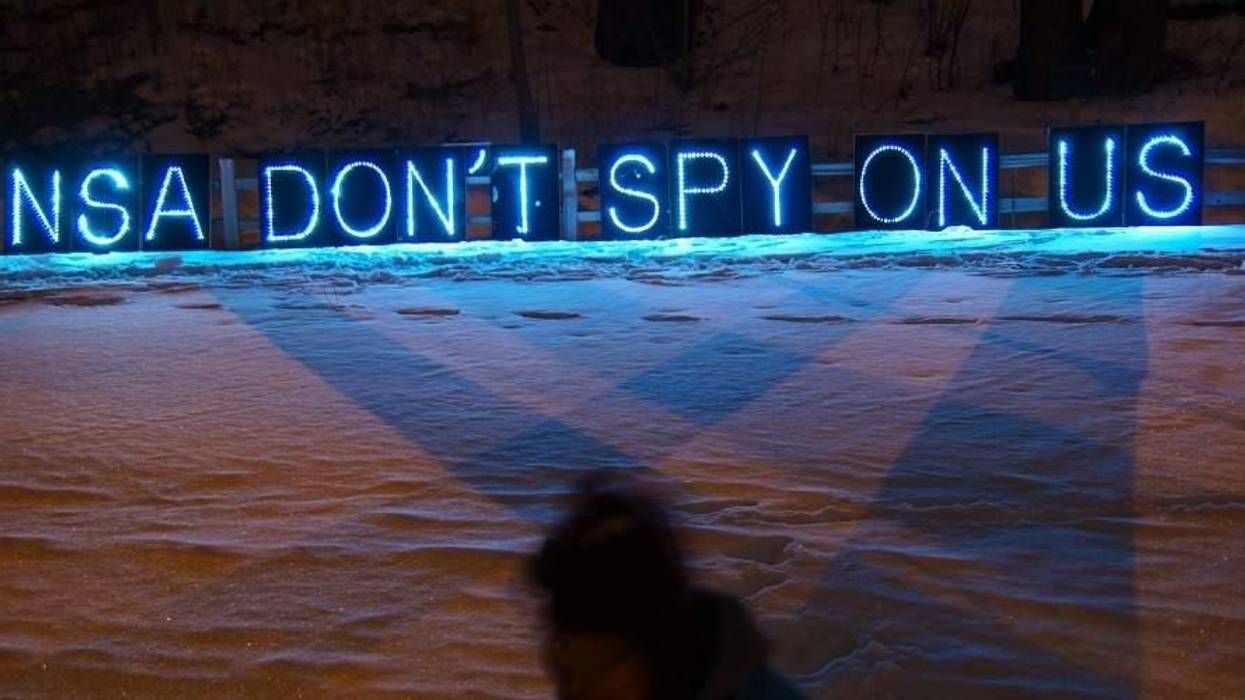
The frenzy over the Nunes memo, likely to be released later today by the Trump administration, contains a profound hypocrisy at its core, one that points to the rot at the core of the American government.
The Republican conspiracy theory promoted by Nunes is that the Federal government over-reached in spying on the Trump campaign.
That's right, the GOP is complaining about government surveillance. But it isn't complaining about the principle of the thing (surprise!). It is complaining that its guy got caught up in these surveillance practices.
On January 18, Republican-dominated the Senate passed a law extending National Security Agency and other agencies' prerogative of warrantless spying on Americans for another six years. The unconstitutional and illegal practices of Federal agencies had been exposed by Ed Snowden, who may as well not have bothered. FISA section 702 lets Federal agents snoop on your Facebook posts even if you marked them as only for friends, and God forbid that you should email a friend in Sweden, since they can read that one too. In fact, since email traffic typically bounces around the world before being delivered, the law lets the government basically read all Americans' correspondence all the time.
There is no evidence that this vast surveillance apparatus has thwarted any significant terrorist plot, since 320 million Americans are not terrorists. The surveillance is being used to advance the careers of government agents by illegally obtaining information about things like drug use, or it is used for economic espionage. The law turns Federal agents into criminals.
Who voted for warrantless surveillance of Americans? Devin Nunes and his whole committee. Almost the whole of the Republican majority in the House of Representatives and the Senate, with the exception of Libertarians like Rand Paul. Not to mention Democratic stalwarts Diane Feinstein, Mark Warner, and Claire McCaskill.
And Donald J. Trump signed it!
So you know what? If the Republican party thinks warrantless surveillance is constitutional and is a great idea, then they just have to STFU about the Nunes memo, which alleges... warrantless surveillance of Americans in contact with foreigners.
This law is unconstitutional on the face of it, but the Federal government cleverly avoids allowing it to come before a Federal judge by not telling the people whose rights are being violated who they are. Secretly, law enforcement is using the surveillance to bust petty marijuana distributors in Colorado and California and then lying to the judges about the evidence trail. The law is subverting the entire justice system. The GOP desperately wants it. But they don't want their guys to get caught up in the surveillance.
So now they are squawking. Too bad.
The tendency of Democrats suddenly to lionize former FBI director James Comey because he was fired by Trump, and Comey's own posturing as a civil libertarian, is part and parcel of the hypocrisy. Comey supports warrantless searches and tried to strong arm Apple into letting every 15 year old hacker in Eastern Europe get at your iPhone just so the FBI could, as well. But at least Comey is consistent.
Securing the Fourth Amendment of the US constitution was one of the reasons for which Americans made their revolution against the British monarchy.
When they defeated the red coats, they put the Fourth Amendment into the Constitution, which says:
"The right of the people to be secure in their persons, houses, papers, and effects, against unreasonable searches and seizures, shall not be violated, and no Warrants shall issue, but upon probable cause, supported by Oath or affirmation, and particularly describing the place to be searched, and the persons or things to be seized.
I wrote a few years ago, after the Snowden revelations,
"The most important 18th-century precedent in English law for our Fourth Amendment is Entick v. Carrington of 1765, in which Lord Halifax, acting for the king, sent agents into the home of John Entick on a fishing expedition for papers and documents that criticized the king. This Revolutionary War site notes:
"During the trial, Entick charged that the entire search and seizure had been unlawfully conducted, and the Court agreed. The Court said that Lord Halifax had no standing to issue the order to search the premises, that probable cause that a crime had been committed had not been demonstrated and that the warrant allowed a general confiscation of anything the officers found, not specifying exactly what they were to look for or could seize. In addition, there were no records kept of what the officers seized."
In the New World, however, colonial authorities ignored this important case and began issuing what were called "writs of assistance," a kind of blanket search warrant that allowed the crown's tax authorities to try to combat smuggling by indiscriminate search and seizure. (We would now call them "National Security Letters.") Attorney James Otis took the case of 50 merchants who sued the British crown over these overly broad warrantless searches, and his powerful speech condemning these practices was heard by John Adams, who considered it the spark that led to the American Revolution.
George Mason's Virginia Declaration of Rights of 1776 forbade these writs of assistance. Thomas Jefferson depended heavily on that document when he authored the Declaration of Independence. When he talks about "Life, liberty and the pursuit of happiness," one of the things he means by liberty is that the government shouldn't be able to snoop at will through your private letters.
The sentiment against warrantless searches and overly broad writs of assistance was put into the constitution by James Madison, with what became the 4th Amendment."
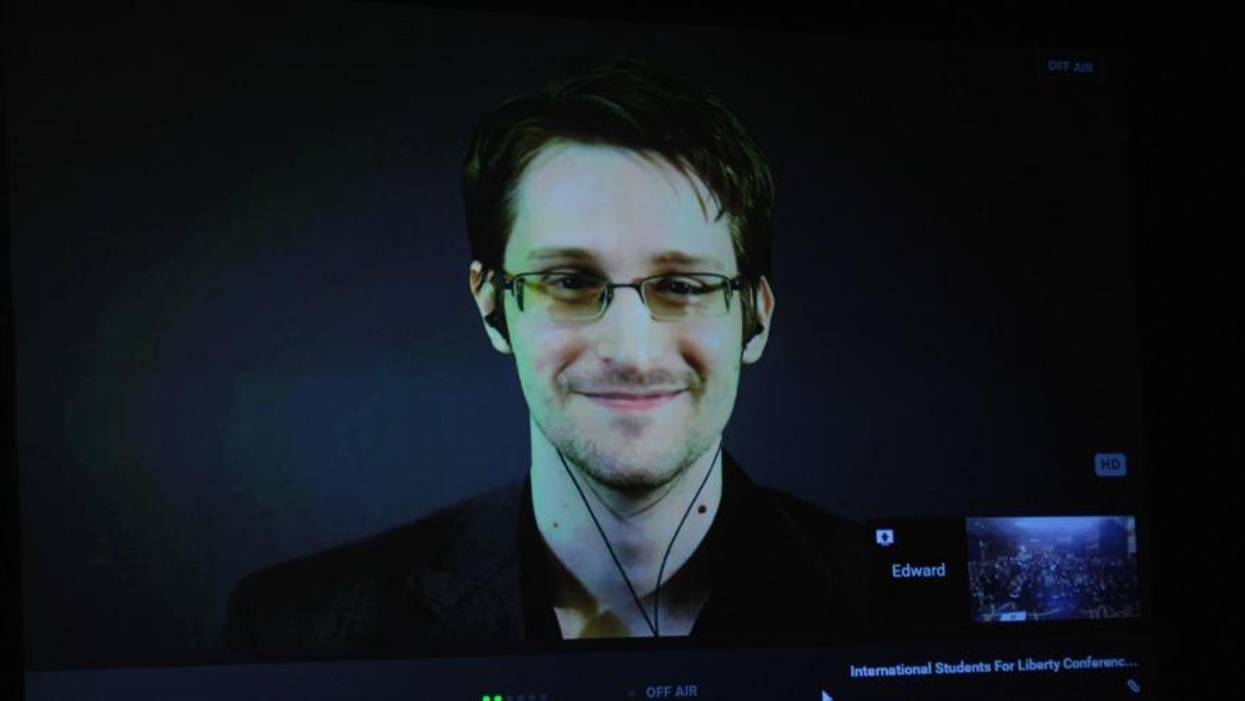
Edward Snowden joined those calling for officials to release a memo that's said to have information about the government's surveillance abuses. The secrecy of the document, according to the NSA whistleblower, contributed to the reauthorization of a government spying bill narrowly approved by Congress this week.
The vote to reauthorize Section 702 of the Foreign Intelligence Surveillance Act (FISA) for six more years, which came despite the objections of privacy and civil liberties advocates, will allow the government to spy on the electronic communications of Americans without a warrant.
And the ACLU agreed:
Calls to #ReleaseTheMemo have been heard largely from Republicans including Rep. Devin Nunes (R-Calif.), who was cleared by an ethics committee last month of giving classified information to the Trump administration as he accused the Obama administration of revealing the names of U.S. officials in documents gathered through foreign surveillance.
Snowden denied that he was aligning himself with Nunes generally, arguing that transparency about a memo that could impact the privacy of Americans, should be out in the open for the good of all citizens regardless of political affiliations.
Ugh, you planting your flag with @DevinNunes ?
-- Peter B (@StrangeCapn) January 19, 2018
In his series of tweets, Snowden acknowledged that right-wing pundits and GOP lawmakers could very well being using the "release the memo" call as a self-serving political distraction, but said there are easy ways to test whether or not this is true:
Reps. Matt Gaetz (R-Fla.) and Steve King (R-Iowa), both of whom have called for an end to Special Counsel Robert Mueller's investigation, are among those calling for a release of the memo.
Meanwhile, journalist Glenn Greenwald, who reported some of the most hard-hitting stories based on the NSA documents leaked by Snowden, also joined the call for transparency even as he, too, made it clear he wasn't interested in aligning with Donald Trump Jr. or others using the demand as a cynical ploy:
Indeed, Greenwald made it clear that it remains House Republicans and President Trump himself, not Democrats, who have the clear authority to make the document public: