SUBSCRIBE TO OUR FREE NEWSLETTER
Daily news & progressive opinion—funded by the people, not the corporations—delivered straight to your inbox.
5
#000000
#FFFFFF
To donate by check, phone, or other method, see our More Ways to Give page.
Daily news & progressive opinion—funded by the people, not the corporations—delivered straight to your inbox.
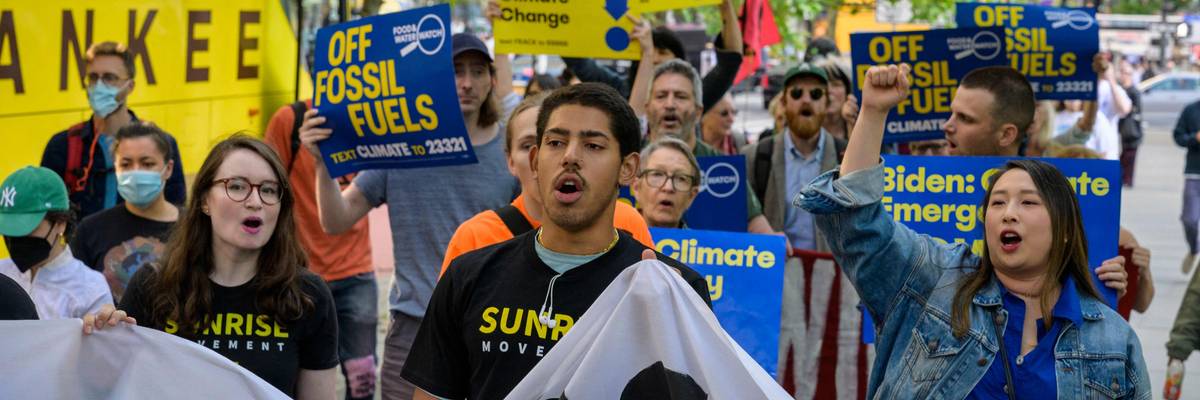
Climate activists marched as President Joe Biden attended a campaign reception on May 10, 2023 in New York.
We have seen too many examples of this White House making pro-fossil fuel decisions that fly in the face of its own climate rhetoric. It's why we're marching and we hope you'll join us.
The following is part of a series of opinion pieces Common Dreams is publishing in the lead-up to the March to End Fossil Fuels on Sunday, September 17 in New York City. Read the rest of the series and our complete coverage here.
In a summer of heat domes and extreme weather, one bit of news actually sounded good: On September 6, the Biden White House was putting a stop to plans to drill for fossil fuels in the Arctic National Wildlife Refuge (ANWR). This would reverse a disastrous Trump-era move that seemed designed to delight corporate polluters.
There is no doubt that less drilling in Alaska—or anywhere else—is better than more. But it’s reasonable to argue that the Biden administration’s move is more symbolic than substantive. And it’s driven at least in part by the need to make up for a series of bad decisions; The New York Times reported that President Biden has felt ‘personally stung’ by the climate movement’s outrage over the administration’s approval of several high profile dirty energy projects.
If the idea is to get activists to stop demanding more, the White House might be in for a reckoning of sorts on Sunday, September 17, when thousands are expected in New York City for the March to End Fossil Fuels.
"If the Biden administration believes what it says about the severity of the climate crisis, it must be willing to directly confront the corporate interests that profit from calamity."
After the decision to block drilling in ANWR, Biden released a statement saying that he “will continue to take bold action to meet the urgency of the climate crisis.” But how bold is he willing to be, really? Look at the details a bit more closely, and you find that the one long-awaited lease sale in ANWR in 2021 was a dud, drawing just three bidders—the largest being a state agency. The two other companies have since withdrawn, and nothing has happened since. Notably, large banks and insurers have chosen to steer clear of ANWR, given the massive logistical hurdles and potential political blowback.
It’s hard to say for sure whether a small number of ANWR leases would have ever led to any drilling. On the other hand, elsewhere in Alaska there are considerably bigger plans in place: namely, ConocoPhillips’ Willow project on the North Slope, which could produce about 200,000 barrels of oil a day over 30 years. It is estimated that Willow will create hundreds of millions of metric tons of climate pollution.
The Biden administration’s decision to approve Willow drew intense grassroots opposition nationwide. The administration, for its part, tried to argue that its hands were tied, and that the best it could do was to slightly modify the company’s drilling plans.
But in a time of climate emergency, messages like this fall flat. And it’s hard to square these justifications with the White House’s overall record. Indeed, we have seen countless examples of the Biden White House making pro-fossil fuel decisions that fly in the face of its own climate rhetoric. In its first two years, the administration approved more oil and gas permits than the Trump administration—despite Biden’s campaign pledge to stop fracking on public lands. The White House is enthusiastically supporting new fracked gas export terminals—a huge buildout of new polluting facilities that will directly impact environmental justice communities along the Gulf Coast.
Meanwhile, a centerpiece of Biden’s climate strategy is carbon capture and storage, a faulty technology favored by fossil fuel corporations that will only extend our dependence on filthy oil and gas. Nothing could be a bigger distraction from the aggressive transition to clean, renewable energy that needs to happen now.
These are the very decisions that are calling thousands of people to the streets of New York City for the March to End Fossil Fuels. The mobilization—endorsed by over 500 groups—is sending a clear set of demands to the White House: Declare a climate emergency, stop new fracking and drilling permits, and rein in dirty energy exports.
This would mean going toe to toe with the fossil fuel industry. If the Biden administration believes what it says about the severity of the climate crisis, it must be willing to directly confront the corporate interests that profit from calamity. UN Secretary-General Antonio Guterres recently renewed his call for world leaders to stop funding or issuing new permits for fossil fuel projects as a critical measure to avert runaway climate catastrophe. It’s that kind of bold leadership that will ensure a livable climate for future generations.
Young people will be marching on September 17 for their future. I hope to see you in the streets of New York City.Dear Common Dreams reader, It’s been nearly 30 years since I co-founded Common Dreams with my late wife, Lina Newhouser. We had the radical notion that journalism should serve the public good, not corporate profits. It was clear to us from the outset what it would take to build such a project. No paid advertisements. No corporate sponsors. No millionaire publisher telling us what to think or do. Many people said we wouldn't last a year, but we proved those doubters wrong. Together with a tremendous team of journalists and dedicated staff, we built an independent media outlet free from the constraints of profits and corporate control. Our mission has always been simple: To inform. To inspire. To ignite change for the common good. Building Common Dreams was not easy. Our survival was never guaranteed. When you take on the most powerful forces—Wall Street greed, fossil fuel industry destruction, Big Tech lobbyists, and uber-rich oligarchs who have spent billions upon billions rigging the economy and democracy in their favor—the only bulwark you have is supporters who believe in your work. But here’s the urgent message from me today. It's never been this bad out there. And it's never been this hard to keep us going. At the very moment Common Dreams is most needed, the threats we face are intensifying. We need your support now more than ever. We don't accept corporate advertising and never will. We don't have a paywall because we don't think people should be blocked from critical news based on their ability to pay. Everything we do is funded by the donations of readers like you. When everyone does the little they can afford, we are strong. But if that support retreats or dries up, so do we. Will you donate now to make sure Common Dreams not only survives but thrives? —Craig Brown, Co-founder |
The following is part of a series of opinion pieces Common Dreams is publishing in the lead-up to the March to End Fossil Fuels on Sunday, September 17 in New York City. Read the rest of the series and our complete coverage here.
In a summer of heat domes and extreme weather, one bit of news actually sounded good: On September 6, the Biden White House was putting a stop to plans to drill for fossil fuels in the Arctic National Wildlife Refuge (ANWR). This would reverse a disastrous Trump-era move that seemed designed to delight corporate polluters.
There is no doubt that less drilling in Alaska—or anywhere else—is better than more. But it’s reasonable to argue that the Biden administration’s move is more symbolic than substantive. And it’s driven at least in part by the need to make up for a series of bad decisions; The New York Times reported that President Biden has felt ‘personally stung’ by the climate movement’s outrage over the administration’s approval of several high profile dirty energy projects.
If the idea is to get activists to stop demanding more, the White House might be in for a reckoning of sorts on Sunday, September 17, when thousands are expected in New York City for the March to End Fossil Fuels.
"If the Biden administration believes what it says about the severity of the climate crisis, it must be willing to directly confront the corporate interests that profit from calamity."
After the decision to block drilling in ANWR, Biden released a statement saying that he “will continue to take bold action to meet the urgency of the climate crisis.” But how bold is he willing to be, really? Look at the details a bit more closely, and you find that the one long-awaited lease sale in ANWR in 2021 was a dud, drawing just three bidders—the largest being a state agency. The two other companies have since withdrawn, and nothing has happened since. Notably, large banks and insurers have chosen to steer clear of ANWR, given the massive logistical hurdles and potential political blowback.
It’s hard to say for sure whether a small number of ANWR leases would have ever led to any drilling. On the other hand, elsewhere in Alaska there are considerably bigger plans in place: namely, ConocoPhillips’ Willow project on the North Slope, which could produce about 200,000 barrels of oil a day over 30 years. It is estimated that Willow will create hundreds of millions of metric tons of climate pollution.
The Biden administration’s decision to approve Willow drew intense grassroots opposition nationwide. The administration, for its part, tried to argue that its hands were tied, and that the best it could do was to slightly modify the company’s drilling plans.
But in a time of climate emergency, messages like this fall flat. And it’s hard to square these justifications with the White House’s overall record. Indeed, we have seen countless examples of the Biden White House making pro-fossil fuel decisions that fly in the face of its own climate rhetoric. In its first two years, the administration approved more oil and gas permits than the Trump administration—despite Biden’s campaign pledge to stop fracking on public lands. The White House is enthusiastically supporting new fracked gas export terminals—a huge buildout of new polluting facilities that will directly impact environmental justice communities along the Gulf Coast.
Meanwhile, a centerpiece of Biden’s climate strategy is carbon capture and storage, a faulty technology favored by fossil fuel corporations that will only extend our dependence on filthy oil and gas. Nothing could be a bigger distraction from the aggressive transition to clean, renewable energy that needs to happen now.
These are the very decisions that are calling thousands of people to the streets of New York City for the March to End Fossil Fuels. The mobilization—endorsed by over 500 groups—is sending a clear set of demands to the White House: Declare a climate emergency, stop new fracking and drilling permits, and rein in dirty energy exports.
This would mean going toe to toe with the fossil fuel industry. If the Biden administration believes what it says about the severity of the climate crisis, it must be willing to directly confront the corporate interests that profit from calamity. UN Secretary-General Antonio Guterres recently renewed his call for world leaders to stop funding or issuing new permits for fossil fuel projects as a critical measure to avert runaway climate catastrophe. It’s that kind of bold leadership that will ensure a livable climate for future generations.
Young people will be marching on September 17 for their future. I hope to see you in the streets of New York City.The following is part of a series of opinion pieces Common Dreams is publishing in the lead-up to the March to End Fossil Fuels on Sunday, September 17 in New York City. Read the rest of the series and our complete coverage here.
In a summer of heat domes and extreme weather, one bit of news actually sounded good: On September 6, the Biden White House was putting a stop to plans to drill for fossil fuels in the Arctic National Wildlife Refuge (ANWR). This would reverse a disastrous Trump-era move that seemed designed to delight corporate polluters.
There is no doubt that less drilling in Alaska—or anywhere else—is better than more. But it’s reasonable to argue that the Biden administration’s move is more symbolic than substantive. And it’s driven at least in part by the need to make up for a series of bad decisions; The New York Times reported that President Biden has felt ‘personally stung’ by the climate movement’s outrage over the administration’s approval of several high profile dirty energy projects.
If the idea is to get activists to stop demanding more, the White House might be in for a reckoning of sorts on Sunday, September 17, when thousands are expected in New York City for the March to End Fossil Fuels.
"If the Biden administration believes what it says about the severity of the climate crisis, it must be willing to directly confront the corporate interests that profit from calamity."
After the decision to block drilling in ANWR, Biden released a statement saying that he “will continue to take bold action to meet the urgency of the climate crisis.” But how bold is he willing to be, really? Look at the details a bit more closely, and you find that the one long-awaited lease sale in ANWR in 2021 was a dud, drawing just three bidders—the largest being a state agency. The two other companies have since withdrawn, and nothing has happened since. Notably, large banks and insurers have chosen to steer clear of ANWR, given the massive logistical hurdles and potential political blowback.
It’s hard to say for sure whether a small number of ANWR leases would have ever led to any drilling. On the other hand, elsewhere in Alaska there are considerably bigger plans in place: namely, ConocoPhillips’ Willow project on the North Slope, which could produce about 200,000 barrels of oil a day over 30 years. It is estimated that Willow will create hundreds of millions of metric tons of climate pollution.
The Biden administration’s decision to approve Willow drew intense grassroots opposition nationwide. The administration, for its part, tried to argue that its hands were tied, and that the best it could do was to slightly modify the company’s drilling plans.
But in a time of climate emergency, messages like this fall flat. And it’s hard to square these justifications with the White House’s overall record. Indeed, we have seen countless examples of the Biden White House making pro-fossil fuel decisions that fly in the face of its own climate rhetoric. In its first two years, the administration approved more oil and gas permits than the Trump administration—despite Biden’s campaign pledge to stop fracking on public lands. The White House is enthusiastically supporting new fracked gas export terminals—a huge buildout of new polluting facilities that will directly impact environmental justice communities along the Gulf Coast.
Meanwhile, a centerpiece of Biden’s climate strategy is carbon capture and storage, a faulty technology favored by fossil fuel corporations that will only extend our dependence on filthy oil and gas. Nothing could be a bigger distraction from the aggressive transition to clean, renewable energy that needs to happen now.
These are the very decisions that are calling thousands of people to the streets of New York City for the March to End Fossil Fuels. The mobilization—endorsed by over 500 groups—is sending a clear set of demands to the White House: Declare a climate emergency, stop new fracking and drilling permits, and rein in dirty energy exports.
This would mean going toe to toe with the fossil fuel industry. If the Biden administration believes what it says about the severity of the climate crisis, it must be willing to directly confront the corporate interests that profit from calamity. UN Secretary-General Antonio Guterres recently renewed his call for world leaders to stop funding or issuing new permits for fossil fuel projects as a critical measure to avert runaway climate catastrophe. It’s that kind of bold leadership that will ensure a livable climate for future generations.
Young people will be marching on September 17 for their future. I hope to see you in the streets of New York City.