

SUBSCRIBE TO OUR FREE NEWSLETTER
Daily news & progressive opinion—funded by the people, not the corporations—delivered straight to your inbox.
5
#000000
#FFFFFF
To donate by check, phone, or other method, see our More Ways to Give page.
Daily news & progressive opinion—funded by the people, not the corporations—delivered straight to your inbox.
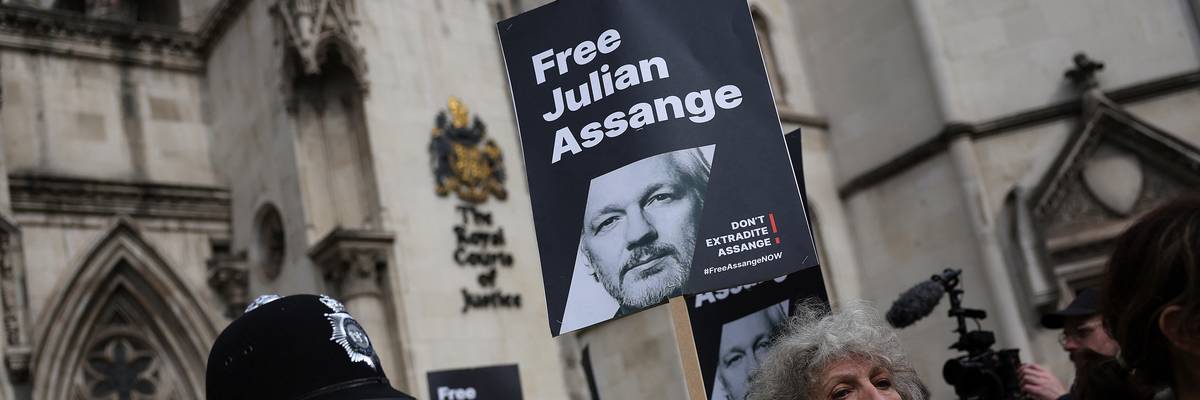
Supporters of WikiLeaks founder Julian Assange hold placards outside of the United Kingdom's High Court in central London on March 26, 2024.
"The Biden administration should take the opportunity to drop this dangerous case once and for all," said the executive director of the Freedom of the Press Foundation.
The United Kingdom's High Court ruled Tuesday that WikiLeaks founder Julian Assange cannot immediately be extradited to the United States and gave the Biden administration three weeks to provide "assurances" that the publisher's First Amendment rights will be protected and that he won't face the death penalty.
If the U.S. does not provide the requested assurances, Assange will be allowed to pursue a limited appeal of his extradition. Should the U.S. submit assurances by the April 16 deadline, a hearing will be held on May 20 to determine whether they are "satisfactory."
Assange, whose health has deteriorated badly during his five years in a high-security London jail, faces 17 counts of violating the Espionage Act and a possible 175-year prison sentence in the U.S. for publishing classified information—a common journalistic practice. WikiLeaks disclosures exposed grave U.S. and U.K. war crimes in Iraq and Afghanistan.
Press freedom and human rights groups say the extradition of Assange to the U.S. would set a dangerous precedent and pose a dire threat to journalism everywhere.
Trevor Timm, executive director of the Freedom of the Press Foundation, said in a statement Tuesday that "we are glad Julian Assange is not getting extradited today."
"But this legal battle is far from over, and the threat to journalists and the news media from the Espionage Act charges against Assange remains," said Timm. "Assange's conviction in American courts would create a dangerous precedent that the U.S. government can and will use against reporters of all stripes who expose its wrongdoing or embarrass it. The Biden administration should take the opportunity to drop this dangerous case once and for all."
"It's long past time for the U.S. Justice Department to abandon the Espionage Act charges and resolve this case."
The U.S., which has been aggressively pursuing Assange's extradition for years, previously provided the U.K. government with assurances that Assange would not be held at a supermax prison that's notorious for its inhumane treatment of inmates.
Human rights groups have said such assurances from the U.S. government are "inherently unreliable" and should not be taken seriously by British authorities.
"While the U.S. has allegedly assured the U.K. that it will not violate Assange's rights, we know from past cases that such 'guarantees' are deeply flawed—and the diplomatic assurances so far in the Assange case are riddled with loopholes," noted Simon Crowther, legal adviser at Amnesty International.
"The U.S. must stop its politically motivated prosecution of Assange, which puts Assange and media freedom at risk worldwide," Crowther said Tuesday. "In trying to imprison him, the U.S. is sending an unambiguous warning to publishers and journalists everywhere that they too could be targeted and that it is not safe for them to receive and publish classified material—even if doing so is in the public interest."
Jameel Jaffer, executive director of the Knight First Amendment Institute at Columbia University, echoed that message, saying in a statement that "prosecuting Assange for the publication of classified information would have profound implications for press freedom, because publishing classified information is what journalists and news organizations often need to do in order to expose wrongdoing by government."
"It's long past time for the U.S. Justice Department to abandon the Espionage Act charges and resolve this case," said Jaffer.
Dear Common Dreams reader, It’s been nearly 30 years since I co-founded Common Dreams with my late wife, Lina Newhouser. We had the radical notion that journalism should serve the public good, not corporate profits. It was clear to us from the outset what it would take to build such a project. No paid advertisements. No corporate sponsors. No millionaire publisher telling us what to think or do. Many people said we wouldn't last a year, but we proved those doubters wrong. Together with a tremendous team of journalists and dedicated staff, we built an independent media outlet free from the constraints of profits and corporate control. Our mission has always been simple: To inform. To inspire. To ignite change for the common good. Building Common Dreams was not easy. Our survival was never guaranteed. When you take on the most powerful forces—Wall Street greed, fossil fuel industry destruction, Big Tech lobbyists, and uber-rich oligarchs who have spent billions upon billions rigging the economy and democracy in their favor—the only bulwark you have is supporters who believe in your work. But here’s the urgent message from me today. It's never been this bad out there. And it's never been this hard to keep us going. At the very moment Common Dreams is most needed, the threats we face are intensifying. We need your support now more than ever. We don't accept corporate advertising and never will. We don't have a paywall because we don't think people should be blocked from critical news based on their ability to pay. Everything we do is funded by the donations of readers like you. When everyone does the little they can afford, we are strong. But if that support retreats or dries up, so do we. Will you donate now to make sure Common Dreams not only survives but thrives? —Craig Brown, Co-founder |
The United Kingdom's High Court ruled Tuesday that WikiLeaks founder Julian Assange cannot immediately be extradited to the United States and gave the Biden administration three weeks to provide "assurances" that the publisher's First Amendment rights will be protected and that he won't face the death penalty.
If the U.S. does not provide the requested assurances, Assange will be allowed to pursue a limited appeal of his extradition. Should the U.S. submit assurances by the April 16 deadline, a hearing will be held on May 20 to determine whether they are "satisfactory."
Assange, whose health has deteriorated badly during his five years in a high-security London jail, faces 17 counts of violating the Espionage Act and a possible 175-year prison sentence in the U.S. for publishing classified information—a common journalistic practice. WikiLeaks disclosures exposed grave U.S. and U.K. war crimes in Iraq and Afghanistan.
Press freedom and human rights groups say the extradition of Assange to the U.S. would set a dangerous precedent and pose a dire threat to journalism everywhere.
Trevor Timm, executive director of the Freedom of the Press Foundation, said in a statement Tuesday that "we are glad Julian Assange is not getting extradited today."
"But this legal battle is far from over, and the threat to journalists and the news media from the Espionage Act charges against Assange remains," said Timm. "Assange's conviction in American courts would create a dangerous precedent that the U.S. government can and will use against reporters of all stripes who expose its wrongdoing or embarrass it. The Biden administration should take the opportunity to drop this dangerous case once and for all."
"It's long past time for the U.S. Justice Department to abandon the Espionage Act charges and resolve this case."
The U.S., which has been aggressively pursuing Assange's extradition for years, previously provided the U.K. government with assurances that Assange would not be held at a supermax prison that's notorious for its inhumane treatment of inmates.
Human rights groups have said such assurances from the U.S. government are "inherently unreliable" and should not be taken seriously by British authorities.
"While the U.S. has allegedly assured the U.K. that it will not violate Assange's rights, we know from past cases that such 'guarantees' are deeply flawed—and the diplomatic assurances so far in the Assange case are riddled with loopholes," noted Simon Crowther, legal adviser at Amnesty International.
"The U.S. must stop its politically motivated prosecution of Assange, which puts Assange and media freedom at risk worldwide," Crowther said Tuesday. "In trying to imprison him, the U.S. is sending an unambiguous warning to publishers and journalists everywhere that they too could be targeted and that it is not safe for them to receive and publish classified material—even if doing so is in the public interest."
Jameel Jaffer, executive director of the Knight First Amendment Institute at Columbia University, echoed that message, saying in a statement that "prosecuting Assange for the publication of classified information would have profound implications for press freedom, because publishing classified information is what journalists and news organizations often need to do in order to expose wrongdoing by government."
"It's long past time for the U.S. Justice Department to abandon the Espionage Act charges and resolve this case," said Jaffer.
The United Kingdom's High Court ruled Tuesday that WikiLeaks founder Julian Assange cannot immediately be extradited to the United States and gave the Biden administration three weeks to provide "assurances" that the publisher's First Amendment rights will be protected and that he won't face the death penalty.
If the U.S. does not provide the requested assurances, Assange will be allowed to pursue a limited appeal of his extradition. Should the U.S. submit assurances by the April 16 deadline, a hearing will be held on May 20 to determine whether they are "satisfactory."
Assange, whose health has deteriorated badly during his five years in a high-security London jail, faces 17 counts of violating the Espionage Act and a possible 175-year prison sentence in the U.S. for publishing classified information—a common journalistic practice. WikiLeaks disclosures exposed grave U.S. and U.K. war crimes in Iraq and Afghanistan.
Press freedom and human rights groups say the extradition of Assange to the U.S. would set a dangerous precedent and pose a dire threat to journalism everywhere.
Trevor Timm, executive director of the Freedom of the Press Foundation, said in a statement Tuesday that "we are glad Julian Assange is not getting extradited today."
"But this legal battle is far from over, and the threat to journalists and the news media from the Espionage Act charges against Assange remains," said Timm. "Assange's conviction in American courts would create a dangerous precedent that the U.S. government can and will use against reporters of all stripes who expose its wrongdoing or embarrass it. The Biden administration should take the opportunity to drop this dangerous case once and for all."
"It's long past time for the U.S. Justice Department to abandon the Espionage Act charges and resolve this case."
The U.S., which has been aggressively pursuing Assange's extradition for years, previously provided the U.K. government with assurances that Assange would not be held at a supermax prison that's notorious for its inhumane treatment of inmates.
Human rights groups have said such assurances from the U.S. government are "inherently unreliable" and should not be taken seriously by British authorities.
"While the U.S. has allegedly assured the U.K. that it will not violate Assange's rights, we know from past cases that such 'guarantees' are deeply flawed—and the diplomatic assurances so far in the Assange case are riddled with loopholes," noted Simon Crowther, legal adviser at Amnesty International.
"The U.S. must stop its politically motivated prosecution of Assange, which puts Assange and media freedom at risk worldwide," Crowther said Tuesday. "In trying to imprison him, the U.S. is sending an unambiguous warning to publishers and journalists everywhere that they too could be targeted and that it is not safe for them to receive and publish classified material—even if doing so is in the public interest."
Jameel Jaffer, executive director of the Knight First Amendment Institute at Columbia University, echoed that message, saying in a statement that "prosecuting Assange for the publication of classified information would have profound implications for press freedom, because publishing classified information is what journalists and news organizations often need to do in order to expose wrongdoing by government."
"It's long past time for the U.S. Justice Department to abandon the Espionage Act charges and resolve this case," said Jaffer.

