SUBSCRIBE TO OUR FREE NEWSLETTER
Daily news & progressive opinion—funded by the people, not the corporations—delivered straight to your inbox.
5
#000000
#FFFFFF
To donate by check, phone, or other method, see our More Ways to Give page.
Daily news & progressive opinion—funded by the people, not the corporations—delivered straight to your inbox.
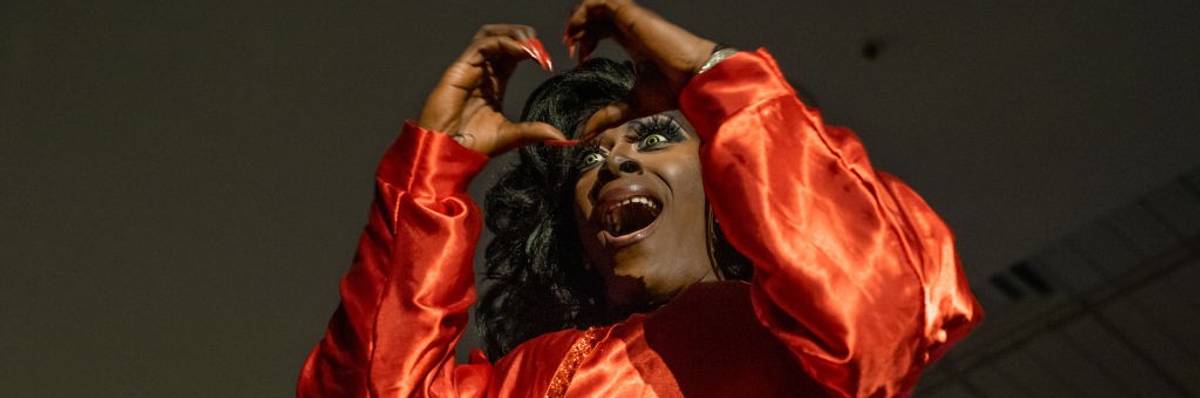
Yasmine Nicole performs in drag during a drag show and story hour held at East Tennessee State University in Johnson City, Tennessee on Friday March 31, 2023. The event was held in protest to the passing of legislation that would go into effect the following day that restricts locations where drag performances can take place along with other parts of the bill which are considered trans-phobic.
"Similar to the countless battles the LGBTQ+ community has faced over the last several decades, our collective success relies upon everyone speaking out and taking a stand against bigotry," said the group who challenged the statute.
A federal judge on Friday evening ruled that Tennessee's anti-drag show law—the first of its kind in the nation signed by Republican Gov. Bill Lee earlier this year after approval by the GOP-controlled state legislature—represented an unconstitutional attack on free speech.
The 70-page ruling issued by U.S. District Judge Thomas L. Parker found that the law was "unconstitutionally vague and substantially overbroad," making it a clear violation of the free protections in the First Amendment.
"We Won!" declared Friends of George's, the non-profit performance group in the state who had challenged the law.
While the word "drag" or phrase "drag show" did not appear in the statute, Judge Parker said the examples offered by the defenders of the law during the hearing of the case exhibited clearly who and what the law was targeting and that it therefore encouraged "discriminatory enforcement" by the state.
"There is no question that obscenity is not protected by the First Amendment," states the ruling. "But there is a difference between material that is 'obscene' in the vernacular, and material that is 'obscene' under the law."
"Simply put," it continues, "no majority of the Supreme Court has held that sexually explicit—but not obscene—speech receives less protection than political, artistic, or scientific speech."
In a statement on Saturday, Friends of George's said the ruling "represents a triumph over hate."
"Similar to the countless battles the LGBTQ+ community has faced over the last several decades, our collective success relies upon everyone speaking out and taking a stand against bigotry," said the group, based in Memphis.
Jonathan Friedman, director of free expression & education programs for PEN America, also celebrated the ruling, calling it a "necessary victory for free speech" in Tennessee.
Dear Common Dreams reader, It’s been nearly 30 years since I co-founded Common Dreams with my late wife, Lina Newhouser. We had the radical notion that journalism should serve the public good, not corporate profits. It was clear to us from the outset what it would take to build such a project. No paid advertisements. No corporate sponsors. No millionaire publisher telling us what to think or do. Many people said we wouldn't last a year, but we proved those doubters wrong. Together with a tremendous team of journalists and dedicated staff, we built an independent media outlet free from the constraints of profits and corporate control. Our mission has always been simple: To inform. To inspire. To ignite change for the common good. Building Common Dreams was not easy. Our survival was never guaranteed. When you take on the most powerful forces—Wall Street greed, fossil fuel industry destruction, Big Tech lobbyists, and uber-rich oligarchs who have spent billions upon billions rigging the economy and democracy in their favor—the only bulwark you have is supporters who believe in your work. But here’s the urgent message from me today. It's never been this bad out there. And it's never been this hard to keep us going. At the very moment Common Dreams is most needed, the threats we face are intensifying. We need your support now more than ever. We don't accept corporate advertising and never will. We don't have a paywall because we don't think people should be blocked from critical news based on their ability to pay. Everything we do is funded by the donations of readers like you. When everyone does the little they can afford, we are strong. But if that support retreats or dries up, so do we. Will you donate now to make sure Common Dreams not only survives but thrives? —Craig Brown, Co-founder |
A federal judge on Friday evening ruled that Tennessee's anti-drag show law—the first of its kind in the nation signed by Republican Gov. Bill Lee earlier this year after approval by the GOP-controlled state legislature—represented an unconstitutional attack on free speech.
The 70-page ruling issued by U.S. District Judge Thomas L. Parker found that the law was "unconstitutionally vague and substantially overbroad," making it a clear violation of the free protections in the First Amendment.
"We Won!" declared Friends of George's, the non-profit performance group in the state who had challenged the law.
While the word "drag" or phrase "drag show" did not appear in the statute, Judge Parker said the examples offered by the defenders of the law during the hearing of the case exhibited clearly who and what the law was targeting and that it therefore encouraged "discriminatory enforcement" by the state.
"There is no question that obscenity is not protected by the First Amendment," states the ruling. "But there is a difference between material that is 'obscene' in the vernacular, and material that is 'obscene' under the law."
"Simply put," it continues, "no majority of the Supreme Court has held that sexually explicit—but not obscene—speech receives less protection than political, artistic, or scientific speech."
In a statement on Saturday, Friends of George's said the ruling "represents a triumph over hate."
"Similar to the countless battles the LGBTQ+ community has faced over the last several decades, our collective success relies upon everyone speaking out and taking a stand against bigotry," said the group, based in Memphis.
Jonathan Friedman, director of free expression & education programs for PEN America, also celebrated the ruling, calling it a "necessary victory for free speech" in Tennessee.
A federal judge on Friday evening ruled that Tennessee's anti-drag show law—the first of its kind in the nation signed by Republican Gov. Bill Lee earlier this year after approval by the GOP-controlled state legislature—represented an unconstitutional attack on free speech.
The 70-page ruling issued by U.S. District Judge Thomas L. Parker found that the law was "unconstitutionally vague and substantially overbroad," making it a clear violation of the free protections in the First Amendment.
"We Won!" declared Friends of George's, the non-profit performance group in the state who had challenged the law.
While the word "drag" or phrase "drag show" did not appear in the statute, Judge Parker said the examples offered by the defenders of the law during the hearing of the case exhibited clearly who and what the law was targeting and that it therefore encouraged "discriminatory enforcement" by the state.
"There is no question that obscenity is not protected by the First Amendment," states the ruling. "But there is a difference between material that is 'obscene' in the vernacular, and material that is 'obscene' under the law."
"Simply put," it continues, "no majority of the Supreme Court has held that sexually explicit—but not obscene—speech receives less protection than political, artistic, or scientific speech."
In a statement on Saturday, Friends of George's said the ruling "represents a triumph over hate."
"Similar to the countless battles the LGBTQ+ community has faced over the last several decades, our collective success relies upon everyone speaking out and taking a stand against bigotry," said the group, based in Memphis.
Jonathan Friedman, director of free expression & education programs for PEN America, also celebrated the ruling, calling it a "necessary victory for free speech" in Tennessee.