

SUBSCRIBE TO OUR FREE NEWSLETTER
Daily news & progressive opinion—funded by the people, not the corporations—delivered straight to your inbox.
5
#000000
#FFFFFF
To donate by check, phone, or other method, see our More Ways to Give page.
Daily news & progressive opinion—funded by the people, not the corporations—delivered straight to your inbox.
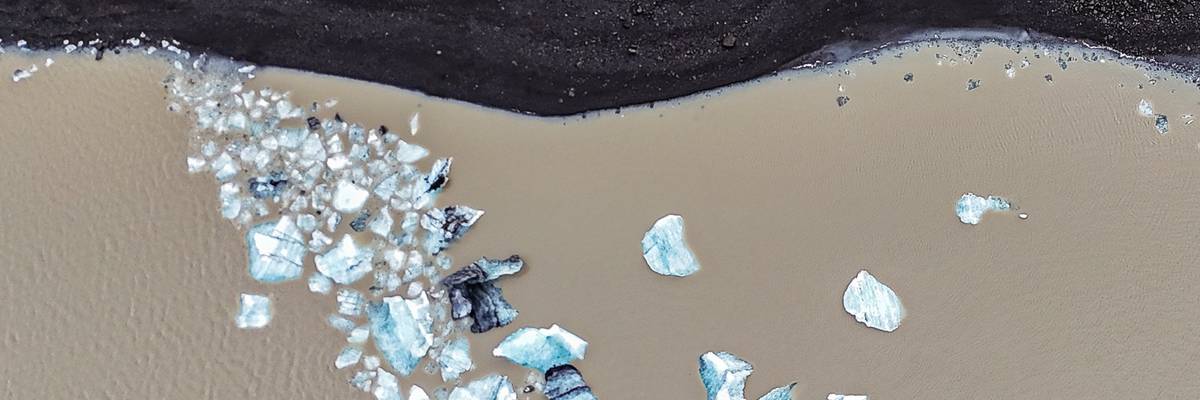
An aerial view shows the Vatnajokull glaciers in Iceland are melting into the ocean or forming lagoons due to global warming and climate change on February 23, 2025.
"The environment does not care about politics. Keep spewing greenhouse gases and face the consequences."
European Union officials said the Copernicus Climate Change Service had issued its latest "stark reminder of why climate action is urgent" when the bloc's program announced that it observed less sea ice covering the Earth's oceans last month than at any other point in recorded history.
In the Arctic, sea ice reached its lowest monthly extent on record, at 8% below average, in early February, and it remained below the previous record for the rest of the month.
The oceans were missing an area of ice roughly the size of the United Kingdom last month, according to Copernicus (C3S), and the finding was not an anomaly in recent sea ice observations.
February marked the third consecutive month in which record low sea ice levels for the corresponding month were observed in the Arctic.
C3S reported that in the Antarctic, sea ice levels have rapidly declined in 2025 after appearing to recover to near-record levels in December 2024.
Last month, sea ice near the South Pole reached its fourth-lowest monthly extent, at 26% below average.
C3S said the daily sea ice extent in the Antarctic may have also reached its annual minimum toward the end of the month, which will be confirmed later in March; if confirmed, it would be the second-lowest annual minimum in the satellite record.
"February 2025 continues the streak of record or near-record temperatures observed throughout the last two years," said Samanatha Burgess, strategic lead for climate at the European Center for Medium-Range Weather Forecasts. "One of the consequences of a warmer world is melting sea ice, and the record or near-record low sea ice cover at both poles has pushed global sea ice cover to an all-time minimum."
The melting sea ice was recorded as global average temperatures rose 1.59°C (2.8°F) above the pre-industrial average last month, making it the third-warmest February on record.
In Europe, the temperatures that most exceeded averages were recorded last month in parts of Scandinavia, Iceland, and the Alps. Outside of Europe, "temperatures were most above average over large parts of the Arctic."
The low extent of sea ice will lead to "more solar heat absorbed by the darker oceans," and "faster warming," said Simon Oldridge, a climate campaigner.
The loss of sea ice can also lead to the collapse of ocean currents that are crucial for marine life to thrive.
C3S reported on the record-low sea ice levels as campaigners in the U.S. and around the world condemned recent anti-climate actions taken by U.S. President Donald Trump and the Republican Party, including the country's exit from the Paris climate agreement, the GOP's passing of a bill to end a federal program aimed at reducing planet-heating methane emissions, and Trump's push to fast-track fossil fuel projects—as scientists warn that new extractive projects have no place on a pathway to limiting planetary heating and avoiding its worst impacts.
"The environment does not care about politics," said public health expert Ali Khan. "Keep spewing greenhouse gases and face the consequences."
Dear Common Dreams reader, It’s been nearly 30 years since I co-founded Common Dreams with my late wife, Lina Newhouser. We had the radical notion that journalism should serve the public good, not corporate profits. It was clear to us from the outset what it would take to build such a project. No paid advertisements. No corporate sponsors. No millionaire publisher telling us what to think or do. Many people said we wouldn't last a year, but we proved those doubters wrong. Together with a tremendous team of journalists and dedicated staff, we built an independent media outlet free from the constraints of profits and corporate control. Our mission has always been simple: To inform. To inspire. To ignite change for the common good. Building Common Dreams was not easy. Our survival was never guaranteed. When you take on the most powerful forces—Wall Street greed, fossil fuel industry destruction, Big Tech lobbyists, and uber-rich oligarchs who have spent billions upon billions rigging the economy and democracy in their favor—the only bulwark you have is supporters who believe in your work. But here’s the urgent message from me today. It's never been this bad out there. And it's never been this hard to keep us going. At the very moment Common Dreams is most needed, the threats we face are intensifying. We need your support now more than ever. We don't accept corporate advertising and never will. We don't have a paywall because we don't think people should be blocked from critical news based on their ability to pay. Everything we do is funded by the donations of readers like you. When everyone does the little they can afford, we are strong. But if that support retreats or dries up, so do we. Will you donate now to make sure Common Dreams not only survives but thrives? —Craig Brown, Co-founder |
European Union officials said the Copernicus Climate Change Service had issued its latest "stark reminder of why climate action is urgent" when the bloc's program announced that it observed less sea ice covering the Earth's oceans last month than at any other point in recorded history.
In the Arctic, sea ice reached its lowest monthly extent on record, at 8% below average, in early February, and it remained below the previous record for the rest of the month.
The oceans were missing an area of ice roughly the size of the United Kingdom last month, according to Copernicus (C3S), and the finding was not an anomaly in recent sea ice observations.
February marked the third consecutive month in which record low sea ice levels for the corresponding month were observed in the Arctic.
C3S reported that in the Antarctic, sea ice levels have rapidly declined in 2025 after appearing to recover to near-record levels in December 2024.
Last month, sea ice near the South Pole reached its fourth-lowest monthly extent, at 26% below average.
C3S said the daily sea ice extent in the Antarctic may have also reached its annual minimum toward the end of the month, which will be confirmed later in March; if confirmed, it would be the second-lowest annual minimum in the satellite record.
"February 2025 continues the streak of record or near-record temperatures observed throughout the last two years," said Samanatha Burgess, strategic lead for climate at the European Center for Medium-Range Weather Forecasts. "One of the consequences of a warmer world is melting sea ice, and the record or near-record low sea ice cover at both poles has pushed global sea ice cover to an all-time minimum."
The melting sea ice was recorded as global average temperatures rose 1.59°C (2.8°F) above the pre-industrial average last month, making it the third-warmest February on record.
In Europe, the temperatures that most exceeded averages were recorded last month in parts of Scandinavia, Iceland, and the Alps. Outside of Europe, "temperatures were most above average over large parts of the Arctic."
The low extent of sea ice will lead to "more solar heat absorbed by the darker oceans," and "faster warming," said Simon Oldridge, a climate campaigner.
The loss of sea ice can also lead to the collapse of ocean currents that are crucial for marine life to thrive.
C3S reported on the record-low sea ice levels as campaigners in the U.S. and around the world condemned recent anti-climate actions taken by U.S. President Donald Trump and the Republican Party, including the country's exit from the Paris climate agreement, the GOP's passing of a bill to end a federal program aimed at reducing planet-heating methane emissions, and Trump's push to fast-track fossil fuel projects—as scientists warn that new extractive projects have no place on a pathway to limiting planetary heating and avoiding its worst impacts.
"The environment does not care about politics," said public health expert Ali Khan. "Keep spewing greenhouse gases and face the consequences."
European Union officials said the Copernicus Climate Change Service had issued its latest "stark reminder of why climate action is urgent" when the bloc's program announced that it observed less sea ice covering the Earth's oceans last month than at any other point in recorded history.
In the Arctic, sea ice reached its lowest monthly extent on record, at 8% below average, in early February, and it remained below the previous record for the rest of the month.
The oceans were missing an area of ice roughly the size of the United Kingdom last month, according to Copernicus (C3S), and the finding was not an anomaly in recent sea ice observations.
February marked the third consecutive month in which record low sea ice levels for the corresponding month were observed in the Arctic.
C3S reported that in the Antarctic, sea ice levels have rapidly declined in 2025 after appearing to recover to near-record levels in December 2024.
Last month, sea ice near the South Pole reached its fourth-lowest monthly extent, at 26% below average.
C3S said the daily sea ice extent in the Antarctic may have also reached its annual minimum toward the end of the month, which will be confirmed later in March; if confirmed, it would be the second-lowest annual minimum in the satellite record.
"February 2025 continues the streak of record or near-record temperatures observed throughout the last two years," said Samanatha Burgess, strategic lead for climate at the European Center for Medium-Range Weather Forecasts. "One of the consequences of a warmer world is melting sea ice, and the record or near-record low sea ice cover at both poles has pushed global sea ice cover to an all-time minimum."
The melting sea ice was recorded as global average temperatures rose 1.59°C (2.8°F) above the pre-industrial average last month, making it the third-warmest February on record.
In Europe, the temperatures that most exceeded averages were recorded last month in parts of Scandinavia, Iceland, and the Alps. Outside of Europe, "temperatures were most above average over large parts of the Arctic."
The low extent of sea ice will lead to "more solar heat absorbed by the darker oceans," and "faster warming," said Simon Oldridge, a climate campaigner.
The loss of sea ice can also lead to the collapse of ocean currents that are crucial for marine life to thrive.
C3S reported on the record-low sea ice levels as campaigners in the U.S. and around the world condemned recent anti-climate actions taken by U.S. President Donald Trump and the Republican Party, including the country's exit from the Paris climate agreement, the GOP's passing of a bill to end a federal program aimed at reducing planet-heating methane emissions, and Trump's push to fast-track fossil fuel projects—as scientists warn that new extractive projects have no place on a pathway to limiting planetary heating and avoiding its worst impacts.
"The environment does not care about politics," said public health expert Ali Khan. "Keep spewing greenhouse gases and face the consequences."

