SUBSCRIBE TO OUR FREE NEWSLETTER
Daily news & progressive opinion—funded by the people, not the corporations—delivered straight to your inbox.
5
#000000
#FFFFFF
To donate by check, phone, or other method, see our More Ways to Give page.
Daily news & progressive opinion—funded by the people, not the corporations—delivered straight to your inbox.
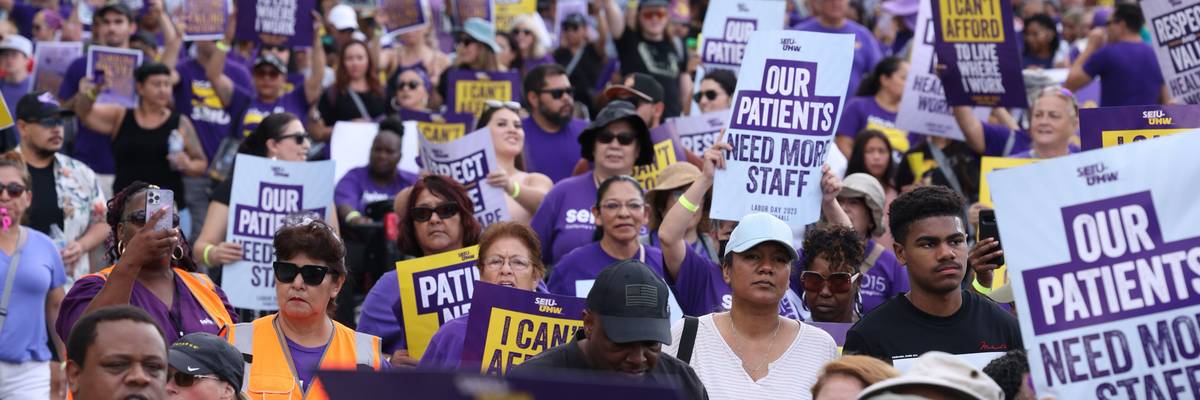
Healthcare workers take part in a rally at Kaiser Permanente's main medical facility on Monday, Sept. 4, 2023 in Los Angeles, California.
"We are prepared to do whatever it takes, even get arrested in an act of civil disobedience, to stand up for our patients," said one Kaiser Permanente worker.
Dozens of healthcare workers were arrested in Los Angeles on Monday after sitting in the street outside of a Kaiser Permanente facility to demand that providers address dangerously low staffing levels at hospitals in California and across the country.
The civil disobedience came as the workers prepared for what could be the largest healthcare strike in U.S. history. Late last month, 85,000 Kaiser Permanente employees represented by the Coalition of Kaiser Permanente Unions began voting on whether to authorize a strike over the nonprofit hospital system's alleged unfair labor practices during ongoing contract negotiations.
The current contract expires on September 30.
"We are burnt out, stretched thin, and fed up after years of the pandemic and chronic short staffing," Datosha Williams, a service representative at Kaiser Permanente South Bay, said Monday. "Healthcare providers are failing workers and patients, and we are at crisis levels in our hospitals and medical centers."
"Our employers take in billions of dollars in profits, yet they refuse to safely staff their facilities or pay many of their workers a living wage," Williams added. "We are prepared to do whatever it takes, even get arrested in an act of civil disobedience, to stand up for our patients."
Kaiser Permanente reported nearly $3.3 billion in net income during the first half of 2023. In 2021, Kaiser CEO Greg Adams brought in more than $16 million in total compensation.
According to the Coalition of Kaiser Permanente Unions, the hospital system "has investments of $113 billion in the U.S. and abroad, including in fossil fuels, casinos, for-profit prisons, alcohol companies, military weapons, and more."
Healthcare workers, meanwhile, say they're being overworked and underpaid, and many are struggling to make ends meet amid high costs of living.
"We have healthcare employees leaving left and right, and we have corporate greed that is trying to pretend that this staffing shortage is not real," Jessica Cruz, a nurse at Kaiser Permanente Los Angeles Medical Center, told LAist.
"We are risking arrest, and the reason why we're doing it is that we need everyone to know that this crisis is real," said Cruz, who was among the 25 workers arrested during the Labor Day protest.
A recent survey of tens of thousands of healthcare workers across California found that 83% reported understaffing in their departments, and 65% said they have witnessed or heard of care being delayed or denied due to staff shortages.
Additionally, more than 40% of the workers surveyed said they feel pressured to neglect safety protocols and skip breaks or meals due to short staffing.
"It's heartbreaking to see our patients suffer from long wait times for the care they need, all because Kaiser won't put patient and worker safety first," Paula Coleman, a clinical laboratory assistant at Kaiser Permanente in Englewood, Colorado, said in a statement late last month. "We will have no choice but to vote to strike if Kaiser won't bargain in good faith and let us give patients the quality care they deserve."
A local NBC affiliate reported Monday that 99% of Colorado Kaiser employees represented by SEIU Local 105 have voted to authorize a strike.
Dear Common Dreams reader, It’s been nearly 30 years since I co-founded Common Dreams with my late wife, Lina Newhouser. We had the radical notion that journalism should serve the public good, not corporate profits. It was clear to us from the outset what it would take to build such a project. No paid advertisements. No corporate sponsors. No millionaire publisher telling us what to think or do. Many people said we wouldn't last a year, but we proved those doubters wrong. Together with a tremendous team of journalists and dedicated staff, we built an independent media outlet free from the constraints of profits and corporate control. Our mission has always been simple: To inform. To inspire. To ignite change for the common good. Building Common Dreams was not easy. Our survival was never guaranteed. When you take on the most powerful forces—Wall Street greed, fossil fuel industry destruction, Big Tech lobbyists, and uber-rich oligarchs who have spent billions upon billions rigging the economy and democracy in their favor—the only bulwark you have is supporters who believe in your work. But here’s the urgent message from me today. It's never been this bad out there. And it's never been this hard to keep us going. At the very moment Common Dreams is most needed, the threats we face are intensifying. We need your support now more than ever. We don't accept corporate advertising and never will. We don't have a paywall because we don't think people should be blocked from critical news based on their ability to pay. Everything we do is funded by the donations of readers like you. When everyone does the little they can afford, we are strong. But if that support retreats or dries up, so do we. Will you donate now to make sure Common Dreams not only survives but thrives? —Craig Brown, Co-founder |
Dozens of healthcare workers were arrested in Los Angeles on Monday after sitting in the street outside of a Kaiser Permanente facility to demand that providers address dangerously low staffing levels at hospitals in California and across the country.
The civil disobedience came as the workers prepared for what could be the largest healthcare strike in U.S. history. Late last month, 85,000 Kaiser Permanente employees represented by the Coalition of Kaiser Permanente Unions began voting on whether to authorize a strike over the nonprofit hospital system's alleged unfair labor practices during ongoing contract negotiations.
The current contract expires on September 30.
"We are burnt out, stretched thin, and fed up after years of the pandemic and chronic short staffing," Datosha Williams, a service representative at Kaiser Permanente South Bay, said Monday. "Healthcare providers are failing workers and patients, and we are at crisis levels in our hospitals and medical centers."
"Our employers take in billions of dollars in profits, yet they refuse to safely staff their facilities or pay many of their workers a living wage," Williams added. "We are prepared to do whatever it takes, even get arrested in an act of civil disobedience, to stand up for our patients."
Kaiser Permanente reported nearly $3.3 billion in net income during the first half of 2023. In 2021, Kaiser CEO Greg Adams brought in more than $16 million in total compensation.
According to the Coalition of Kaiser Permanente Unions, the hospital system "has investments of $113 billion in the U.S. and abroad, including in fossil fuels, casinos, for-profit prisons, alcohol companies, military weapons, and more."
Healthcare workers, meanwhile, say they're being overworked and underpaid, and many are struggling to make ends meet amid high costs of living.
"We have healthcare employees leaving left and right, and we have corporate greed that is trying to pretend that this staffing shortage is not real," Jessica Cruz, a nurse at Kaiser Permanente Los Angeles Medical Center, told LAist.
"We are risking arrest, and the reason why we're doing it is that we need everyone to know that this crisis is real," said Cruz, who was among the 25 workers arrested during the Labor Day protest.
A recent survey of tens of thousands of healthcare workers across California found that 83% reported understaffing in their departments, and 65% said they have witnessed or heard of care being delayed or denied due to staff shortages.
Additionally, more than 40% of the workers surveyed said they feel pressured to neglect safety protocols and skip breaks or meals due to short staffing.
"It's heartbreaking to see our patients suffer from long wait times for the care they need, all because Kaiser won't put patient and worker safety first," Paula Coleman, a clinical laboratory assistant at Kaiser Permanente in Englewood, Colorado, said in a statement late last month. "We will have no choice but to vote to strike if Kaiser won't bargain in good faith and let us give patients the quality care they deserve."
A local NBC affiliate reported Monday that 99% of Colorado Kaiser employees represented by SEIU Local 105 have voted to authorize a strike.
Dozens of healthcare workers were arrested in Los Angeles on Monday after sitting in the street outside of a Kaiser Permanente facility to demand that providers address dangerously low staffing levels at hospitals in California and across the country.
The civil disobedience came as the workers prepared for what could be the largest healthcare strike in U.S. history. Late last month, 85,000 Kaiser Permanente employees represented by the Coalition of Kaiser Permanente Unions began voting on whether to authorize a strike over the nonprofit hospital system's alleged unfair labor practices during ongoing contract negotiations.
The current contract expires on September 30.
"We are burnt out, stretched thin, and fed up after years of the pandemic and chronic short staffing," Datosha Williams, a service representative at Kaiser Permanente South Bay, said Monday. "Healthcare providers are failing workers and patients, and we are at crisis levels in our hospitals and medical centers."
"Our employers take in billions of dollars in profits, yet they refuse to safely staff their facilities or pay many of their workers a living wage," Williams added. "We are prepared to do whatever it takes, even get arrested in an act of civil disobedience, to stand up for our patients."
Kaiser Permanente reported nearly $3.3 billion in net income during the first half of 2023. In 2021, Kaiser CEO Greg Adams brought in more than $16 million in total compensation.
According to the Coalition of Kaiser Permanente Unions, the hospital system "has investments of $113 billion in the U.S. and abroad, including in fossil fuels, casinos, for-profit prisons, alcohol companies, military weapons, and more."
Healthcare workers, meanwhile, say they're being overworked and underpaid, and many are struggling to make ends meet amid high costs of living.
"We have healthcare employees leaving left and right, and we have corporate greed that is trying to pretend that this staffing shortage is not real," Jessica Cruz, a nurse at Kaiser Permanente Los Angeles Medical Center, told LAist.
"We are risking arrest, and the reason why we're doing it is that we need everyone to know that this crisis is real," said Cruz, who was among the 25 workers arrested during the Labor Day protest.
A recent survey of tens of thousands of healthcare workers across California found that 83% reported understaffing in their departments, and 65% said they have witnessed or heard of care being delayed or denied due to staff shortages.
Additionally, more than 40% of the workers surveyed said they feel pressured to neglect safety protocols and skip breaks or meals due to short staffing.
"It's heartbreaking to see our patients suffer from long wait times for the care they need, all because Kaiser won't put patient and worker safety first," Paula Coleman, a clinical laboratory assistant at Kaiser Permanente in Englewood, Colorado, said in a statement late last month. "We will have no choice but to vote to strike if Kaiser won't bargain in good faith and let us give patients the quality care they deserve."
A local NBC affiliate reported Monday that 99% of Colorado Kaiser employees represented by SEIU Local 105 have voted to authorize a strike.