SUBSCRIBE TO OUR FREE NEWSLETTER
Daily news & progressive opinion—funded by the people, not the corporations—delivered straight to your inbox.
5
#000000
#FFFFFF
To donate by check, phone, or other method, see our More Ways to Give page.
Daily news & progressive opinion—funded by the people, not the corporations—delivered straight to your inbox.
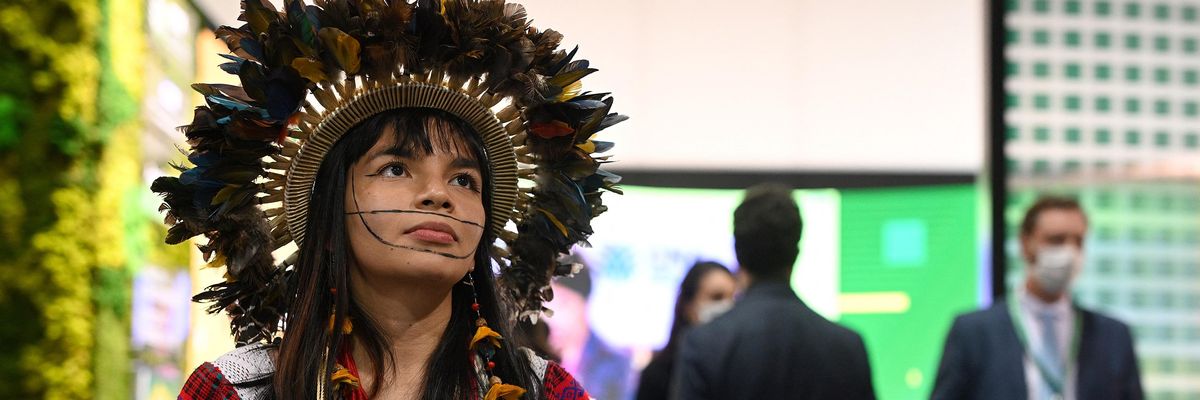
Txai Surui, an Indigenous activist from the Paiter Surui people of the state of Rondonia, Brazil, poses for a photo on November 1, 2021 during the United Nations Climate Change Conference in Glasgow, Scotland. (Photo: Oli Scarff/AFP via Getty Images)
As the United Nations Climate Change Conference--also known as COP26--got underway in Glasgow, Scotland this week, Indigenous activists from around the world warned that failure to center their peoples' voices and solutions would seriously hamper efforts to tackle the growing planetary emergency.
"We can develop actions based on our culture and our traditional knowledge."
"Today, the climate is warming, the animals are disappearing, the rivers are dying and our plants don't flower like they did before," Txai Surui, a law student, activist, and member of the Paiter Surui people of northwestern Brazil, said during Sunday's COP26 opening ceremony. "The Earth is speaking. She tells us that we have no more time."
"Indigenous people are in the frontline of the climate emergency, and we must be at the center of the decisions happening here," she stressed. "We have ideas to postpone the end of the world."
However, Rebecca Sinclair, a member of the Cree from Barren Lands First Nation in Manitoba, Canada and a research and policy analyst at Indigenous Climate Action (ICA), lamented that "we're being excluded from the conversation."
"I think people at a global stage need to hear that we, regardless of who's making policy or what's going on, Indigenous folks, knowledge keepers, elders are still caring for this land and we can only benefit from that," she told CBC News, adding that ICA's COP26 delegates will be "trying to influence as much policy as we can to uplift Indigenous voices and sovereignty and our rights."
"What the global stage needs to understand is that you're repackaging solutions that we have and excluding us from that conversation, which can be detrimental to the climate crisis already," Sinclair added.
Kyle Whyte, a member of the Citizen Potawatomi Nation in Oklahoma who serves on U.S. President Joe Biden's White House Environmental Justice Advisory Council, told NBC News that "if countries don't get on board with us, leaving out the people who steward a lot of the lands, it's not just a moral issue anymore. It will have a devastating effect on the speed at which the rest of the world will get to sustainability."
Mina Setra, deputy secretary-general of the Indigenous Peoples Alliance of the Archipelago (AMAN) in Indonesia, told Mongabay that "no [climate] initiative can succeed if rights are not recognized."
"We can develop actions based on our culture and our traditional knowledge," Setra said, adding that with official recognition of Indigenous land and forest tenure, "we can do even more because communities will be able to scale up their actions."
Sonia Guajajara, head of the Articulation of Indigenous Peoples of Brazil (ABIP), told Reuters that "if there is no protection of Indigenous territories and rights, there will also be no solution to the climate crisis, because we are part of that solution."
Guajajara is part of a 40-strong delegation of Indigenous peoples from Brazil who decried the increasing threats posed by logging and mining, as well as by the administration of right-wing Brazilian President Jair Bolsonaro--a climate change skeptic sometimes called "Captain Chainsaw" for having presided over the destruction of over 10,000 square miles of rainforest during his tenure.
"We need to urgently save our territories to protect the lives of Indigenous people and the future of our planet," she said.
Indigenous activists also warned against false market-based climate "solutions."
"We see that everything is leading up to the carbon market," said Setra. "That really worries us."
Others took issue with what they called the shortsightedness of some nations' climate policies.
Jayce Chiblow, an Anishinaabe from the Garden River First Nation in northern Ontario, Canada and an ICA activist, told CBC News that "the youth have to think of our next seven generations, so bringing that to the table is really important."
"And in my experience," Chiblow added, "I haven't seen colonial governments think that far ahead."
Dear Common Dreams reader, It’s been nearly 30 years since I co-founded Common Dreams with my late wife, Lina Newhouser. We had the radical notion that journalism should serve the public good, not corporate profits. It was clear to us from the outset what it would take to build such a project. No paid advertisements. No corporate sponsors. No millionaire publisher telling us what to think or do. Many people said we wouldn't last a year, but we proved those doubters wrong. Together with a tremendous team of journalists and dedicated staff, we built an independent media outlet free from the constraints of profits and corporate control. Our mission has always been simple: To inform. To inspire. To ignite change for the common good. Building Common Dreams was not easy. Our survival was never guaranteed. When you take on the most powerful forces—Wall Street greed, fossil fuel industry destruction, Big Tech lobbyists, and uber-rich oligarchs who have spent billions upon billions rigging the economy and democracy in their favor—the only bulwark you have is supporters who believe in your work. But here’s the urgent message from me today. It's never been this bad out there. And it's never been this hard to keep us going. At the very moment Common Dreams is most needed, the threats we face are intensifying. We need your support now more than ever. We don't accept corporate advertising and never will. We don't have a paywall because we don't think people should be blocked from critical news based on their ability to pay. Everything we do is funded by the donations of readers like you. When everyone does the little they can afford, we are strong. But if that support retreats or dries up, so do we. Will you donate now to make sure Common Dreams not only survives but thrives? —Craig Brown, Co-founder |
As the United Nations Climate Change Conference--also known as COP26--got underway in Glasgow, Scotland this week, Indigenous activists from around the world warned that failure to center their peoples' voices and solutions would seriously hamper efforts to tackle the growing planetary emergency.
"We can develop actions based on our culture and our traditional knowledge."
"Today, the climate is warming, the animals are disappearing, the rivers are dying and our plants don't flower like they did before," Txai Surui, a law student, activist, and member of the Paiter Surui people of northwestern Brazil, said during Sunday's COP26 opening ceremony. "The Earth is speaking. She tells us that we have no more time."
"Indigenous people are in the frontline of the climate emergency, and we must be at the center of the decisions happening here," she stressed. "We have ideas to postpone the end of the world."
However, Rebecca Sinclair, a member of the Cree from Barren Lands First Nation in Manitoba, Canada and a research and policy analyst at Indigenous Climate Action (ICA), lamented that "we're being excluded from the conversation."
"I think people at a global stage need to hear that we, regardless of who's making policy or what's going on, Indigenous folks, knowledge keepers, elders are still caring for this land and we can only benefit from that," she told CBC News, adding that ICA's COP26 delegates will be "trying to influence as much policy as we can to uplift Indigenous voices and sovereignty and our rights."
"What the global stage needs to understand is that you're repackaging solutions that we have and excluding us from that conversation, which can be detrimental to the climate crisis already," Sinclair added.
Kyle Whyte, a member of the Citizen Potawatomi Nation in Oklahoma who serves on U.S. President Joe Biden's White House Environmental Justice Advisory Council, told NBC News that "if countries don't get on board with us, leaving out the people who steward a lot of the lands, it's not just a moral issue anymore. It will have a devastating effect on the speed at which the rest of the world will get to sustainability."
Mina Setra, deputy secretary-general of the Indigenous Peoples Alliance of the Archipelago (AMAN) in Indonesia, told Mongabay that "no [climate] initiative can succeed if rights are not recognized."
"We can develop actions based on our culture and our traditional knowledge," Setra said, adding that with official recognition of Indigenous land and forest tenure, "we can do even more because communities will be able to scale up their actions."
Sonia Guajajara, head of the Articulation of Indigenous Peoples of Brazil (ABIP), told Reuters that "if there is no protection of Indigenous territories and rights, there will also be no solution to the climate crisis, because we are part of that solution."
Guajajara is part of a 40-strong delegation of Indigenous peoples from Brazil who decried the increasing threats posed by logging and mining, as well as by the administration of right-wing Brazilian President Jair Bolsonaro--a climate change skeptic sometimes called "Captain Chainsaw" for having presided over the destruction of over 10,000 square miles of rainforest during his tenure.
"We need to urgently save our territories to protect the lives of Indigenous people and the future of our planet," she said.
Indigenous activists also warned against false market-based climate "solutions."
"We see that everything is leading up to the carbon market," said Setra. "That really worries us."
Others took issue with what they called the shortsightedness of some nations' climate policies.
Jayce Chiblow, an Anishinaabe from the Garden River First Nation in northern Ontario, Canada and an ICA activist, told CBC News that "the youth have to think of our next seven generations, so bringing that to the table is really important."
"And in my experience," Chiblow added, "I haven't seen colonial governments think that far ahead."
As the United Nations Climate Change Conference--also known as COP26--got underway in Glasgow, Scotland this week, Indigenous activists from around the world warned that failure to center their peoples' voices and solutions would seriously hamper efforts to tackle the growing planetary emergency.
"We can develop actions based on our culture and our traditional knowledge."
"Today, the climate is warming, the animals are disappearing, the rivers are dying and our plants don't flower like they did before," Txai Surui, a law student, activist, and member of the Paiter Surui people of northwestern Brazil, said during Sunday's COP26 opening ceremony. "The Earth is speaking. She tells us that we have no more time."
"Indigenous people are in the frontline of the climate emergency, and we must be at the center of the decisions happening here," she stressed. "We have ideas to postpone the end of the world."
However, Rebecca Sinclair, a member of the Cree from Barren Lands First Nation in Manitoba, Canada and a research and policy analyst at Indigenous Climate Action (ICA), lamented that "we're being excluded from the conversation."
"I think people at a global stage need to hear that we, regardless of who's making policy or what's going on, Indigenous folks, knowledge keepers, elders are still caring for this land and we can only benefit from that," she told CBC News, adding that ICA's COP26 delegates will be "trying to influence as much policy as we can to uplift Indigenous voices and sovereignty and our rights."
"What the global stage needs to understand is that you're repackaging solutions that we have and excluding us from that conversation, which can be detrimental to the climate crisis already," Sinclair added.
Kyle Whyte, a member of the Citizen Potawatomi Nation in Oklahoma who serves on U.S. President Joe Biden's White House Environmental Justice Advisory Council, told NBC News that "if countries don't get on board with us, leaving out the people who steward a lot of the lands, it's not just a moral issue anymore. It will have a devastating effect on the speed at which the rest of the world will get to sustainability."
Mina Setra, deputy secretary-general of the Indigenous Peoples Alliance of the Archipelago (AMAN) in Indonesia, told Mongabay that "no [climate] initiative can succeed if rights are not recognized."
"We can develop actions based on our culture and our traditional knowledge," Setra said, adding that with official recognition of Indigenous land and forest tenure, "we can do even more because communities will be able to scale up their actions."
Sonia Guajajara, head of the Articulation of Indigenous Peoples of Brazil (ABIP), told Reuters that "if there is no protection of Indigenous territories and rights, there will also be no solution to the climate crisis, because we are part of that solution."
Guajajara is part of a 40-strong delegation of Indigenous peoples from Brazil who decried the increasing threats posed by logging and mining, as well as by the administration of right-wing Brazilian President Jair Bolsonaro--a climate change skeptic sometimes called "Captain Chainsaw" for having presided over the destruction of over 10,000 square miles of rainforest during his tenure.
"We need to urgently save our territories to protect the lives of Indigenous people and the future of our planet," she said.
Indigenous activists also warned against false market-based climate "solutions."
"We see that everything is leading up to the carbon market," said Setra. "That really worries us."
Others took issue with what they called the shortsightedness of some nations' climate policies.
Jayce Chiblow, an Anishinaabe from the Garden River First Nation in northern Ontario, Canada and an ICA activist, told CBC News that "the youth have to think of our next seven generations, so bringing that to the table is really important."
"And in my experience," Chiblow added, "I haven't seen colonial governments think that far ahead."