SUBSCRIBE TO OUR FREE NEWSLETTER
Daily news & progressive opinion—funded by the people, not the corporations—delivered straight to your inbox.
5
#000000
#FFFFFF
To donate by check, phone, or other method, see our More Ways to Give page.
Daily news & progressive opinion—funded by the people, not the corporations—delivered straight to your inbox.
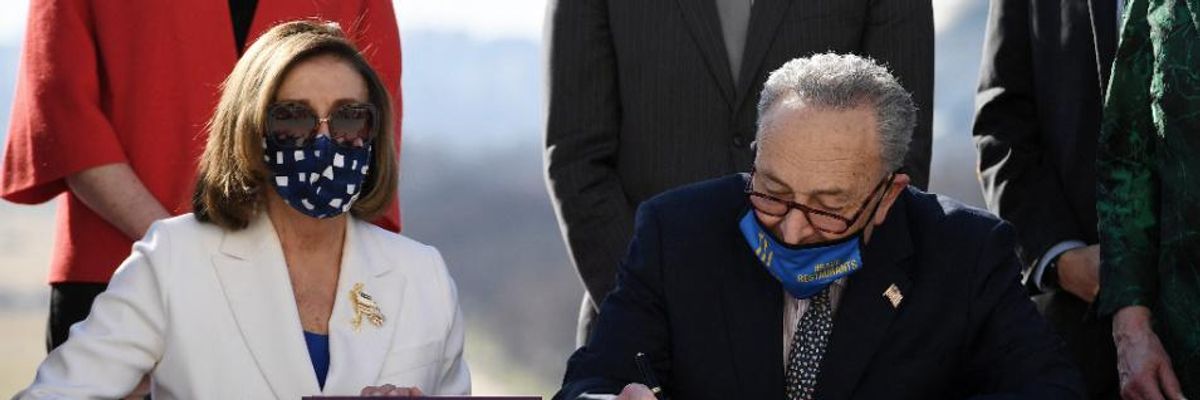
Speaker of the House Nancy Pelosi and Senate Majority Leader Chuck Schumer sign the American Rescue Plan Act on March 10, 2021 in Washington, D.C. (Photo: Olivier Douliery/AFP via Getty Images)
Direct payments from the newly approved coronavirus relief package began landing in people's bank accounts with striking quickness this weekend, but a glaring shortcoming of the American Rescue Plan caused by the arcane procedural tool that Democrats used to pass the bill could prevent checks from reaching many vulnerable households.
Unlike the Covid relief bill that Congress passed through regular order in December, the new $1.9 trillion legislation does not include protections barring debt collectors from hoovering up the checks and using them to pay off people's private debts--which, as The American Prospect's David Dayen put it, makes the American Rescue Plan "also a cash cow for debt collectors."
"Congress must take immediate action to ensure that the economic stimulus payments feed families as intended rather than debt collectors."
--Lauren Saunders, National Consumer Law Center
Lawmakers were well aware of the looming issue as the aid package made its way through Congress; days after the Senate passed its version of the bill earlier this month, Senate Finance Committee Chair Ron Wyden (D-Ore.) put out a statement vowing to introduce standalone legislation to protect the payments from debt collectors.
"While Democrats intend to protect the third payment from private debt collectors, Senate rules did not allow us to include that protection in the American Rescue Plan," Wyden said, referring to the rules of the budget reconciliation process, which requires provisions to have a direct impact on federal spending or revenue.
"Last year, Democrats and Republicans joined together to shield relief payments," Wyden added, "and I would hope that Senate Republicans again support ensuring families receive the $1,400 they need to pay rent and buy groceries."
The CARES Act, a $2.2 trillion relief bill Congress approved last March, did not include language preventing debt collectors from snatching the $1,200 payments, and some people had their money seized as a result. Following outrage from consumer advocates, lawmakers, and state attorneys general (pdf), the aid legislation Congress approved in December contained a provision barring private debt collectors from taking the measure's $600 checks to offset people's debts.
But the December legislation was not passed through reconciliation, meaning lawmakers did not have to contend with the procedure's rules against provisions that don't have a direct budgtary impact.
"The Byrd rule in this case actively transfers emergency funds to financiers," noted Dayen. "Now that checks are already moving through direct deposit, a patch at this point would have limited effect. Needed to have been passed the same day. A real failure of Congress and the president."
Dayen added that "a patch would have some effect, stopping a flood of new judgments from debt collectors to siphon stimulus funds out."
"For those with debts who don't have a judgment yet: get the money out of your bank account immediately," Dayen urged. "One in three U.S. adults had debt in collections as of 2014. This is not theoretical."
As Yahoo Money explained Saturday, "Any private debt collector that has a judgment against you can garnish the latest round of payments. Credit card and medical debt are the two most likely to be collected by debtors... Stimulus checks may also be garnished by debt collectors for unpaid private student loans in some circumstances."
Unless Senate Democrats eliminate the filibuster, any legislative fix for the issue would likely require Democrats to win the support of at least 10 Republicans--an unlikely feat, given that not a single GOP lawmaker voted in favor of the latest relief package.
A spokesperson for Wyden told Mother Jones last week that he intends to introduce his legislation "soon" but did not provide a specific timeline.
Lauren Saunders, associate director National Consumer Law Center, said in a statement last week that the American Rescue Package "is an essential shot in the arm to help families pay for food, rent, medicine, and auto loans."
"Now," said Saunders, "Congress must take immediate action to ensure that the economic stimulus payments feed families as intended rather than debt collectors."
Dear Common Dreams reader, It’s been nearly 30 years since I co-founded Common Dreams with my late wife, Lina Newhouser. We had the radical notion that journalism should serve the public good, not corporate profits. It was clear to us from the outset what it would take to build such a project. No paid advertisements. No corporate sponsors. No millionaire publisher telling us what to think or do. Many people said we wouldn't last a year, but we proved those doubters wrong. Together with a tremendous team of journalists and dedicated staff, we built an independent media outlet free from the constraints of profits and corporate control. Our mission has always been simple: To inform. To inspire. To ignite change for the common good. Building Common Dreams was not easy. Our survival was never guaranteed. When you take on the most powerful forces—Wall Street greed, fossil fuel industry destruction, Big Tech lobbyists, and uber-rich oligarchs who have spent billions upon billions rigging the economy and democracy in their favor—the only bulwark you have is supporters who believe in your work. But here’s the urgent message from me today. It's never been this bad out there. And it's never been this hard to keep us going. At the very moment Common Dreams is most needed, the threats we face are intensifying. We need your support now more than ever. We don't accept corporate advertising and never will. We don't have a paywall because we don't think people should be blocked from critical news based on their ability to pay. Everything we do is funded by the donations of readers like you. When everyone does the little they can afford, we are strong. But if that support retreats or dries up, so do we. Will you donate now to make sure Common Dreams not only survives but thrives? —Craig Brown, Co-founder |
Direct payments from the newly approved coronavirus relief package began landing in people's bank accounts with striking quickness this weekend, but a glaring shortcoming of the American Rescue Plan caused by the arcane procedural tool that Democrats used to pass the bill could prevent checks from reaching many vulnerable households.
Unlike the Covid relief bill that Congress passed through regular order in December, the new $1.9 trillion legislation does not include protections barring debt collectors from hoovering up the checks and using them to pay off people's private debts--which, as The American Prospect's David Dayen put it, makes the American Rescue Plan "also a cash cow for debt collectors."
"Congress must take immediate action to ensure that the economic stimulus payments feed families as intended rather than debt collectors."
--Lauren Saunders, National Consumer Law Center
Lawmakers were well aware of the looming issue as the aid package made its way through Congress; days after the Senate passed its version of the bill earlier this month, Senate Finance Committee Chair Ron Wyden (D-Ore.) put out a statement vowing to introduce standalone legislation to protect the payments from debt collectors.
"While Democrats intend to protect the third payment from private debt collectors, Senate rules did not allow us to include that protection in the American Rescue Plan," Wyden said, referring to the rules of the budget reconciliation process, which requires provisions to have a direct impact on federal spending or revenue.
"Last year, Democrats and Republicans joined together to shield relief payments," Wyden added, "and I would hope that Senate Republicans again support ensuring families receive the $1,400 they need to pay rent and buy groceries."
The CARES Act, a $2.2 trillion relief bill Congress approved last March, did not include language preventing debt collectors from snatching the $1,200 payments, and some people had their money seized as a result. Following outrage from consumer advocates, lawmakers, and state attorneys general (pdf), the aid legislation Congress approved in December contained a provision barring private debt collectors from taking the measure's $600 checks to offset people's debts.
But the December legislation was not passed through reconciliation, meaning lawmakers did not have to contend with the procedure's rules against provisions that don't have a direct budgtary impact.
"The Byrd rule in this case actively transfers emergency funds to financiers," noted Dayen. "Now that checks are already moving through direct deposit, a patch at this point would have limited effect. Needed to have been passed the same day. A real failure of Congress and the president."
Dayen added that "a patch would have some effect, stopping a flood of new judgments from debt collectors to siphon stimulus funds out."
"For those with debts who don't have a judgment yet: get the money out of your bank account immediately," Dayen urged. "One in three U.S. adults had debt in collections as of 2014. This is not theoretical."
As Yahoo Money explained Saturday, "Any private debt collector that has a judgment against you can garnish the latest round of payments. Credit card and medical debt are the two most likely to be collected by debtors... Stimulus checks may also be garnished by debt collectors for unpaid private student loans in some circumstances."
Unless Senate Democrats eliminate the filibuster, any legislative fix for the issue would likely require Democrats to win the support of at least 10 Republicans--an unlikely feat, given that not a single GOP lawmaker voted in favor of the latest relief package.
A spokesperson for Wyden told Mother Jones last week that he intends to introduce his legislation "soon" but did not provide a specific timeline.
Lauren Saunders, associate director National Consumer Law Center, said in a statement last week that the American Rescue Package "is an essential shot in the arm to help families pay for food, rent, medicine, and auto loans."
"Now," said Saunders, "Congress must take immediate action to ensure that the economic stimulus payments feed families as intended rather than debt collectors."
Direct payments from the newly approved coronavirus relief package began landing in people's bank accounts with striking quickness this weekend, but a glaring shortcoming of the American Rescue Plan caused by the arcane procedural tool that Democrats used to pass the bill could prevent checks from reaching many vulnerable households.
Unlike the Covid relief bill that Congress passed through regular order in December, the new $1.9 trillion legislation does not include protections barring debt collectors from hoovering up the checks and using them to pay off people's private debts--which, as The American Prospect's David Dayen put it, makes the American Rescue Plan "also a cash cow for debt collectors."
"Congress must take immediate action to ensure that the economic stimulus payments feed families as intended rather than debt collectors."
--Lauren Saunders, National Consumer Law Center
Lawmakers were well aware of the looming issue as the aid package made its way through Congress; days after the Senate passed its version of the bill earlier this month, Senate Finance Committee Chair Ron Wyden (D-Ore.) put out a statement vowing to introduce standalone legislation to protect the payments from debt collectors.
"While Democrats intend to protect the third payment from private debt collectors, Senate rules did not allow us to include that protection in the American Rescue Plan," Wyden said, referring to the rules of the budget reconciliation process, which requires provisions to have a direct impact on federal spending or revenue.
"Last year, Democrats and Republicans joined together to shield relief payments," Wyden added, "and I would hope that Senate Republicans again support ensuring families receive the $1,400 they need to pay rent and buy groceries."
The CARES Act, a $2.2 trillion relief bill Congress approved last March, did not include language preventing debt collectors from snatching the $1,200 payments, and some people had their money seized as a result. Following outrage from consumer advocates, lawmakers, and state attorneys general (pdf), the aid legislation Congress approved in December contained a provision barring private debt collectors from taking the measure's $600 checks to offset people's debts.
But the December legislation was not passed through reconciliation, meaning lawmakers did not have to contend with the procedure's rules against provisions that don't have a direct budgtary impact.
"The Byrd rule in this case actively transfers emergency funds to financiers," noted Dayen. "Now that checks are already moving through direct deposit, a patch at this point would have limited effect. Needed to have been passed the same day. A real failure of Congress and the president."
Dayen added that "a patch would have some effect, stopping a flood of new judgments from debt collectors to siphon stimulus funds out."
"For those with debts who don't have a judgment yet: get the money out of your bank account immediately," Dayen urged. "One in three U.S. adults had debt in collections as of 2014. This is not theoretical."
As Yahoo Money explained Saturday, "Any private debt collector that has a judgment against you can garnish the latest round of payments. Credit card and medical debt are the two most likely to be collected by debtors... Stimulus checks may also be garnished by debt collectors for unpaid private student loans in some circumstances."
Unless Senate Democrats eliminate the filibuster, any legislative fix for the issue would likely require Democrats to win the support of at least 10 Republicans--an unlikely feat, given that not a single GOP lawmaker voted in favor of the latest relief package.
A spokesperson for Wyden told Mother Jones last week that he intends to introduce his legislation "soon" but did not provide a specific timeline.
Lauren Saunders, associate director National Consumer Law Center, said in a statement last week that the American Rescue Package "is an essential shot in the arm to help families pay for food, rent, medicine, and auto loans."
"Now," said Saunders, "Congress must take immediate action to ensure that the economic stimulus payments feed families as intended rather than debt collectors."