SUBSCRIBE TO OUR FREE NEWSLETTER
Daily news & progressive opinion—funded by the people, not the corporations—delivered straight to your inbox.
5
#000000
#FFFFFF
To donate by check, phone, or other method, see our More Ways to Give page.
Daily news & progressive opinion—funded by the people, not the corporations—delivered straight to your inbox.
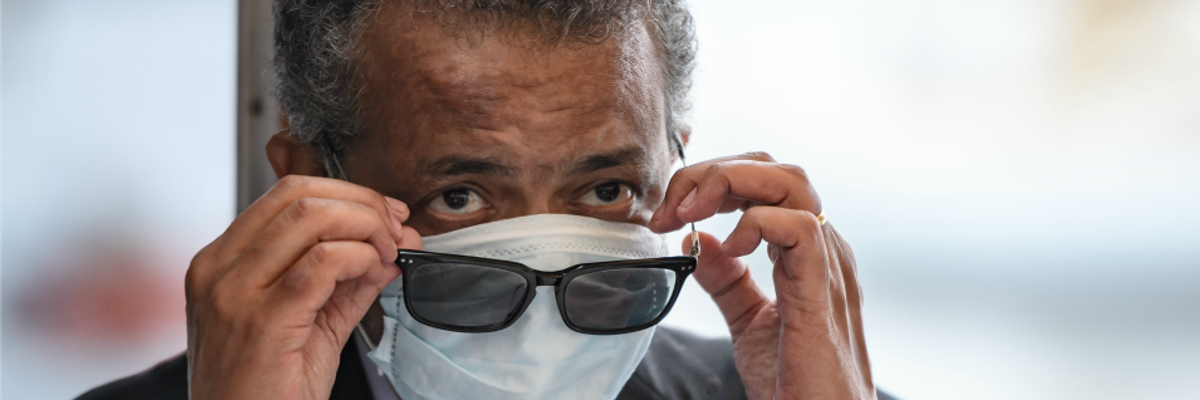
World Health Organization Director-General Dr. Tedros Adhanom Ghebreyesus wears a mask after leaving a ceremony of the restarting of Geneva's landmark fountain, "Jet d'Eau," on June 11, 2020. (Photo: Fabrice Coffrini/AFP via Getty Images)
The head of the World Health Organization warned on Monday that the coronavirus pandemic which has killed hundreds of thousands of people and devastated the world's economy is far from over--just a day before the six-month mark of when China first alerted the United Nations agency about a cluster of pneumonia cases with an unknown cause.
"The hard reality is: this is not even close to being over. Although many countries have made some progress, globally the pandemic is actually speeding up."
--Dr. Tedros Adhanom Ghebreyesus, WHO
"The six-month anniversary of the outbreak coincides with reaching 10 million cases and 500,000 deaths," WHO Director-General Dr. Tedros Adhanom Ghebreyesus said during a press briefing. "Six months ago, none of us could have imagined how our world--and our lives--would be thrown into turmoil by this new virus."
After detailing the WHO's efforts since December 2019 to help contain the virus, identify effective treatments, and develop a vaccine, Tedros explained that "some countries are now experiencing a resurgence of cases as they start to re-open their economies and societies."
"Most people remain susceptible. The virus still has a lot of room to move," the WHO chief continued. "We all want this to be over. We all want to get on with our lives. But the hard reality is: this is not even close to being over. Although many countries have made some progress, globally the pandemic is actually speeding up."
"This is a time for renewing our commitment to empowering communities, suppressing transmission, saving lives, accelerating research, and political and moral leadership," he added, summarizing top priorities for governments amid global efforts to develop a vaccine. "But it's also a time for all countries to renew their commitment to universal health coverage as the cornerstone of social and economic development--and to building the safer, fairer, greener, more inclusive world we all want."
Mike Ryan, head of the WHO's emergencies program, said during the briefing that while there has been progress on finding a vaccine to prevent infection, those efforts aren't guaranteed to succeed, Reuters reported. Ryan urged countries to continue testing, isolating people with confirmed cases, and tracking their contacts. He specifically recognized the "comprehensive, sustained strategy" of Germany, Japan, and South Korea to combat the pandemic.
There were about 10.2 million confirmed Covid-19 cases and over 502,900 deaths globally as of Monday afternoon, according to Johns Hopkins University's tracker. The United States leads the world at over 2.56 million infections and nearly 126,000 deaths--with Brazil as a distant second. The administrations of both U.S. President Donald Trump and Brazilian President Jair Bolsonaro have faced international criticism for how they have handled the public health crisis.
As Common Dreams reported Sunday, U.S. House Speaker Nancy Pelosi (D-Calif.) told CNN that a national mandate requiring everyone to wear a mask in public is "definitely long overdue." Pelosi, with a mask around her neck, specifically called on Trump to "be an example to the country, and wear the mask."
Pelosi suggested that the nation's Centers for Disease Control and Prevention only recommends that everyone cover their face in public rather than requiring it because the agency did not want to "offend the president." Both Trump and Vice President Mike Pence, who chairs the White House Coronavirus Task Force, have repeatedly attended public events without wearing masks throughout the pandemic.
Asked during a Sunday appearance on CBS News why Trump won't ask everyone to wear masks, Pence said that "we believe people should wear masks wherever... social distancing is not possible, wherever it's indicated by either state or local authorities. And, you know, the president has worn a mask. I wore a mask on several occasions this week."
On Friday, former Vice President Joe Biden--who is expected to face off against Trump as the Democratic Party's presidential nominee in November--said while wearing a mask during a television interview with a CNN affiliate in Pittsburgh that if elected, "I would do everything possible to make it required that people had to wear masks in public."
Dr. Anthony Fauci, director of the National Institute of Allergy and Infectious Diseases, said at the Sacramento Press Club last Wednesday that "everybody should wear a mask when out public." Fauci, a member of the White House Coronavirus Task Force, added: "It should not be a political issue... It is purely a public health issue."
That same day, University of Washington's Institute for Health Metrics and Evaluation (IHME) projected that nearly 180,000 people in the United States could die because of Covid-19 by October 1--but that figure could drop to about 146,000 if at least 95% of people wore masks in public. As IHME director Dr. Christopher Murray put it: "People need to know that wearing masks can reduce transmission of the virus by as much as 50%, and those who refuse are putting their lives, their families, their friends, and their communities at risk."
Dear Common Dreams reader, It’s been nearly 30 years since I co-founded Common Dreams with my late wife, Lina Newhouser. We had the radical notion that journalism should serve the public good, not corporate profits. It was clear to us from the outset what it would take to build such a project. No paid advertisements. No corporate sponsors. No millionaire publisher telling us what to think or do. Many people said we wouldn't last a year, but we proved those doubters wrong. Together with a tremendous team of journalists and dedicated staff, we built an independent media outlet free from the constraints of profits and corporate control. Our mission has always been simple: To inform. To inspire. To ignite change for the common good. Building Common Dreams was not easy. Our survival was never guaranteed. When you take on the most powerful forces—Wall Street greed, fossil fuel industry destruction, Big Tech lobbyists, and uber-rich oligarchs who have spent billions upon billions rigging the economy and democracy in their favor—the only bulwark you have is supporters who believe in your work. But here’s the urgent message from me today. It's never been this bad out there. And it's never been this hard to keep us going. At the very moment Common Dreams is most needed, the threats we face are intensifying. We need your support now more than ever. We don't accept corporate advertising and never will. We don't have a paywall because we don't think people should be blocked from critical news based on their ability to pay. Everything we do is funded by the donations of readers like you. When everyone does the little they can afford, we are strong. But if that support retreats or dries up, so do we. Will you donate now to make sure Common Dreams not only survives but thrives? —Craig Brown, Co-founder |
The head of the World Health Organization warned on Monday that the coronavirus pandemic which has killed hundreds of thousands of people and devastated the world's economy is far from over--just a day before the six-month mark of when China first alerted the United Nations agency about a cluster of pneumonia cases with an unknown cause.
"The hard reality is: this is not even close to being over. Although many countries have made some progress, globally the pandemic is actually speeding up."
--Dr. Tedros Adhanom Ghebreyesus, WHO
"The six-month anniversary of the outbreak coincides with reaching 10 million cases and 500,000 deaths," WHO Director-General Dr. Tedros Adhanom Ghebreyesus said during a press briefing. "Six months ago, none of us could have imagined how our world--and our lives--would be thrown into turmoil by this new virus."
After detailing the WHO's efforts since December 2019 to help contain the virus, identify effective treatments, and develop a vaccine, Tedros explained that "some countries are now experiencing a resurgence of cases as they start to re-open their economies and societies."
"Most people remain susceptible. The virus still has a lot of room to move," the WHO chief continued. "We all want this to be over. We all want to get on with our lives. But the hard reality is: this is not even close to being over. Although many countries have made some progress, globally the pandemic is actually speeding up."
"This is a time for renewing our commitment to empowering communities, suppressing transmission, saving lives, accelerating research, and political and moral leadership," he added, summarizing top priorities for governments amid global efforts to develop a vaccine. "But it's also a time for all countries to renew their commitment to universal health coverage as the cornerstone of social and economic development--and to building the safer, fairer, greener, more inclusive world we all want."
Mike Ryan, head of the WHO's emergencies program, said during the briefing that while there has been progress on finding a vaccine to prevent infection, those efforts aren't guaranteed to succeed, Reuters reported. Ryan urged countries to continue testing, isolating people with confirmed cases, and tracking their contacts. He specifically recognized the "comprehensive, sustained strategy" of Germany, Japan, and South Korea to combat the pandemic.
There were about 10.2 million confirmed Covid-19 cases and over 502,900 deaths globally as of Monday afternoon, according to Johns Hopkins University's tracker. The United States leads the world at over 2.56 million infections and nearly 126,000 deaths--with Brazil as a distant second. The administrations of both U.S. President Donald Trump and Brazilian President Jair Bolsonaro have faced international criticism for how they have handled the public health crisis.
As Common Dreams reported Sunday, U.S. House Speaker Nancy Pelosi (D-Calif.) told CNN that a national mandate requiring everyone to wear a mask in public is "definitely long overdue." Pelosi, with a mask around her neck, specifically called on Trump to "be an example to the country, and wear the mask."
Pelosi suggested that the nation's Centers for Disease Control and Prevention only recommends that everyone cover their face in public rather than requiring it because the agency did not want to "offend the president." Both Trump and Vice President Mike Pence, who chairs the White House Coronavirus Task Force, have repeatedly attended public events without wearing masks throughout the pandemic.
Asked during a Sunday appearance on CBS News why Trump won't ask everyone to wear masks, Pence said that "we believe people should wear masks wherever... social distancing is not possible, wherever it's indicated by either state or local authorities. And, you know, the president has worn a mask. I wore a mask on several occasions this week."
On Friday, former Vice President Joe Biden--who is expected to face off against Trump as the Democratic Party's presidential nominee in November--said while wearing a mask during a television interview with a CNN affiliate in Pittsburgh that if elected, "I would do everything possible to make it required that people had to wear masks in public."
Dr. Anthony Fauci, director of the National Institute of Allergy and Infectious Diseases, said at the Sacramento Press Club last Wednesday that "everybody should wear a mask when out public." Fauci, a member of the White House Coronavirus Task Force, added: "It should not be a political issue... It is purely a public health issue."
That same day, University of Washington's Institute for Health Metrics and Evaluation (IHME) projected that nearly 180,000 people in the United States could die because of Covid-19 by October 1--but that figure could drop to about 146,000 if at least 95% of people wore masks in public. As IHME director Dr. Christopher Murray put it: "People need to know that wearing masks can reduce transmission of the virus by as much as 50%, and those who refuse are putting their lives, their families, their friends, and their communities at risk."
The head of the World Health Organization warned on Monday that the coronavirus pandemic which has killed hundreds of thousands of people and devastated the world's economy is far from over--just a day before the six-month mark of when China first alerted the United Nations agency about a cluster of pneumonia cases with an unknown cause.
"The hard reality is: this is not even close to being over. Although many countries have made some progress, globally the pandemic is actually speeding up."
--Dr. Tedros Adhanom Ghebreyesus, WHO
"The six-month anniversary of the outbreak coincides with reaching 10 million cases and 500,000 deaths," WHO Director-General Dr. Tedros Adhanom Ghebreyesus said during a press briefing. "Six months ago, none of us could have imagined how our world--and our lives--would be thrown into turmoil by this new virus."
After detailing the WHO's efforts since December 2019 to help contain the virus, identify effective treatments, and develop a vaccine, Tedros explained that "some countries are now experiencing a resurgence of cases as they start to re-open their economies and societies."
"Most people remain susceptible. The virus still has a lot of room to move," the WHO chief continued. "We all want this to be over. We all want to get on with our lives. But the hard reality is: this is not even close to being over. Although many countries have made some progress, globally the pandemic is actually speeding up."
"This is a time for renewing our commitment to empowering communities, suppressing transmission, saving lives, accelerating research, and political and moral leadership," he added, summarizing top priorities for governments amid global efforts to develop a vaccine. "But it's also a time for all countries to renew their commitment to universal health coverage as the cornerstone of social and economic development--and to building the safer, fairer, greener, more inclusive world we all want."
Mike Ryan, head of the WHO's emergencies program, said during the briefing that while there has been progress on finding a vaccine to prevent infection, those efforts aren't guaranteed to succeed, Reuters reported. Ryan urged countries to continue testing, isolating people with confirmed cases, and tracking their contacts. He specifically recognized the "comprehensive, sustained strategy" of Germany, Japan, and South Korea to combat the pandemic.
There were about 10.2 million confirmed Covid-19 cases and over 502,900 deaths globally as of Monday afternoon, according to Johns Hopkins University's tracker. The United States leads the world at over 2.56 million infections and nearly 126,000 deaths--with Brazil as a distant second. The administrations of both U.S. President Donald Trump and Brazilian President Jair Bolsonaro have faced international criticism for how they have handled the public health crisis.
As Common Dreams reported Sunday, U.S. House Speaker Nancy Pelosi (D-Calif.) told CNN that a national mandate requiring everyone to wear a mask in public is "definitely long overdue." Pelosi, with a mask around her neck, specifically called on Trump to "be an example to the country, and wear the mask."
Pelosi suggested that the nation's Centers for Disease Control and Prevention only recommends that everyone cover their face in public rather than requiring it because the agency did not want to "offend the president." Both Trump and Vice President Mike Pence, who chairs the White House Coronavirus Task Force, have repeatedly attended public events without wearing masks throughout the pandemic.
Asked during a Sunday appearance on CBS News why Trump won't ask everyone to wear masks, Pence said that "we believe people should wear masks wherever... social distancing is not possible, wherever it's indicated by either state or local authorities. And, you know, the president has worn a mask. I wore a mask on several occasions this week."
On Friday, former Vice President Joe Biden--who is expected to face off against Trump as the Democratic Party's presidential nominee in November--said while wearing a mask during a television interview with a CNN affiliate in Pittsburgh that if elected, "I would do everything possible to make it required that people had to wear masks in public."
Dr. Anthony Fauci, director of the National Institute of Allergy and Infectious Diseases, said at the Sacramento Press Club last Wednesday that "everybody should wear a mask when out public." Fauci, a member of the White House Coronavirus Task Force, added: "It should not be a political issue... It is purely a public health issue."
That same day, University of Washington's Institute for Health Metrics and Evaluation (IHME) projected that nearly 180,000 people in the United States could die because of Covid-19 by October 1--but that figure could drop to about 146,000 if at least 95% of people wore masks in public. As IHME director Dr. Christopher Murray put it: "People need to know that wearing masks can reduce transmission of the virus by as much as 50%, and those who refuse are putting their lives, their families, their friends, and their communities at risk."