

SUBSCRIBE TO OUR FREE NEWSLETTER
Daily news & progressive opinion—funded by the people, not the corporations—delivered straight to your inbox.
5
#000000
#FFFFFF
To donate by check, phone, or other method, see our More Ways to Give page.
Daily news & progressive opinion—funded by the people, not the corporations—delivered straight to your inbox.
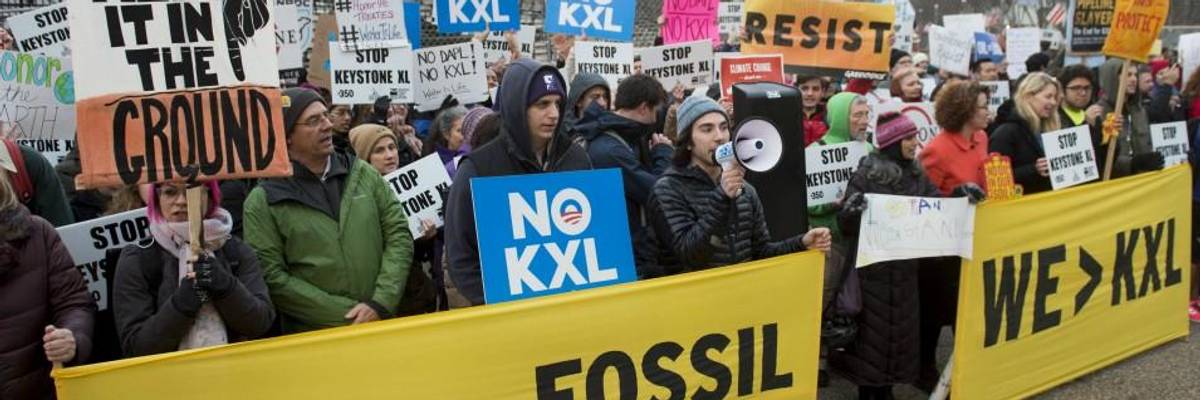
Opponents of the Keystone XL and Dakota Access pipelines protest President Donald Trump's executive orders advancing their construction, at Lafayette Park next to the White House in Washington, D.C, on Jan. 24, 2017. (Photo: Saul Loeb/AFP/Getty Images)
Environmental and indigenous rights activists vowed Friday to continue fighting after Nebraska's supreme court ruled in favor of the state's proposed route for the Keystone XL pipeline.
"From the tar sands region to the Gulf Coast," said the Indigenous Environmental Network in a tweet, "our resistance has shown that we will not give up, we will protect the sacred for the seven generations to come."
"The fight to stop this pipeline is far from over."
--Ken Winston, Nebraska Sierra ClubIn the new ruling, the seven justices shot down landowner, environmental, and native groups' concerns over the 2017 approval for a proposed compromise route from the state's Public Service Commission.
"It's disappointing that the court ignored key concerns about property rights and irreparable damage to natural resources, including threats to the endangered whooping crane, but today's ruling does nothing to change the fact that Keystone XL faces overwhelming public opposition and ongoing legal challenges and simply never will be built," said Ken Winston, attorney for the Nebraska Sierra Club, in a statement. "The fight to stop this pipeline is far from over."
Domina Law Group, which represented the plaintiffs, warned, "If history recalls Nebraska at all, it may remember this as its most regrettable decision."
Jane Kleeb, founder of Bold Nebraska, also expressed disappointment with the ruling. She called on the state legislature to "fix our broken state laws that give too much power to Big Oil."
"Our water is on the line here," said Kleeb, adding, "It's time for our elected officials to now step up and make it clear that pipelines are not in our public interest."
TC Energy, formerly known as TransCanada and the company behind the pipeline project, welcomed the decision. In a statement, its CEO and president Russ Girling called the ruling "another important step as we advance towards building this vital energy infrastructure project."
Yet its future, as Sierra Club's Winston noted, is uncertain. There are ongoing legal battles over the Army Corps of Engineers' approval of the pipeline as well as President Donald Trump's executive memorandum advancing Keystone XL and another pipeline, the Dakota Access.
"Every day without it is a legal victory for tomorrow, for the people and creatures, and for the Earth itself," tweeted Domina Law. "There is no place, and now is not the time for a crude oil pipeline."
With that frame in mind, groups including Bold Nebraska and the Ponca Tribe of Nebraska are calling on the Democratic presidential candidates to sign the "No KXL Pledge."
The document asks the candidates "to take executive action on Day One to stop any construction on the Keystone XL pipeline--no matter what --and revoke the existing presidential permits issued unilaterally by President Trump for the Keystone XL and Dakota Access pipelines, sending both projects back to relevant federal agencies to undergo legitimate environmental review and tribal consultations."
"The President of the United States," write the groups, "should stand with the sovereign rights of tribal nations, the property rights of farmers and ranchers in rural communities opposed to the pipeline, and everyday Americans who care about a livable planet for our grandchildren who have been fighting together to stop KXL for nearly ten years."
Dear Common Dreams reader, It’s been nearly 30 years since I co-founded Common Dreams with my late wife, Lina Newhouser. We had the radical notion that journalism should serve the public good, not corporate profits. It was clear to us from the outset what it would take to build such a project. No paid advertisements. No corporate sponsors. No millionaire publisher telling us what to think or do. Many people said we wouldn't last a year, but we proved those doubters wrong. Together with a tremendous team of journalists and dedicated staff, we built an independent media outlet free from the constraints of profits and corporate control. Our mission has always been simple: To inform. To inspire. To ignite change for the common good. Building Common Dreams was not easy. Our survival was never guaranteed. When you take on the most powerful forces—Wall Street greed, fossil fuel industry destruction, Big Tech lobbyists, and uber-rich oligarchs who have spent billions upon billions rigging the economy and democracy in their favor—the only bulwark you have is supporters who believe in your work. But here’s the urgent message from me today. It's never been this bad out there. And it's never been this hard to keep us going. At the very moment Common Dreams is most needed, the threats we face are intensifying. We need your support now more than ever. We don't accept corporate advertising and never will. We don't have a paywall because we don't think people should be blocked from critical news based on their ability to pay. Everything we do is funded by the donations of readers like you. When everyone does the little they can afford, we are strong. But if that support retreats or dries up, so do we. Will you donate now to make sure Common Dreams not only survives but thrives? —Craig Brown, Co-founder |
Environmental and indigenous rights activists vowed Friday to continue fighting after Nebraska's supreme court ruled in favor of the state's proposed route for the Keystone XL pipeline.
"From the tar sands region to the Gulf Coast," said the Indigenous Environmental Network in a tweet, "our resistance has shown that we will not give up, we will protect the sacred for the seven generations to come."
"The fight to stop this pipeline is far from over."
--Ken Winston, Nebraska Sierra ClubIn the new ruling, the seven justices shot down landowner, environmental, and native groups' concerns over the 2017 approval for a proposed compromise route from the state's Public Service Commission.
"It's disappointing that the court ignored key concerns about property rights and irreparable damage to natural resources, including threats to the endangered whooping crane, but today's ruling does nothing to change the fact that Keystone XL faces overwhelming public opposition and ongoing legal challenges and simply never will be built," said Ken Winston, attorney for the Nebraska Sierra Club, in a statement. "The fight to stop this pipeline is far from over."
Domina Law Group, which represented the plaintiffs, warned, "If history recalls Nebraska at all, it may remember this as its most regrettable decision."
Jane Kleeb, founder of Bold Nebraska, also expressed disappointment with the ruling. She called on the state legislature to "fix our broken state laws that give too much power to Big Oil."
"Our water is on the line here," said Kleeb, adding, "It's time for our elected officials to now step up and make it clear that pipelines are not in our public interest."
TC Energy, formerly known as TransCanada and the company behind the pipeline project, welcomed the decision. In a statement, its CEO and president Russ Girling called the ruling "another important step as we advance towards building this vital energy infrastructure project."
Yet its future, as Sierra Club's Winston noted, is uncertain. There are ongoing legal battles over the Army Corps of Engineers' approval of the pipeline as well as President Donald Trump's executive memorandum advancing Keystone XL and another pipeline, the Dakota Access.
"Every day without it is a legal victory for tomorrow, for the people and creatures, and for the Earth itself," tweeted Domina Law. "There is no place, and now is not the time for a crude oil pipeline."
With that frame in mind, groups including Bold Nebraska and the Ponca Tribe of Nebraska are calling on the Democratic presidential candidates to sign the "No KXL Pledge."
The document asks the candidates "to take executive action on Day One to stop any construction on the Keystone XL pipeline--no matter what --and revoke the existing presidential permits issued unilaterally by President Trump for the Keystone XL and Dakota Access pipelines, sending both projects back to relevant federal agencies to undergo legitimate environmental review and tribal consultations."
"The President of the United States," write the groups, "should stand with the sovereign rights of tribal nations, the property rights of farmers and ranchers in rural communities opposed to the pipeline, and everyday Americans who care about a livable planet for our grandchildren who have been fighting together to stop KXL for nearly ten years."
Environmental and indigenous rights activists vowed Friday to continue fighting after Nebraska's supreme court ruled in favor of the state's proposed route for the Keystone XL pipeline.
"From the tar sands region to the Gulf Coast," said the Indigenous Environmental Network in a tweet, "our resistance has shown that we will not give up, we will protect the sacred for the seven generations to come."
"The fight to stop this pipeline is far from over."
--Ken Winston, Nebraska Sierra ClubIn the new ruling, the seven justices shot down landowner, environmental, and native groups' concerns over the 2017 approval for a proposed compromise route from the state's Public Service Commission.
"It's disappointing that the court ignored key concerns about property rights and irreparable damage to natural resources, including threats to the endangered whooping crane, but today's ruling does nothing to change the fact that Keystone XL faces overwhelming public opposition and ongoing legal challenges and simply never will be built," said Ken Winston, attorney for the Nebraska Sierra Club, in a statement. "The fight to stop this pipeline is far from over."
Domina Law Group, which represented the plaintiffs, warned, "If history recalls Nebraska at all, it may remember this as its most regrettable decision."
Jane Kleeb, founder of Bold Nebraska, also expressed disappointment with the ruling. She called on the state legislature to "fix our broken state laws that give too much power to Big Oil."
"Our water is on the line here," said Kleeb, adding, "It's time for our elected officials to now step up and make it clear that pipelines are not in our public interest."
TC Energy, formerly known as TransCanada and the company behind the pipeline project, welcomed the decision. In a statement, its CEO and president Russ Girling called the ruling "another important step as we advance towards building this vital energy infrastructure project."
Yet its future, as Sierra Club's Winston noted, is uncertain. There are ongoing legal battles over the Army Corps of Engineers' approval of the pipeline as well as President Donald Trump's executive memorandum advancing Keystone XL and another pipeline, the Dakota Access.
"Every day without it is a legal victory for tomorrow, for the people and creatures, and for the Earth itself," tweeted Domina Law. "There is no place, and now is not the time for a crude oil pipeline."
With that frame in mind, groups including Bold Nebraska and the Ponca Tribe of Nebraska are calling on the Democratic presidential candidates to sign the "No KXL Pledge."
The document asks the candidates "to take executive action on Day One to stop any construction on the Keystone XL pipeline--no matter what --and revoke the existing presidential permits issued unilaterally by President Trump for the Keystone XL and Dakota Access pipelines, sending both projects back to relevant federal agencies to undergo legitimate environmental review and tribal consultations."
"The President of the United States," write the groups, "should stand with the sovereign rights of tribal nations, the property rights of farmers and ranchers in rural communities opposed to the pipeline, and everyday Americans who care about a livable planet for our grandchildren who have been fighting together to stop KXL for nearly ten years."

