SUBSCRIBE TO OUR FREE NEWSLETTER
Daily news & progressive opinion—funded by the people, not the corporations—delivered straight to your inbox.
5
#000000
#FFFFFF
To donate by check, phone, or other method, see our More Ways to Give page.
Daily news & progressive opinion—funded by the people, not the corporations—delivered straight to your inbox.
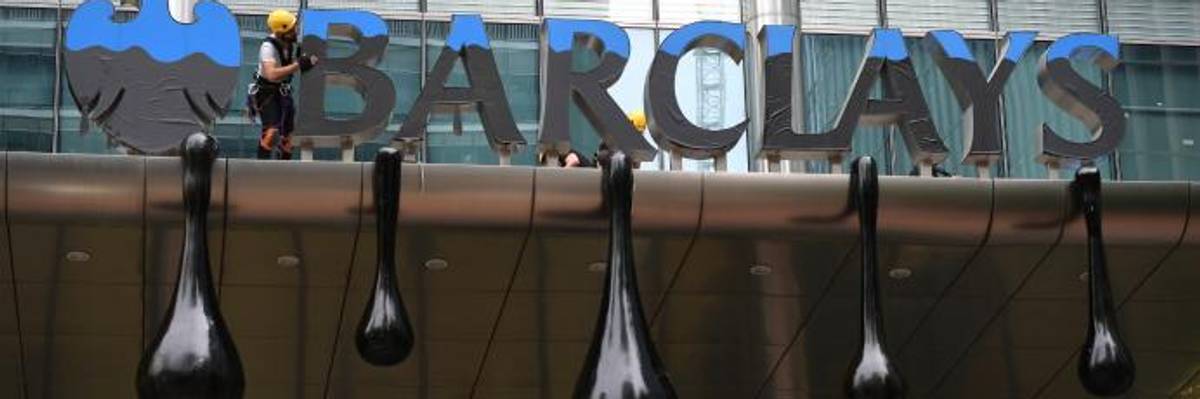
Forty Greenpeace U.K. activists took over the main entrance to Barclays' corporate headquarters in London on Thursday. (Photo: Chris J. Ratcliffe/Greenpeace)
Greenpeace U.K. activists staged a protest at Barclays' Canary Wharf headquarters in London on Thursday to denounce the multinational bank's investments in Canadian tar sands pipelines--hanging massive mock-oil droplets from the logo on the building's awning, blaring recorded messages through a loudspeaker in the lobby, and passing out flyers to customers, urging them to rethink where they put their money.
"Barclays have been ignoring the damage their dirty funding decisions are doing to the world, and to Indigenous communities in North America, so we've brought a little taste of what they're trying to ignore right to their doorstep."
--Hannah Martin, Greenpeace U.K."Tar sands are a climate disaster," explained Greenpeace U.K. oil campaigner Hannah Martin. They "produce more than twice the carbon of an average barrel of oil, and a tar sands oil spill is even worse than a normal crude oil spill--the oil sinks in water, making it almost impossible to clean up."
"Barclays have been ignoring the damage their dirty funding decisions are doing to the world, and to Indigenous communities in North America, so we've brought a little taste of what they're trying to ignore right to their doorstep," declared Martin. "We need to hold them to account for the damage they're causing."
Greenpeace U.K. live-streamed the protest on Facebook:
Ocean Hyland, from the Tsleil-Waututh Nation in Canada's British Columbia province, traveled to London to join the action and highlight the threat that oil pipelines pose to communities like hers.
Indigenous people have been key opponents of the Trans Mountain pipeline expansion project that Canadian Prime Minister Justin Trudeau recently decided to take over from Kinder Morgan after the Houston-based firm halted construction due to protests. Activists and scientists have warned that the project threatens marine life in the area, including the inlet from which Hyland's people took their name and continue to acquire much of their food.
"Industrialization poisoned our home, and we spent 40 years repairing that damage, until finally, two years ago, we were able to safely eat clams harvested from the inlet again," Hyland said. "A tar sands pipeline will increase oil tanker traffic in the inlet seven-fold, and put our inlet and all of our work at risk. I urge Barclays to reconsider its involvement in this project, and avoid funding the further destruction of my people and the planet."
Greenpeace U.K. is also circulating a petition to urge Barclays to withdraw their financial support of tar sands projects.
While customers turned to Twitter on Thursday to pressure Barclays to stop investing in dirty energy--threatening to cut their credit cards and take their business elsewhere unless the bank changes course--the company's response to the protest suggested that the mounting public outrage could be having an impact.
A Barclays spokesperson said: "We take seriously our societal and environmental obligations and are in dialogue with Greenpeace on this issue. We will continue to carefully consider our approach, taking into consideration the views of all relevant stakeholders, as well as the world's energy needs."
Dear Common Dreams reader, It’s been nearly 30 years since I co-founded Common Dreams with my late wife, Lina Newhouser. We had the radical notion that journalism should serve the public good, not corporate profits. It was clear to us from the outset what it would take to build such a project. No paid advertisements. No corporate sponsors. No millionaire publisher telling us what to think or do. Many people said we wouldn't last a year, but we proved those doubters wrong. Together with a tremendous team of journalists and dedicated staff, we built an independent media outlet free from the constraints of profits and corporate control. Our mission has always been simple: To inform. To inspire. To ignite change for the common good. Building Common Dreams was not easy. Our survival was never guaranteed. When you take on the most powerful forces—Wall Street greed, fossil fuel industry destruction, Big Tech lobbyists, and uber-rich oligarchs who have spent billions upon billions rigging the economy and democracy in their favor—the only bulwark you have is supporters who believe in your work. But here’s the urgent message from me today. It's never been this bad out there. And it's never been this hard to keep us going. At the very moment Common Dreams is most needed, the threats we face are intensifying. We need your support now more than ever. We don't accept corporate advertising and never will. We don't have a paywall because we don't think people should be blocked from critical news based on their ability to pay. Everything we do is funded by the donations of readers like you. When everyone does the little they can afford, we are strong. But if that support retreats or dries up, so do we. Will you donate now to make sure Common Dreams not only survives but thrives? —Craig Brown, Co-founder |
Greenpeace U.K. activists staged a protest at Barclays' Canary Wharf headquarters in London on Thursday to denounce the multinational bank's investments in Canadian tar sands pipelines--hanging massive mock-oil droplets from the logo on the building's awning, blaring recorded messages through a loudspeaker in the lobby, and passing out flyers to customers, urging them to rethink where they put their money.
"Barclays have been ignoring the damage their dirty funding decisions are doing to the world, and to Indigenous communities in North America, so we've brought a little taste of what they're trying to ignore right to their doorstep."
--Hannah Martin, Greenpeace U.K."Tar sands are a climate disaster," explained Greenpeace U.K. oil campaigner Hannah Martin. They "produce more than twice the carbon of an average barrel of oil, and a tar sands oil spill is even worse than a normal crude oil spill--the oil sinks in water, making it almost impossible to clean up."
"Barclays have been ignoring the damage their dirty funding decisions are doing to the world, and to Indigenous communities in North America, so we've brought a little taste of what they're trying to ignore right to their doorstep," declared Martin. "We need to hold them to account for the damage they're causing."
Greenpeace U.K. live-streamed the protest on Facebook:
Ocean Hyland, from the Tsleil-Waututh Nation in Canada's British Columbia province, traveled to London to join the action and highlight the threat that oil pipelines pose to communities like hers.
Indigenous people have been key opponents of the Trans Mountain pipeline expansion project that Canadian Prime Minister Justin Trudeau recently decided to take over from Kinder Morgan after the Houston-based firm halted construction due to protests. Activists and scientists have warned that the project threatens marine life in the area, including the inlet from which Hyland's people took their name and continue to acquire much of their food.
"Industrialization poisoned our home, and we spent 40 years repairing that damage, until finally, two years ago, we were able to safely eat clams harvested from the inlet again," Hyland said. "A tar sands pipeline will increase oil tanker traffic in the inlet seven-fold, and put our inlet and all of our work at risk. I urge Barclays to reconsider its involvement in this project, and avoid funding the further destruction of my people and the planet."
Greenpeace U.K. is also circulating a petition to urge Barclays to withdraw their financial support of tar sands projects.
While customers turned to Twitter on Thursday to pressure Barclays to stop investing in dirty energy--threatening to cut their credit cards and take their business elsewhere unless the bank changes course--the company's response to the protest suggested that the mounting public outrage could be having an impact.
A Barclays spokesperson said: "We take seriously our societal and environmental obligations and are in dialogue with Greenpeace on this issue. We will continue to carefully consider our approach, taking into consideration the views of all relevant stakeholders, as well as the world's energy needs."
Greenpeace U.K. activists staged a protest at Barclays' Canary Wharf headquarters in London on Thursday to denounce the multinational bank's investments in Canadian tar sands pipelines--hanging massive mock-oil droplets from the logo on the building's awning, blaring recorded messages through a loudspeaker in the lobby, and passing out flyers to customers, urging them to rethink where they put their money.
"Barclays have been ignoring the damage their dirty funding decisions are doing to the world, and to Indigenous communities in North America, so we've brought a little taste of what they're trying to ignore right to their doorstep."
--Hannah Martin, Greenpeace U.K."Tar sands are a climate disaster," explained Greenpeace U.K. oil campaigner Hannah Martin. They "produce more than twice the carbon of an average barrel of oil, and a tar sands oil spill is even worse than a normal crude oil spill--the oil sinks in water, making it almost impossible to clean up."
"Barclays have been ignoring the damage their dirty funding decisions are doing to the world, and to Indigenous communities in North America, so we've brought a little taste of what they're trying to ignore right to their doorstep," declared Martin. "We need to hold them to account for the damage they're causing."
Greenpeace U.K. live-streamed the protest on Facebook:
Ocean Hyland, from the Tsleil-Waututh Nation in Canada's British Columbia province, traveled to London to join the action and highlight the threat that oil pipelines pose to communities like hers.
Indigenous people have been key opponents of the Trans Mountain pipeline expansion project that Canadian Prime Minister Justin Trudeau recently decided to take over from Kinder Morgan after the Houston-based firm halted construction due to protests. Activists and scientists have warned that the project threatens marine life in the area, including the inlet from which Hyland's people took their name and continue to acquire much of their food.
"Industrialization poisoned our home, and we spent 40 years repairing that damage, until finally, two years ago, we were able to safely eat clams harvested from the inlet again," Hyland said. "A tar sands pipeline will increase oil tanker traffic in the inlet seven-fold, and put our inlet and all of our work at risk. I urge Barclays to reconsider its involvement in this project, and avoid funding the further destruction of my people and the planet."
Greenpeace U.K. is also circulating a petition to urge Barclays to withdraw their financial support of tar sands projects.
While customers turned to Twitter on Thursday to pressure Barclays to stop investing in dirty energy--threatening to cut their credit cards and take their business elsewhere unless the bank changes course--the company's response to the protest suggested that the mounting public outrage could be having an impact.
A Barclays spokesperson said: "We take seriously our societal and environmental obligations and are in dialogue with Greenpeace on this issue. We will continue to carefully consider our approach, taking into consideration the views of all relevant stakeholders, as well as the world's energy needs."