

SUBSCRIBE TO OUR FREE NEWSLETTER
Daily news & progressive opinion—funded by the people, not the corporations—delivered straight to your inbox.
5
#000000
#FFFFFF
To donate by check, phone, or other method, see our More Ways to Give page.
Daily news & progressive opinion—funded by the people, not the corporations—delivered straight to your inbox.
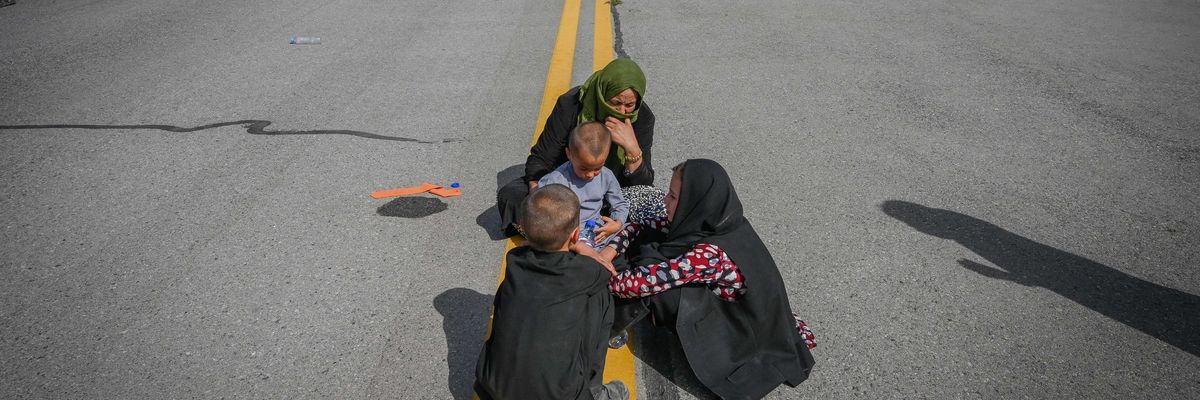
An Afghan family sits on the tarmac as they wait to leave the Kabul airport after a stunningly swift end to Afghanistan's 20-year war. They were among thousands of people who mobbed the city's airport trying to flee the Taliban. Photo by WAKIL KOHSAR/AFP via Getty Images
Kabul, it's been noted, was not lost yesterday. It was the final fall of a calamitous, arrogant, 20-year, trillion-dollar, too-many-deaths imperial misadventure doomed to failure from its inept start. In the end, we didn't help the stricken people we said we'd help, and it was always "Team Taliban or Team Stay Forever," period. "It's awful, it's bad," says a bitter veteran who feels just "grim relief" on leaving a "dusty beige nightmare of a place full of proud, brave people who did not fucking want us there...No more pretending it meant anything. It didn't. It didn't mean a fucking thing."
Kabul, it's been noted, was not lost yesterday. It was the inevitable final fall of a calamitous, arrogant, 20-year, trillion-dollar, too-many-deaths imperial misadventure doomed, like too many before it, to failure from its inept start. In Biden's speech, generally deemed resolute but callous about the mayhem unfolding, he asked a tough, good question - "How many more generations of America's daughters and sons would you have me send to fight Afghanistan's civil war?" - but framed it in a cynical, disingenuous way by adding, "when Afghan troops will not?" The fourth president to oversee yet another senseless war in "the graveyard of empires," he thus found an easy target for what is the "breathtaking failure" of longtime U.S. foreign policy while blithely ignoring the blood-soaked, hubris-laden history behind it - a "post-imperial Western fantasy" of disastrous military or CIA interventions through Africa, Latin America, Southeast Asia and then Iran, Syria, Libya, Iraq, Afghanistan, which was never at war with the U.S. and where Donald Rumsfeld, may he have no rest, demanded Bush "punish and get out." Bush and his imperious ilk spoke of nation-building, "as if nations were made of Legos." Instead, we got our forever war, where rather than offer schools, clinics, water, job training to a beleaguered population, the U.S. blew up whatever infrastructure they had and spent 86% of a staggering trillion dollars - though some say it's closer to 2 trillion - on often hapless military initiatives that, thanks to "a complex ecosystem of defense contractors, Washington banditry" and corruption, largely returned to the U.S. economy. Add in corruption by Afghan elites, and ultimately less than 2% of U.S. money actually went to the people who needed it. A final irony: Even as the West frantically fought to stop it, soaring Afghan poppy production fueled the insurgency, spreading from six to 28 provinces: "Opium floated the Taliban back to power." All topped by a rushed, artless, possibly balance-tipping "deal" giving too much to the Taliban by the idiot Former Guy.
In the end, of course, the cost was human. Over 170,000 Afghans were killed. According to Brown's Cost of War Project, they are among over 800,000 people who have died from our imperial wars since 9/11; several times as many have died "due to the reverberating effects of war," about 37 million have been displaced, and the U.S. still conducts "counter-terror activities" in 85 countries. In Kabul, meanwhile, there are already images and stories of the humanitarian crisis to come: Fleeing crowds at the airport, a jammed cargo plane of refugees, Taliban fighters painting over billboards of modern Afghan women, who now stand to lose their rights and maybe their lives for, say, baring their heads or shopping without a male relative. One story about the swift takeover includes a photo of Zarifa Ghafari, one of the country's first female mayors; she could not escape, it notes, "and she is waiting for the rebels to kill her." The carnage got to veteran and journalist Laura Jedeed, who deployed there twice and started remembering things: "Going through the phones of the people we detained and finding clip after clip of Bollywood musicals," whose owners are getting shipped "god knows where"; U.S. forces trying to decide every year what to do with the opium fields - let them alone (the Taliban shake down the farmers and use the money for weapons), carpet bomb the fields (the farmers join the Taliban), give the farmers fertilizer to grow wheat (they sell the fertilizer to the Taliban for explosives); orders not to throw away batteries because Afghans on bases would collect them to get enough juice for one IED charge; her roommate's face after she had to cut two soldiers out of a Humvee probably blown-up by fertilizer and detonated by thrown-out batteries; a smiling Afghan kid they called Cowboy who served them food but is likely dead now. If so, "It's our fault for going there in the first place, giving his family the option of trusting us when we are the least trustworthy people on the planet. We use people up and throw them away like it's nothing." There was only "Team Taliban or Team Stay Forever," but she was "Team Get The Fuck Out Of Afghanistan." "I know how bad the Taliban is. It's awful," she says, but "all I feel is grim relief...Finally, you have to see it too. No more pretending it meant anything. It didn't. It didn't mean a fucking thing."
Dear Common Dreams reader, It’s been nearly 30 years since I co-founded Common Dreams with my late wife, Lina Newhouser. We had the radical notion that journalism should serve the public good, not corporate profits. It was clear to us from the outset what it would take to build such a project. No paid advertisements. No corporate sponsors. No millionaire publisher telling us what to think or do. Many people said we wouldn't last a year, but we proved those doubters wrong. Together with a tremendous team of journalists and dedicated staff, we built an independent media outlet free from the constraints of profits and corporate control. Our mission has always been simple: To inform. To inspire. To ignite change for the common good. Building Common Dreams was not easy. Our survival was never guaranteed. When you take on the most powerful forces—Wall Street greed, fossil fuel industry destruction, Big Tech lobbyists, and uber-rich oligarchs who have spent billions upon billions rigging the economy and democracy in their favor—the only bulwark you have is supporters who believe in your work. But here’s the urgent message from me today. It's never been this bad out there. And it's never been this hard to keep us going. At the very moment Common Dreams is most needed, the threats we face are intensifying. We need your support now more than ever. We don't accept corporate advertising and never will. We don't have a paywall because we don't think people should be blocked from critical news based on their ability to pay. Everything we do is funded by the donations of readers like you. When everyone does the little they can afford, we are strong. But if that support retreats or dries up, so do we. Will you donate now to make sure Common Dreams not only survives but thrives? —Craig Brown, Co-founder |
Kabul, it's been noted, was not lost yesterday. It was the inevitable final fall of a calamitous, arrogant, 20-year, trillion-dollar, too-many-deaths imperial misadventure doomed, like too many before it, to failure from its inept start. In Biden's speech, generally deemed resolute but callous about the mayhem unfolding, he asked a tough, good question - "How many more generations of America's daughters and sons would you have me send to fight Afghanistan's civil war?" - but framed it in a cynical, disingenuous way by adding, "when Afghan troops will not?" The fourth president to oversee yet another senseless war in "the graveyard of empires," he thus found an easy target for what is the "breathtaking failure" of longtime U.S. foreign policy while blithely ignoring the blood-soaked, hubris-laden history behind it - a "post-imperial Western fantasy" of disastrous military or CIA interventions through Africa, Latin America, Southeast Asia and then Iran, Syria, Libya, Iraq, Afghanistan, which was never at war with the U.S. and where Donald Rumsfeld, may he have no rest, demanded Bush "punish and get out." Bush and his imperious ilk spoke of nation-building, "as if nations were made of Legos." Instead, we got our forever war, where rather than offer schools, clinics, water, job training to a beleaguered population, the U.S. blew up whatever infrastructure they had and spent 86% of a staggering trillion dollars - though some say it's closer to 2 trillion - on often hapless military initiatives that, thanks to "a complex ecosystem of defense contractors, Washington banditry" and corruption, largely returned to the U.S. economy. Add in corruption by Afghan elites, and ultimately less than 2% of U.S. money actually went to the people who needed it. A final irony: Even as the West frantically fought to stop it, soaring Afghan poppy production fueled the insurgency, spreading from six to 28 provinces: "Opium floated the Taliban back to power." All topped by a rushed, artless, possibly balance-tipping "deal" giving too much to the Taliban by the idiot Former Guy.
In the end, of course, the cost was human. Over 170,000 Afghans were killed. According to Brown's Cost of War Project, they are among over 800,000 people who have died from our imperial wars since 9/11; several times as many have died "due to the reverberating effects of war," about 37 million have been displaced, and the U.S. still conducts "counter-terror activities" in 85 countries. In Kabul, meanwhile, there are already images and stories of the humanitarian crisis to come: Fleeing crowds at the airport, a jammed cargo plane of refugees, Taliban fighters painting over billboards of modern Afghan women, who now stand to lose their rights and maybe their lives for, say, baring their heads or shopping without a male relative. One story about the swift takeover includes a photo of Zarifa Ghafari, one of the country's first female mayors; she could not escape, it notes, "and she is waiting for the rebels to kill her." The carnage got to veteran and journalist Laura Jedeed, who deployed there twice and started remembering things: "Going through the phones of the people we detained and finding clip after clip of Bollywood musicals," whose owners are getting shipped "god knows where"; U.S. forces trying to decide every year what to do with the opium fields - let them alone (the Taliban shake down the farmers and use the money for weapons), carpet bomb the fields (the farmers join the Taliban), give the farmers fertilizer to grow wheat (they sell the fertilizer to the Taliban for explosives); orders not to throw away batteries because Afghans on bases would collect them to get enough juice for one IED charge; her roommate's face after she had to cut two soldiers out of a Humvee probably blown-up by fertilizer and detonated by thrown-out batteries; a smiling Afghan kid they called Cowboy who served them food but is likely dead now. If so, "It's our fault for going there in the first place, giving his family the option of trusting us when we are the least trustworthy people on the planet. We use people up and throw them away like it's nothing." There was only "Team Taliban or Team Stay Forever," but she was "Team Get The Fuck Out Of Afghanistan." "I know how bad the Taliban is. It's awful," she says, but "all I feel is grim relief...Finally, you have to see it too. No more pretending it meant anything. It didn't. It didn't mean a fucking thing."
Kabul, it's been noted, was not lost yesterday. It was the inevitable final fall of a calamitous, arrogant, 20-year, trillion-dollar, too-many-deaths imperial misadventure doomed, like too many before it, to failure from its inept start. In Biden's speech, generally deemed resolute but callous about the mayhem unfolding, he asked a tough, good question - "How many more generations of America's daughters and sons would you have me send to fight Afghanistan's civil war?" - but framed it in a cynical, disingenuous way by adding, "when Afghan troops will not?" The fourth president to oversee yet another senseless war in "the graveyard of empires," he thus found an easy target for what is the "breathtaking failure" of longtime U.S. foreign policy while blithely ignoring the blood-soaked, hubris-laden history behind it - a "post-imperial Western fantasy" of disastrous military or CIA interventions through Africa, Latin America, Southeast Asia and then Iran, Syria, Libya, Iraq, Afghanistan, which was never at war with the U.S. and where Donald Rumsfeld, may he have no rest, demanded Bush "punish and get out." Bush and his imperious ilk spoke of nation-building, "as if nations were made of Legos." Instead, we got our forever war, where rather than offer schools, clinics, water, job training to a beleaguered population, the U.S. blew up whatever infrastructure they had and spent 86% of a staggering trillion dollars - though some say it's closer to 2 trillion - on often hapless military initiatives that, thanks to "a complex ecosystem of defense contractors, Washington banditry" and corruption, largely returned to the U.S. economy. Add in corruption by Afghan elites, and ultimately less than 2% of U.S. money actually went to the people who needed it. A final irony: Even as the West frantically fought to stop it, soaring Afghan poppy production fueled the insurgency, spreading from six to 28 provinces: "Opium floated the Taliban back to power." All topped by a rushed, artless, possibly balance-tipping "deal" giving too much to the Taliban by the idiot Former Guy.
In the end, of course, the cost was human. Over 170,000 Afghans were killed. According to Brown's Cost of War Project, they are among over 800,000 people who have died from our imperial wars since 9/11; several times as many have died "due to the reverberating effects of war," about 37 million have been displaced, and the U.S. still conducts "counter-terror activities" in 85 countries. In Kabul, meanwhile, there are already images and stories of the humanitarian crisis to come: Fleeing crowds at the airport, a jammed cargo plane of refugees, Taliban fighters painting over billboards of modern Afghan women, who now stand to lose their rights and maybe their lives for, say, baring their heads or shopping without a male relative. One story about the swift takeover includes a photo of Zarifa Ghafari, one of the country's first female mayors; she could not escape, it notes, "and she is waiting for the rebels to kill her." The carnage got to veteran and journalist Laura Jedeed, who deployed there twice and started remembering things: "Going through the phones of the people we detained and finding clip after clip of Bollywood musicals," whose owners are getting shipped "god knows where"; U.S. forces trying to decide every year what to do with the opium fields - let them alone (the Taliban shake down the farmers and use the money for weapons), carpet bomb the fields (the farmers join the Taliban), give the farmers fertilizer to grow wheat (they sell the fertilizer to the Taliban for explosives); orders not to throw away batteries because Afghans on bases would collect them to get enough juice for one IED charge; her roommate's face after she had to cut two soldiers out of a Humvee probably blown-up by fertilizer and detonated by thrown-out batteries; a smiling Afghan kid they called Cowboy who served them food but is likely dead now. If so, "It's our fault for going there in the first place, giving his family the option of trusting us when we are the least trustworthy people on the planet. We use people up and throw them away like it's nothing." There was only "Team Taliban or Team Stay Forever," but she was "Team Get The Fuck Out Of Afghanistan." "I know how bad the Taliban is. It's awful," she says, but "all I feel is grim relief...Finally, you have to see it too. No more pretending it meant anything. It didn't. It didn't mean a fucking thing."
