SUBSCRIBE TO OUR FREE NEWSLETTER
Daily news & progressive opinion—funded by the people, not the corporations—delivered straight to your inbox.
5
#000000
#FFFFFF
To donate by check, phone, or other method, see our More Ways to Give page.
Daily news & progressive opinion—funded by the people, not the corporations—delivered straight to your inbox.
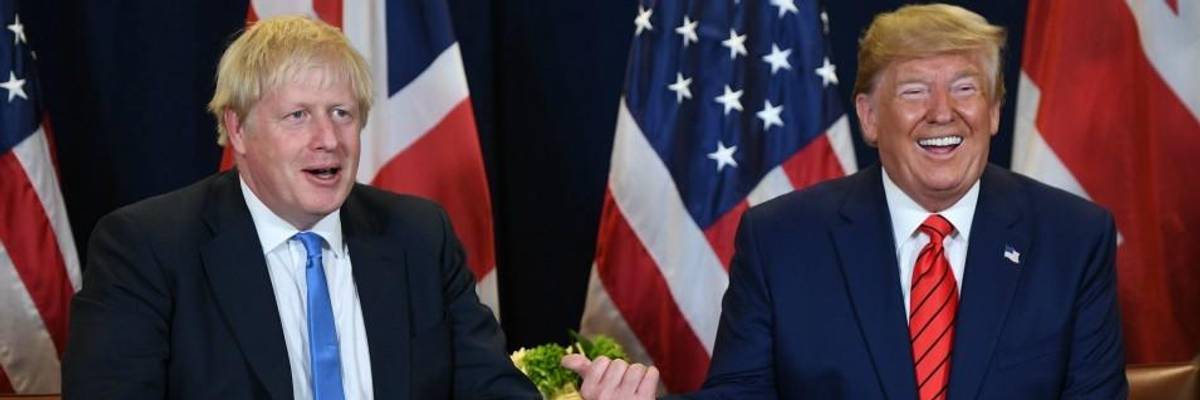
US President Donald Trump and British Prime Minister Boris Johnson at U.N. Headquarters in New York, September 24, 2019, on the sidelines of the United Nations General Assembly. (Photo: Saul Loeb/AFP/Getty Images)
As the U.S. and U.K. push forward with scheduled trade talks set to begin Tuesday a roundtable of advocacy groups on both sides of the Atlantic is calling on the two countries to prioritize working people, the climate, and a just recovery from the coronavirus pandemic affecting both nations.
"Our approach to trade policy needs to be fundamentally overhauled to benefit working families, not just the executives and large shareholders of multinational corporations," Communications Workers of America (CWA) director of government affairs Dan Mauer said in a statement Monday.
CWA is among 69 groups signed on to an open letter (pdf) to the heads of the U.S. and U.K. trade delegations calling for any agreement to be "based upon ambitious environmental and social aims" and lists 12 priorities for leaders to adhere to.
"To ensure that trade talks follow this positive agenda, it is essential that they are carried out transparently with democratic scrutiny, meaning opening texts and draft texts following each negotiating round must be made publicly available and the process includes ongoing opportunities for public consultation, and be subject to democratic consent," the letter declares.
U.S. President Donald Trump and U.K. Prime Minister Boris Johnson have each made a deal a priority for 2020 as Britain works on leaving the European Union. As Common Dreams has reported, the secrecy around the talks has been a constant source of frustration for progressives on both sides of the pond.
In a statement, Friends of the Earth England, Wales, and Northern Ireland campaigner Kierra Box said that the U.K.'s commitment to a more just and green world was belied by dealing with Trump.
"If the UK is to act on the environmental and social crises we face, or lead international climate talks with integrity, we cannot chase a trade deal with a nation that is abandoning climate commitments and defending polluting industries.," said Box, adding that "now is not the time to be putting the standards that protect our health and environment on the line."
Sister Simone Campbell, the executive director of NETWORK Lobby for Catholic Social Justice, said that in the midst of a pandemic Britain's National Health Service must be protected from the inequality and corporate capture endemic to the U.S. system.
"This immoral system is further entrenched by powerful companies that use complicated trade negotiations to lock in current U.S. drug policies and prevent Congress from taking reasonable steps to curb drug price gouging and export our bad policies to our trade partners," said Campbell. "A U.S.-UK deal should leave the National Health Service off the table and exclude terms that would raise drug prices in either country."
Global Justice Now campaign and policy director Jean Blaylock warned that both nations would try to use the Covid-19 outbreak as an excuse to push the deal through with minimal oversight--though the disease has made clear the failings of the current trade paradigm.
"Coronavirus has exposed the flaws in the pro-corporate agenda that this trade deal is intended to entrench--from weakening public services, to bringing the market into health care, driving up medicine prices and lowering safety standards," said Blaylock.
"All this type of deal will do is tie the hands of the government at a time when they need full scope to provide economic stimulus, a green recovery, and to protect jobs," she added.
Dear Common Dreams reader, It’s been nearly 30 years since I co-founded Common Dreams with my late wife, Lina Newhouser. We had the radical notion that journalism should serve the public good, not corporate profits. It was clear to us from the outset what it would take to build such a project. No paid advertisements. No corporate sponsors. No millionaire publisher telling us what to think or do. Many people said we wouldn't last a year, but we proved those doubters wrong. Together with a tremendous team of journalists and dedicated staff, we built an independent media outlet free from the constraints of profits and corporate control. Our mission has always been simple: To inform. To inspire. To ignite change for the common good. Building Common Dreams was not easy. Our survival was never guaranteed. When you take on the most powerful forces—Wall Street greed, fossil fuel industry destruction, Big Tech lobbyists, and uber-rich oligarchs who have spent billions upon billions rigging the economy and democracy in their favor—the only bulwark you have is supporters who believe in your work. But here’s the urgent message from me today. It's never been this bad out there. And it's never been this hard to keep us going. At the very moment Common Dreams is most needed, the threats we face are intensifying. We need your support now more than ever. We don't accept corporate advertising and never will. We don't have a paywall because we don't think people should be blocked from critical news based on their ability to pay. Everything we do is funded by the donations of readers like you. When everyone does the little they can afford, we are strong. But if that support retreats or dries up, so do we. Will you donate now to make sure Common Dreams not only survives but thrives? —Craig Brown, Co-founder |
As the U.S. and U.K. push forward with scheduled trade talks set to begin Tuesday a roundtable of advocacy groups on both sides of the Atlantic is calling on the two countries to prioritize working people, the climate, and a just recovery from the coronavirus pandemic affecting both nations.
"Our approach to trade policy needs to be fundamentally overhauled to benefit working families, not just the executives and large shareholders of multinational corporations," Communications Workers of America (CWA) director of government affairs Dan Mauer said in a statement Monday.
CWA is among 69 groups signed on to an open letter (pdf) to the heads of the U.S. and U.K. trade delegations calling for any agreement to be "based upon ambitious environmental and social aims" and lists 12 priorities for leaders to adhere to.
"To ensure that trade talks follow this positive agenda, it is essential that they are carried out transparently with democratic scrutiny, meaning opening texts and draft texts following each negotiating round must be made publicly available and the process includes ongoing opportunities for public consultation, and be subject to democratic consent," the letter declares.
U.S. President Donald Trump and U.K. Prime Minister Boris Johnson have each made a deal a priority for 2020 as Britain works on leaving the European Union. As Common Dreams has reported, the secrecy around the talks has been a constant source of frustration for progressives on both sides of the pond.
In a statement, Friends of the Earth England, Wales, and Northern Ireland campaigner Kierra Box said that the U.K.'s commitment to a more just and green world was belied by dealing with Trump.
"If the UK is to act on the environmental and social crises we face, or lead international climate talks with integrity, we cannot chase a trade deal with a nation that is abandoning climate commitments and defending polluting industries.," said Box, adding that "now is not the time to be putting the standards that protect our health and environment on the line."
Sister Simone Campbell, the executive director of NETWORK Lobby for Catholic Social Justice, said that in the midst of a pandemic Britain's National Health Service must be protected from the inequality and corporate capture endemic to the U.S. system.
"This immoral system is further entrenched by powerful companies that use complicated trade negotiations to lock in current U.S. drug policies and prevent Congress from taking reasonable steps to curb drug price gouging and export our bad policies to our trade partners," said Campbell. "A U.S.-UK deal should leave the National Health Service off the table and exclude terms that would raise drug prices in either country."
Global Justice Now campaign and policy director Jean Blaylock warned that both nations would try to use the Covid-19 outbreak as an excuse to push the deal through with minimal oversight--though the disease has made clear the failings of the current trade paradigm.
"Coronavirus has exposed the flaws in the pro-corporate agenda that this trade deal is intended to entrench--from weakening public services, to bringing the market into health care, driving up medicine prices and lowering safety standards," said Blaylock.
"All this type of deal will do is tie the hands of the government at a time when they need full scope to provide economic stimulus, a green recovery, and to protect jobs," she added.
As the U.S. and U.K. push forward with scheduled trade talks set to begin Tuesday a roundtable of advocacy groups on both sides of the Atlantic is calling on the two countries to prioritize working people, the climate, and a just recovery from the coronavirus pandemic affecting both nations.
"Our approach to trade policy needs to be fundamentally overhauled to benefit working families, not just the executives and large shareholders of multinational corporations," Communications Workers of America (CWA) director of government affairs Dan Mauer said in a statement Monday.
CWA is among 69 groups signed on to an open letter (pdf) to the heads of the U.S. and U.K. trade delegations calling for any agreement to be "based upon ambitious environmental and social aims" and lists 12 priorities for leaders to adhere to.
"To ensure that trade talks follow this positive agenda, it is essential that they are carried out transparently with democratic scrutiny, meaning opening texts and draft texts following each negotiating round must be made publicly available and the process includes ongoing opportunities for public consultation, and be subject to democratic consent," the letter declares.
U.S. President Donald Trump and U.K. Prime Minister Boris Johnson have each made a deal a priority for 2020 as Britain works on leaving the European Union. As Common Dreams has reported, the secrecy around the talks has been a constant source of frustration for progressives on both sides of the pond.
In a statement, Friends of the Earth England, Wales, and Northern Ireland campaigner Kierra Box said that the U.K.'s commitment to a more just and green world was belied by dealing with Trump.
"If the UK is to act on the environmental and social crises we face, or lead international climate talks with integrity, we cannot chase a trade deal with a nation that is abandoning climate commitments and defending polluting industries.," said Box, adding that "now is not the time to be putting the standards that protect our health and environment on the line."
Sister Simone Campbell, the executive director of NETWORK Lobby for Catholic Social Justice, said that in the midst of a pandemic Britain's National Health Service must be protected from the inequality and corporate capture endemic to the U.S. system.
"This immoral system is further entrenched by powerful companies that use complicated trade negotiations to lock in current U.S. drug policies and prevent Congress from taking reasonable steps to curb drug price gouging and export our bad policies to our trade partners," said Campbell. "A U.S.-UK deal should leave the National Health Service off the table and exclude terms that would raise drug prices in either country."
Global Justice Now campaign and policy director Jean Blaylock warned that both nations would try to use the Covid-19 outbreak as an excuse to push the deal through with minimal oversight--though the disease has made clear the failings of the current trade paradigm.
"Coronavirus has exposed the flaws in the pro-corporate agenda that this trade deal is intended to entrench--from weakening public services, to bringing the market into health care, driving up medicine prices and lowering safety standards," said Blaylock.
"All this type of deal will do is tie the hands of the government at a time when they need full scope to provide economic stimulus, a green recovery, and to protect jobs," she added.