SUBSCRIBE TO OUR FREE NEWSLETTER
Daily news & progressive opinion—funded by the people, not the corporations—delivered straight to your inbox.
5
#000000
#FFFFFF
To donate by check, phone, or other method, see our More Ways to Give page.
Daily news & progressive opinion—funded by the people, not the corporations—delivered straight to your inbox.
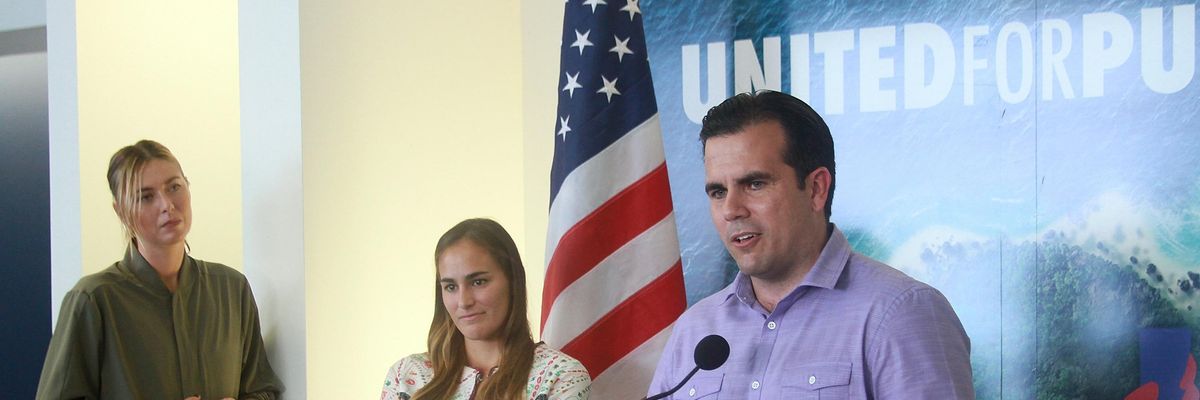
Puerto Rican Governor Ricardo Rossello said Monday that Hurricane Maria-related deaths on the island should be recounted, after multiple reports found that they have been undercounted by nearly 1,000. (Photo: Gladys Vega/Getty Images)
Following numerous reports that Hurricane Maria's death toll in Puerto Rico has been drastically under-counted by more than one thousand casualties, Gov. Ricardo Rossello ordered an official recount of deaths related to the storm.
"This is about more than numbers, these are lives: real people, leaving behind loved ones and families," said Rossello in a statement on Monday. "Every death must have a name and vital information attached to it, as well as an accurate accounting of the facts related to their passing."
Analysis by the New York Times has shown that the hurricane has led to far more casualties than the 64 that have been officially reported. While relatively few deaths may have been directly caused by the storm, the Times found that between Maria's landfall on September 20 and early December, 1,052 more Puerto Ricans had died than had over the same period of time in 2016.
The Center for Investigative Journalism (CPI), based on the island, found an even bigger discrepancy, reporting that 1,065 more people had died in September and October than in the previous year--a rise in mortality that could only be attributed to the storm, said the group. CPI blamed the huge gap in reporting on "the poor methodology being used to analyze and account for cases."
The higher-than-reported death toll is likely related to a lack of clean drinking water for many residents and the power outage that is still affecting nearly a third of the island.
While President Donald Trump insisted in early October that 16 people had died as a result of Hurricane Maria, 556 more deaths than usual had been counted by demographers since the storm. Around the same time, at least one million people were resorting to drinking water from Superfund sites and hospitals were struggling to care for people with diabetes, kidney disease, and other conditions, amid the power outage.
Rossello has previously stood by the official count of 64 deaths. On social media, critics praised his call for a review of the death toll.
Dear Common Dreams reader, It’s been nearly 30 years since I co-founded Common Dreams with my late wife, Lina Newhouser. We had the radical notion that journalism should serve the public good, not corporate profits. It was clear to us from the outset what it would take to build such a project. No paid advertisements. No corporate sponsors. No millionaire publisher telling us what to think or do. Many people said we wouldn't last a year, but we proved those doubters wrong. Together with a tremendous team of journalists and dedicated staff, we built an independent media outlet free from the constraints of profits and corporate control. Our mission has always been simple: To inform. To inspire. To ignite change for the common good. Building Common Dreams was not easy. Our survival was never guaranteed. When you take on the most powerful forces—Wall Street greed, fossil fuel industry destruction, Big Tech lobbyists, and uber-rich oligarchs who have spent billions upon billions rigging the economy and democracy in their favor—the only bulwark you have is supporters who believe in your work. But here’s the urgent message from me today. It's never been this bad out there. And it's never been this hard to keep us going. At the very moment Common Dreams is most needed, the threats we face are intensifying. We need your support now more than ever. We don't accept corporate advertising and never will. We don't have a paywall because we don't think people should be blocked from critical news based on their ability to pay. Everything we do is funded by the donations of readers like you. When everyone does the little they can afford, we are strong. But if that support retreats or dries up, so do we. Will you donate now to make sure Common Dreams not only survives but thrives? —Craig Brown, Co-founder |
Following numerous reports that Hurricane Maria's death toll in Puerto Rico has been drastically under-counted by more than one thousand casualties, Gov. Ricardo Rossello ordered an official recount of deaths related to the storm.
"This is about more than numbers, these are lives: real people, leaving behind loved ones and families," said Rossello in a statement on Monday. "Every death must have a name and vital information attached to it, as well as an accurate accounting of the facts related to their passing."
Analysis by the New York Times has shown that the hurricane has led to far more casualties than the 64 that have been officially reported. While relatively few deaths may have been directly caused by the storm, the Times found that between Maria's landfall on September 20 and early December, 1,052 more Puerto Ricans had died than had over the same period of time in 2016.
The Center for Investigative Journalism (CPI), based on the island, found an even bigger discrepancy, reporting that 1,065 more people had died in September and October than in the previous year--a rise in mortality that could only be attributed to the storm, said the group. CPI blamed the huge gap in reporting on "the poor methodology being used to analyze and account for cases."
The higher-than-reported death toll is likely related to a lack of clean drinking water for many residents and the power outage that is still affecting nearly a third of the island.
While President Donald Trump insisted in early October that 16 people had died as a result of Hurricane Maria, 556 more deaths than usual had been counted by demographers since the storm. Around the same time, at least one million people were resorting to drinking water from Superfund sites and hospitals were struggling to care for people with diabetes, kidney disease, and other conditions, amid the power outage.
Rossello has previously stood by the official count of 64 deaths. On social media, critics praised his call for a review of the death toll.
Following numerous reports that Hurricane Maria's death toll in Puerto Rico has been drastically under-counted by more than one thousand casualties, Gov. Ricardo Rossello ordered an official recount of deaths related to the storm.
"This is about more than numbers, these are lives: real people, leaving behind loved ones and families," said Rossello in a statement on Monday. "Every death must have a name and vital information attached to it, as well as an accurate accounting of the facts related to their passing."
Analysis by the New York Times has shown that the hurricane has led to far more casualties than the 64 that have been officially reported. While relatively few deaths may have been directly caused by the storm, the Times found that between Maria's landfall on September 20 and early December, 1,052 more Puerto Ricans had died than had over the same period of time in 2016.
The Center for Investigative Journalism (CPI), based on the island, found an even bigger discrepancy, reporting that 1,065 more people had died in September and October than in the previous year--a rise in mortality that could only be attributed to the storm, said the group. CPI blamed the huge gap in reporting on "the poor methodology being used to analyze and account for cases."
The higher-than-reported death toll is likely related to a lack of clean drinking water for many residents and the power outage that is still affecting nearly a third of the island.
While President Donald Trump insisted in early October that 16 people had died as a result of Hurricane Maria, 556 more deaths than usual had been counted by demographers since the storm. Around the same time, at least one million people were resorting to drinking water from Superfund sites and hospitals were struggling to care for people with diabetes, kidney disease, and other conditions, amid the power outage.
Rossello has previously stood by the official count of 64 deaths. On social media, critics praised his call for a review of the death toll.